Greensboro, North Carolina: Where Did General Greene's E Go?
Greensboro is named for Gen. Nathanael Greene, who led the American army at the Battle of Guilford Courthouse in 1781. County officials laid out the town in 1808 as a new county seat in the middle of Guilford County and spelled it Greensborough. Why the general's final e was left out isn't known.
The general’s missing e
Greensboro, North Carolina, honors Gen. Nathanael Greene, but its founders left the e off his name in 1808, and the tourism office calls that a mystery. Visit Greensboro says the e “seems to have tumbled out of the middle of the city’s name,” then corrects itself: “In fact, it was never there.”
So the city of Greensboro sits on streets that remember the general properly. The tourism office points out that the e is still in Greene Street, Greene Township and two schools named for him. As for why the county commissioners dropped it when they started “Greensborough, as originally spelled,” the office calls it “a mystery.” Because of the missing letter, it adds, plenty of people assume the name is about greenery. It isn’t.
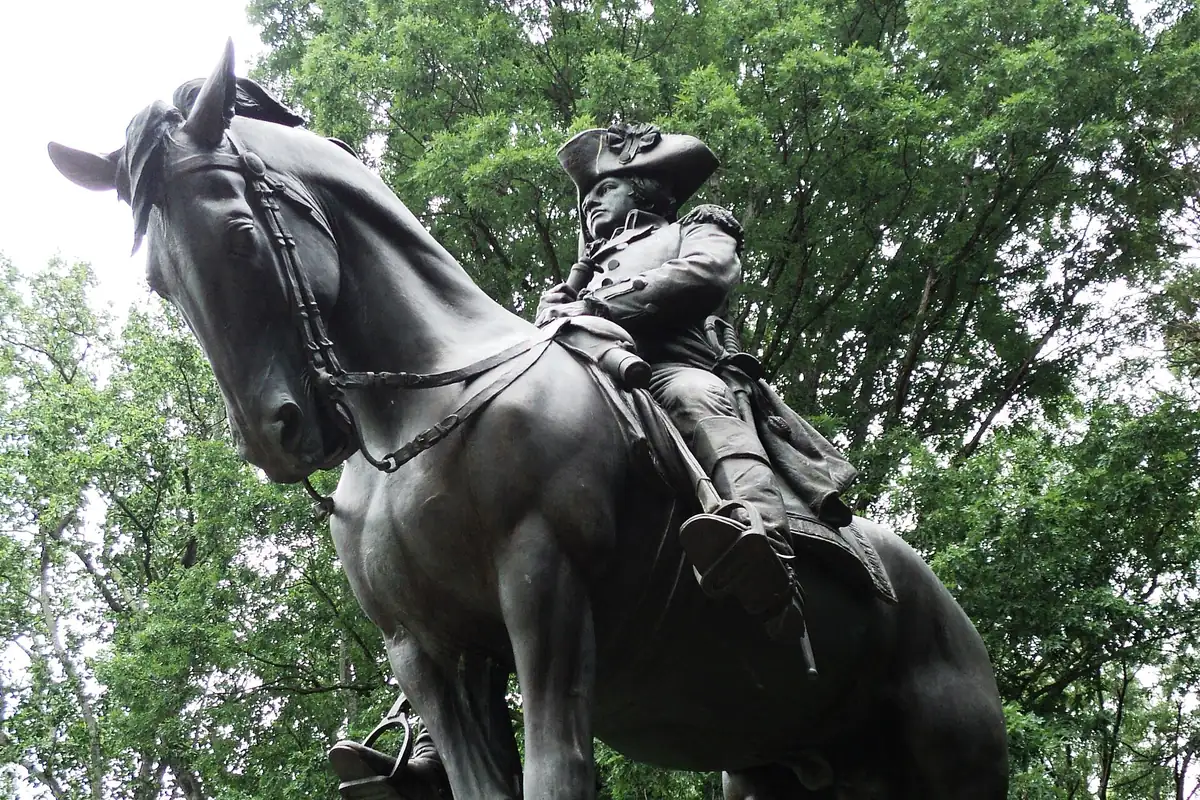
General Greene at Guilford Courthouse
The name goes back to a battle fought before the town existed. On March 15, 1781, Visit Greensboro says, Major General Nathanael Greene put 4,400 American troops in three battle lines at Guilford Courthouse to stop about 1,900 British regulars under Lord Cornwallis. Cornwallis lost a quarter of his army, and seven months later he surrendered at Yorktown.
The National Park Service, which runs the battlefield today, says Cornwallis won a tactical victory there, but it set the British Army on the path to that surrender.
Here’s a small irony. When Sallie W. Stockard wrote The History of Guilford County in 1902, she described the battle on page 27 with the forces of the Revolution “under the command of General Green,” spelled the same way the town spells it. A few lines later she gets it right: “Greene had so weakened his force as to compel him to retire to Wilmington.”
A new county seat in the middle
In 1781 the courthouse community was a different place. Stockard says the battle was fought “near Guilford Courthouse, then at old Martinsville,” and that Martinsville was named for Alexander Martin, a Guilford leader who became governor of North Carolina. The National Park Service puts the battlefield park about six miles (10 km) north of downtown Greensboro today.
The county itself was older than the battle. Visit Greensboro says permanent settlement in the area began around 1740, mostly by Germans, Quakers of Welsh and English descent, and Scotch-Irish families who came down from the northern colonies. By the early 1800s people wanted the county seat somewhere else. The Greensboro History Museum says the town was founded in 1808 “after voters spoke out for a new county seat, one in the center of Guilford County,” and was named in honor of Revolutionary War Gen. Nathanael Greene. Visit Greensboro adds the price: county officials paid $98 for a 42-acre tract and suggested naming it Greensborough, after the patriot commander.
Stockard copied the county court’s own minutes. Entries from 1807 and 1808 mention “a plan of a town at New Courthouse,” and at the May 1809 term at Martinsville, it was announced that the new courthouse was ready:
“The court adjourned from the town of Martinsville to the town of Greensboro (which was the centre of the county)”
The court met in Greensboro for the first time on Friday, May 19, 1809. A U.S. Census Bureau history says the new town replaced the hamlet of Guilford Court House as the county seat, at a time when the whole county had about 11,420 people. Stockard, writing in 1902, counted the town’s age from that court day: “In 1909 Greensboro will see her centennial.”
Greensborough, then Greensboro
For many years the town stayed small. The museum calls it “a community of familiar faces,” with modest cabins and grand homes along dusty streets, and the Census Bureau counted only 497 people there in 1870. A Presbyterian minister, J. Henry Smith, quoted in the museum’s gallery, wrote in 1859 that “Greensboro is a pleasant looking village,” with houses “generally of wood, & white.” After 1865, the museum says, the town picked up a nickname, the City of Flowers. Stockard was still using it in 1902, along with another one, the Gate City, which she called “the open door of transportation between North and South.” By 1900 the Census Bureau counted 10,035 people, and the museum says that by century’s end “spirited voices and rumbling manufacturing plants” were sending the city toward a new era. The long spelling hung on, too: the museum’s gallery on the early town is called “Early Greensborough,” and it says that by the end of the century the city was “now spelled Greensboro.”
So the general lost his e in 1808 and the town lost its “ugh” later in the century. The museum doesn’t give an exact year for the shorter spelling, and we won’t guess one.
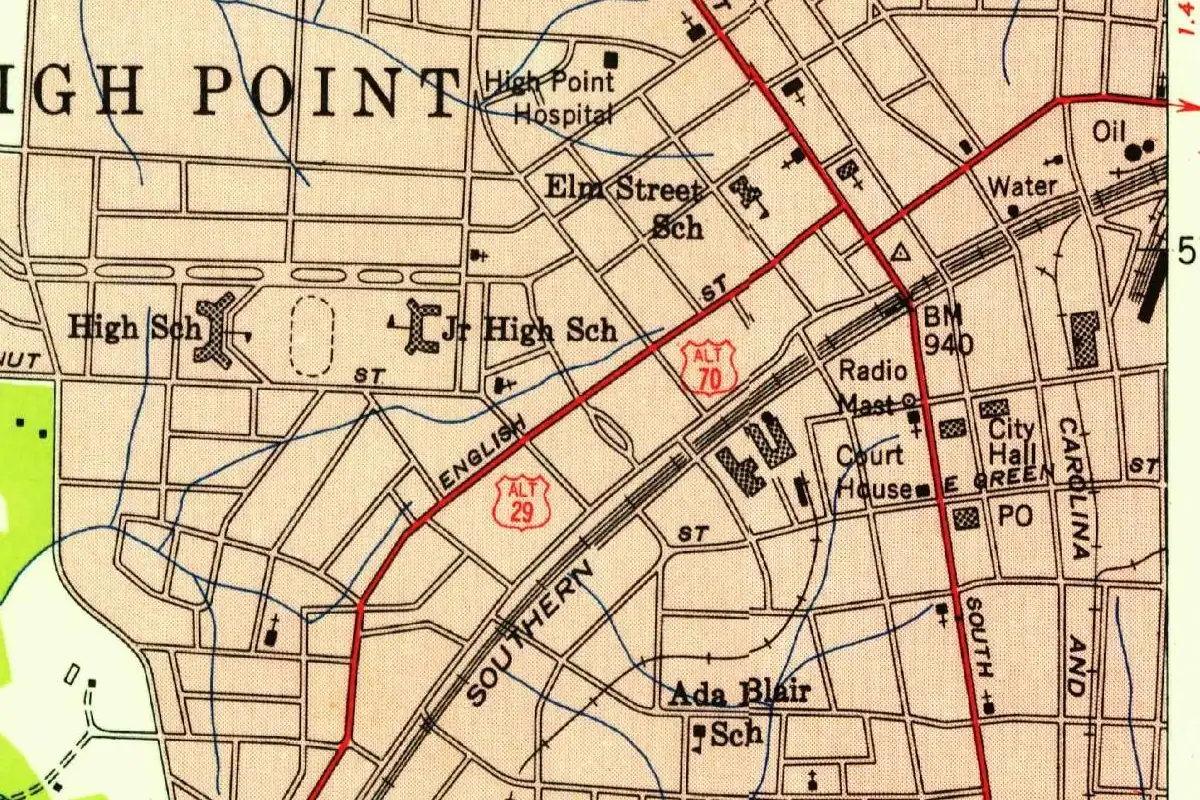
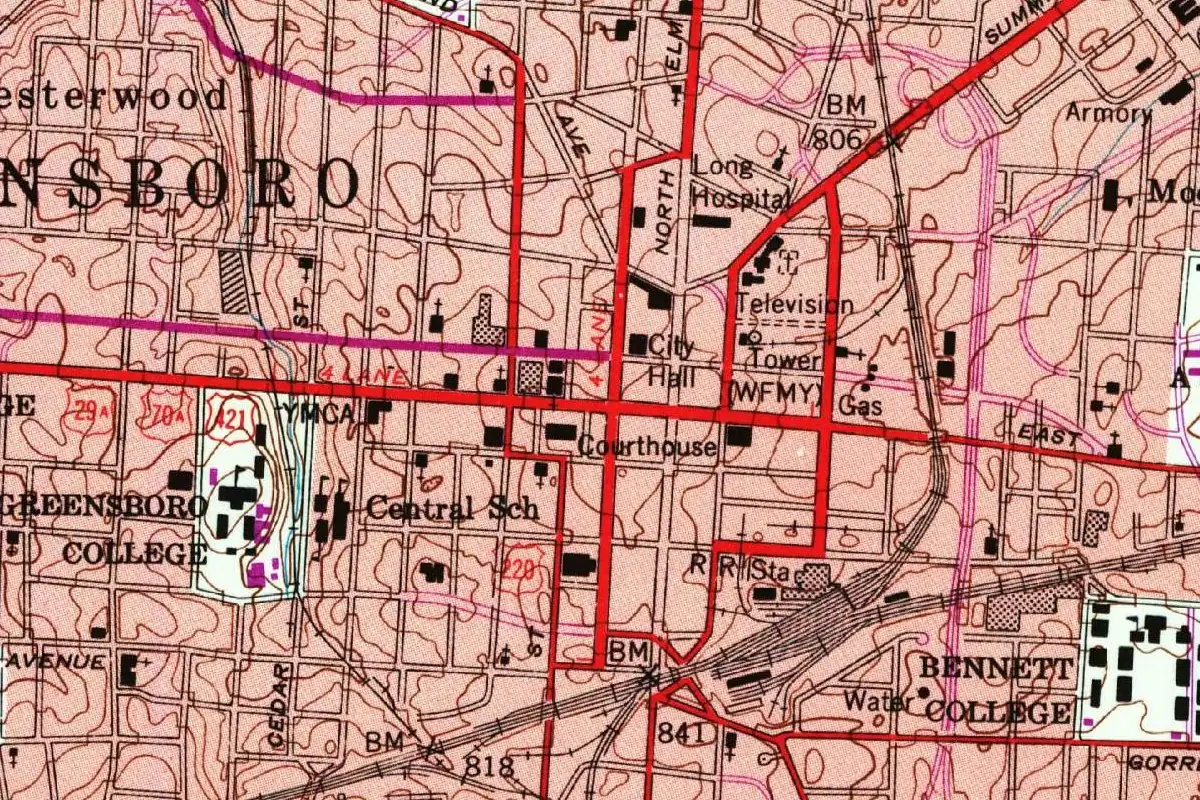
The 1951 map at the top of this page shows how far the county seat had come by the middle of the 20th century, with the Courthouse and City Hall at the main crossroads, two colleges, the railroad station and a television tower. If you look closely, you can also pick out North Elm Street and Summit Avenue.
Guilford County names
Greensboro shares its county with High Point, the other principal town Stockard named in 1902, whose name is just a description of its spot on the railroad. And in South Carolina, Greenville also gets linked to General Greene in modern guides, though there the old documents don’t back him up the way Greensboro’s sources do. There’s more on our North Carolina page.
Quick answers
Who is Greensboro, North Carolina, named after?
Gen. Nathanael Greene, the Revolutionary War commander at the Battle of Guilford Courthouse in 1781. The Greensboro History Museum and the U.S. Census Bureau both say the town was named for him when it was founded in 1808.
Why is there no e in Greensboro?
It’s a mystery, according to Visit Greensboro. It says the town was spelled Greensborough from the start and the general’s final e “was never there,” and it calls the reason “a mystery.”
Is Greensboro named for the color green?
No. Visit Greensboro says the name “doesn’t reference a color,” even though the missing e leads many people to think it does.
Was Greensboro the original county seat of Guilford County?
No. The court sat at Martinsville, near Guilford Courthouse, until it moved to the new town of Greensboro in May 1809, according to the court records Stockard published in 1902.
Key dates
- 1781On March 15, Gen. Nathanael Greene's army meets Lord Cornwallis's at Guilford Courthouse.
- 1808County officials buy a 42-acre tract for $98 and lay out Greensborough as the new county seat.
- 1809On May 19, the Guilford County court meets in Greensboro for the first time, after adjourning from Martinsville.
- 1870The census counts 497 people in Greensboro.
Things to do in Greensboro, North Carolina
Guilford Courthouse National Military Park
The battlefield where General Greene's army met Cornwallis on March 15, 1781, with a visitor center, the Hoskins Farmstead, 29 monuments, foot trails and a one-way tour road across 250 acres.
Greensboro History Museum
The city's history museum, started by volunteers in 1924, with galleries such as Voices of a City on early Greensborough, plus archives, collections and the First Presbyterian Church Cemetery.
International Civil Rights Center & Museum
A museum in the old F.W. Woolworth building, where four Black college students began a sit-in at the lunch counter on February 1, 1960; a large restored section of the counter is inside.
Greensboro Science Center
An aquarium, science museum and zoo in one place on Lawndale Drive, with hands-on exhibits for all ages.
Getting there
Open Greensboro in Google Maps
Opens in a new tab. The pin is the center of Greensboro in the USGS place-name record.
The closest airports, Amtrak stations and intercity bus stops, measured in a straight line from the center of Greensboro.
Airports
- Piedmont Triad International (GSO) Greensboro 9 mi 14 km
- Raleigh-Durham International (RDU) 58 mi 93 km
Amtrak trains
- Greensboro station (GRO) under 1 mi 0.5 km
- High Point station (HPT) 14 mi 23 km
Intercity buses
- FlixBus Greensboro Bus Stop under 1 mi 0.5 km
- Sunway Charters Greensboro under 1 mi 0.5 km
- Greyhound High Point Transportation Terminal 14 mi 23 km
Distances are as the crow flies, not by road. We don't list schedules or fares because they change; check with the airline, Amtrak or the bus company before you go. Official data (FAA commercial service airports (2025), FAA airport locations, Amtrak stations and Intercity Bus Atlas) from the FAA and the U.S. Bureau of Transportation Statistics, checked Nov 14, 2026.
Sponsored
Staying in Greensboro?
Compare hotels in Greensboro, North Carolina, on Expedia.
See hotels in GreensboroWe may earn a commission if you buy through this link. It never changes what we write. Read our affiliate disclosure
Sponsored
Want the spooky side of Greensboro?
The name has its story above. For the ghost stories, US Ghost Adventures runs walking ghost tours in Greensboro.
See ghost tours in GreensboroWe may earn a commission if you book through this link. It never changes what we write. Read our affiliate disclosure
Historical Sources & References
- Greensboro History Museum, “Voices of a City: Early Greensborough”. Founded in 1808 after voters asked for a county seat in the center of the county; “Named in honor of Revolutionary War Gen. Nathanael Greene”; “a community of familiar faces”; J. Henry Smith’s 1859 description; the City of Flowers nickname after 1865; “now spelled Greensboro” by the century’s end.
- Visit Greensboro, “Greensboro History”. The missing e “was never there” and “is a mystery”; the e in Greene Street and other names; settlement from about 1740; $98 for 42 acres in 1808 and the name Greensborough; the 1781 battle, 4,400 Americans against 1,900 redcoats, and Yorktown seven months later.
- U.S. Census Bureau, “History and the Census: The 1960 Greensboro Sit-In”. Founded in 1808 and named for General Nathanael Greene; replaced the hamlet of Guilford Court House as county seat; 497 people in 1870 and 10,035 in 1900; about 11,420 people in the county at the founding; the February 1, 1960, Woolworth’s sit-in.
- Sallie W. Stockard, The History of Guilford County (1902), p. 27. The battle “near Guilford Courthouse, then at old Martinsville,” under “General Green.”
- Sallie W. Stockard, The History of Guilford County (1902), pp. 29-30. Alexander Martin, governor, and Martinsville named in his honor.
- Sallie W. Stockard, The History of Guilford County (1902), p. 45. Court minutes: the plan of a town at New Courthouse (1807-1808) and the quoted adjournment to Greensboro, “the centre of the county,” for May 19, 1809.
- Sallie W. Stockard, The History of Guilford County (1902), pp. 132-133. Greensboro as the “City of Flowers” and the “Gate City,” “In 1909 Greensboro will see her centennial,” and the court’s first sitting there on May 19, 1809.
- National Park Service, Guilford Courthouse National Military Park. Greene and Cornwallis, the tactical British victory that led toward Yorktown, and the park six miles north of downtown.
- GNIS feature 1020557 (U.S. Geological Survey). Greensboro’s federal names entry, in Guilford County.
- U.S. Geological Survey, Greensboro sheet (1951). The 1:24,000 quadrangle the map at the top of this page was cropped from.
Spot something wrong, or know more? Tell us here. You can also email us or use our contact page. Corrections are noted here with their date, never made silently.