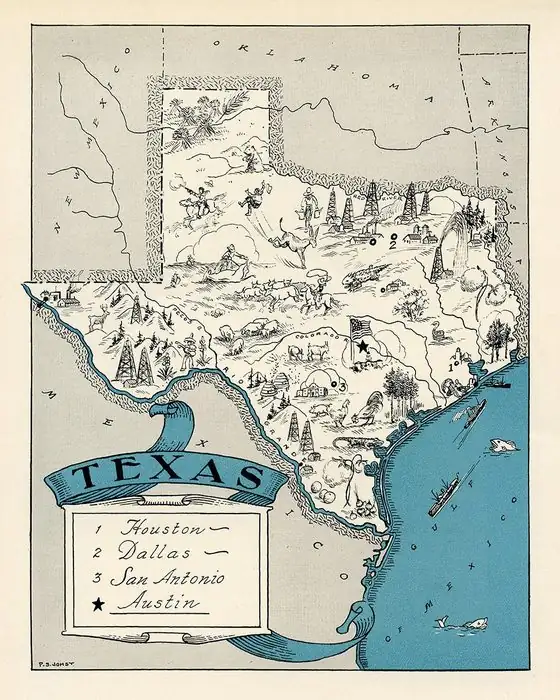
Grand Prairie, Texas: It Was Dechman Until 1877
Grand Prairie, Texas, took its name from the Texas and Pacific Railway, which used it for its stop there. The settlement's post office was called Dechman or Deckman, after landowner A. M. Dechman, until it switched to Grand Prairie in 1877. The city says the name fit a town on the eastern edge of a vast prairie.
A broken wagon and a family name
Until 1877 the post office in Grand Prairie, Texas, went by Dechman or Deckman, the name of the man whose land the town grew on. That year it switched to Grand Prairie, the name the Texas and Pacific Railway was already using for its stop there.
The man was Alexander MacRae Dechman. The Handbook of Texas tells how he ended up with the land: in 1863 his wagon broke down on a trip from Jacksonville, Texas, to Fort Belknap with supplies for the army commissary. He traded the broken wagon, his ox team and $200 in Confederate money for a 239-acre tract. The City of Grand Prairie puts his land in what’s now downtown. The city’s history dates his title filing with the county to January 2, 1863.
When a post office opened in 1874, the Handbook says, the community became “officially known as Dechman or Deckman.” You’ll find both spellings, and the sources don’t settle which one the post office used. W. M. Haskett was the first postmaster, and the office sat on land Dechman donated. By then a daily stage ran through on its way from Dallas to Fort Worth.
The railroad’s name wins
The Texas and Pacific Railway came through in 1876, building west from Eagle Ford, just outside Dallas. The city says service through Dechman to Fort Worth began on July 19, 1876. Dechman surveyed and platted a townsite and gave the railroad every other lot in four blocks in exchange for a depot.
Then the names collided. The railroad called its stop Grand Prairie; the post office called the same place Deckman. In 1877, the Handbook says, the post office gave in and changed its name “to agree with the railroad which had called the town Grand Prairie since 1873.” The city tells it a little differently: in its version, the railroad renamed Dechman in 1877. Either way, you end up in the same spot, with the railroad’s name on the town and the landowner’s name gone from the post office.
If that sounds familiar, it’s because the same thing happened next door. The Texas and Pacific laid out Arlington in 1876 on the same stretch of line between Dallas and Fort Worth, and its post office also took the new name in 1877.
Which prairie?
Nobody left a note saying who at the railroad picked the name. The city’s explanation is geographic: the town got it “because of its location on the eastern edge of the vast grand prairie that stretched into West Texas.”
That prairie had a name in print long before the city’s website. A Dallas County history published in Chicago in 1892 walks through the soils and rocks of North Texas, and after describing the Black Prairie it says what comes next to the west:
“This is the Grand, or Fort Worth, Prairie, or ‘hard-lime-rock region.’”
So “Grand Prairie” wasn’t just a nice phrase. It was the name geologists and county historians gave a whole belt of country west of Dallas.
The woman on the train
There’s a livelier story. The Handbook passes it along with a careful word: the community was “supposedly so named because a woman stepped off the train and said, ‘What a grand prairie!’” It doesn’t name the woman or give a date, and no source here backs it up. Treat it as a good line, not a record.
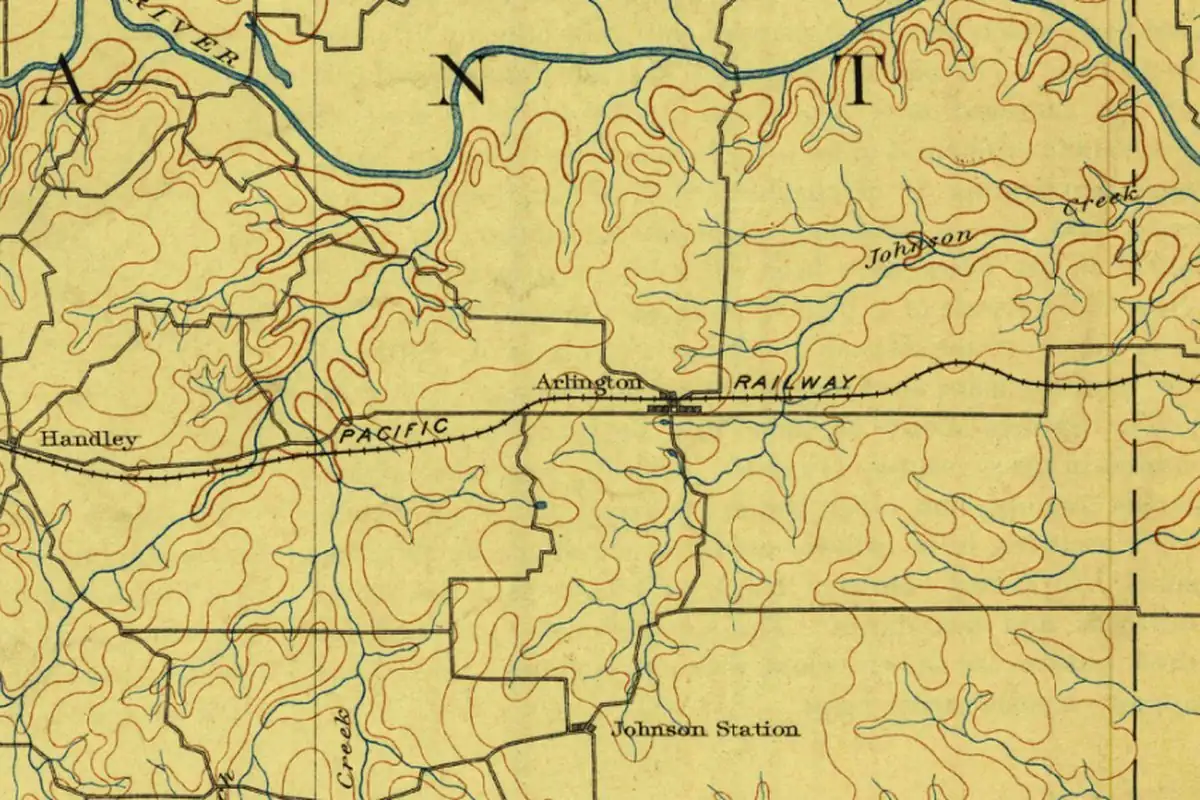
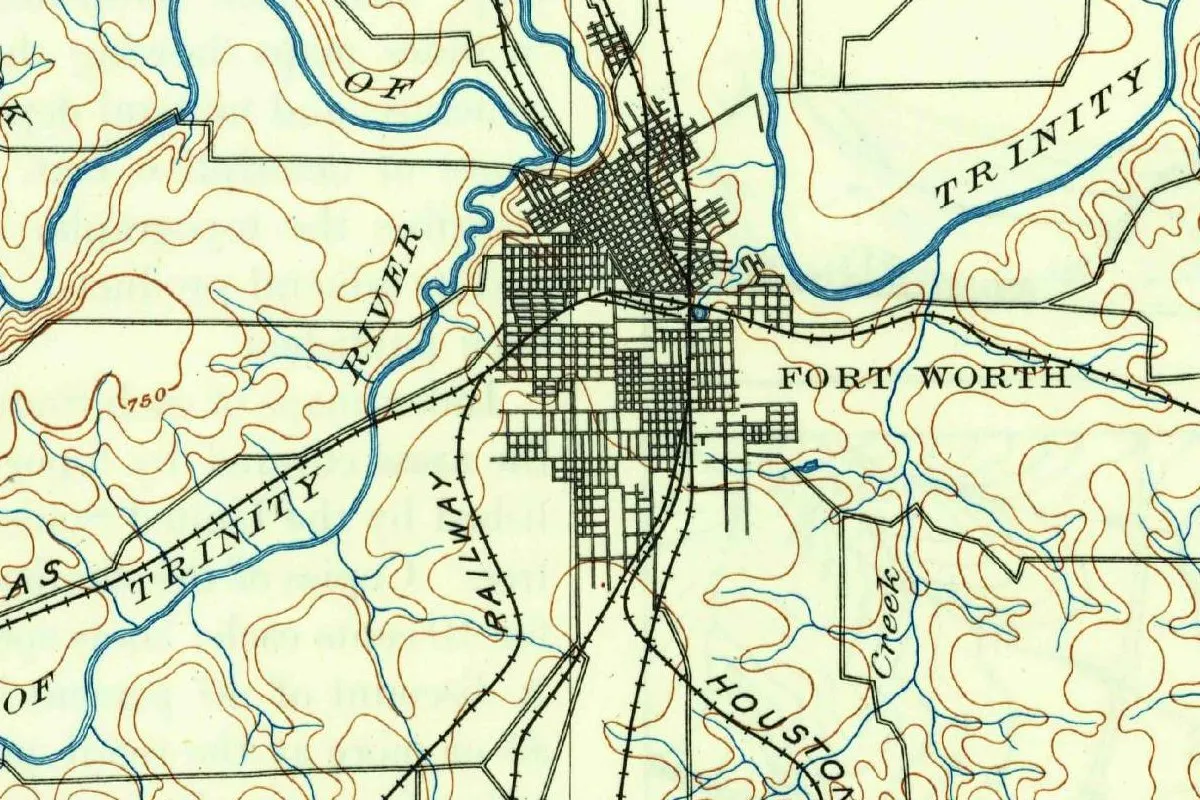
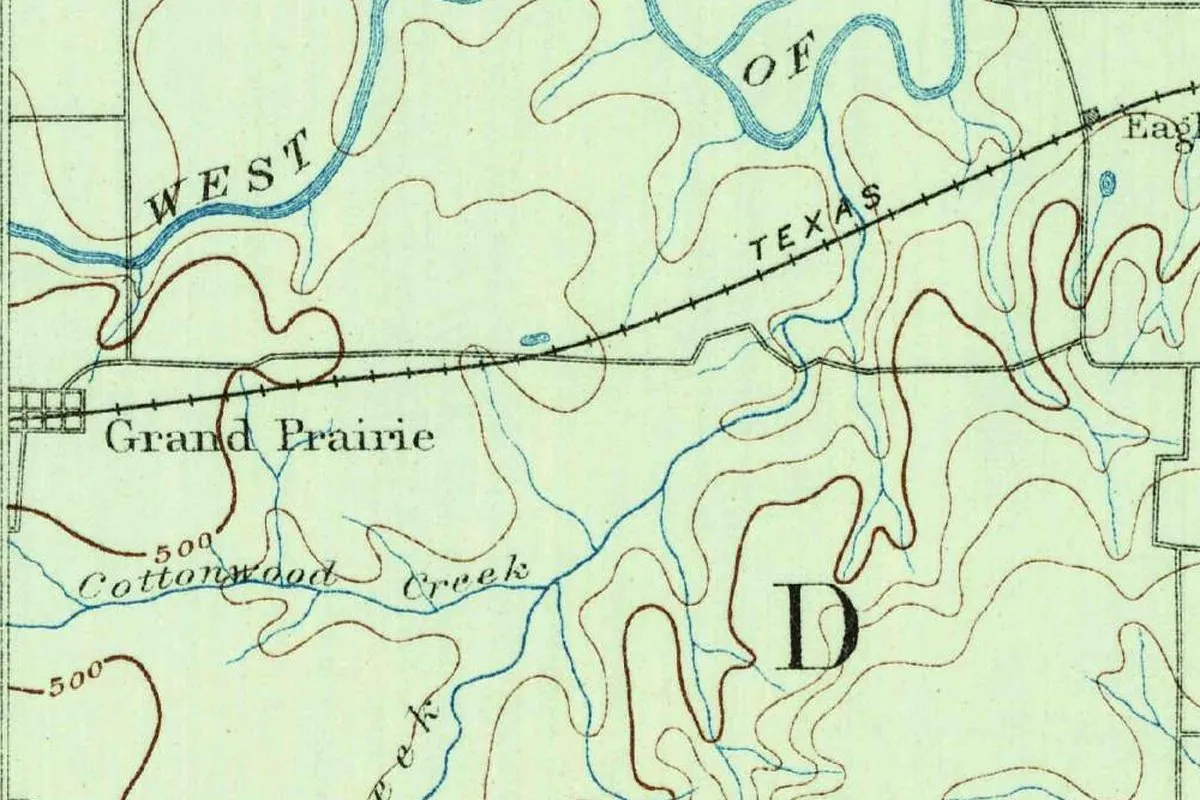
The 1891 survey map at the top of this page shows what the train actually stopped at: a few blocks of streets on the Texas and Pacific, with the West Fork of the Trinity to the north and Cottonwood Creek to the south. The town didn’t incorporate until 1902. And there’s a small irony in all of it: Dechman handed the railroad every other lot in four blocks to get a depot, and about a year later the railroad’s name had replaced his.
Quick answers
What was Grand Prairie, Texas, called before?
Dechman, also spelled Deckman. The post office used that name from 1874 until 1877, after A. M. Dechman, whose land the town grew on.
Did a woman name Grand Prairie when she got off a train?
Probably not in any way anyone can prove. The Handbook of Texas says the town was “supposedly” named after a woman exclaimed “What a grand prairie!” and gives no name or date.
Who named Grand Prairie?
The Texas and Pacific Railway, as far as the sources go. The Handbook says the railroad used the name from 1873, and the post office adopted it in 1877. No source names the person who chose it.
When was Grand Prairie founded?
The Handbook dates the community’s start to 1863, when Dechman got his land. The post office followed in 1874, the railroad in 1876, and incorporation in 1902.
Key dates
- 1863A. M. Dechman gets a 239-acre tract where downtown Grand Prairie is now; the city dates his title filing to January 2, 1863.
- 1873The Texas and Pacific Railway is already calling the place Grand Prairie, according to the Handbook of Texas.
- 1874A post office opens under the name Dechman or Deckman, with W. M. Haskett as first postmaster.
- 1876The Texas and Pacific reaches the town from Eagle Ford; the city dates the start of service to Fort Worth to July 19.
- 1877The post office drops Deckman and takes the railroad's name, Grand Prairie.
- 1902Grand Prairie incorporates, with S. R. Lively as mayor.
Getting there
Open Grand Prairie in Google Maps
Opens in a new tab. The pin is the center of Grand Prairie in the USGS place-name record.
The closest airports, Amtrak stations and intercity bus stops, measured in a straight line from the center of Grand Prairie.
Airports
- Dallas-Fort Worth International (DFW) 11 mi 17 km
- Dallas Love Field (DAL) 11 mi 18 km
Amtrak trains
- Dallas station (DAL) 11 mi 18 km
- Fort Worth station (FTW) 19 mi 31 km
Intercity buses
- Greyhound Arlington Andrews Street 6 mi 9 km
- FlixBus Arlington Andrews Street 6 mi 9 km
Distances are as the crow flies, not by road. We don't list schedules or fares because they change; check with the airline, Amtrak or the bus company before you go. Official data (FAA commercial service airports (2025), FAA airport locations, Amtrak stations and Intercity Bus Atlas) from the FAA and the U.S. Bureau of Transportation Statistics, checked Nov 13, 2026.
Sponsored
Staying in Grand Prairie?
Compare hotels in Grand Prairie, Texas, on Expedia.
See hotels in Grand PrairieWe may earn a commission if you buy through this link. It never changes what we write. Read our affiliate disclosure
Historical Sources & References
- Lisa C. Maxwell, “Grand Prairie, TX,” Handbook of Texas Online. Dechman’s broken wagon and 239-acre trade in 1863, the post office “officially known as Dechman or Deckman” in 1874 with W. M. Haskett as postmaster, the Texas and Pacific from Eagle Ford in 1876, the change to Grand Prairie in 1877 “to agree with the railroad,” the “supposedly” story of the woman on the train, and incorporation in 1902.
- City of Grand Prairie, “Historical Recap”. Dechman’s title filing on January 2, 1863, train service to Fort Worth from July 19, 1876, and the 1877 renaming “because of its location on the eastern edge of the vast grand prairie that stretched into West Texas.”
- Memorial and Biographical History of Dallas County, Texas (1892), p. 130. The description of the Grand, or Fort Worth, Prairie region west of the Black Prairie, quoted above.
- GNIS feature 1336802 (U.S. Geological Survey). Grand Prairie’s listing in Dallas County and the coordinates this page uses.
- U.S. Geological Survey, Dallas sheet (1891). The source of the map at the top of this page, with Grand Prairie on the railroad and Eagle Ford to the east.
Spot something wrong, or know more? Tell us here. You can also email us or use our contact page. Corrections are noted here with their date, never made silently.