Leavenworth, Washington: Before Bavaria, It Was Icicle
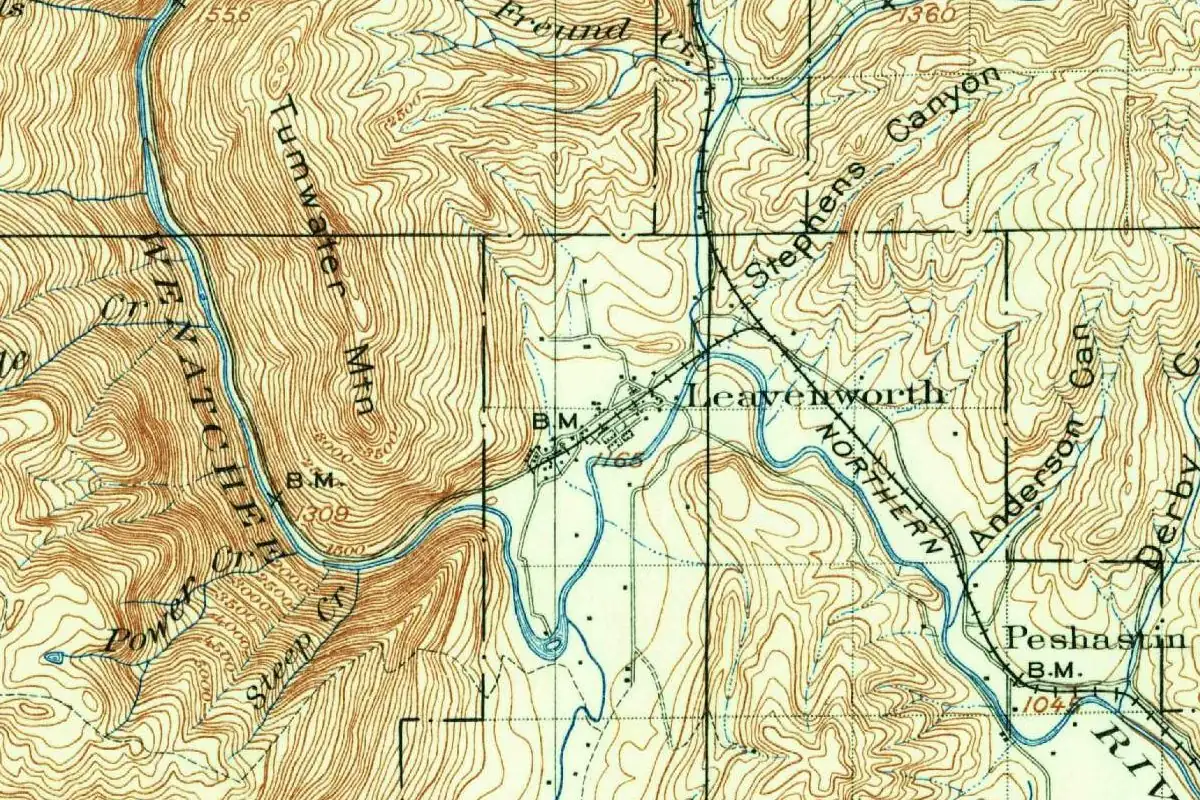
Leavenworth, Washington, looks Bavarian, but it’s named for a land company president, and before the tracks arrived it was a log camp called Icicle. The man behind the name was Captain Leavenworth, who headed the company that laid out the town when the Great Northern Railway arrived in 1892. The Bavarian look came some 70 years later.
A camp called Icicle
The story starts with the railroad crews. A county history published in 1904 says the town’s history “dates from the spring of 1892,” when the graders building the Great Northern roadway reached the upper Wenatchee River. A little town of log buildings went up “about a mile up the river from the present site of Leavenworth” (that’s about 1.6 km), “and was named Icicle.” HistoryLink, the online encyclopedia of Washington history, puts that cluster of cabins along Icicle Creek.
Icicle got a post office in March 1892. Franklin A. Losekamp, who’d opened a store in the area a year ahead of the railroad, was the postmaster, “the office at that period being named ‘Icicle,’” according to his biography in the same 1904 book. By June the camp had a general store, two restaurants, a blacksmith shop and three saloons. So for a few months, if you wanted to mail a letter from this valley, you sent it from Icicle.
Captain Leavenworth’s townsite
Then the tracks showed up. In October 1892 the railroad reached the spot, and word got out that the Great Northern would make it a division point, with a depot, a roundhouse and coal bunkers. That set off what the 1904 history calls “a full-fledged ‘boom.’”
Here’s the line that answers the question: “The Okanogan Investment Company, of which Captain Leavenworth, of Olympia, J. P. Graves, Alonzo M. Murphy and S. T. Arthur, all of Spokane, were the members, platted the townsite where Leavenworth now stands. The new town was named Leavenworth, in honor of the president of the Okanogan Investment Company.” So the name went to a man from Olympia, the state capital, while his three partners were Spokane men.
You’ll also run into 1893 as the start date. HistoryLink says the Leavenworth Real Estate and Improvement Company filed the first plat on April 1, 1893, but the 1904 book lists that same date as the town’s first addition, after the original townsite.
Icicle didn’t last long after that. Through the winter of 1892-93, “all of the business houses at Icicle were removed to the new site,” and by February 1893 the new town claimed 700 people. The old name hung on a little longer in the papers, though. In April 1893 the Seattle Post-Intelligencer reported that unhappy people in Wenatchee were moving “to Leavenworth (Icicle),” as if readers might still need the reminder. The 1904 book does the same thing in the biography of John B. Bjork, who ran a restaurant and then a hotel in town, saying he “settled in Icicle, now Leavenworth.”
Who was the captain?
The 1904 history never gives Captain Leavenworth a first name. HistoryLink calls him Charles Leavenworth and describes him as a major stockholder in the company. It also says he was from Portland, not Olympia, so the two accounts don’t agree on where he lived.
There’s one more clue in the state records. In March 1891 the state appointed a Charles F. Leavenworth “of Olympia” to the University Land and Building Commissioners, a board that organized in Seattle that April to plan new buildings for the University of Washington. The board’s 1892 report shows him making motions at its meetings. That’s an Olympia man with the right name at the right time. Still, none of the records we read ties the university commissioner to the Icicle townsite in so many words, so treat the match as likely, not proven.
Not the Kansas Leavenworth
If the name rings a bell, you’re probably thinking of Kansas. Henry Gannett’s 1905 federal book of place names says the city and county of Leavenworth in Kansas were “named for Gen. Henry Leavenworth, for whom Fort Leavenworth is named.” His list has a third one, too, in Crawford County, Indiana, named for its proprietors, S. M. and Z. Leavenworth.
Washington’s Leavenworth isn’t in Gannett at all. It isn’t in Edmond Meany’s 1923 Origin of Washington Geographic Names either, even though Meany has an entry for Dryden, another town on the Wenatchee River. That’s why the 1904 county history carries so much weight here: it was written only about a dozen years after the boom.
The Bavarian part came much later
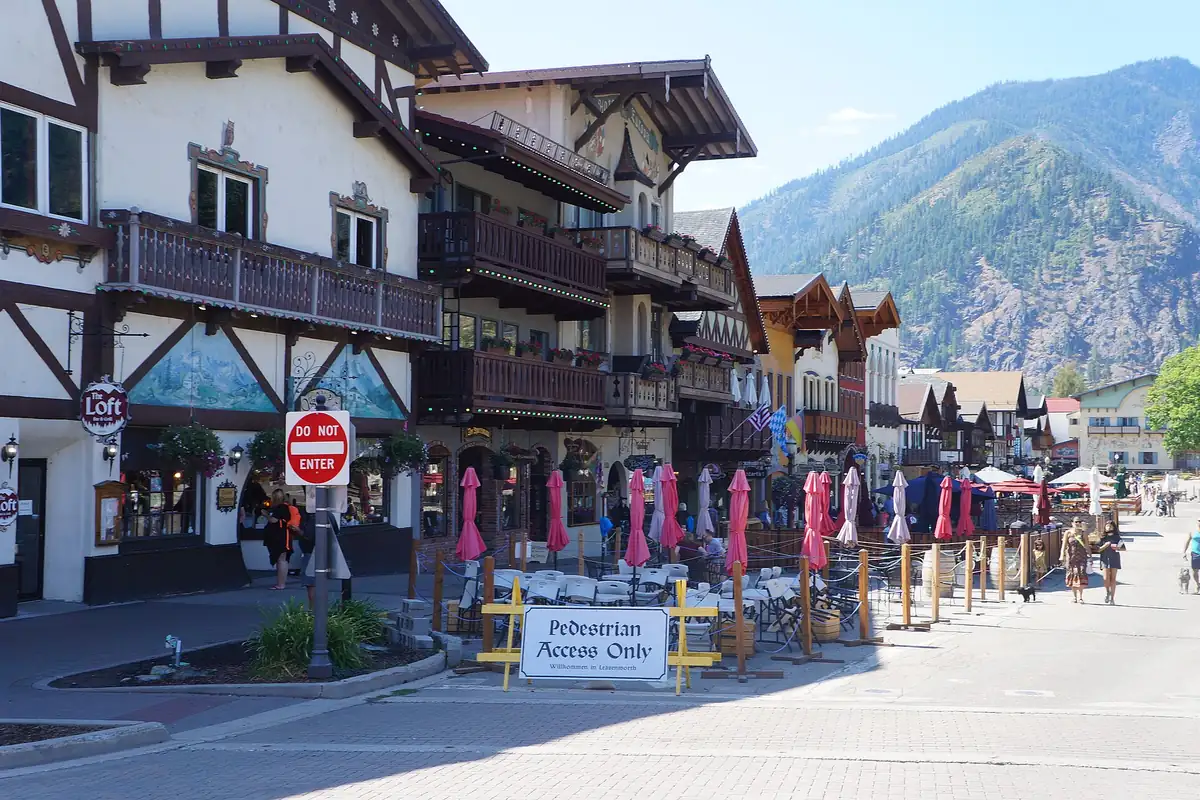
So where do the half-timbered buildings come from? The town’s own chamber of commerce says it plainly: “we were not always a Bavarian style village.” The sawmill business faded, the railroad moved out, and by the Depression the town was struggling.
In 1962 the Chamber of Commerce turned to the University of Washington for a self-study program, and HistoryLink says the effort that grew out of it was called Project LIFE, short for Leavenworth Improvement for Everyone. Two Seattle men who ran a café up the highway, Ted Price and Bob Rodgers, pushed for tourism and a Bavarian village theme, partly because the mountain setting reminded people of towns like Garmisch-Partenkirchen and Oberammergau. HistoryLink adds that only a few residents could claim German roots. The first building made over was the Chikamin Hotel, renamed the Edelweiss, and on July 16, 1970, the town’s Design Review Board made the Bavarian style a rule for building and remodeling.
That’s the twist you’ll notice walking down Front Street. Everything looks like it came from Bavaria except the name on the sign, which belongs to a land company captain from the 1890s and a railroad division point.
Quick answers
Is Leavenworth, Washington, named after a German town?
No. The 1904 county history says the town was named for Captain Leavenworth, president of the Okanogan Investment Company, which platted the townsite after the railroad arrived in 1892. The Bavarian look was adopted in the 1960s.
What was Leavenworth, Washington, called before?
Icicle. That was the name of the log-cabin camp that went up about a mile (1.6 km) upriver when the railroad graders arrived in 1892, and of its post office, before the businesses moved to the new townsite.
Is Leavenworth, Washington, named for Fort Leavenworth in Kansas?
No. Gannett ties the Kansas city and fort to Gen. Henry Leavenworth, while the Washington town honors the captain who headed the Okanogan Investment Company.
When did Leavenworth become a Bavarian town?
In the 1960s. HistoryLink traces it to Project LIFE, which grew out of a 1962 self-study, and the town made the Bavarian style a building rule when its Design Review Board became official on July 16, 1970.
Key dates
- 1892Spring: railroad graders put up a log camp called Icicle. A post office opens there in March.
- 1892October: the Great Northern reaches the spot and a boom starts. The Okanogan Investment Company then plats a new town named Leavenworth.
- 1893April 1: the Leavenworth Real Estate and Improvement Company files a plat. Later that month a Seattle paper still writes "Leavenworth (Icicle)."
- 1962The Chamber of Commerce turns to the University of Washington for a self-study. Project LIFE grows out of it.
- 1970July 16: the Leavenworth Design Review Board becomes official.
Getting there
The closest airports, Amtrak stations and intercity bus stops, measured in a straight line from the center of Leavenworth.
Airports
- Pangborn Memorial (EAT) East Wenatchee 25 mi 41 km
- Yakima Air Trml/McAllister Field (YKM) 71 mi 115 km
- Seattle-Tacoma International (SEA) 78 mi 125 km
Amtrak trains
- Leavenworth station (LWA) 1 mi 2 km
- Wenatchee station (WEN) 20 mi 33 km
Intercity buses
- Northwestern Stage Lines Leavenworth under 1 mi 1 km
- Apple Line Travel Washington · Orondo Market 20 mi 33 km
- FlixBus Ellensburg East 10th Avenue 41 mi 67 km
Distances are as the crow flies, not by road. We don't list schedules or fares because they change; check with the airline, Amtrak or the bus company before you go. Official data (FAA commercial service airports (2025), FAA airport locations, Amtrak stations and Intercity Bus Atlas) from the FAA and the U.S. Bureau of Transportation Statistics, checked Oct 31, 2026.
Historical Sources & References
- An Illustrated History of Stevens, Ferry, Okanogan and Chelan Counties (Western Historical Publishing Co., 1904). The chapter on Leavenworth (pp. 729-731): the Icicle camp of spring 1892, its post office and businesses, the railroad’s arrival in October, the Okanogan Investment Company and its members, the town “named Leavenworth, in honor of the president,” the move from Icicle, the 700 people of February 1893 and the first addition of April 1, 1893. Biographies of Franklin A. Losekamp, postmaster when the office was “named ‘Icicle’” (p. 769), and John B. Bjork, who “settled in Icicle, now Leavenworth” (p. 746).
- Seattle Post-Intelligencer, April 28, 1893, p. 1. A Wenatchee dispatch about people “moving to Leavenworth (Icicle),” a few months after the town was laid out.
- Report of the University Land and Building Commissioners (1892). Charles F. Leavenworth “of Olympia” appointed March 14, 1891, and his motions at the board’s meetings.
- Laura Arksey, “Leavenworth – Thumbnail History,” HistoryLink.org (2010). Icicle along Icicle Creek; Charles Leavenworth of Portland as a major stockholder; the first plat of April 1, 1893; Project LIFE in 1962; Ted Price and Bob Rodgers; the Bavarian theme, the Edelweiss and the Design Review Board of July 16, 1970.
- Leavenworth Chamber of Commerce, “The History of Leavenworth”. The town’s own account that it was “not always a Bavarian style village” and that the change began in the early 1960s.
- Henry Gannett, The Origin of Certain Place Names in the United States, 2nd ed. (1905). Leavenworth, Kansas, named for Gen. Henry Leavenworth, and Leavenworth, Indiana, named for its proprietors. No entry for the Washington town.
- Edmond S. Meany, Origin of Washington Geographic Names (1923). Checked for Leavenworth and Icicle: neither has an entry.
- GNIS feature 1521981 (U.S. Geological Survey). The federal record, county and coordinates for Leavenworth.
Spot something wrong, or know more? Tell us here. You can also email us or use our contact page. Corrections are noted here with their date, never made silently.