Why Is Colorado Springs Called Colorado Springs?
Colorado Springs is named for mineral springs, but the famous ones are a few miles west, at Manitou Springs. The Pioneers Museum traces the name to Fitz Hugh Ludlow's travel writing of 1867. William Jackson Palmer's Colorado Springs Company started the town in 1871 as the Fountain Colony and renamed it in 1872.
Springs up the creek
The springs in the name aren’t really in Colorado Springs. “Where, oh where, are the springs Colorado Springs was named for?” Linda Navarro asked in The Gazette in 2026, calling it a question visitors often ask. Her answer: the many familiar springs “were and are in the aquifer beneath Manitou Springs,” a few miles west, up the creek that nineteenth-century travelers knew by its French name, the Fontaine qui Bouille: the boiling fountain.
The writer Fitz Hugh Ludlow went to see them on his travels in the West. In The Heart of the Continent (1870) he describes riding “two miles and a half up the Fontaine qui Bouille to visit the springs which gave it its name,” about 4 km from the little town of Colorado City. The water bubbled out of mounds of mineral crust in the creek, fizzy enough that he and his friends made lemon soda with it. Then he looked ahead:
“When Colorado becomes a populous State, the springs of the Fontaine qui Bouille will constitute its spa.”
He even imagined “a railroad from Denver to the Springs.” His book doesn’t use the words “Colorado Springs,” but the Colorado Springs Pioneers Museum says the first documented use of the name comes from Ludlow’s travel writing, in 1867.
The Fountain Colony
A few years later, a town was planned near the springs. William Jackson Palmer, a Civil War general turned railroad builder, was bringing his Denver and Rio Grande Railroad to the area. In May 1871, according to the museum, he organized the Colorado Springs Company, capitalized at $300,000, to sell lots in a new town on the line. The museum calls the company the “organizing mechanism” for the Fountain Colony, a 2,000-acre town site.
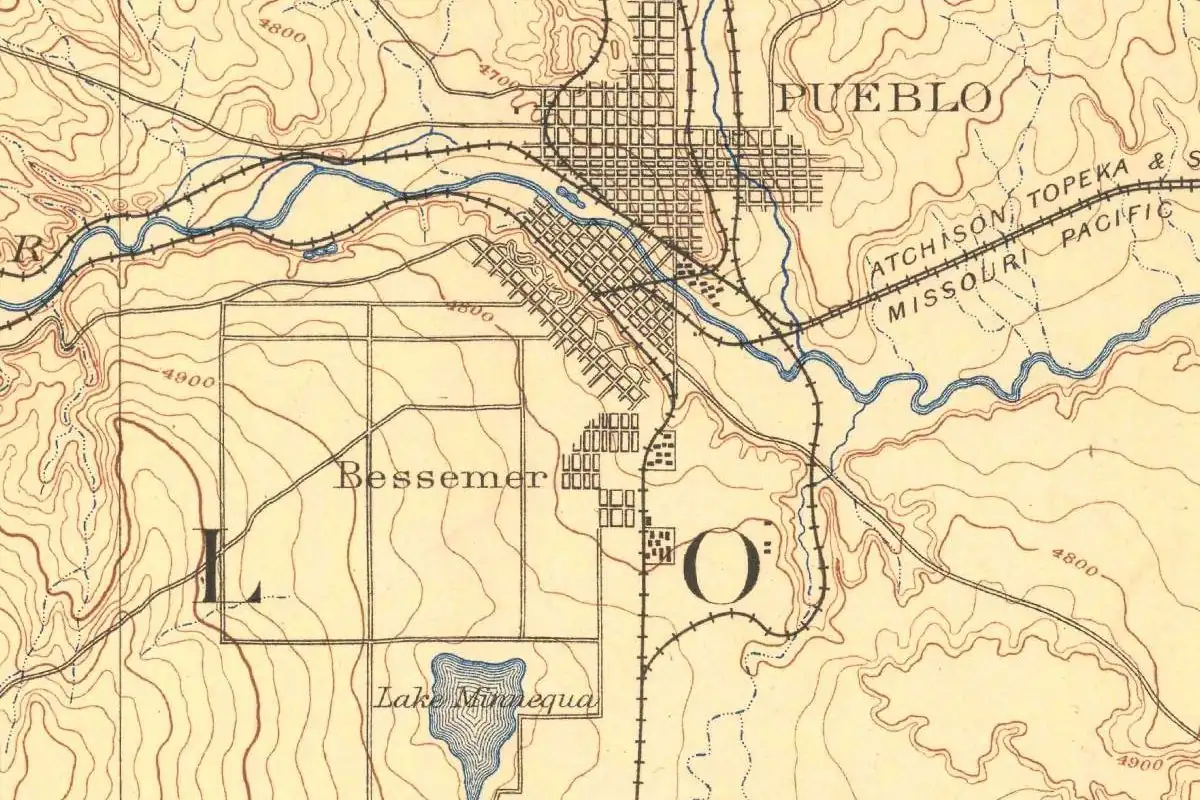
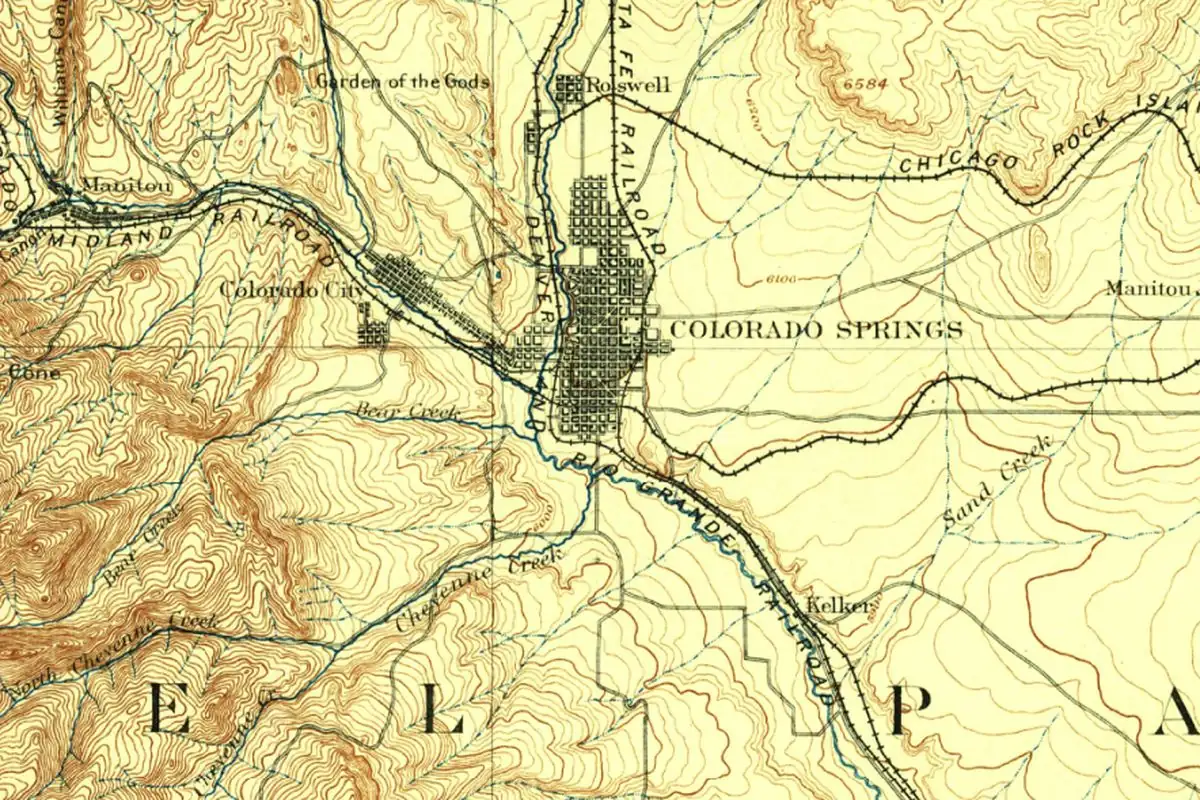
Palmer’s plan split the work in two. The town would be the respectable outpost, and the spa resort for health seekers would be nearby Manitou Springs, right by the springs Ludlow wrote about. On the 1893 survey map above, you can see the arrangement: Colorado Springs on the railroad, Colorado City and then Manitou up the creek to the west.
Colony officials drove the first stake on July 31, 1871, at the corner of Cascade and Pikes Peak avenues, and started selling lots the next day. Residents were to be of “good moral character and strict temperance habits,” and every deed banned liquor. Palmer’s Colorado Springs Hotel opened on New Year’s Day 1872.
The company’s name wins
The colony didn’t keep its first name for long. According to the museum, the Fountain Colony was renamed Colorado Springs in 1872, the same year the town became the El Paso County seat. The new name was the company’s own. So Colorado Springs got the springs’ name, and Manitou got the springs.
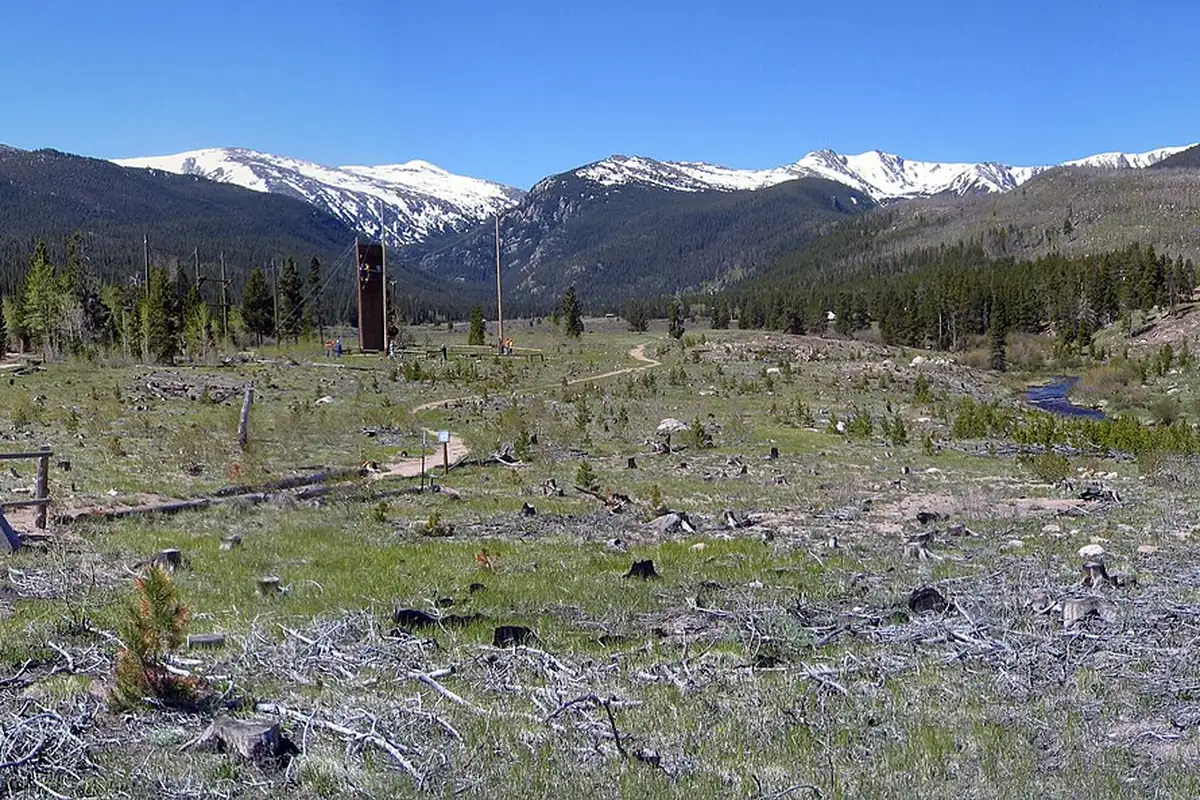
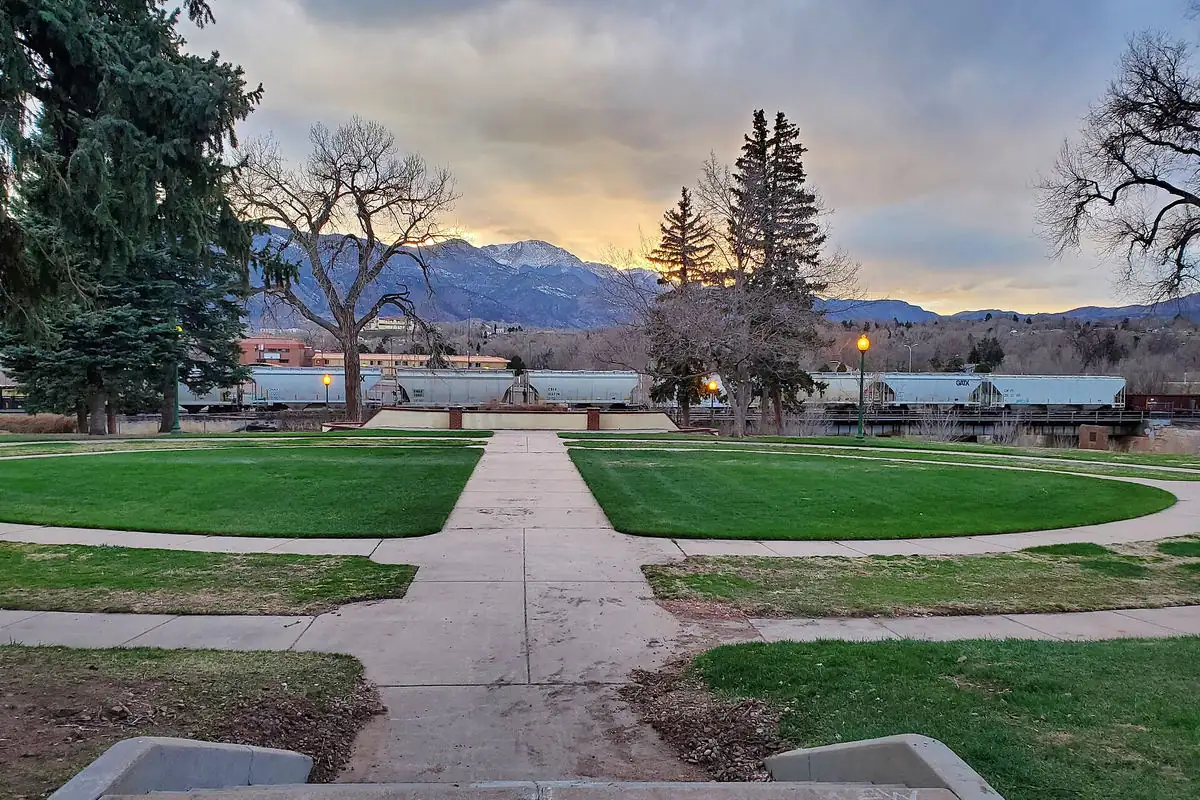
The city did have one natural spring of its own. Navarro writes that Tahama Spring, in Monument Valley Park, the park in the photo above, drew residents for its water and got a Spanish Colonial Revival pavilion in 1926. Floods damaged it in 1935, and after the floods of 1965 the spring was capped and the pavilion torn down. If you walk the park today, you’re passing the city’s only spring.
Quick answers
Why is Colorado Springs called Colorado Springs?
It’s named for mineral springs, but the well-known ones are a few miles west, at Manitou Springs. Palmer’s Colorado Springs Company used the name, and the town took it in 1872.
What was Colorado Springs originally called?
The Fountain Colony. The town was founded under that name in 1871 and renamed Colorado Springs in 1872.
Who named Colorado Springs?
William Jackson Palmer’s Colorado Springs Company gave the town its name. The Pioneers Museum traces the name itself to Fitz Hugh Ludlow’s travel writing of 1867.
Are there springs in Colorado Springs?
Only one, Tahama Spring in Monument Valley Park, now capped. The famous springs are at Manitou Springs, just west, where Palmer planned the spa.
Key dates
- 1867The name Colorado Springs first appears in Fitz Hugh Ludlow's travel writing, according to the Pioneers Museum.
- 1871May, by the Pioneers Museum's date: William Jackson Palmer organizes the Colorado Springs Company, capitalized at $300,000, for the Fountain Colony.
- 1871July 31: colony officials drive the first stake at Cascade and Pikes Peak avenues; lots go on sale the next day.
- 1872January 1: Palmer's Colorado Springs Hotel opens.
- 1872The Fountain Colony is renamed Colorado Springs and becomes the El Paso County seat.
Getting there
Open Colorado Springs in Google Maps
Opens in a new tab. The pin is the center of Colorado Springs in the USGS place-name record.
The closest airports, Amtrak stations and intercity bus stops, measured in a straight line from the center of Colorado Springs.
Airports
- City of Colorado Springs Municipal (COS) 7 mi 11 km
- Denver International (DEN) 71 mi 115 km
Amtrak trains
- Denver station (DEN) 64 mi 103 km
- Winter Park station (WPR) 88 mi 142 km
Intercity buses
- Colorado Department of Transportation Bustang · Colorado Springs Downtown Station under 1 mi 0.2 km
- Bustang Outrider Bustang · Colorado Springs Downtown Transit Terminal under 1 mi 0.2 km
- Greyhound Colorado Springs CO (COS) 1 mi 2 km
Distances are as the crow flies, not by road. We don't list schedules or fares because they change; check with the airline, Amtrak or the bus company before you go. Official data (FAA commercial service airports (2025/2026 cached FAA categories from existing site), FAA airport locations, Amtrak stations and Intercity Bus Atlas) from the FAA and the U.S. Bureau of Transportation Statistics, checked Nov 10, 2026.
Sponsored
Staying in Colorado Springs?
Compare hotels in Colorado Springs, Colorado, on Expedia.
See hotels in Colorado SpringsWe may earn a commission if you buy through this link. It never changes what we write. Read our affiliate disclosure
Sponsored
Want the spooky side of Colorado Springs?
The name has its story above. For the ghost stories, US Ghost Adventures runs walking ghost tours in Colorado Springs.
See ghost tours in Colorado SpringsWe may earn a commission if you book through this link. It never changes what we write. Read our affiliate disclosure
Historical Sources & References
- Colorado Springs Pioneers Museum, “Colorado Springs Company”. Ludlow’s 1867 use of the name, the company of May 1871 and its $300,000 capital, the Fountain Colony, the spa at Manitou Springs, the first stake of July 31, 1871, the liquor deeds, the hotel of January 1, 1872, the renaming and the county seat in 1872.
- Linda Navarro, “Palmer called his city Colorado Springs — but why aren’t there any springs?,” The Gazette (June 16, 2026). The springs the city was named for, “in the aquifer beneath Manitou Springs,” and Tahama Spring in Monument Valley Park, its 1926 pavilion and the floods of 1935 and 1965.
- Fitz Hugh Ludlow, The Heart of the Continent (1870), pp. 176-178. His visit to the springs “two miles and a half up the Fontaine qui Bouille,” the lemon soda, and the passage on the future spa and “a railroad from Denver to the Springs” (p. 178).
- GNIS feature 204797 (U.S. Geological Survey). The populated-place entry for Colorado Springs, in El Paso County, from the national place-name database.
- U.S. Geological Survey, Colorado Springs sheet (1893). The source of the map at the top of this page.
Spot something wrong, or know more? Tell us here. You can also email us or use our contact page. Corrections are noted here with their date, never made silently.