Cripple Creek, Colorado: Who Got Crippled in the Creek?
Cripple Creek, Colorado, took its name from the mountain stream it was built on. Why the stream was called Cripple Creek is disputed. An 1892 railroad booklet blamed a rider who broke his leg there, an 1896 booklet blamed cattle crippled in prospect holes, and later accounts point to a string of accidents or to Cripple Creek, Virginia.
The town took the creek’s name
Everyone agrees Cripple Creek, Colorado, is named for a creek, but since the 1890s people have argued over who or what got crippled in it. The town part is easy. The creek part is where the stories start.
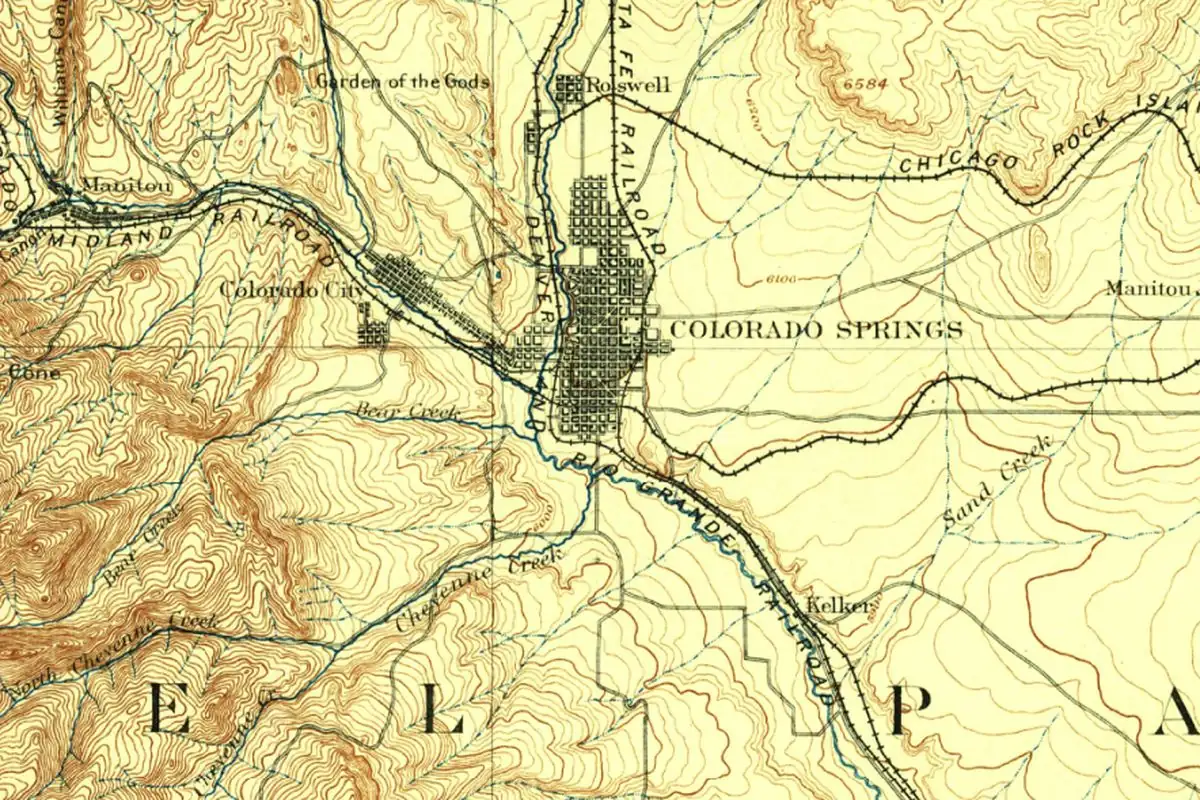
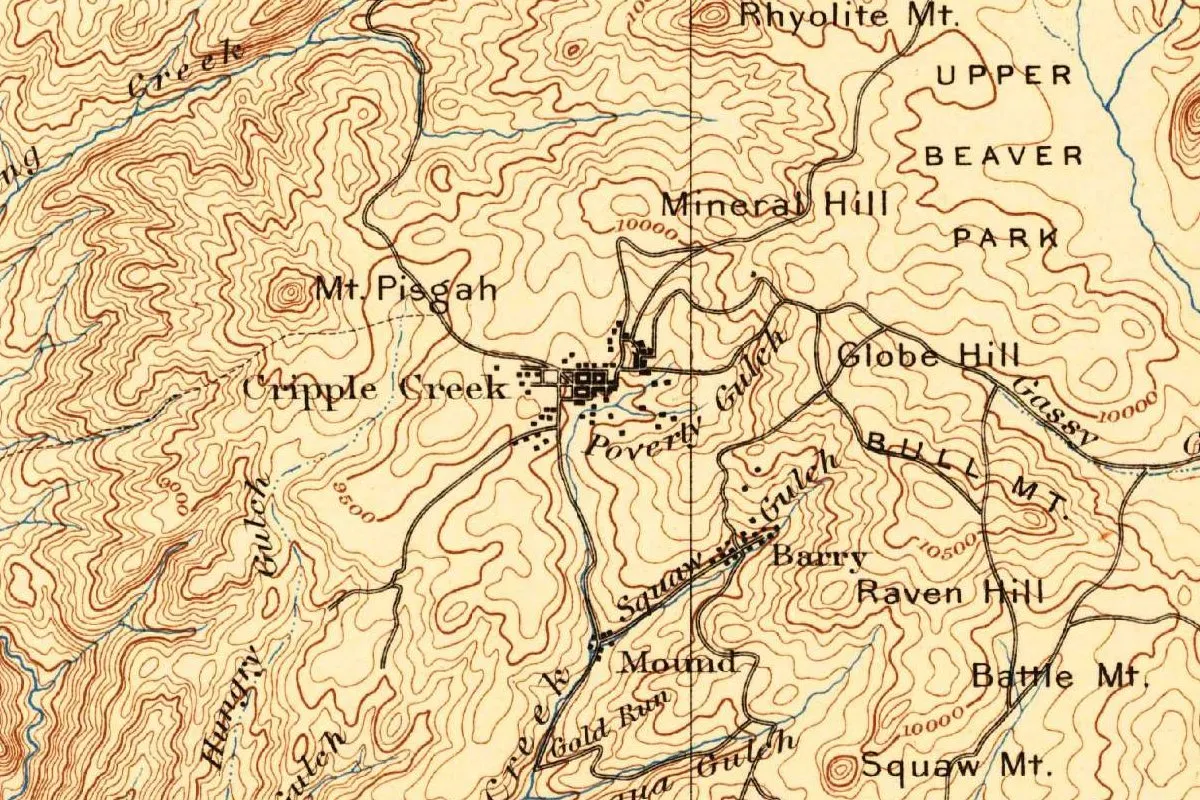
The Cripple Creek Times put the town’s side simply in a souvenir edition of 1903. Down in the valley, it said, a settlement sprang up “which took its name from the mountain stream upon which it was located,” and it was incorporated on May 31, 1892. Another new town, Fremont, had been incorporated that January. The two joined on February 23, 1893, and the combined camp kept the stream’s name. If you look at the map at the top of this page, from 1894, you can see the little creek running south past the town.
The same paper says the camp’s post office went through three names first. It opened as Womack, then took the name Fremont, then Moreland. But “the name bestowed by the cattlemen nearly twenty years before still stuck,” and Cripple Creek went onto the government’s list of post offices.
A broken leg, in 1892
The oldest explanation we found is in a booklet the Colorado Midland Railway printed to bring people to the new gold field, around 1892. Its very first page tells it this way:
“Some years ago a man attempted to cross the creek; his horse stumbled under him, he was thrown and had his leg broken, and from that time the before nameless stream has been known as ‘Cripple Creek.’”
The booklet doesn’t name the rider or say when it happened. It also admits the name is “neither euphoneous nor beautiful,” which is about as honest as railroad advertising gets.
Crippled cattle, in 1896
Four years later, a different railroad told a different story. The Santa Fe Route’s own Cripple Creek booklet of 1896 said the site had been a cattle ranch until prospectors began wandering in around 1889, and Robert Womack had been “digging holes all over the ranch looking for mineral.” So many holes went down, it said, that cattle fell in and were shipped to market “maimed and crippled,” and “from this circumstance, it is said, the name ‘Cripple Creek’ was derived.”
That one doesn’t fit the earlier booklet, which already called the creek by its name “some years” before 1892. But the holes were real enough to annoy the ranch. The 1903 Times says the manager complained that “every hole sunk by Womack meant the loss of a steer.”
Welty’s accidents, or a creek in Virginia?
The Times also gives the land’s history. The Womacks came to Colorado in 1872, it says, and in 1876 they bought the Welty homestead, which covered what became the townsite. Today’s Colorado Encyclopedia picks up from there with two more ideas. One is a legend that settler Levi Welty named the creek after a string of accidents and injuries there. The other, which the encyclopedia thinks more likely, is that the Womack family named it after Cripple Creek, Virginia, near the family’s earlier home in Kentucky.
Then there’s the calf. In 2022 the historical commission of Superior, Colorado, ran a “Did you know” item saying the name came when cowboys found a calf that had jumped a fence, landed in a gully and broken its leg. It gives no source, and it’s the youngest of the stories, but you have to admit it’s the easiest one to picture.
Who’s right?
Nobody can prove it. The rider, the cattle, the calf and Welty’s run of bad luck are all accidents, and none of them comes with a date or a witness. The Virginia idea is the odd one out, a name carried west rather than earned on the spot. What the record does show is that the name came from the stream, and that the stream’s name came first.
Quick answers
How did Cripple Creek get its name?
From the stream the town was built on. Why the stream is called Cripple Creek is disputed: an 1892 booklet blames a rider’s broken leg, an 1896 booklet blames crippled cattle, and later accounts give other versions.
What does Cripple Creek mean?
It means a creek where someone, or something, got crippled, if you go by the accident stories. The Colorado Encyclopedia also says the name may have come from Cripple Creek, Virginia.
Did a calf with a broken leg give Cripple Creek its name?
That’s one version, told by the Superior Historical Commission in 2022 without a source. The oldest version we found, from 1892, says it was a man whose horse stumbled and who broke his leg.
Was the town of Cripple Creek ever called Fremont?
Not the town, but its post office was, for a while. Fremont was a separate town, incorporated in January 1892, that joined Cripple Creek on February 23, 1893. The 1903 Cripple Creek Times says the camp’s post office was called Womack, then Fremont, then Moreland before it took the Cripple Creek name.
Key dates
- 1872The Womacks, father and son, come to Colorado and start a cattle ranch north of Pueblo, the Cripple Creek Times wrote in 1903.
- 1876The Womacks buy the Welty homestead, which covered the site of the future town.
- 1892A Colorado Midland Railway booklet, printed around 1892, says the creek was named after a rider broke his leg crossing it.
- 1892January 19: Fremont is incorporated. May 31: the settlement of Cripple Creek, named for the stream, is incorporated.
- 1893February 23: Fremont and Cripple Creek are consolidated as one town.
- 1896A Santa Fe Railway booklet says the name came from cattle that fell into prospectors' holes.
Getting there
Open Cripple Creek in Google Maps
Opens in a new tab. The pin is the center of Cripple Creek in the USGS place-name record.
The closest airports, Amtrak stations and intercity bus stops, measured in a straight line from the center of Cripple Creek.
Airports
- City of Colorado Springs Municipal (COS) 26 mi 42 km
- Denver International (DEN) 82 mi 131 km
Amtrak trains
- Denver station (DEN) 70 mi 113 km
- Winter Park station (WPR) 85 mi 136 km
Intercity buses
- Greyhound Colorado Springs CO (COS) 20 mi 32 km
- Bustang Outrider Bustang · Colorado Springs Downtown Transit Terminal 20 mi 32 km
- Colorado Department of Transportation Bustang · Colorado Springs Downtown Station 20 mi 32 km
Distances are as the crow flies, not by road. We don't list schedules or fares because they change; check with the airline, Amtrak or the bus company before you go. Official data (FAA commercial service airports (2025), FAA airport locations, Amtrak stations and Intercity Bus Atlas) from the FAA and the U.S. Bureau of Transportation Statistics, checked Nov 13, 2026.
Sponsored
Staying in Cripple Creek?
Compare hotels in Cripple Creek, Colorado, on Expedia.
See hotels in Cripple CreekWe may earn a commission if you buy through this link. It never changes what we write. Read our affiliate disclosure
Sponsored
Want the spooky side of Cripple Creek?
The name has its story above. For the ghost stories, US Ghost Adventures runs walking ghost tours in Cripple Creek.
See ghost tours in Cripple CreekWe may earn a commission if you book through this link. It never changes what we write. Read our affiliate disclosure
Historical Sources & References
- Colorado Midland Railway, The Cripple Creek Gold Fields, Placers, Lodes (about 1892), p. 3. The rider whose horse stumbled, the broken leg, and “the before nameless stream,” on the first page of text (unnumbered; the next page is 4).
- Santa Fe Route, Cripple Creek (1896), p. 5. The cattle ranch, Womack’s holes, the cattle “maimed and crippled,” and “it is said, the name ‘Cripple Creek’ was derived.”
- The Cripple Creek Times, souvenir edition (1903), pp. 9, 55. Fremont incorporated on January 19, the settlement “which took its name from the mountain stream” incorporated on May 31, 1892, the consolidation of February 23, 1893, and the post office called Womack, Fremont and Moreland before “the name bestowed by the cattlemen nearly twenty years before still stuck” (p. 9); the Womacks in 1872 and 1876, the Welty homestead, and “every hole sunk by Womack meant the loss of a steer” (p. 55).
- Colorado Encyclopedia, “Cripple Creek”. The legend that Levi Welty named the creek after a string of accidents, and the view that the Womacks more likely named it for Cripple Creek, Virginia.
- Town of Superior Historical Commission, “Historical Commission Corner” (2022). The calf that jumped a fence, landed in a gully and broke its leg.
- Where Teller County’s Cripple Creek sits in the Geographic Names Information System. The town’s official entry as a populated place, with coordinates.
- U.S. Geological Survey, Pikes Peak sheet (1894). The source of the map at the top of this page.
Spot something wrong, or know more? Tell us here. You can also email us or use our contact page. Corrections are noted here with their date, never made silently.