Ocala, Florida: A Timucua Name and the Big Hammock Question
Ocala takes its name from Ocali, a Timucua village; Spanish accounts from Hernando de Soto's expedition of 1539 spell it Ocale. The meaning is not settled. The City of Ocala has said the name is commonly thought to mean "Big Hammock." Henry Gannett wrote in 1905 that it meant "green" or "fertile land."
Ocala, Florida, carries the name of a Timucua town Hernando de Soto heard so much about he dared not repeat it all, and sources disagree on what it means. The city has said “Big Hammock.” A 1905 government bulletin said “green,” or “fertile land.”
The town De Soto heard about
On July 9, 1539, writing from his camp at Tampa Bay, De Soto sent a letter to the town officials of Santiago de Cuba. Local people had been telling him about the country ahead, and one town got a bigger buildup than the rest. In the English translation printed in 1904, he wrote:
“there is another town, called Ocale. It is so large, and they so extol it, that I dare not repeat all that is said.”
He went on anyway, a little. The people there were said to keep turkeys in pens and “herds of tame deer that are tended,” which De Soto admitted he didn’t understand. Then he hedged the whole report: “of what these Indians say I believe nothing but what I see.”
So the oldest name in this story arrives as a rumor, written down by a man who didn’t trust it.
What the Spaniards found
The army went to see for itself. Rodrigo Ranjel, who rode with the expedition, says De Soto took some horsemen “along the road to Ocale” because “he had great reports of the riches he expected to find there.” The editor of the 1904 edition added a one-line footnote to that spelling: “Or Ocali.”
Ranjel’s account of the place itself is much plainer than the rumors. The governor reached “the first village of Ocale, which was called Uqueten,” sent corn back to the hungry soldiers still stuck in a swamp behind him, and set up camp. “The camp was now at Ocale,” Ranjel wrote, “a village in a good region for corn.” It was also a place where the Spaniards lost men: Ranjel says the Indians killed three soldiers of the governor’s guard and a horse while the army was foraging.
Ocali and the city’s name
The modern city doesn’t spell it the way the Spaniards did. In the city’s own historical summary, as it stood on Ocala’s website in 2008, “Ocala’s name comes from the extinct Timucuan Indians who called their village Ocali, commonly thought to mean ‘Big Hammock.’” The county’s visitors bureau puts it more simply: the area was “once called Ocali by Timicua Indians.”
Notice the hedge in the city’s sentence. “Commonly thought” isn’t a translation from a Timucua dictionary. It’s a report of what people believe. The city didn’t say who first offered “Big Hammock,” and the word “hammock” doesn’t appear anywhere in the 1904 edition of the De Soto narratives.
Henry Gannett gave a different reading in 1905, in the bulletin on name origins he put together for the Geological Survey. The city in Marion County, he wrote, was “named from the Indian village, the word meaning ‘green,’ or ‘fertile land.’” He didn’t name his source either.
That leaves you with two meanings and no way to choose between them from these sources. The word is old enough that the Spanish wrote it down more than three centuries before Ocala had a courthouse. What it meant to the people who used it first is the part nobody here can show.
Fort King, a county seat and a square
American settlement started with Fort King, the Florida Department of State says, built by the Army in the 1820s and active during the Seminole Wars. The city’s Fort King page says the fort later “became the county seat and housed the first court house” and “played a vital role in the birthplace of Marion County and the City of Ocala.”
The city’s 2008 summary picks up from there. In 1846 Ocala became the county seat of the new Marion County, named for General Francis Marion. By 1847 settlers had built a courthouse on the square, the post office had moved to Ocala, and a weekly newspaper was up and running. Ocala was incorporated as a city in 1885, the state says.
The town’s other name
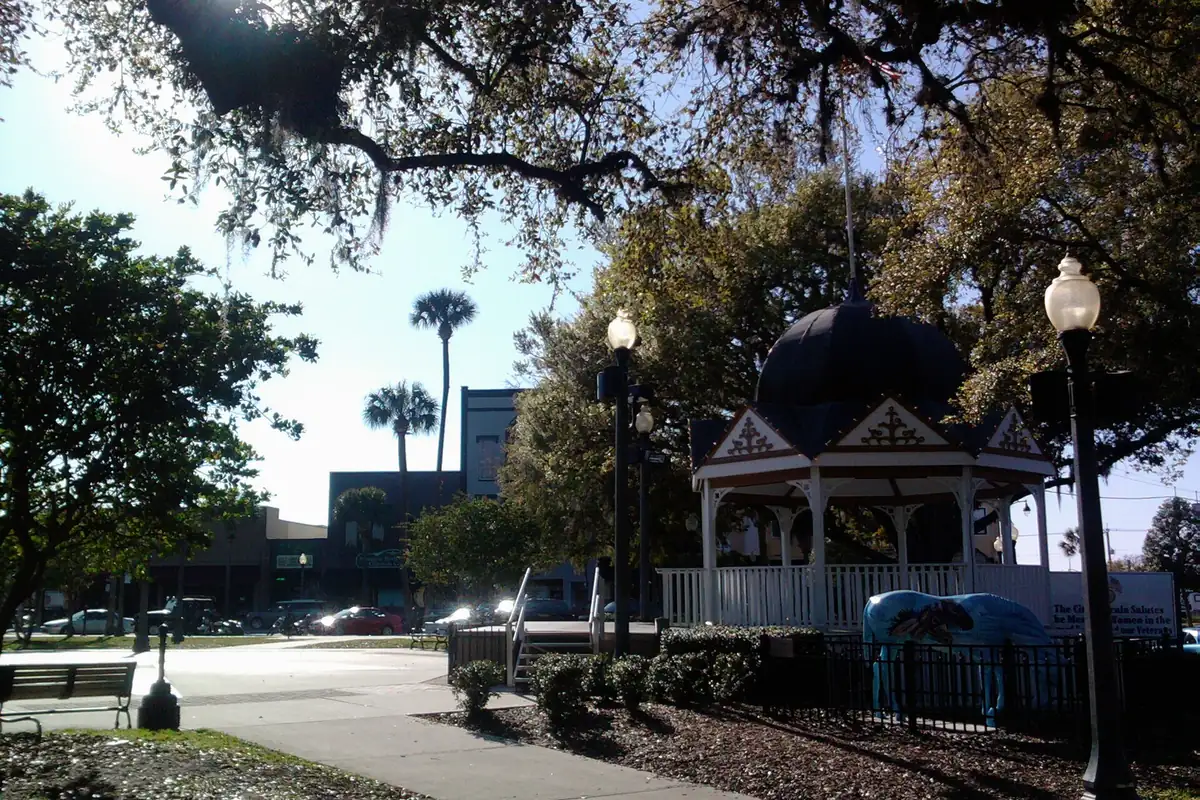
Ocala has a nickname with a much clearer origin. Rail service reached the town in 1881, and two years later, on Thanksgiving Day 1883, a fire wiped out four blocks of the business district around the Downtown Square. The burned wooden buildings were replaced with brick, and when that construction was finished in 1888, the state says, Ocala “became known as the ‘Brick City.’” The gazebo in the photo at the bottom of this page stands on that same Downtown Square.
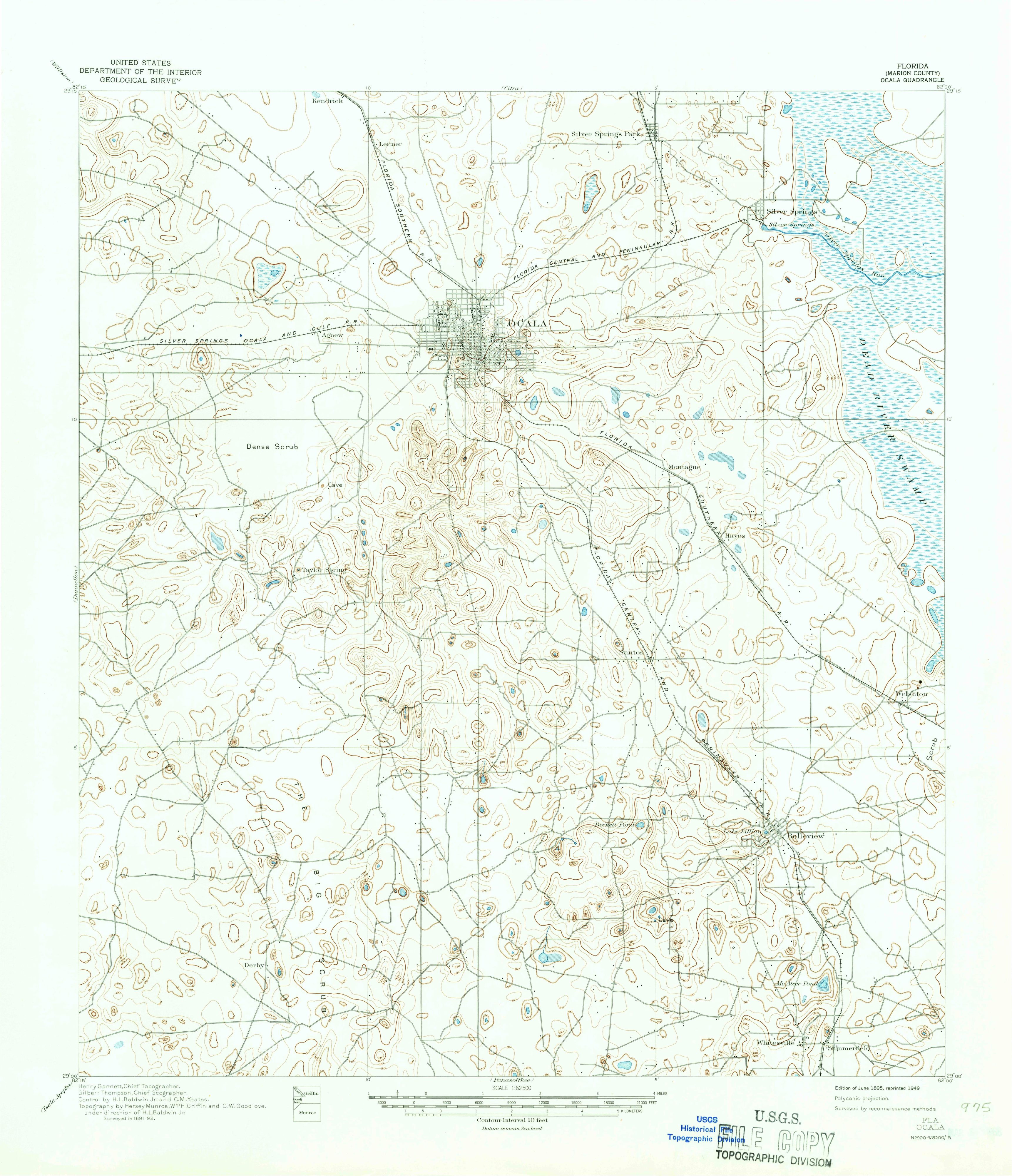
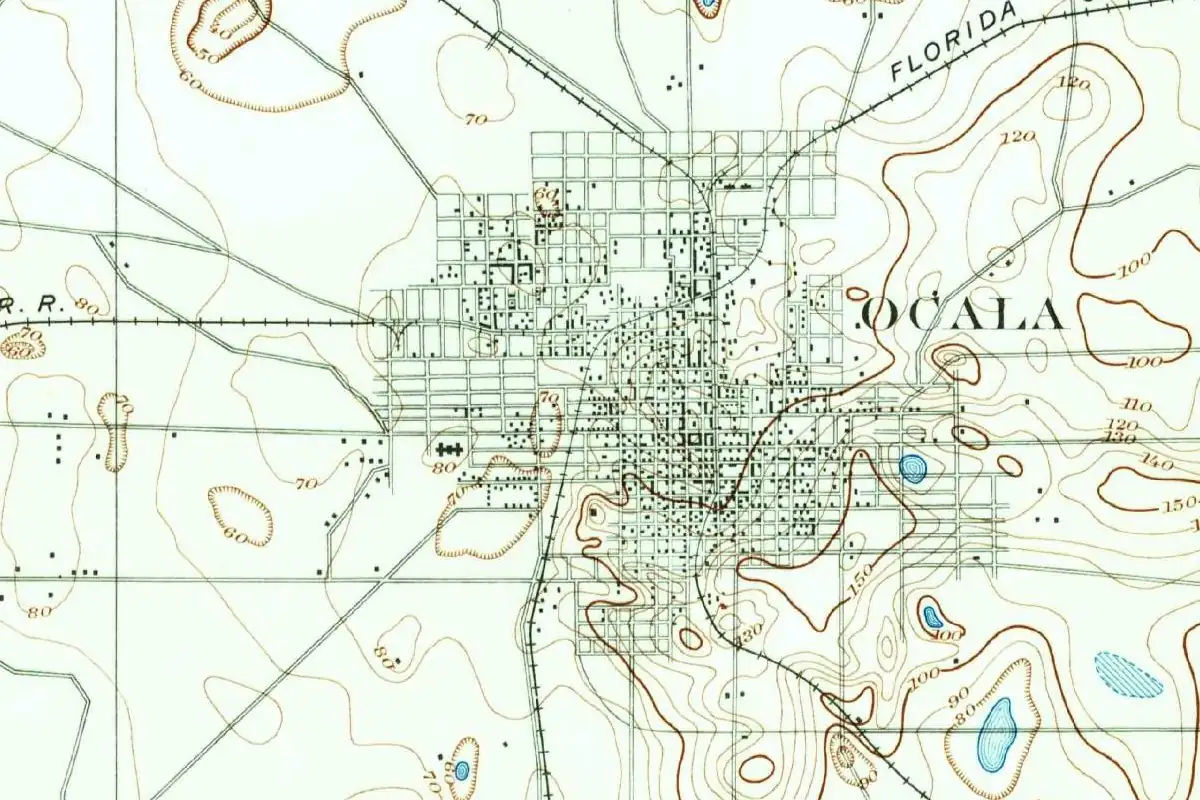
The map at the top of this page was published in 1895 and surveyed less than a decade after the fire. It shows the town with railroad lines crossing at its center and the grid of streets packed tightest in the middle. The full sheet’s margin is candid about how it was made: the country was “surveyed by reconnaissance methods” in 1891-92, under Henry Gannett as chief topographer, and the copy scanned for the Survey’s archive is a 1949 reprint.
So Ocala has two names with two very different paper trails. You can date “Brick City” to the year. “Ocala” reaches back to a rumor De Soto didn’t dare repeat in full, and its meaning is still a matter of who you ask.
Other Florida cities carry Indigenous names with loose ends of their own. Tampa was written down by a Spaniard in the 1500s and still has no settled meaning, Kissimmee took its river’s name without a sure translation, and Tallahassee was named for an Indian town. You’ll find more on our Florida page.
Quick answers
Where does the name Ocala come from?
From Ocali, the name of a Timucua village, according to the City of Ocala and Henry Gannett’s 1905 bulletin. Accounts from Hernando de Soto’s expedition of 1539 spell it Ocale.
Does Ocala mean “big hammock”?
Not for certain. The city has said Ocali is “commonly thought” to mean “Big Hammock,” but Gannett gave “green” or “fertile land,” and neither names a source.
Why is Ocala called the Brick City?
After a Thanksgiving Day fire in 1883 destroyed four blocks of downtown, the town rebuilt in brick, and by 1888 it was known as the Brick City, according to the Florida Department of State.
Did Hernando de Soto visit Ocala?
His army camped at a village called Ocale in 1539, Rodrigo Ranjel wrote. The sources here don’t say whether that village stood where the city is now.
Key dates
- 1539Hernando de Soto writes from Tampa Bay of a town called Ocale, and his army camps there that summer.
- 1846Ocala becomes the county seat of the new Marion County.
- 1881Rail service reaches Ocala.
- 1883A Thanksgiving Day fire destroys four blocks of the business district around the Downtown Square.
- 1885Ocala is incorporated as a city.
- 1888Brick rebuilding is finished, and Ocala becomes known as the Brick City.
Things to do in Ocala, Florida
Fort King National Historic Landmark
A reconstructed U.S. Army frontier fort tied to the Second Seminole War, with rebuilt fort structures, a heritage garden of 19th-century farming and walking trails. The city says the fort played a vital role in the birth of Ocala.
Silver Springs State Park
One of the country's largest springs, where glass-bottom boats show off the clear water and underwater life, and kayakers can paddle the Silver River through old forest.
Appleton Museum of Art
The College of Central Florida's art museum, opened in 1987, with a permanent collection of more than 24,000 objects and outdoor sculptures.
Historic Downtown Ocala
The downtown that was rebuilt in brick after the 1883 fire. Ocala Main Street offers a self-guided walking tour of the historic Brick City and its buildings in downtown and midtown.
Getting there
Open Ocala in Google Maps
Opens in a new tab. The pin is the center of Ocala in the USGS place-name record.
The closest airports, Amtrak stations and intercity bus stops, measured in a straight line from the center of Ocala.
Airports
- Gainesville Regional (GNV) 36 mi 57 km
- Orlando Sanford International (SFB) 62 mi 99 km
- Orlando International (MCO) 73 mi 117 km
Amtrak trains
- Palatka station (PAK) 44 mi 71 km
- DeLand station (DLD) 49 mi 79 km
Intercity buses
- Amtrak Chartered Vehicle Amtrak Connecting Service · Ocala Amtrak Bus Stop under 1 mi 0.7 km
- FlixBus Gainesville 34 mi 54 km
- Greyhound Gainesville Bus Stop 38 mi 62 km
Distances are as the crow flies, not by road. We don't list schedules or fares because they change; check with the airline, Amtrak or the bus company before you go. Official data (FAA commercial service airports (2025), FAA airport locations, Amtrak stations and Intercity Bus Atlas) from the FAA and the U.S. Bureau of Transportation Statistics, checked Nov 14, 2026.
Sponsored
Staying in Ocala?
Compare hotels in Ocala, Florida, on Expedia.
See hotels in OcalaWe may earn a commission if you buy through this link. It never changes what we write. Read our affiliate disclosure
Historical Sources & References
- Henry Gannett, The Origin of Certain Place Names in the United States (1905), p. 228. Ocala, “named from the Indian village, the word meaning ‘green,’ or ‘fertile land.’”
- City of Ocala, “Historic Highlights” (2008). The city’s old history page, read in the Internet Archive’s copy: Ocali, “commonly thought to mean ‘Big Hammock’”; Fort King; county seat in 1846; courthouse, post office and newspaper by 1847.
- Hernando de Soto’s letter of July 9, 1539, in Bourne, ed., Narratives of the Career of Hernando de Soto, vol. 2 (1904), p. 162. The quoted lines on the town “called Ocale,” the tame deer and “I believe nothing but what I see.”
- Relation of Rodrigo Ranjel, in Bourne (1904), p. 65. De Soto rides “along the road to Ocale”; the editor’s footnote, “Or Ocali.”
- Relation of Rodrigo Ranjel, in Bourne (1904), p. 68. Uqueten, “the first village of Ocale,” and the camp at Ocale, “a village in a good region for corn.”
- Ocala/Marion County Visitors and Convention Bureau, “Historic Sites”. The area “once called Ocali by Timicua Indians.”
- Florida Department of State, press release on Ocala Main Street (2023). The Timucua at first contact, Fort King in the 1820s, the railroad in 1881, the 1883 fire, city status in 1885 and the Brick City name by 1888.
- City of Ocala, Fort King, “History of the Site”. The fort as county seat and first courthouse, and its role in the birth of Marion County and the City of Ocala.
- GNIS feature 288030 (U.S. Geological Survey). The U.S. gazetteer listing for Ocala, Marion County, with its coordinates.
- U.S. Geological Survey, Ocala sheet (1895). The 1:62,500 map, surveyed in 1891-92, that the image at the top of this page was cropped from.
Sponsored
Put this 1895 map on your wall
The 1895 USGS Ocala sheet, in a 1949 reprint, is in the public domain. Download the full-size scan for free, then have it printed on canvas with CanvasOnTheCheap.
Print a map on canvasDownload the full-size mapWe may earn a commission if you buy through this link. It never changes what we write. Read our affiliate disclosure
Spot something wrong, or know more? Tell us here. You can also email us or use our contact page. Corrections are noted here with their date, never made silently.