Athens, Georgia: Named in 1801 for Greece's City of Learning
Athens is named for the ancient Greek city famed for culture and learning. In 1801 a committee picked a hill above Cedar Shoals on the Oconee River for Georgia's new state university, John Milledge bought the land and gave it to the trustees, and the place was called Athens. Sources differ on whether Milledge or the trustees chose it.
A college with no campus
Athens, Georgia, got its name in 1801 from the ancient Greek city of learning, picked as the home of a state university that so far existed only on paper. The town came second. First there was a school that needed somewhere to stand, and the name was chosen for the school’s sake.
The paper part is no exaggeration. On January 27, 1785, the Georgia General Assembly chartered the University of Georgia, the first state-supported university to get a charter. Abraham Baldwin drafted that charter, and the county government’s history says it “existed only on paper for 16 years.” No buildings, no teachers, no students.
Augustus Longstreet Hull, who put together the Annals of Athens in 1906, picks up the story in 1801. The governor, the state senate and the university’s trustees, sitting together as the Senatus Academicus, were “stirred to action by public complaints of their neglect” and finally sent people out to find a site. So the town owes its start, in part, to a round of public complaints.
Five men, a hill and a ballot
The committee was John Milledge, Abraham Baldwin, George Walton, John Twiggs and Hugh Lawson. In late June 1801 they met at Billups’ Tavern on the Lexington road and rode out to look at land in what was then Jackson County.
What they found was a hill above Cedar Shoals on the Oconee River. Back then, the Athens-Clarke County history says, the place was “no more than a trading settlement” by that name. Daniel Easley, a settler and land speculator, ran a mill on the shoals and owned the hill, according to the New Georgia Encyclopedia. The committee voted by ballot, and the vote was unanimous.
Hull didn’t paraphrase what came next. He copied it from the Augusta Chronicle of July 20, 1801, a newspaper printed in Augusta:
“For this purpose the tract containing 633 acres was purchased of Mr. Easley by Mr. Milledge, one of the Committee, and made a donation of to the Trustees, and it was called Athens.”
That’s the oldest account of the name in this article, and you’ll notice what it skips. It says the land “was called Athens,” as if the name just happened. It doesn’t say who said it first.
Milledge or the trustees?
Later writers filled the gap, and they didn’t fill it the same way. The Athens-Clarke County government says Milledge bought the 633 acres from Easley on July 25, 1801, donated them to the university, and “named the land Athens in honor of the Greek city that was the center of culture and learning during ancient times.”
The New Georgia Encyclopedia, in an entry by Frances Taliaferro Thomas, gives the credit to the board instead: “The trustees named the place Athens after the center of classical culture in Greece.” She adds that Milledge paid $4,000 for the land.
So which was it? Nobody in these sources settles it. Milledge may have proposed the name and the trustees made it official, or the other way around, but that’s a guess, not a record. The dates don’t line up neatly either. The newspaper story ran on July 20 and already reported the purchase, while the county’s history dates the purchase to July 25. What doesn’t change from one account to the next is the city in Greece.
Why name a college town for Greece?
Because Athens meant school. Henry Gannett of the U.S. Geological Survey needed five words for it in 1905: “Named from the capital city of Greece.” The modern accounts spell out the reason. Ancient Athens was the center of culture and learning, and these men were building a university in the woods.
The new school didn’t wear the Greek name itself, at least not at first. The county’s history says the first building was called Franklin College, after Ben Franklin, and that name was often used as the school’s unofficial nickname in the early years. So the college carried an American name while the land around it carried a Greek one.
Georgia’s Athens wasn’t alone, either. Gannett listed cities named Athens in Clarke County, Georgia, and Menard County, Illinois, villages in Louisiana and New York, a county in Ohio, a borough in Pennsylvania “and many other cities, towns, and villages.” He traced every one of them to the same Greek capital, so if you run into an Athens somewhere else, odds are it’s the same borrowing.
Lots for sale
The town grew because the college needed money. To pay for its buildings, the university sold lots next to the campus. By 1803, the county says, three homes, three stores and other buildings faced Front Street, which later became Broad Street. Hotels, general stores, a blacksmith and a tailor followed.
The first class graduated on May 31, 1804. In December 1806 the town of Athens was officially incorporated, with a three-member commission to run it. Thomas counts what it had by then: seventeen families, ten frame houses and four stores.
That’s the trade the founders made. They wanted a place worthy of the most famous school city in the ancient world, and they got a hilltop over a mill dam with a handful of storefronts. The name was a promise about what the place would become. Athens turns up in other Georgia name stories, too: Martha Lumpkin, the woman Atlanta’s earlier name Marthasville honored, was still living in 1912 at the old Lumpkin home outside Athens. You can find more name stories like these on our Georgia page.
Quick answers
Why is Athens, Georgia, called Athens?
For Athens, Greece. Georgia’s local government says the land was named for the Greek city that was “the center of culture and learning during ancient times,” which suited the site picked in 1801 for the state university.
Who named Athens, Georgia?
Accounts differ. The Athens-Clarke County government credits John Milledge, who bought the land and gave it to the university; the New Georgia Encyclopedia says the university’s trustees named it. The 1801 newspaper report only says the place “was called Athens.”
What was Athens, Georgia, before the university?
A trading settlement on the Oconee River called Cedar Shoals, where Daniel Easley ran a mill. The town itself grew up on lots the university sold to pay for its buildings, and it was incorporated in 1806.
Key dates
- 1785On January 27, the Georgia General Assembly charters the University of Georgia. For 16 years it exists only on paper.
- 1801John Milledge buys 633 acres above Cedar Shoals on the Oconee River, gives them to the university, and the place is called Athens.
- 1804The university's first class graduates on May 31.
- 1806In December, the town of Athens is officially incorporated.
Things to do in Athens, Georgia
Georgia Museum of Art
The museum began in 1945, when retired lawyer Alfred Heber Holbrook gave about 100 paintings to the University of Georgia. It started in a library basement and now holds nearly 20,000 works of art.
State Botanical Garden of Georgia
A 313-acre garden run by the University of Georgia, with nature trails, display gardens, a conservatory and a chapel. It's also headquarters for the Garden Club of Georgia.
Morton Theatre
Built in 1910 by Monroe Bowers "Pink" Morton, it's one of the first and the oldest surviving vaudeville theatres in the country built, owned and operated by an African American. Shows still go on there.
T.R.R. Cobb House
A Watson-Brown Foundation house museum about Thomas Reade Rootes Cobb, his family and the people he enslaved, and a resource for anyone digging into the history of the 19th-century South.
Getting there
Open Athens in Google Maps
Opens in a new tab. The pin is the center of Athens in the USGS place-name record.
The closest airports, Amtrak stations and intercity bus stops, measured in a straight line from the center of Athens.
Airports
- Hartsfield/Jackson Atlanta International (ATL) 64 mi 103 km
- Middle Georgia Regional (MCN) Macon 89 mi 143 km
Amtrak trains
- Gainesville station (GNS) 34 mi 55 km
- Toccoa station (TCA) 43 mi 69 km
Intercity buses
- FlixBus Athens Bus Station under 1 mi 0.7 km
- Greyhound Monroe (Taylor Wrecker Service) 22 mi 36 km
Distances are as the crow flies, not by road. We don't list schedules or fares because they change; check with the airline, Amtrak or the bus company before you go. Official data (FAA commercial service airports (2025), FAA airport locations, Amtrak stations and Intercity Bus Atlas) from the FAA and the U.S. Bureau of Transportation Statistics, checked Nov 13, 2026.
Sponsored
Staying in Athens?
Compare hotels in Athens, Georgia, on Expedia.
See hotels in AthensWe may earn a commission if you buy through this link. It never changes what we write. Read our affiliate disclosure
Historical Sources & References
- Athens-Clarke County Unified Government, “City of Athens”. The 1785 charter that “existed only on paper for 16 years,” the Cedar Shoals trading settlement, the five-man committee, Milledge’s purchase of 633 acres on July 25, 1801, the naming “in honor of the Greek city,” Franklin College, the lots and Front Street by 1803, the first graduation in 1804 and incorporation in December 1806.
- Frances Taliaferro Thomas, “Athens,” New Georgia Encyclopedia. Daniel Easley and his mill at Cedar Shoals, the $4,000 purchase, the line “The trustees named the place Athens after the center of classical culture in Greece,” and the town of 1806 with seventeen families, ten frame dwellings and four stores.
- Augustus Longstreet Hull, Annals of Athens, Georgia, 1801-1901 (1906), pp. 1-2. The Senatus Academicus and its committee, Billups’ Tavern, the unanimous ballot, and the Augusta Chronicle report of July 20, 1801, ending “and it was called Athens” (p. 2).
- Henry Gannett, The Origin of Certain Place Names in the United States (USGS, 1905), p. 31. “Named from the capital city of Greece,” with the other American places named Athens.
- GNIS feature 354407 (U.S. Geological Survey). Athens as the national names database carries it: a populated place in Clarke County, with the coordinates used on this page.
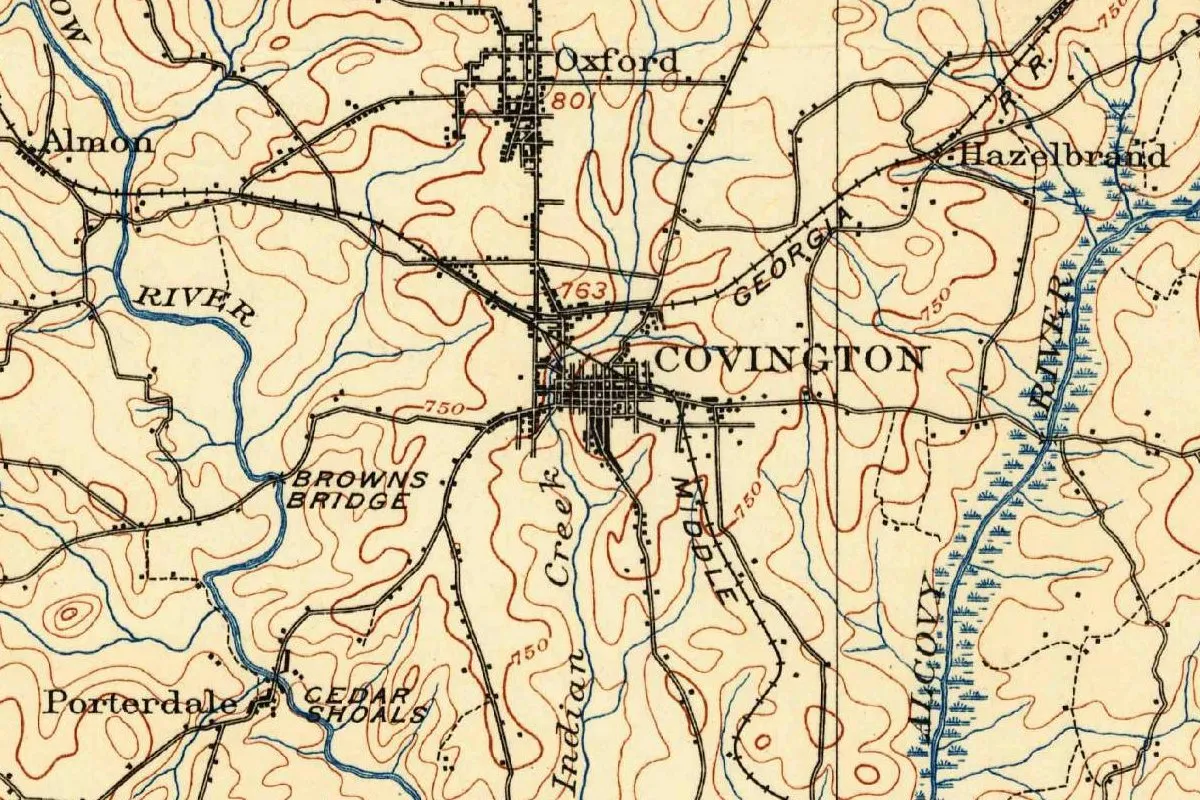
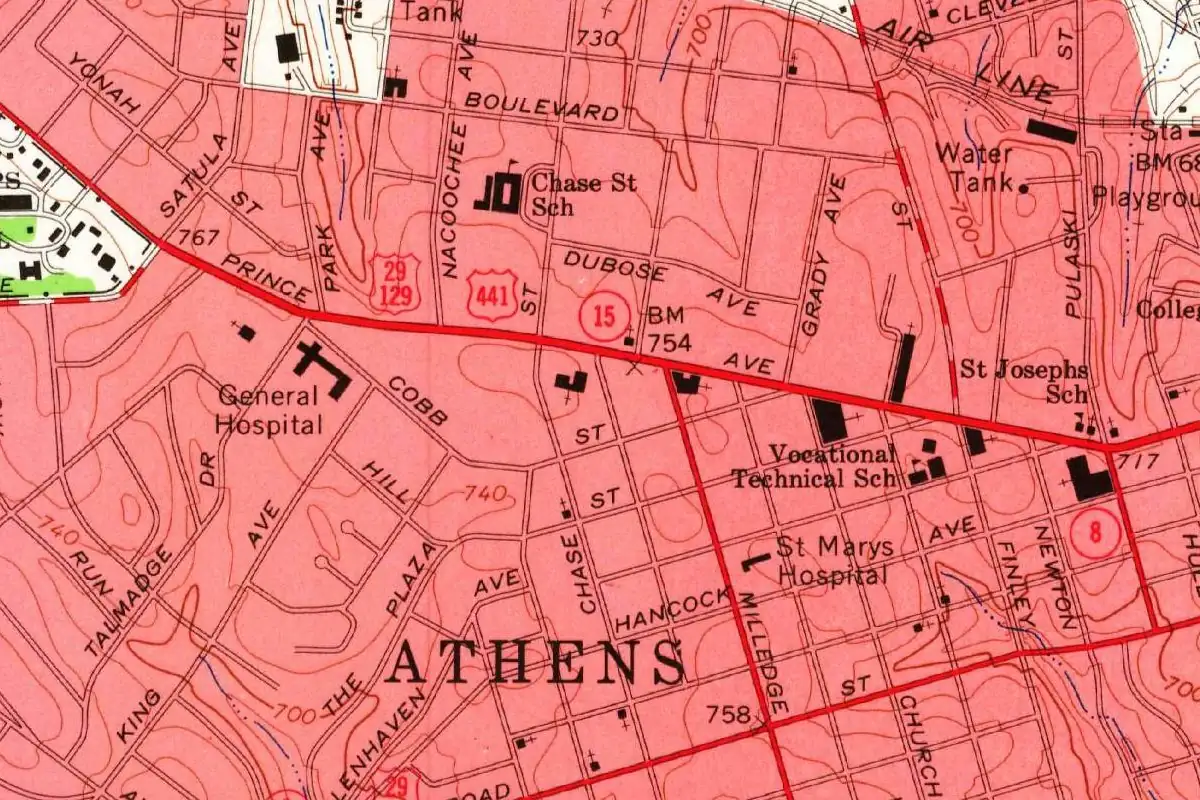
- U.S. Geological Survey, Athens West sheet (1964). The 1:24,000 quadrangle the old map at the top of this page was cut from; downtown sits at its right-hand edge.
Spot something wrong, or know more? Tell us here. You can also email us or use our contact page. Corrections are noted here with their date, never made silently.