Bryson City, North Carolina: Charleston Until 1889
Bryson City was incorporated as Charleston in 1887 and renamed by an act of the North Carolina General Assembly ratified on January 21, 1889. The new name honors Thaddeus Dillard Bryson (1829-1890), a legislator and one of the town's founders. Writer and naturalist George Ellison writes that mail for Charleston kept going to Charleston, South Carolina.
Bryson City, North Carolina, was Charleston until 1889, when the state legislature renamed it for Thaddeus Dillard Bryson, one of its founders. The change took two sentences of law, and one reason for it, a local writer says, was the mail.
A town laid out as Charleston
The town began as a county seat. Swain County’s Historical & Genealogical Society says that after the county was formed, “commissioners were assigned to lay out a town to be called Charleston and to select a site for the courthouse.” The county itself was named for David Lowry Swain, a former governor of North Carolina. William S. Powell’s North Carolina Gazetteer says the town was incorporated in 1887 “as Charleston.”
Two sentences in Raleigh
The act that renamed it is short. In the Public Laws of 1889, chapter 4 is titled “An act to change the name of Charleston in the county of Swain to Bryson City.” Section 1 reads: “That the name of the town of Charleston in the county of Swain be changed to Bryson City.” Section 2 puts it in force from ratification, and the act was “Ratified the 21st day of January, A. D. 1889.”
Why not Charleston?
The law doesn’t give a reason. George Ellison, writing in the Smoky Mountain News in 2016, does: “Charleston, the first name for the county seat, proved unsatisfactory. Mail was being misdirected to the city on the South Carolina coast.” That city is Charleston, South Carolina. Renaming the town, Ellison went on, “would provide an opportunity to honor Thaddeus Dillard Bryson, one of the town’s primary benefactors.”
Captain or colonel?
You’ll see Bryson called by two ranks. Powell’s gazetteer says the town was “named in honor of Capt. Thaddeus Dillard Bryson (1829-90), one of the founders of the town.” The county’s historical society says it was renamed “in honor of Colonel Thad Dillard Bryson.”
Both are right, for different years. Ellison quotes a family sketch by Edwin C. Bryson saying that Thaddeus Bryson was commissioned a lieutenant colonel of militia in 1854, “Captain of the Volunteer Company of Jackson Guards, June 28th, 1861, and Colonel in the 20th North Carolina Infantry of the Confederate Army, September 7th, 1861.”
The same sketch says he was born on February 13, 1829, represented Jackson County in the General Assembly, and in September 1868 bought “a large tract of land on the north side of the Tuckaseegee River,” now part of the town, where he built an eight-room house. When Swain County was organized in 1871, he became the first to represent it in the legislature. Ellison, citing Lillian Thomasson’s 1965 county history, adds that he ran a mill at the mouth of Deep Creek, and notes that he died the year after the renaming. He’s buried in the Bryson City Cemetery, “overlooking the town bearing his name.”
Bryson, without the City
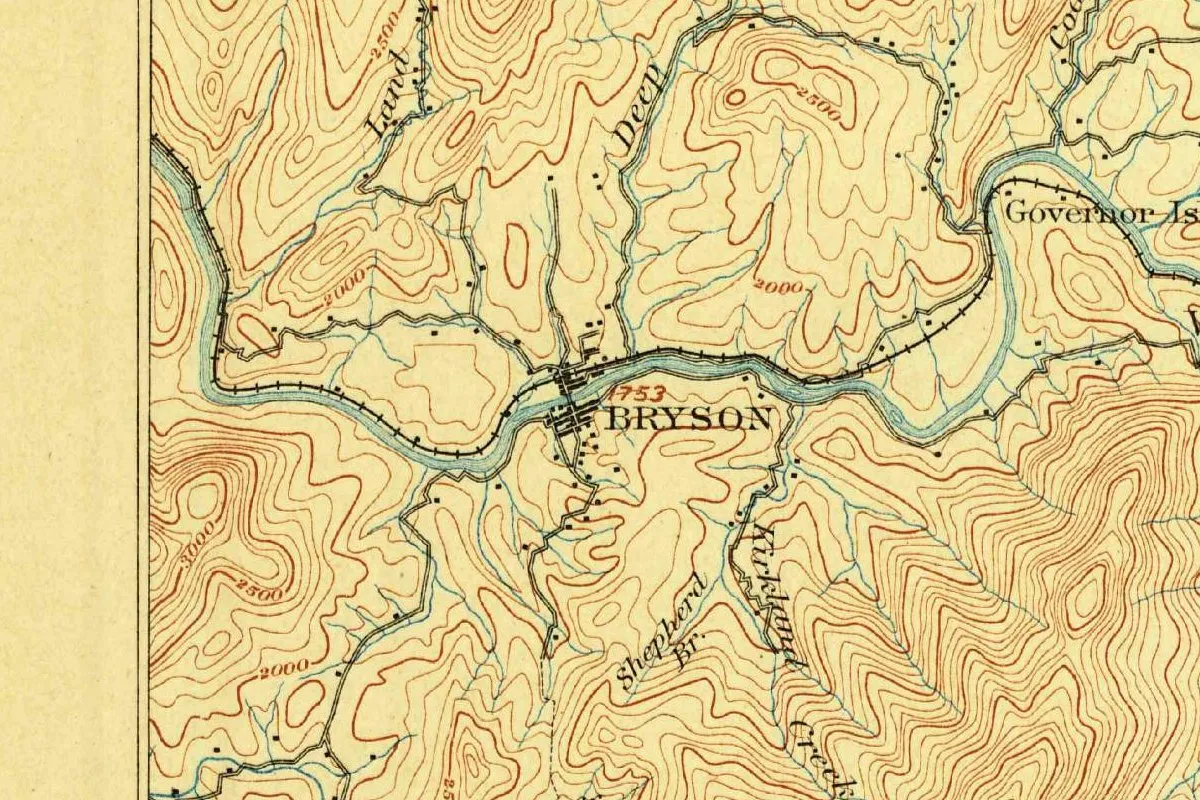
Two federal publications from those years use a shorter name. The Geological Survey’s Cowee sheet of 1897 labels the town simply “BRYSON.” Henry Gannett’s 1905 entry is under “Bryson” too: “town in Swain County, North Carolina, named for T. D. Bryson, member of the legislature, and owner of the town site.”
The Bryson Place in the Smokies
The town isn’t Bryson’s only namesake. If you hike up Deep Creek, you can reach the other one: Ellison writes that the Bryson Place, now Backcountry Campsite No. 57 in Great Smoky Mountains National Park, is about six miles (10 km) north of the gated trailhead in the Deep Creek Campground. Bryson bought land in the Deep Creek watershed in 1878 and built a hunting cabin there, Ellison says, citing the trail historian Ken Wise. The writer Horace Kephart stayed at the Bryson Place in the spring of 1910 before settling in Bryson City.
The 1897 map
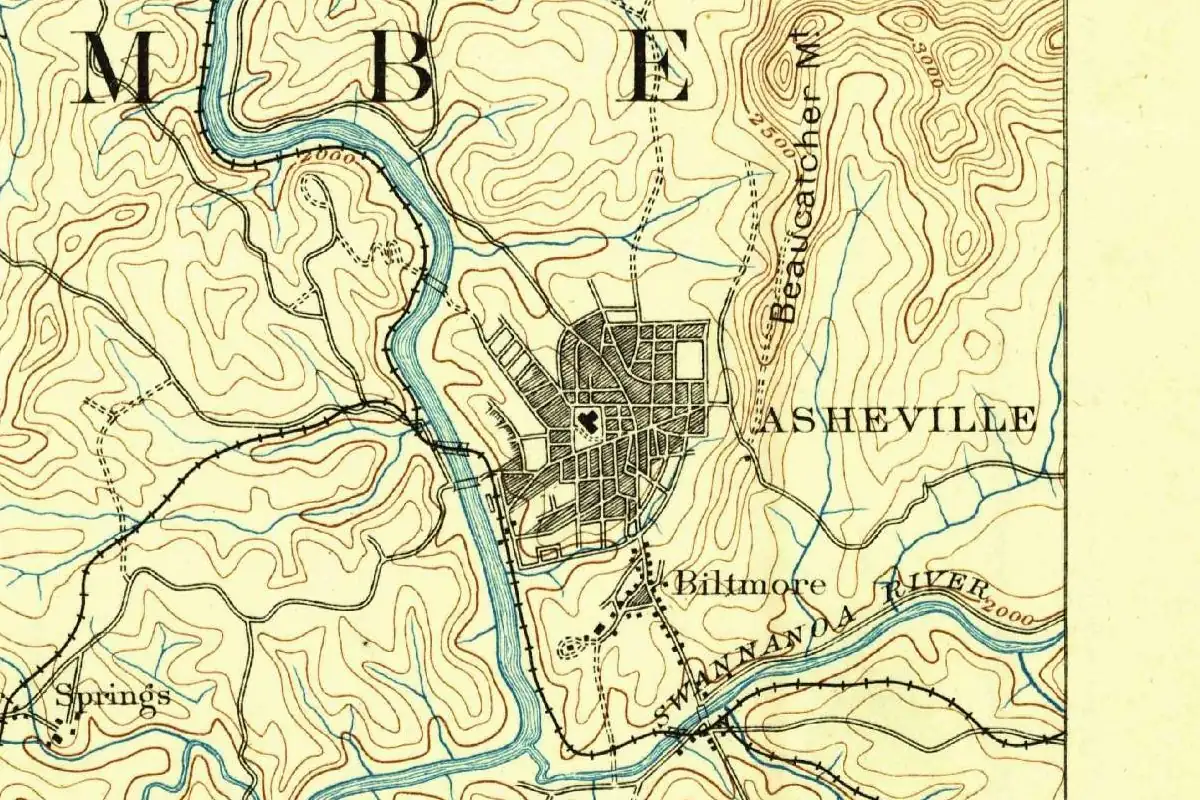
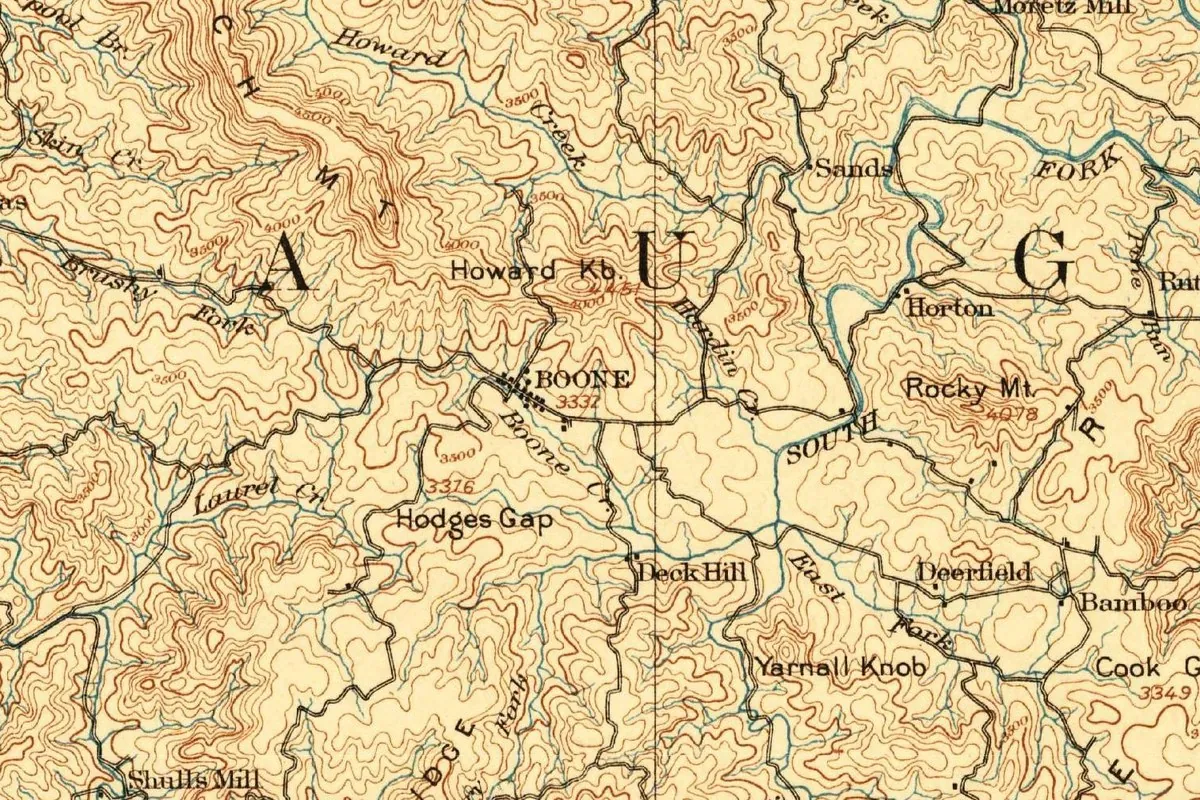
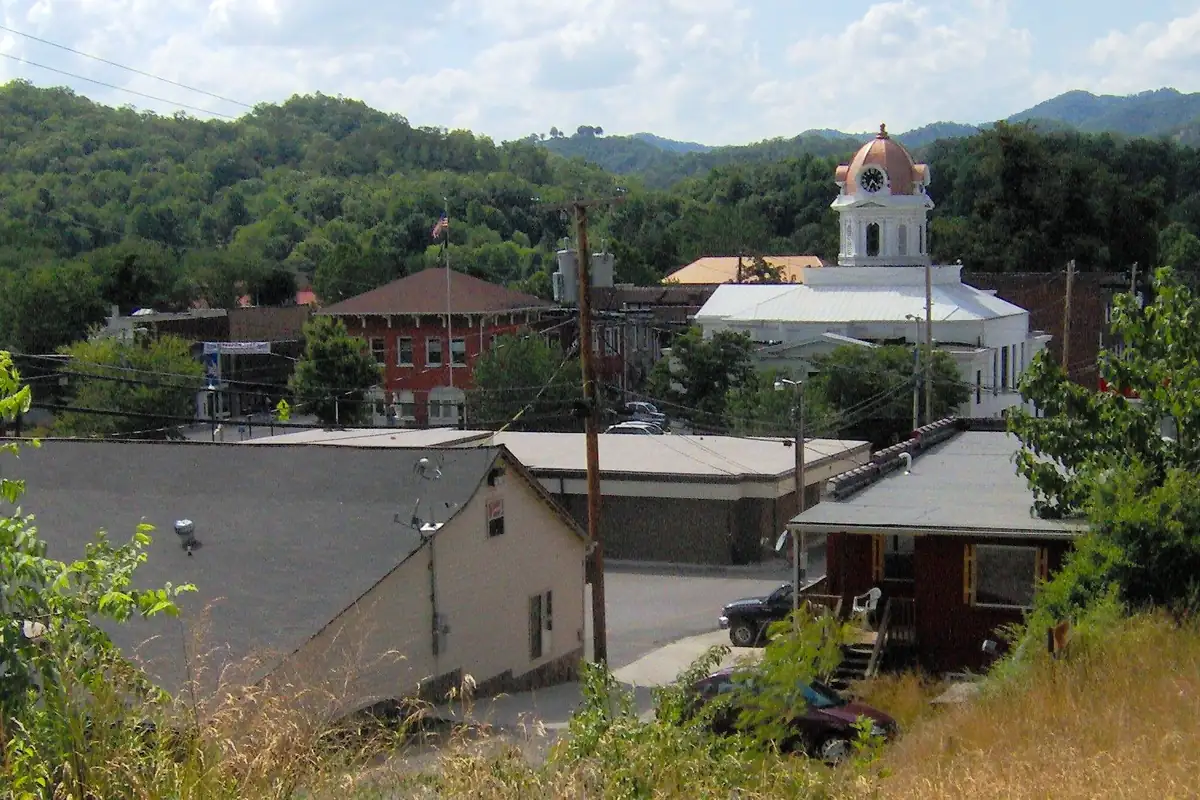
The map at the top of this page comes from the Geological Survey’s Cowee sheet of 1897, at a scale of 1:125,000. It marks the town at 1,753 feet (534 m), with the railroad running along the river and Deep Creek coming in from the north. Powell’s gazetteer gives the town’s altitude as 1,736 feet (529 m). The photo below looks north over downtown Bryson City to the clock tower of the old Swain County Courthouse. The Swain County Heritage Museum is in the 1908 courthouse, the museum says. The Park Service places its Deep Creek area just north of Bryson City and west of Cherokee, and lists the park’s headquarters on the Tennessee side, in Gatlinburg.
Quick answers
Why is it called Bryson City?
For Thaddeus Dillard Bryson (1829-1890), a legislator and one of the town’s founders. The North Carolina General Assembly gave the town the name in 1889.
What was Bryson City called before?
Charleston. Powell’s gazetteer says it was incorporated as Charleston in 1887, and the 1889 act changed “the name of the town of Charleston in the county of Swain” to Bryson City.
Why was Charleston renamed?
George Ellison wrote in 2016 that mail for the town was being sent to Charleston, South Carolina, and that a new name also let the town honor Bryson. The 1889 act itself gives no reason.
Was Bryson a captain or a colonel?
Both. A family sketch quoted by Ellison says he became captain of the Jackson Guards in June 1861 and colonel of the 20th North Carolina Infantry that September.
Key dates
- 1829Thaddeus Dillard Bryson is born on February 13.
- 1861Bryson becomes captain of the Jackson Guards in June and colonel of the 20th North Carolina Infantry in September.
- 1868Bryson buys a large tract north of the Tuckasegee River, now part of the town.
- 1871Swain County is organized, and Bryson becomes the first to represent it in the General Assembly.
- 1887The town is incorporated as Charleston.
- 1889An act ratified on January 21 changes the name of Charleston to Bryson City.
- 1890Thaddeus Dillard Bryson dies.
- 1897The Geological Survey's Cowee sheet labels the town "Bryson."
- 1905Henry Gannett lists "Bryson" as named for T. D. Bryson, legislator and owner of the town site.
Things to do in Bryson City, North Carolina
Great Smoky Mountains Railroad
Excursion trains leave from the historic depot in the heart of Bryson City, pulled by steam or diesel locomotives. The Nantahala Gorge Excursion follows Fontana Lake and the Nantahala River on a 44-mile (71 km) round trip.
Deep Creek
An area of the national park just north of Bryson City known for its streams and waterfalls, with loop hikes, a picnic area, a campground and one of the few park trails open to bicycles. The Park Service doesn't recommend swimming or tubing in park waters.
Juney Whank Falls
A short, steep trail from the end of Deep Creek Road leads to falls that drop 80 feet (24 m) and then flow under a wooden footbridge. The Park Service says the name is a Cherokee phrase meaning "place where the bear passes."
Swain County Heritage Museum
In the 1908 courthouse downtown, with exhibits on early settlers and on how the national park and Fontana Dam changed the county, plus a restored log cabin porch, an 1887 church organ and one-room schoolhouse desks.
Getting there
Open Bryson City in Google Maps
Opens in a new tab. The pin is the center of Bryson City in the USGS place-name record.
The closest airports, Amtrak stations and intercity bus stops, measured in a straight line from the center of Bryson City.
Airports
- McGhee Tyson (TYS) Alcoa 40 mi 65 km
- Asheville Regional (AVL) 51 mi 82 km
- Hartsfield/Jackson Atlanta International (ATL) 136 mi 219 km
Amtrak trains
- Toccoa station (TCA) 59 mi 95 km
- Clemson station (CSN) 62 mi 99 km
Intercity buses
- Greyhound Knoxville Area Transit Bus Stop 46 mi 74 km
- Sunway Charters Asheville 51 mi 83 km
Distances are as the crow flies, not by road. We don't list schedules or fares because they change; check with the airline, Amtrak or the bus company before you go. Official data (FAA commercial service airports (2025), FAA airport locations, Amtrak stations and Intercity Bus Atlas) from the FAA and the U.S. Bureau of Transportation Statistics, checked Nov 16, 2026.
Sponsored
Staying in Bryson City?
Compare hotels in Bryson City, North Carolina, on Expedia.
See hotels in Bryson CityWe may earn a commission if you buy through this link. It never changes what we write. Read our affiliate disclosure
Sponsored
Want the spooky side of Bryson City?
The name has its story above. For the ghost stories, US Ghost Adventures runs walking ghost tours in Bryson City.
See ghost tours in Bryson CityWe may earn a commission if you book through this link. It never changes what we write. Read our affiliate disclosure
Historical Sources & References
- Public Laws of North Carolina, 1889, ch. 4, p. 40. The act changing the name of Charleston to Bryson City, ratified January 21, 1889. Checked against the page image.
- William S. Powell, The North Carolina Gazetteer, “Bryson City” (NCpedia). Incorporation as Charleston in 1887, the 1889 act, “Capt. Thaddeus Dillard Bryson (1829-90)” and the altitude of 1,736 feet (529 m).
- Swain County, “Historical & Genealogical Society”. The town laid out as Charleston, David Lowry Swain and “Colonel Thad Dillard Bryson.”
- George Ellison, “Not a lot known about Bryson City’s namesake” (2016). The misdirected mail, Edwin C. Bryson’s family sketch, the mill, the grave and the Bryson Place about six miles (10 km) up Deep Creek.
- Henry Gannett, The Origin of Certain Place Names in the United States (1905), p. 59. The “Bryson” entry. Checked against the page image.
- Great Smoky Mountains Railroad; Deep Creek; Juney Whank Falls; Swain County Heritage Museum. The details in the things-to-do list, the 1908 courthouse, Deep Creek’s place west of Cherokee and the park headquarters in Gatlinburg.
- GNIS feature 1019348 (U.S. Geological Survey). The listing for Bryson City, in Swain County, in the Survey’s place-name files, with its coordinates.
- U.S. Geological Survey, Cowee sheet (1897). The 1:125,000 map that the image at the top of this page was cropped from.
Spot something wrong, or know more? Tell us here. You can also email us or use our contact page. Corrections are noted here with their date, never made silently.