Chicago Names: Where Its Streets and Neighborhoods Came From
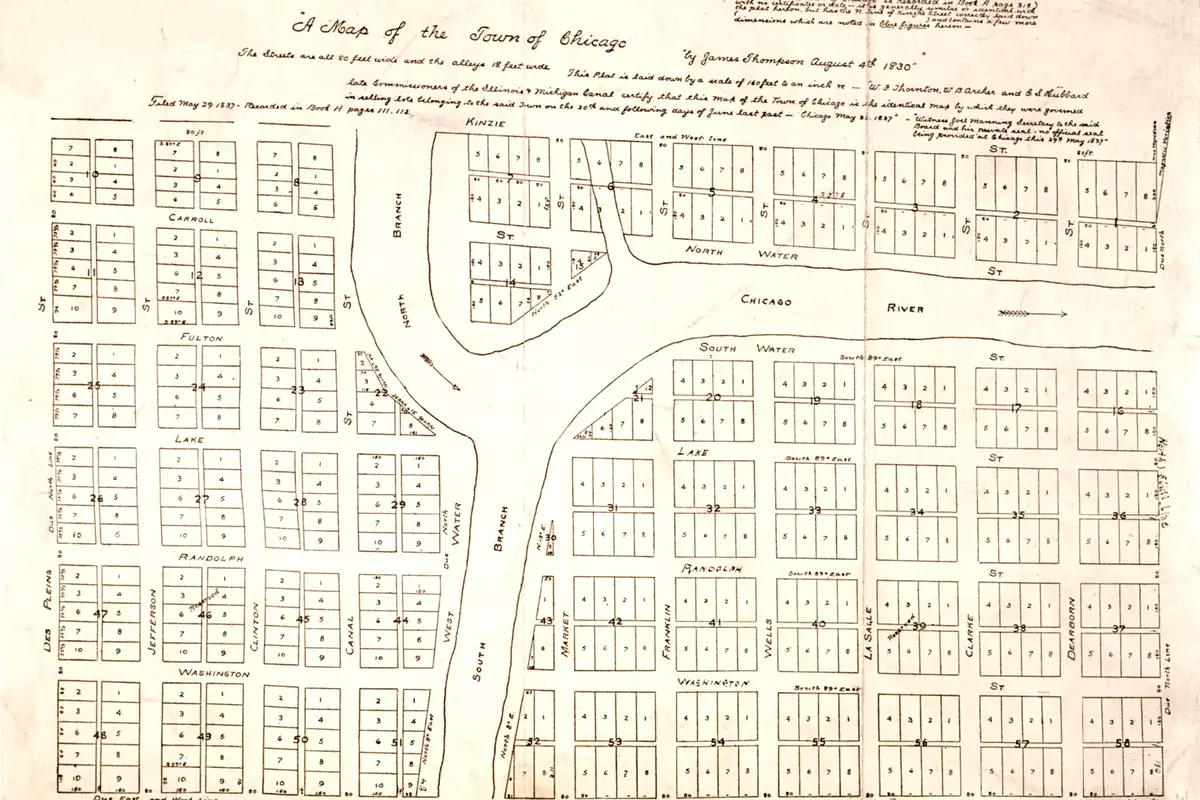
On Chicago’s first town plat, drawn in 1830, Clark Street is spelled Clarke, and the extra e stayed on the street for a long time. A lot of downtown’s names go back to that first little grid: a fort, a French explorer, a few frontier heroes and an early settler or two.
Planning a trip? Here’s where the names on your map came from. The city’s own name, from a Native word for its river, has its own story. Henry Gannett’s 1905 place-name book adds that Cook County was named for Daniel P. Cook, a member of Congress.
The 1830 town plat
Dearborn, Wells and Kinzie
The first survey of Chicago, made and platted in 1830 by James Thompson, already had most of downtown’s oldest names on it. A. T. Andreas, who wrote a three-volume History of Chicago in the 1880s, said Dearborn Street “of course” took its name from Fort Dearborn, which was named for General Henry Dearborn. (Dearborn turns up in Maine’s capital story too.) Wells Street was named for Captain William Wells, “massacred at Fort Dearborn,” in Andreas’s words. He noted in 1884 that the street had been changed to Fifth Avenue. It’s Wells Street again today.
Kinzie Street was one of the four streets that framed the little town in 1830, along with Washington, Jefferson and Dearborn. Andreas thought the “presumption is reasonable” that the settlers named three of those edges after the three men they considered most prominent: George Washington, Thomas Jefferson and John Kinzie.
LaSalle and Clark
LaSalle Street honors the French explorer La Salle, the same man who claimed Louisiana for King Louis XIV. Clark Street is for General George Rogers Clark, “the conqueror of Kaskaskia,” as Andreas put it, and the man who brought the first families to Louisville. You can see the spelling problem on the 1830 plat at the top of this page. Andreas explained that Clark Street “for a long time was spelt with a terminal e,” until someone found that the general spelled his name without one, and the e was dropped.
Randolph, Lake and Canal
The rest of the 1830 grid reads like a list of who mattered to a canal town. Randolph Street was named for John Randolph of Roanoke, Fulton Street for Robert Fulton and Clinton Street for DeWitt Clinton. Lake Street is for Lake Michigan, and Canal Street is for the Illinois & Michigan Canal. Market Street got its name, Andreas says, simply “because the market was located on that street.”
The presidents’ streets
Chicago named a run of streets for presidents, but not all of them. Andreas listed Washington, Madison and Monroe, and wrote that the early Chicagoans skipped John Adams at first, then gave in and named Adams Street for him, “but could not forgive” John Quincy Adams, so his name went on only a little street by the Government Building. After that came Jackson, Van Buren, Harrison and Tyler, then Polk and Taylor. Tyler Street didn’t last. By 1884 it was West Congress Street. And Fillmore, Andreas noted, “is ignored.”
North of the river
Illinois, Ohio, Ontario and Erie
If you cross the river on foot, you’ll walk through a geography lesson. Andreas says the east-west streets north of the river were named for four states, Michigan, Illinois, Indiana and Ohio, and the next four for four lakes: Ontario, Erie, Huron and Superior.
Rush, State and St. Clair
Rush Street is named for Benjamin Rush. The north end of State Street started out as Wolcott Street, for Alexander Wolcott. And St. Clair Street was first called Sand Street “because of the nature of the soil,” Andreas wrote, before it was renamed for General Arthur St. Clair.
Streeterville
Streeterville is named for a man who said it wasn’t in Illinois. The Chicago Public Library’s archivists date it to a stormy night, July 10, 1886, when “Captain” George Wellington Streeter’s small steamship lodged on a sandbar off Oak Street, though they add that the events of that night aren’t entirely agreed upon. Builders dumped fill around the boat, Streeter claimed the new land wasn’t part of Illinois at all, and he called it the “District of Lake Michigan.” The lawsuits went on for decades. Streeter died in 1921, and the courts finally ruled against his heirs in 1928. He lost the land, but his name stuck to it.
Roads out of town
Ashland Avenue and Paulina Street
Ashland Avenue used to be Reuben Street, named for Reuben Taylor, an early settler near what’s now Ashland and Madison. Paulina Street is named for his wife, Paulina Edy Taylor. Andreas wrote in 1885:
“Ashland Avenue was first called Reuben Street, after Mr. Tayler’s Christian name, and the changing thereof to Ashland Avenue was the great grievance of the old gentleman’s sincere, honest, earnest, yet simple, life.”
So the next time you see Paulina and Ashland on the same map, you’re looking at a husband and wife, and only one of them kept the name.
Halsted Street
Halsted Street started out as Dyer Avenue, for Charles Volney Dyer. Andreas says the new name came from “Halsted, a Philadelphian whose money was invested in Chicago by William B. Ogden.” He doesn’t give Halsted’s first name.
Lincoln, Milwaukee, Ogden and Archer
Chicago’s diagonal streets were the roads to somewhere else. Lincoln Avenue was the Little Fort Road, “so called because it was the road to Little Fort, now Waukegan.” Milwaukee Avenue was the Northwestern Plank Road. Ogden Avenue was the Southwestern Plank Road, named for William B. Ogden, and Archer Avenue was named for W. B. Archer, a commissioner of the Illinois & Michigan Canal.
Division Street and Cottage Grove
Some names just describe what was there. Division Street was named for “the section line.” Cottage Grove Avenue was named “after a cottage that once stood there.”
Neighborhoods
The Loop
The Loop is named for a loop of track. A National Register nomination for the downtown retail district explains that horsecars, then cable cars, then electric trolleys followed tracks that “encircled the core of downtown Chicago, creating a transit ‘loop.’” The name passed to the Union Loop elevated tracks, built in 1897, and from there to the whole downtown. The L trains still run around it.
Pilsen
Pilsen is named for a city in Bohemia, the same one that gave the world Pilsner beer, according to the neighborhood’s National Register nomination. Bohemian immigrants began settling here after the Great Fire of 1871. An earlier Bohemian settlement just to the east, from about 1860, was called “Prague,” after the largest city in Bohemia.
Bronzeville
The City of Chicago’s landmarks office says the name “Black Metropolis” became firmly established with a 1945 sociological study of the same title. In later years, people called the area Bronzeville, a term the city attributes to an editor at the Chicago Bee. The city’s summary doesn’t name the editor, and we couldn’t confirm who it was.
The lakefront and the ballparks
Lake Shore Drive
Lake Shore Drive began as a short lakefront boulevard. The Gold Coast’s National Register nomination says it opened between Oak Street and North Avenue in 1875. Since 2021, much of it has a longer name. On June 25, 2021, the City Council voted to rename about 18 miles (29 km) of the outer drive, from Hollywood Avenue to East 67th Street, Jean-Baptiste Pointe DuSable Lake Shore Drive.
DuSable set up a trading post at the mouth of the Chicago River in the 1770s, and the National Register nomination for his homesite calls him the first permanent non-Indian settler of what became Chicago. Arent de Peyster, the British commandant at Michilimackinac, mentioned him in the printed notes to a speech he gave on July 4, 1779, as a man “settled in Eschecagou” but “much in the French interest.”
Grant Park
Grant Park was Lake Park first. The city dedicated the open lakefront as Lake Park in 1847, and in 1901, after members of the Grand Army of the Republic had petitioned for the change, the South Park Commission renamed it Grant Park. The Cultural Landscape Foundation confirms the honoree: Ulysses S. Grant.
Lincoln Park
Lincoln Park started as part of the old City Cemetery. In 1860 the city set aside an unused section of it as a park, and an ordinance named it Lake Park. That made two Lake Parks in Chicago. In 1865, Alderman Lawrence Proudfoot suggested renaming the North Side one for President Abraham Lincoln, who had just been assassinated, and the new name stuck.
Soldier Field
Soldier Field opened as Grant Park Stadium. According to its National Register nomination, the South Park Commissioners officially dedicated it in 1925 to the soldiers of World War I, which is why the Bears now play on a war memorial.
Navy Pier
Navy Pier opened in 1916 as “Municipal Pier No. 2.” The city’s landmarks office notes that the other pier was never built, and that the name was changed in 1927 “to honor those who served in the U.S. Navy during World War I.”
Wrigley Field
Wrigley Field wasn’t always Wrigley. The National Park Service says the ballpark was built in 1914 as Weeghman Park for Charles Weeghman’s Federal League team, became known as Cubs Park in 1920, and was officially renamed for William Wrigley Jr., the chewing gum maker, in 1926.
Airports
O’Hare
O’Hare was Orchard Field when the city picked the site in 1945. The Chicago Department of Aviation says the City Council renamed it in 1949 for Lieutenant Commander Edward H. “Butch” O’Hare, a naval aviator and Medal of Honor recipient from Chicago.
Midway
Midway opened as Chicago Municipal Airport, dedicated in 1927. In 1949, the Department of Aviation says, it was renamed Midway in honor of the Battle of Midway in the Pacific during World War II.
So if you land at Midway, ride the L around the Loop and walk up Clark Street, you’ve just crossed a World War II battle, a ring of old trolley tracks and a general whose name the town once spelled wrong.
Quick answers
Why is it called the Loop?
Because of a loop of track. Streetcar lines circled downtown, and the name passed to the Union Loop elevated tracks in 1897 and then to the whole area.
Why was Clark Street spelled Clarke?
Because early Chicago got the general’s name wrong. The 1830 plat says “Clarke,” and Andreas wrote that the final e was dropped once people learned George Rogers Clark spelled it without one.
Who is Lake Shore Drive named after?
Jean Baptiste Point DuSable, Chicago’s first permanent non-Indian settler, at least on the outer drive. In 2021 the City Council renamed about 18 miles (29 km) of it, from Hollywood Avenue to East 67th Street, for him.
Why is it called Navy Pier?
To honor World War I’s Navy veterans. It opened as Municipal Pier No. 2 in 1916, and in 1927 the city renamed it for those who served in the U.S. Navy during that war.
Key dates
- 1830August 4: James Thompson draws the first plat of Chicago, with Kinzie, Wells, La Salle, "Clarke" and Dearborn streets.
- 1847The lakefront ground east of Michigan Avenue is dedicated as Lake Park. It becomes Grant Park in 1901.
- 1865The North Side's Lake Park, on old cemetery land, is renamed for Abraham Lincoln.
- 1886July 10: George Wellington Streeter's steamship lodges on a sandbar near Oak Street. Streeterville grows around it.
- 1897The Union Loop elevated tracks are built around downtown, taking the name of the older transit loop.
- 1926The ballpark known as Weeghman Park, then Cubs Park, is renamed for William Wrigley Jr.
- 1927Municipal Pier No. 2 becomes Navy Pier, to honor those who served in the U.S. Navy in World War I.
- 1949Orchard Field becomes O'Hare, and Chicago Municipal Airport becomes Midway.
- 2021June 25: the City Council votes to rename outer Lake Shore Drive for Jean Baptiste Point DuSable.
Historical Sources & References
- A. T. Andreas, History of Chicago, vol. 1 (1884), pp. 194-196. The chapter “Street Nomenclature”: Thompson’s 1830 survey, Dearborn, Wells, Kinzie, LaSalle, Clark and its “terminal e,” the presidents’ streets, the state and lake streets north of the river, Rush, Wolcott, Sand and St. Clair, Halsted, Lincoln, Milwaukee, Ogden, Archer, Division, Cottage Grove and Paulina.
- A. T. Andreas, History of Chicago, vol. 2 (1885), p. 660. Reuben Taylor and the change from Reuben Street to Ashland Avenue.
- Henry Gannett, The Origin of Certain Place Names in the United States (USGS, 1905). Cook County, “named for Daniel P. Cook, member of Congress.”
- James Thompson, A Map of the Town of Chicago (1830). The original plat, with “Clarke” Street.
- National Register nomination, Loop Retail Historic District (1998). How a transit “loop” named the Union Loop and then downtown.
- National Register nomination, Pilsen Historic District (2006). Pilsen’s Bohemian namesake, Pilsner beer and the earlier “Prague” settlement.
- National Register nomination, Grant Park (1993). Lake Park in 1847, the Grand Army of the Republic’s petition and the 1901 renaming.
- National Register nomination, Lincoln Park (1994), pp. 47-49. The cemetery, the two Lake Parks and Alderman Proudfoot’s 1865 proposal.
- National Register nomination, Soldier Field (1984). Grant Park Stadium and its 1925 dedication to the soldiers of World War I.
- National Register nomination, Gold Coast Historic District (1978). Lake Shore Drive’s opening between Oak and North in 1875.
- National Register nomination, Du Sable Homesite (1976). DuSable’s trading post and his place as the first permanent non-Indian settler.
- Arent Schuyler de Peyster, Miscellanies, by an Officer (1888 ed.), p. 10. The note to his July 4, 1779 speech on DuSable, “settled in Eschecagou.”
- Chicago Public Library, Streeterville Collection. The night of July 10, 1886, the “District of Lake Michigan” and the lawsuits.
- City of Chicago, Black Metropolis-Bronzeville District. “Black Metropolis” and the Chicago Bee editor behind “Bronzeville.”
- City of Chicago, Navy Pier Headhouse and Auditorium. Municipal Pier No. 2 and the 1927 renaming.
- The Cultural Landscape Foundation, Grant Park. Lake Park from 1847, renamed for Ulysses S. Grant in 1901.
- National Park Service, Wrigley Field. Weeghman Park, Cubs Park and the 1926 renaming.
- Chicago Department of Aviation, O’Hare History. Orchard Field and Butch O’Hare.
- Chicago Department of Aviation, Midway history. Chicago Municipal Airport and the Battle of Midway.
- Block Club Chicago (2021). The June 25, 2021 vote and the 18 miles from Hollywood Avenue to East 67th Street.
- GNIS feature 423587 (U.S. Geological Survey). The U.S. gazetteer listing for the city and its coordinates.
Spot something wrong, or know more? Tell us here. You can also email us or use our contact page. Corrections are noted here with their date, never made silently.