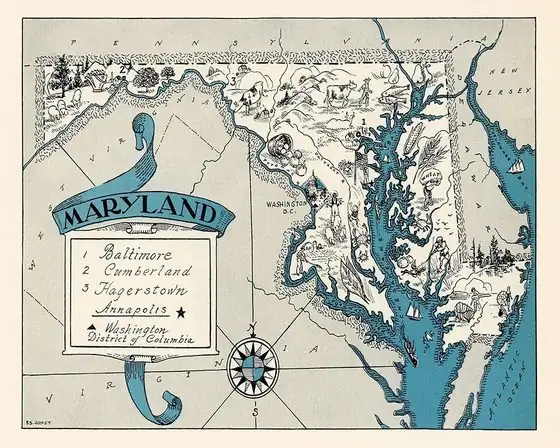
Frederick, Maryland: A Town Named for a Teenage Heir
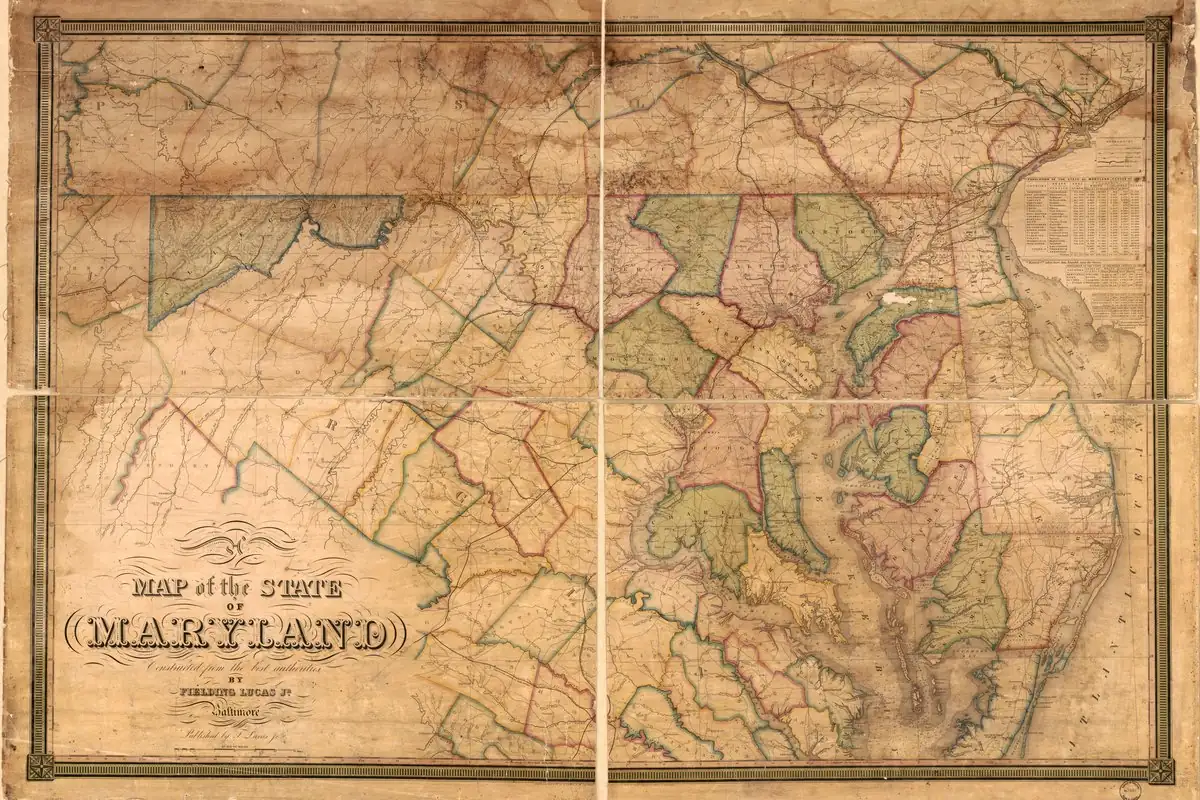
Frederick was laid out in 1745 as Frederick Town, named for Frederick Calvert, the young son of Charles, fifth Lord Baltimore, who later became the sixth and last Lord Baltimore. An 1896 paper calls it a compliment to a 14-year-old, and the Maryland State Archives and Heritage Frederick agree on the namesake.
A compliment to a 14-year-old
When Frederick, Maryland, was laid out on Carroll Creek in 1745, it was called Fredericktown as a compliment to a 14-year-old: Lord Baltimore’s son. That boy was Frederick Calvert, the only son of Charles, the fifth Lord Baltimore, and he’d grow up to be the sixth and last one.
The clearest old statement comes from Edward T. Schultz, who read a paper on the first German settlements in Maryland to the Frederick County Historical Society in January 1896. He explains that about 100 families from the Palatinate, in Germany, arrived in 1735 and settled on land that belonged to Daniel Dulany of Annapolis. Ten years later a town was laid out there, on both sides of Carroll Creek and three miles (5 km) from the Monocacy River. Then he gives the name in one sentence:
“In compliment to Frederick, son of Lord Baltimore, then a youth of 14, it was called Fredericktown.”
So the town wasn’t named for a king or a saint. It was named for a teenager who, six years later, would become the colony’s proprietor.
The modern record agrees
Present-day sources tell the same story about the town. The Maryland State Archives’ biography of Daniel Dulany says that in 1745, under an agreement with Lord Baltimore, Dulany got the authority to set up a town and offer land for rent. Then it says: “This town was called Frederick Town in honor of the Lord Baltimore’s son.” Heritage Frederick, the county’s historical society, says Dulany “laid out a market town named in honor of Frederick Calvert, the son of Charles Calvert and future sixth Baron Baltimore.”
J. Thomas Scharf’s History of Western Maryland, published in 1882, adds the family background. Charles, the fifth Lord Baltimore, died on April 24, 1751, and his will left the province to “his only son, Frederick Calvert.” The state archives’ county page says Frederick was Proprietor of Maryland from 1751 until he died in 1771 at Naples, Italy.
Which Dulany drew the streets?
Scharf tells the founding a little differently. He writes: “In September, 1745, Patrick Dulany laid out Frederick Town, on part of the survey called ‘Tasker’s Chance.’” Every other source here gives Daniel Dulany as the man behind the town, and Scharf himself later calls the landowner simply “Mr. Dulany,” so the “Patrick” may just be a slip.
His version comes with a couple of good details, though. The plan was first to put the town on the Monocacy at Ceresville. But the man who’d bought the land where Frederick now stands regretted the purchase, so Dulany took that tract back and laid the town out there, on Carroll’s Creek. And the commissioners wanted the streets to run to the points of the compass, but their surveyor had “a defective compass,” so they only managed it “imperfectly.” If downtown’s grid looks a little off true north to you, Scharf has the explanation.
The county is where the doubts are
If you look up how Frederick got its name, you’ll probably run into a longer list of candidates. Those lists are about Frederick County, which came three years after the town. The legislature created it in 1748, and Fredericktown, already standing, became the county seat.
Henry Gannett’s 1905 federal bulletin on place names only has an entry for the county, not the town. It says the county was named for Frederick, son of Charles, Fifth Lord Baltimore, and adds: “It may have been given also in reference to Frederick, Prince of Wales.” The Maryland Manual for 1955-56, on page 485, goes further and lists three options: Frederick Calvert, Frederick Louis, Prince of Wales, “or Frederick the Great.” Today the state archives’ page for the county says it “probably was named after Frederick Calvert.”
Every source here that talks about the town itself names the Calvert heir. So the uncertainty is real, but it belongs to the county, not to the town that had the name first.
A namesake who never earned it
Scharf didn’t think much of the man the town honored. Writing in 1882, he called Frederick “a fast young man” and said “his memory is not precious.” Frederick had no legitimate children, and when he died in 1771 the title of Lord Baltimore died with him.
The town and the county both outlived him. In 1776, Scharf notes, the county was split, and a new Washington County was carved out of its western part, where Hagerstown stands. Fredericktown kept its name and, over time, dropped the “town.” The Baltimore title is long gone, but its last holder’s first name is still on the map of Maryland.
Quick answers
Who was Frederick, Maryland, named after?
Frederick Calvert, the son of Charles, fifth Lord Baltimore. Schultz’s 1896 paper, the Maryland State Archives and Heritage Frederick all name him for the town laid out in 1745.
Was Frederick named after the Prince of Wales?
Not the town, as far as the sources go. Gannett in 1905 and the 1955-56 Maryland Manual raise the Prince of Wales only for Frederick County, and the state archives now say the county “probably” honors Frederick Calvert.
How old was Frederick Calvert when the town was named?
Fourteen, according to Schultz, who wrote that the name was given “in compliment to Frederick, son of Lord Baltimore, then a youth of 14.”
When was Frederick, Maryland, founded?
In 1745. Schultz gives the year, and Scharf dates the laying out of the town to September 1745, three years before Frederick County was created in 1748.
Key dates
- 1735About 100 families from the Palatinate settle on land belonging to Daniel Dulany, an 1896 paper says.
- 1745September: the town is laid out on part of Tasker's Chance, along Carroll Creek, and called Fredericktown.
- 1748Frederick County is created, three years after the town, and Frederick Town becomes its county seat.
- 1751Frederick Calvert becomes Proprietor of Maryland after his father's death, as the sixth Lord Baltimore.
- 1771Frederick Calvert dies in Naples, Italy, the last Lord Baltimore.
- 1776Washington County is carved out of Frederick County.
Getting there
Open Frederick in Google Maps
Opens in a new tab. The pin is the center of Frederick in the USGS place-name record.
The closest airports, Amtrak stations and intercity bus stops, measured in a straight line from the center of Frederick.
Airports
- Hagerstown Regional/Richard A Henson Field (HGR) 26 mi 42 km
- Washington Dulles International (IAD) 32 mi 52 km
Amtrak trains
- Harpers Ferry station (HFY) 18 mi 29 km
- Rockville station (RKV) 27 mi 43 km
Intercity buses
- Greyhound Frederick MD - Transit Center/MARC Station (FRC) under 1 mi 0.5 km
- BayRunner Shuttle Frederick (Transit Center) under 1 mi 0.5 km
- OurBus Frederick, MD (Prospect Plaza shopping center, close to Dollar tree at 403 S Jefferson St.) 1 mi 2 km
Distances are as the crow flies, not by road. We don't list schedules or fares because they change; check with the airline, Amtrak or the bus company before you go. Official data (FAA commercial service airports (2025), FAA airport locations, Amtrak stations and Intercity Bus Atlas) from the FAA and the U.S. Bureau of Transportation Statistics, checked Nov 13, 2026.
Sponsored
Staying in Frederick?
Compare hotels in Frederick, Maryland, on Expedia.
See hotels in FrederickWe may earn a commission if you buy through this link. It never changes what we write. Read our affiliate disclosure
Sponsored
Want the spooky side of Frederick?
The name has its story above. For the ghost stories, US Ghost Adventures runs walking ghost tours in Frederick.
See ghost tours in FrederickWe may earn a commission if you book through this link. It never changes what we write. Read our affiliate disclosure
Historical Sources & References
- Edward T. Schultz, First Settlements of Germans in Maryland (1896), p. 7. The Palatine families of 1735 on Daniel Dulany’s land, the town of 1745 on both sides of Carroll Creek and three miles from the Monocacy, and “In compliment to Frederick, son of Lord Baltimore, then a youth of 14, it was called Fredericktown.”
- J. Thomas Scharf, History of Western Maryland, vol. 1 (1882), pp. 360-362 and 484. The town laid out in 1745, three years before the county, which was named for Frederick, sixth Lord Baltimore, and the death of his father on April 24, 1751 (p. 360); the will leaving the province to “his only son, Frederick Calvert,” Frederick as “a fast young man,” his death in Naples in 1771 and the end of the title (p. 361); Washington County formed from Frederick County in 1776 (p. 362); “Patrick Dulany,” Tasker’s Chance, the Ceresville plan and the defective compass (p. 484).
- Henry Gannett, The Origin of Certain Place Names in the United States (USGS, 1905), p. 131. The entry for Frederick County, with the Prince of Wales as a possible second reference, and no entry for the town.
- Maryland State Archives, “Daniel Dulany: Indentured Servant to Statesman”. Dulany’s 1745 agreement with Lord Baltimore and “This town was called Frederick Town in honor of the Lord Baltimore’s son.”
- Heritage Frederick, “Cultivating Independence”. Dulany’s market town “named in honor of Frederick Calvert, the son of Charles Calvert and future sixth Baron Baltimore.”
- Maryland State Archives, “Frederick County Historical Chronology”. Daniel Dulany the Elder laying out Frederick Town in 1745.
- Maryland State Archives, “Frederick County, Maryland: Origin”. The county created in 1748, “probably” named after Frederick Calvert, Proprietor from 1751 until his death in Naples in 1771.
- Maryland Manual 1955-56, p. 485. Three possible namesakes for the county: Frederick Calvert, Frederick Louis, Prince of Wales, or Frederick the Great.
- GNIS feature 584497 (U.S. Geological Survey). Federal name record for the city, giving its county and coordinates.
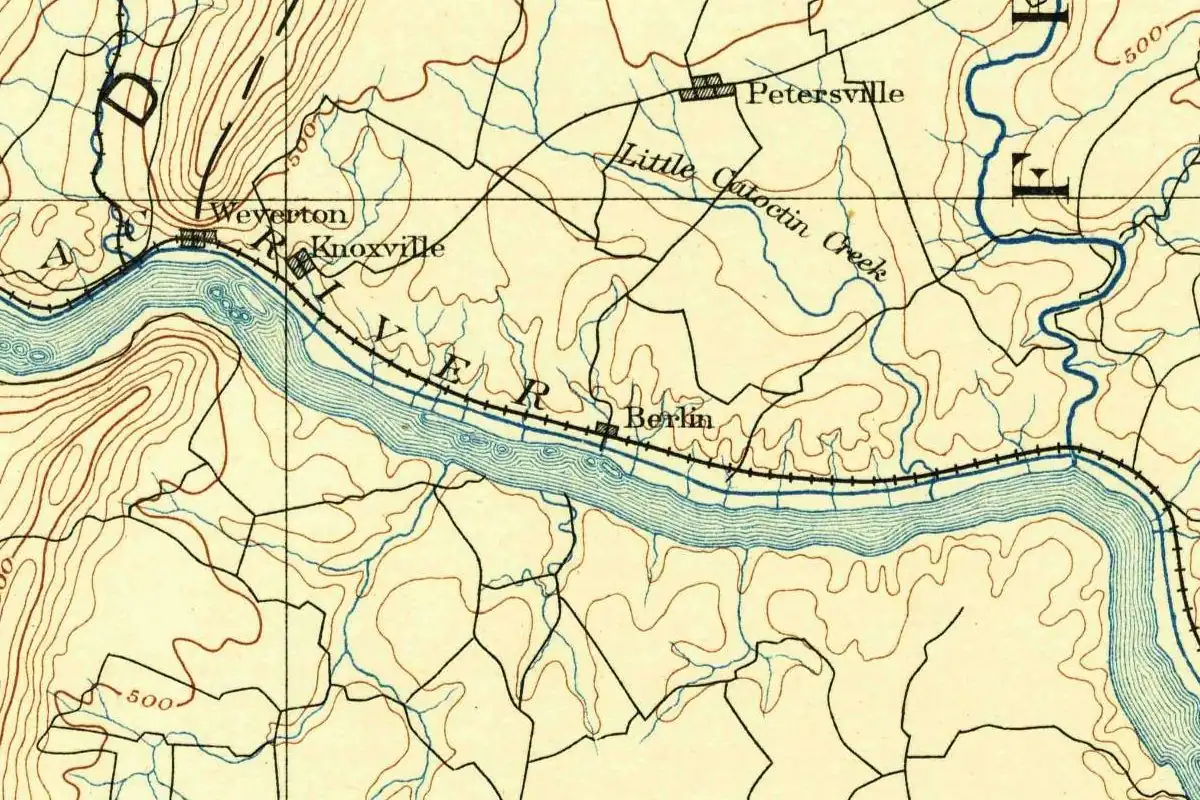
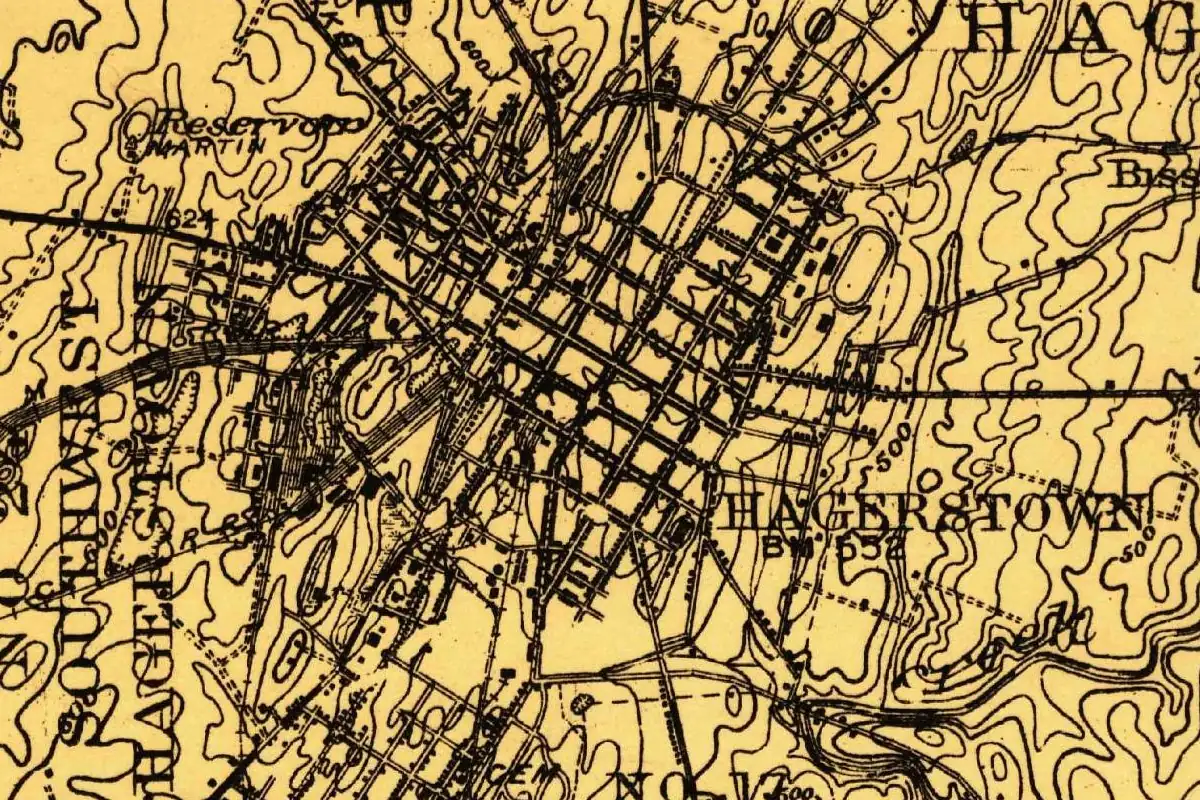
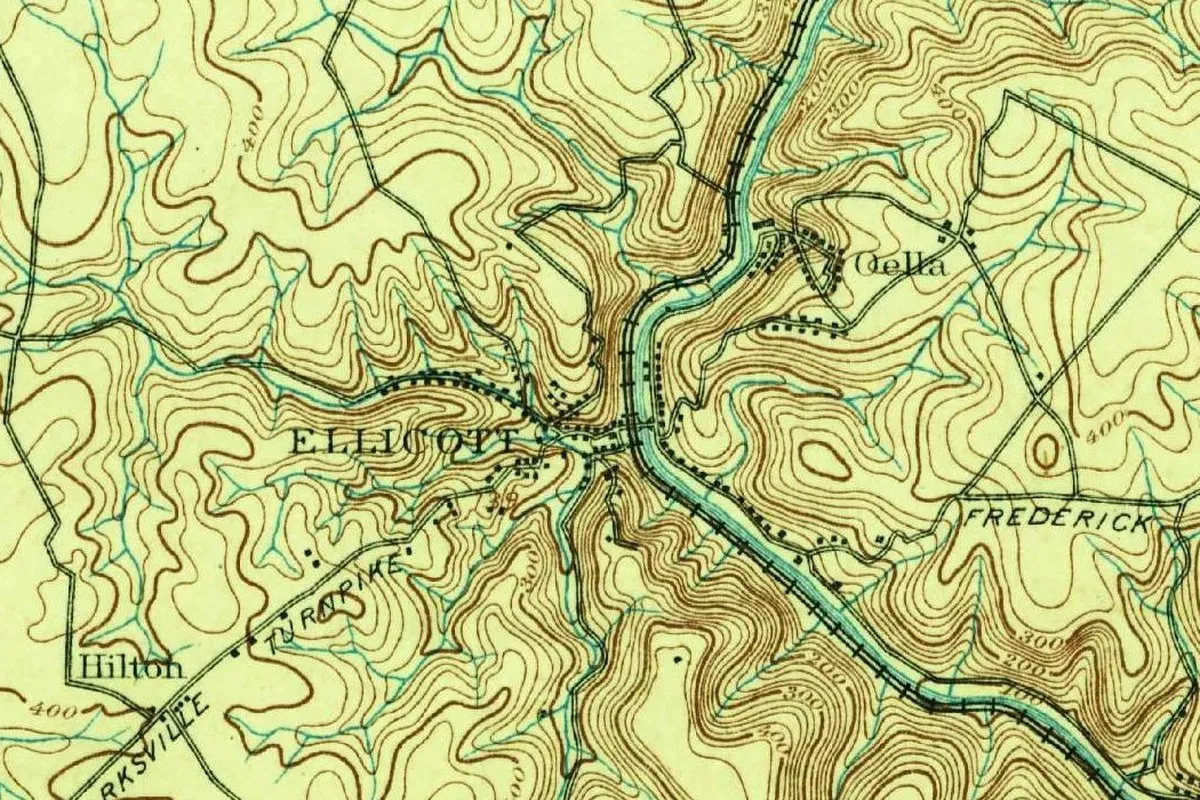
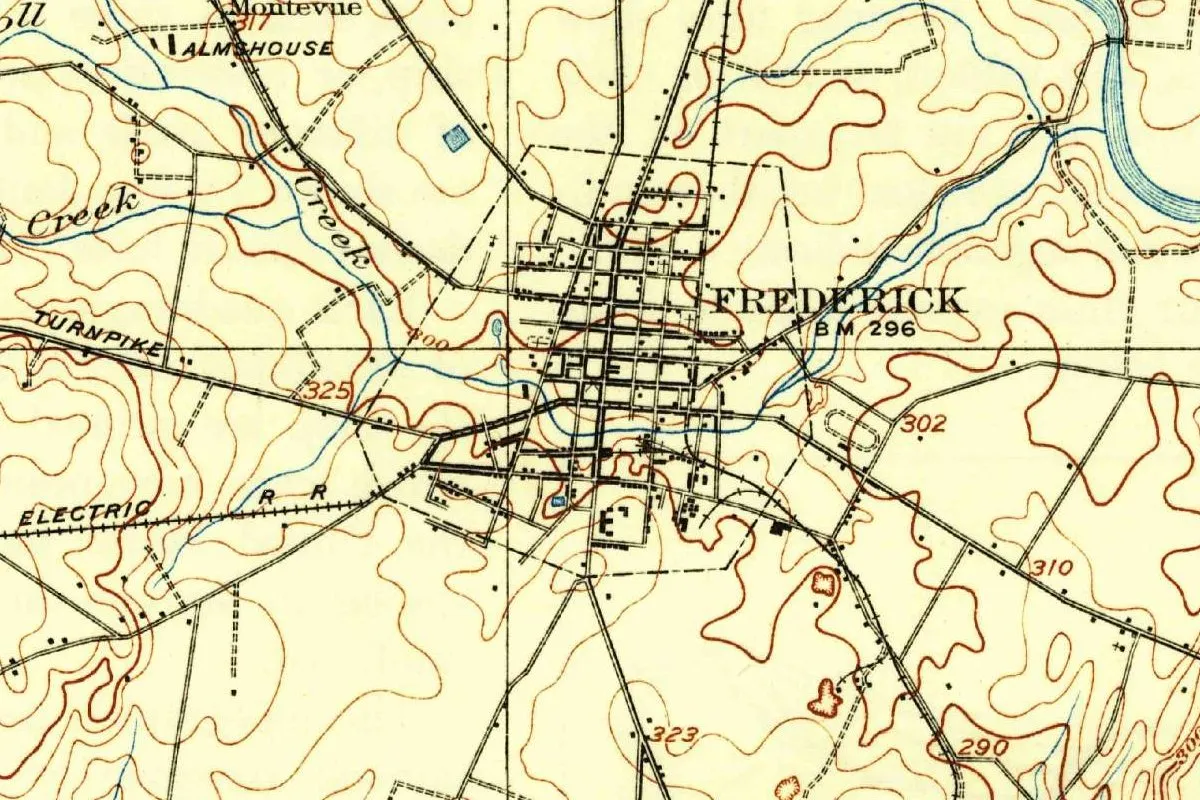
- U.S. Geological Survey, Frederick sheet (1909). Source of the 1909 map detail showing the town between its creeks and the Monocacy.
Spot something wrong, or know more? Tell us here. You can also email us or use our contact page. Corrections are noted here with their date, never made silently.