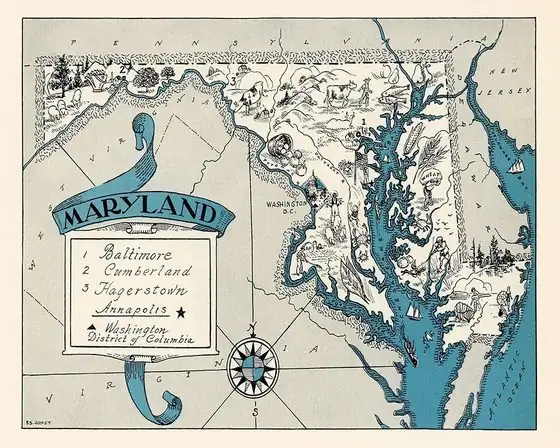
Salisbury, Maryland: A 1732 Act and an English City
Salisbury was named by Maryland's General Assembly in a 1732 act that laid out a town of twenty lots at the head of the Wicomico River and ordered it "called by the Name of Salisbury Town." The act doesn't say why. Henry Gannett wrote in 1905 that it was named from the city in England.
Salisbury, Maryland, was named by a 1732 law ordering that a new river town “be called by the Name of Salisbury Town,” a name traced to England. The law itself never says why, so for that part you have to go to those later writers.
“Salisbury Town,” by act of assembly
In the summer session of 1732, Maryland’s General Assembly passed “An Act for the Erecting a Town at the Head of Wiccomoco River, in Somerset County.” The long title says where: on fifteen acres “in the Fork thereof, and at the Landing commonly now called Handy’s, or Carr’s Landing.”
The act explains that inhabitants of Somerset County had petitioned for a town at the head of the river, on part of a tract “commonly called, or known, by the Name of Pemberton’s Good-Will,” then in the possession of William Winder, a minor. It named five commissioners, John Caldwell, Ebenezer Handy, Thomas Gillys, Isaac Handy and John Disharoon, to buy the fifteen acres and lay them out in twenty lots, numbered “One, Two, Three, and so on to Twenty.” The landowner got “first Choice for Two Lots,” and for the first four months nobody could buy more than one lot. The lots were meant for “the Inhabitants of the County,” and only if they hadn’t taken them up within six months could “any Person or Persons whatsoever” step in. Then, at the bottom of page 539 in the printed edition, comes the line that matters:
“And be it further Enacted, by the Authority aforesaid, by and with the Advice and Consent aforesaid, That the Town aforesaid be called by the Name of Salisbury Town.”
That’s the whole naming. No reason, no honoree, just the name.
Named from the city in England
Henry Gannett filled in the reason in 1905, in his USGS bulletin on where the country’s place names came from. His entry is short: “Salisbury; towns in Wicomico County, Maryland, and Essex County, Massachusetts, named from the city in England.”
Charles J. Truitt went further in Historic Salisbury, Maryland, a local history published for the town’s bicentennial in 1932. “That the town was named for Salisbury, Wiltshire, England, there can be no doubt,” he wrote. His reasoning: many of the big landowners around the head of the river had come from the area near the English city, and the names they gave their land show it.
Truitt’s best evidence is older than the town. He says John Rhodeson, who acquired 200 acres on the river on April 3, 1667, “gave it the name “Salisbury,”” and that John Glass called his 500-acre grant of June 13, 1675, “Wiltshire.” So, if Truitt’s land records are right, a Salisbury was already on the river 65 years before the assembly made one official.
Still, keep in mind what the 1732 act does and doesn’t say. It proves the name and the date. The English connection comes from Gannett and Truitt, writing long afterward, and neither one quotes a lawmaker explaining the choice.
A town that was slow to fill
Naming a town on paper didn’t fill it with people. Truitt says the original plat of “Salisbury-Town,” “if ever any was filed by the surveyor or commissioners,” had never been found, despite searches at the Land Office in Annapolis and the courthouse in Princess Anne.
Thirty-one years later, residents were still trying to get the place going. A petition from “many Inhabitants of Somerset County,” presented in the Lower House on October 22, 1763, recalled that twenty lots had been laid out “& a Town was erected & called Salisbury.” Then came the complaint: although the town was “very comodiously situated for Trade and Navigation very few Lots were taken up under the said Law.” The petitioners asked to repeal the 1732 act and write a better one. The Lower House rejected it.
The Advisory Council on Historic Preservation sums up what came next. Salisbury “grew slowly at first,” it says, but its importance as an economic hub was clear by the late 18th century, and intersecting railroads plus a deepened channel on the Wicomico secured its role on the Eastern Shore by the third quarter of the 19th century. Fires in 1860 and 1886 destroyed large sections of the community, the ACHP adds, but Salisbury rebounded.
From Somerset to Wicomico
If you’re hunting for old records, the county matters. In 1732 the town was in Somerset County, the same county where the assembly created Princess Anne by another act the following year. The Maryland Manual says Salisbury was incorporated in 1854, and that Wicomico County was created from Somerset and Worcester counties in 1867. Salisbury is its county seat today.
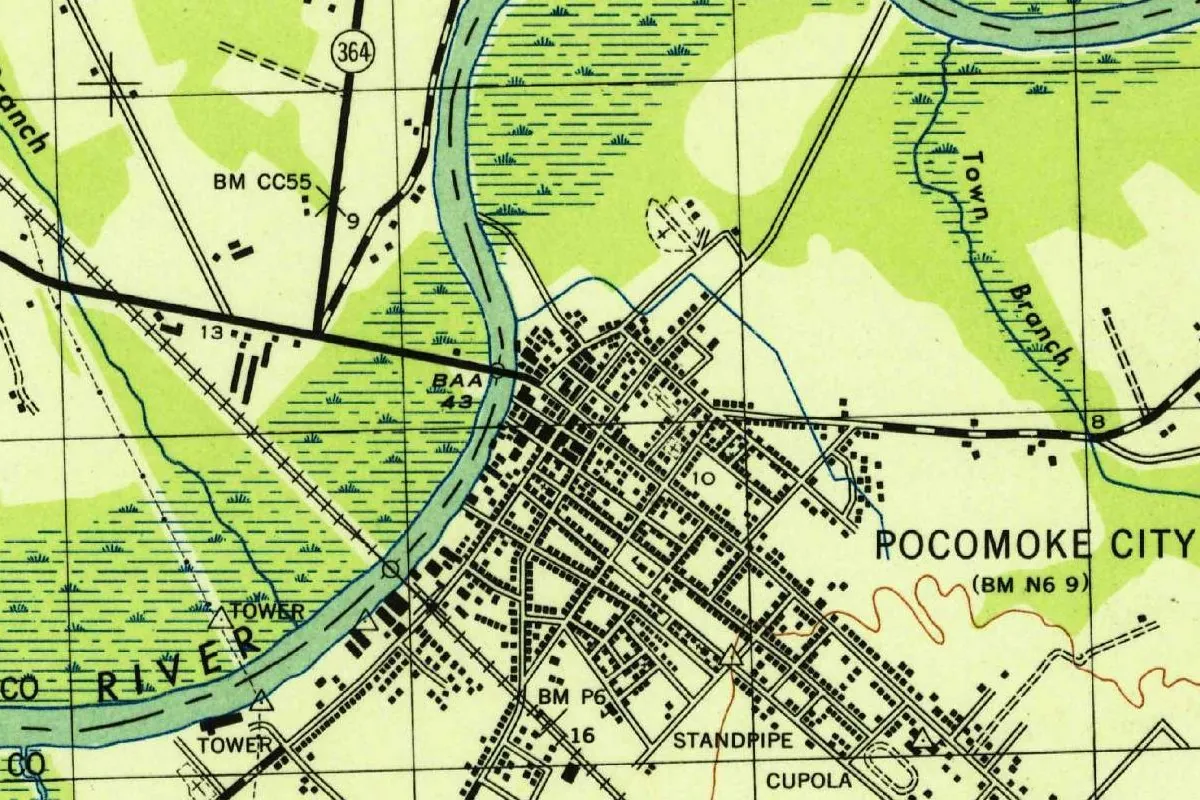
The new county took the river’s name. The Manual says Wicomico comes from the Native American words “wicko” and “mekee,” “meaning “a place where houses are built,” apparently referring to an Indian town on the river banks.” That “apparently” is the Manual’s, and it’s worth keeping. On the Eastern Shore, Pocomoke City is another town whose name the Manual ties to a river.
What the 1901 map shows
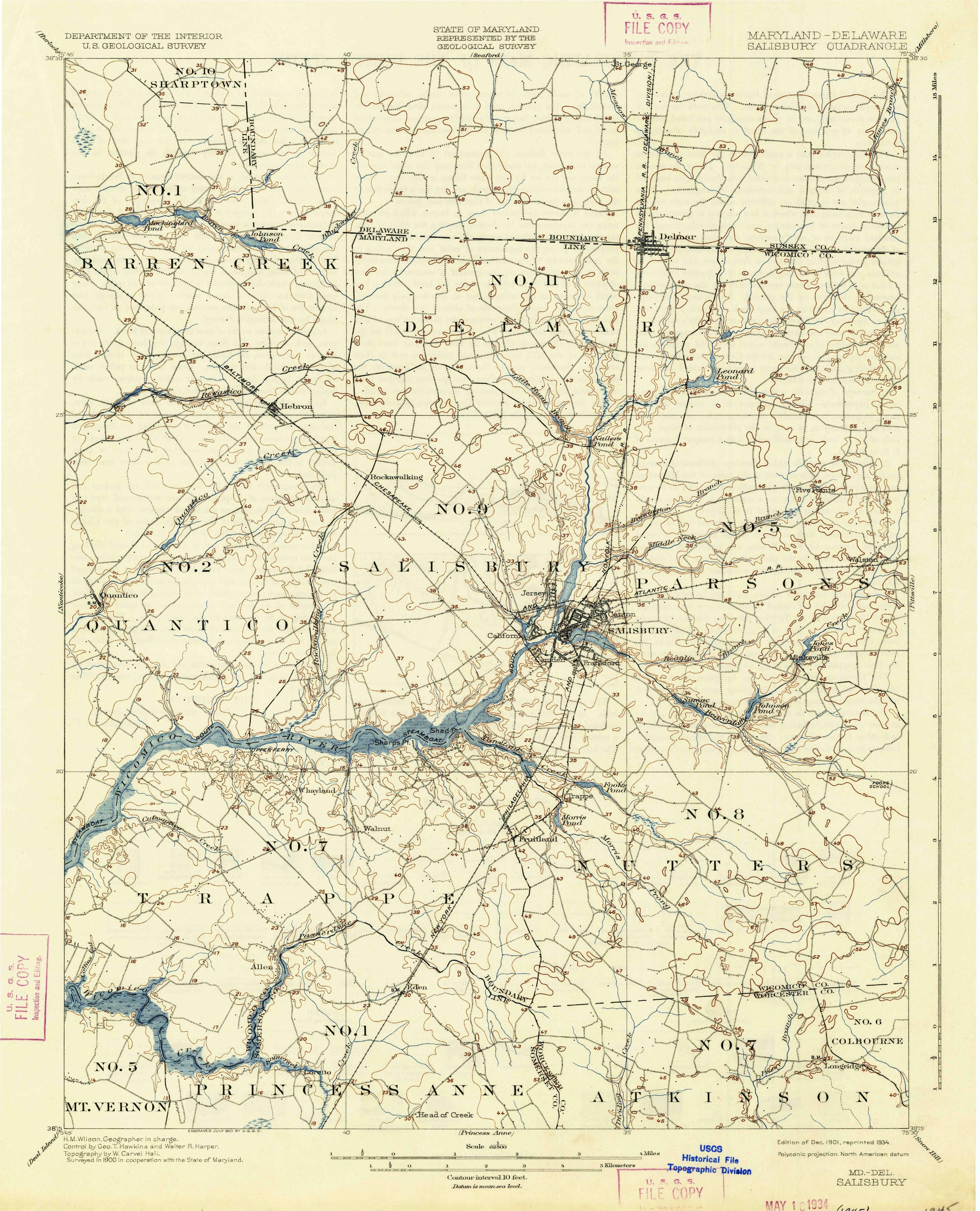
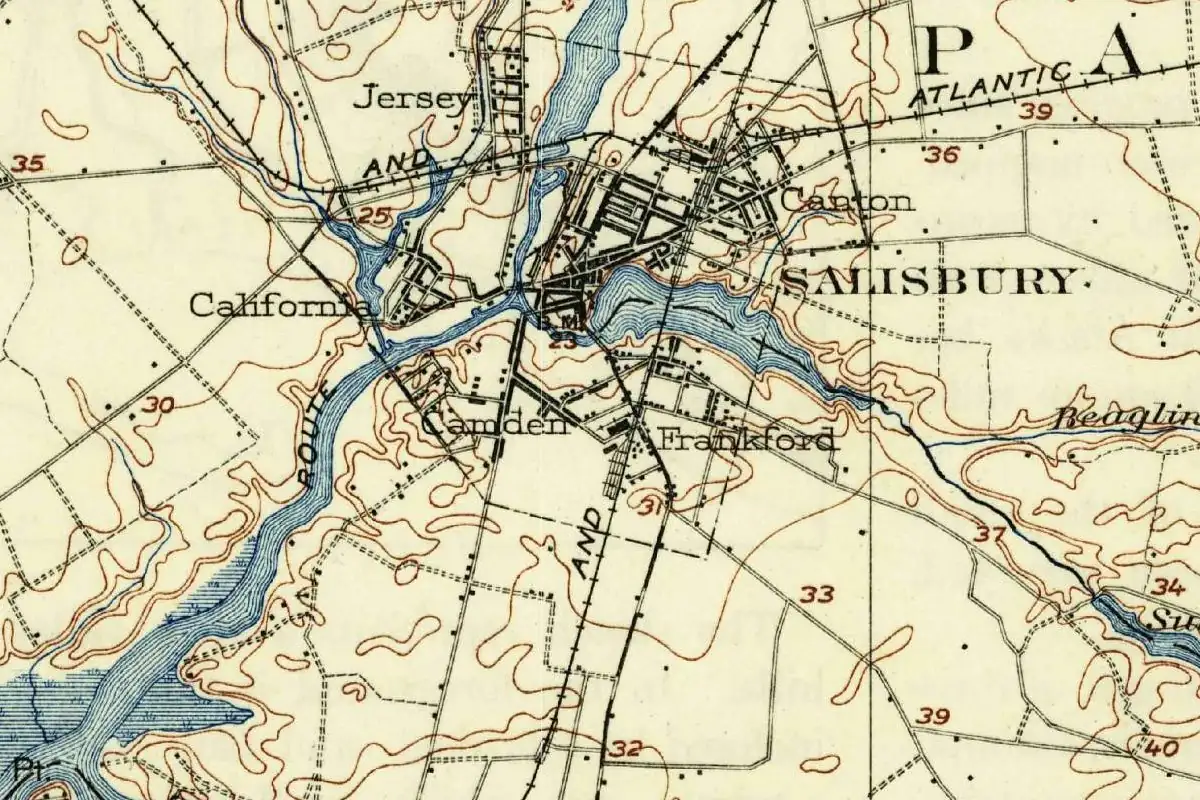
The map at the top of this page was surveyed in 1900 and published in 1901. You can see the river widening below town, railroad lines crossing in the middle, and a cluster of neighborhood names: Jersey, California, Camden, Frankford and Canton. Camden is one of the three areas the ACHP lists as historic districts today, along with Newtown and Downtown Plaza.
The spot elevations printed in this crop run from 23 to 40 feet (7 to 12 m), so the hills here are gentle ones.
There’s more on Maryland’s names on our Maryland page.
Quick answers
Why is it called Salisbury, Maryland?
Because a 1732 act of Maryland’s General Assembly ordered the new town at the head of the Wicomico River “be called by the Name of Salisbury Town.” Henry Gannett wrote in 1905 that it was named from the city in England.
Is Salisbury, MD, named after Salisbury, England?
Yes, according to later writers. Gannett says it was “named from the city in England,” and Charles J. Truitt wrote in 1932 that there could be “no doubt” it was named for Salisbury, Wiltshire. The 1732 act itself gives no reason.
What was Salisbury, MD, before it was a town?
A river landing. The 1732 act placed the town “at the Landing commonly now called Handy’s, or Carr’s Landing,” on part of a tract known as Pemberton’s Good-Will.
What county was Salisbury in originally?
Somerset County. Wicomico County, where Salisbury is now the county seat, was created from Somerset and Worcester counties in 1867.
Key dates
- 1667John Rhodeson names his 200 acres on the river "Salisbury," according to Truitt.
- 1732Maryland's General Assembly orders a town at the head of the Wicomico River, to be called Salisbury Town.
- 1763A petition to repeal and replace the 1732 act, saying very few lots were taken up, is rejected by the Lower House on October 22.
- 1854Salisbury is incorporated.
- 1867Wicomico County is created from Somerset and Worcester counties.
Things to do in Salisbury, Maryland
Poplar Hill Mansion
A Federal-style house begun in 1795-96 by Major Levin Handy on part of the old Pemberton's Good Will land patent and finished by Dr. John Huston from 1805. The City of Salisbury has owned it as a house museum since 1974.
Salisbury Zoo
A 12-acre zoo in Salisbury City Park, beside a tributary of the Wicomico River, with more than 100 animals from North and South America and Australia, among them spectacled bears, river otters, wallabies and flamingos.
Museum of Eastern Shore Culture
A museum on West Main Street, opened in November 2024, with Ward Brothers decoys, works by Salisbury University and local artists, and displays of Native American artifacts.
Pohanka Riverwalk Amphitheater
An outdoor stage at the eastern end of the Riverwalk along the Wicomico, home to seasonal events such as the Friday Night Live concerts and Movies on the River.
Getting there
Open Salisbury in Google Maps
Opens in a new tab. The pin is the center of Salisbury in the USGS place-name record.
The closest airports, Amtrak stations and intercity bus stops, measured in a straight line from the center of Salisbury.
Airports
- Salisbury-Ocean City Wicomico Regional (SBY) 5 mi 8 km
- Baltimore/Washington International Thurgood Marshall (BWI) Glen Burnie 81 mi 130 km
Amtrak trains
- New Carrollton station (NCR) 80 mi 128 km
- BWI Marshall Airport station (BWI) 82 mi 133 km
Intercity buses
- BayRunner Shuttle Salisbury (BRS) under 1 mi 0.6 km
- FlixBus Salisbury Park & Ride 2 mi 4 km
- Greyhound Princess Anne Umes 11 mi 18 km
Distances are as the crow flies, not by road. We don't list schedules or fares because they change; check with the airline, Amtrak or the bus company before you go. Official data (FAA commercial service airports (2025), FAA airport locations, Amtrak stations and Intercity Bus Atlas) from the FAA and the U.S. Bureau of Transportation Statistics, checked Nov 14, 2026.
Sponsored
Staying in Salisbury?
Compare hotels in Salisbury, Maryland, on Expedia.
See hotels in SalisburyWe may earn a commission if you buy through this link. It never changes what we write. Read our affiliate disclosure
Sponsored
Want the spooky side of Salisbury?
The name has its story above. For the ghost stories, US Ghost Adventures runs walking ghost tours in Salisbury.
See ghost tours in SalisburyWe may earn a commission if you book through this link. It never changes what we write. Read our affiliate disclosure
Historical Sources & References
- Archives of Maryland, vol. 37, p. 537. The title of the 1732 act for erecting a town at the head of the “Wiccomoco” River, at Handy’s or Carr’s Landing, and the petition and tract called Pemberton’s Good-Will. Checked against the page image.
- Archives of Maryland, vol. 37, p. 538. The five commissioners and the fifteen acres laid out in twenty lots.
- Archives of Maryland, vol. 37, p. 539. The quoted clause naming “Salisbury Town.” Checked against the page image.
- Archives of Maryland, vol. 58, p. 581. The 1763 petition, presented and rejected on October 22, 1763, and its complaint that very few lots were taken up.
- Henry Gannett, The Origin of Certain Place Names in the United States, 2nd ed. (1905), p. 272. Salisbury in Wicomico County “named from the city in England.”
- Charles J. Truitt, Historic Salisbury, Maryland (1932), pp. 20-21. The lost plat of Salisbury-Town (p. 20); the town “named for Salisbury, Wiltshire, England,” and the land grants called “Salisbury” (1667) and “Wiltshire” (1675) (p. 21).
- Maryland Manual On-Line, “Salisbury”. Incorporation in 1854.
- Maryland Manual On-Line, “Wicomico County”. The county created in 1867 from Somerset and Worcester, and the Manual’s explanation of the name Wicomico.
- Advisory Council on Historic Preservation, “Salisbury, Maryland”. Slow early growth, the railroads and the deepened channel, the fires of 1860 and 1886, and the Camden, Newtown and Downtown Plaza historic districts.
- GNIS feature 591221 (U.S. Geological Survey). The U.S. gazetteer listing for Salisbury, Wicomico County, with its coordinates.
- U.S. Geological Survey, Salisbury sheet (1901). The 1:62,500 map, surveyed in 1900, that the image at the top of this page was cropped from.
Sponsored
Put this 1901 map on your wall
The 1901 USGS Salisbury sheet, in a 1934 reprint, is in the public domain. Download the full-size scan for free, then have it printed on canvas with CanvasOnTheCheap.
Print a map on canvasDownload the full-size mapWe may earn a commission if you buy through this link. It never changes what we write. Read our affiliate disclosure
Spot something wrong, or know more? Tell us here. You can also email us or use our contact page. Corrections are noted here with their date, never made silently.