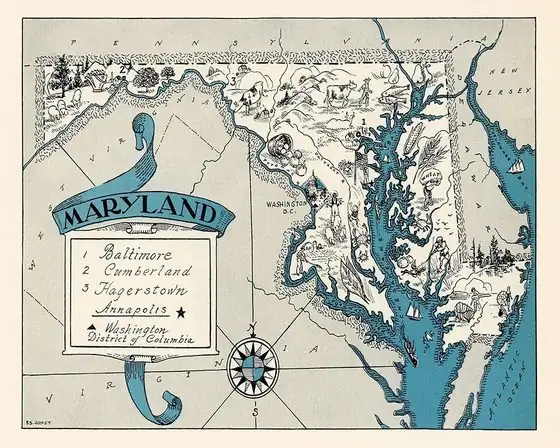
Who Was Princess Anne, Maryland, Named After?
Princess Anne got its name from a 1733 act of the Maryland General Assembly, which laid out a 25-acre town near the head of the Manokin River and ordered it called Princess Anne Town. The act doesn't say which Anne. The Maryland Manual and the town identify her as Anne, the Princess Royal, daughter of King George II.
A 1733 act of Maryland’s assembly named Princess Anne, and the princess it’s usually tied to is Anne, the Princess Royal, daughter of King George II. The act itself, though, never says which Anne it meant.
That gap is worth knowing about, because Maryland already had a royal Anne on its map. After Annapolis received its city charter in 1708, its leaders wrote that their town had been founded “in Remembrance of Princess Anne, now our good Queen.” That was an earlier Anne, already on the throne a generation before the Somerset County town was laid out.
A town by act of assembly
Princess Anne didn’t grow up around a crossroads and pick up a name later. It was ordered into being. At the session that opened on March 13, 1732/3, the General Assembly passed “An Act for the Erecting a Town near the Head of Monokin River, on the South Side thereof, in Somerset County; and for laying into Lots, Twenty Five Acres of Land.”
The act names five commissioners, Col. Levin Gale, Capt. George Dashiels, Major Robert King, Capt. Henry Ballard and George Gale, and tells them to buy 25 acres from a tract “now in Possession of David Brown” and divide it into 30 lots. They were to meet before the last day of August 1733. Then, near the end, comes the line that settled the name:
“That the Town aforesaid be called by the Name of Princess Anne Town.”
That’s on page 130 of the printed volume. You’ll notice the double year in the session date. Maryland was still on the old English calendar, where the new year started on March 25, so March 1732/3 is what we’d call March 1733.
Which Anne?
The act doesn’t add a word about who she was. Going by the Maryland Manual’s dates for her, 1709 to 1759, the Anne it names was in her early twenties in 1733 and the daughter of the reigning king, George II.
That’s the identification you’ll find in today’s official sources. The Maryland Manual, the state’s own reference book, says the town was “Named for Anne, Princess Royal & Princess of Orange (1709–1759).” The town’s website says it was “Named after King George II’s daughter,” and a 2009 marker put up by the Maryland Historical Trust and the State Highway Administration says the same.
The assembly’s own records show she was on people’s minds. When the legislature met in March 1734/5, the governor opened with congratulations on “the marriage of the Princess Royal with his Serene Highness the Prince of Orange.” That marriage fits the “Princess of Orange” in the Manual’s description. The speech doesn’t prove the town was named for her, but it shows the colony was following her news.
So the name is on record, and the Anne behind it comes from later identification rather than from the act itself. Nothing we read points to any other candidate.
Laid out twice
The first town didn’t hold together very well on paper. In 1745 the assembly passed “An Act for laying out the Town a-new commonly called Princess Anne Town.” Its preamble complains that the bounds of the town and its lots were “so obscure, that the same are scarcely known by the Owners or others,” and it named a new set of commissioners to resurvey the same 25 acres, keeping the ground set aside for public buildings.
That act also gives the original law’s date its own way, as a session “begun and held at the City of Annapolis, the thirteenth Day of March, Anno Domini Seventeen hundred thirty and two.” That’s the same session, counted by the old calendar, which is why you’ll see the founding given as either 1732 or 1733.
The 2009 marker adds that the 25 acres came from the Beckford plantation, and that Princess Anne became the seat of the Somerset County court in 1742. The 1733 act itself only names David Brown as the man in possession of the land. The Maryland Manual dates the town’s incorporation to 1867.
Quick answers
Who was Princess Anne, Maryland, named after?
The Maryland Manual and the town identify her as Anne, the Princess Royal (1709-1759), daughter of King George II, who married the Prince of Orange. The 1733 act that named the town doesn’t say which Anne.
When was Princess Anne founded?
By an act of the session that began March 13, 1732/3, which is 1733 on today’s calendar. It laid out 25 acres in 30 lots near the head of the Manokin River.
Is Princess Anne named for the same Anne as Annapolis?
No. A petition from Annapolis, written after the city’s 1708 charter and printed in Elihu Riley’s history of the city, says it was named “in Remembrance of Princess Anne, now our good Queen.” The Anne the Maryland Manual names for the Somerset County town was born in 1709.
Key dates
- 1733An act of the session begun March 13, 1732/3 lays out 25 acres near the head of the Manokin in 30 lots and calls it Princess Anne Town.
- 1735Maryland's governor congratulates the assembly on news of the Princess Royal's marriage to the Prince of Orange.
- 1742Princess Anne becomes the seat of the Somerset County court, according to a 2009 state historical marker.
- 1745A new act orders the town laid out again, saying its bounds and lots had become "so obscure" that owners scarcely knew them.
- 1867Princess Anne is incorporated, according to the Maryland Manual (Chapter 183, Acts of 1867).
Getting there
Open Princess Anne in Google Maps
Opens in a new tab. The pin is the center of Princess Anne in the USGS place-name record.
The closest airports, Amtrak stations and intercity bus stops, measured in a straight line from the center of Princess Anne.
Airports
- Salisbury-Ocean City Wicomico Regional (SBY) 14 mi 22 km
- Baltimore/Washington International Thurgood Marshall (BWI) Glen Burnie 85 mi 137 km
Amtrak trains
- New Carrollton station (NCR) 82 mi 132 km
- Williamsburg station (WBG) 85 mi 136 km
Intercity buses
- Greyhound Princess Anne Umes under 1 mi 0.9 km
- BayRunner Shuttle Salisbury (BRS) 12 mi 19 km
- FlixBus Salisbury Park & Ride 13 mi 22 km
Distances are as the crow flies, not by road. We don't list schedules or fares because they change; check with the airline, Amtrak or the bus company before you go. Official data (FAA commercial service airports (2025), FAA airport locations, Amtrak stations and Intercity Bus Atlas) from the FAA and the U.S. Bureau of Transportation Statistics, checked Nov 13, 2026.
Sponsored
Staying in Princess Anne?
Compare hotels in Princess Anne, Maryland, on Expedia.
See hotels in Princess AnneWe may earn a commission if you buy through this link. It never changes what we write. Read our affiliate disclosure
Sponsored
Want the spooky side of Princess Anne?
The name has its story above. For the ghost stories, US Ghost Adventures runs walking ghost tours in Princess Anne.
See ghost tours in Princess AnneWe may earn a commission if you book through this link. It never changes what we write. Read our affiliate disclosure
Historical Sources & References
- Archives of Maryland, vol. 39, Proceedings and Acts of the General Assembly, 1733-1736 (1919), pp. 128-130. The 1733 act’s title, the five commissioners, David Brown’s land, the 25 acres in 30 lots, the August 1733 meeting and the clause naming “Princess Anne Town” (p. 130).
- Archives of Maryland, vol. 39, p. 162. The governor’s congratulations on “the marriage of the Princess Royal with his Serene Highness the Prince of Orange” at the session of March 1734/5.
- Archives of Maryland, vol. 44, Proceedings and Acts of the General Assembly, 1745-1747, p. 209. The 1745 act to lay the town out anew, its “so obscure” preamble and its date for the first act.
- Elihu S. Riley, “The Ancient City”: A History of Annapolis, in Maryland, 1649-1887 (1887), pp. 85-86. The city received its charter on August 10, 1708 (p. 85); the later petition of the Annapolis corporation (p. 86) says the town was erected “in Remembrance of Princess Anne, now our good Queen.”
- Maryland Manual On-Line: Princess Anne. County seat of Somerset County, incorporated in 1867 (Chapter 183) and “Named for Anne, Princess Royal & Princess of Orange (1709–1759).”
- Town of Princess Anne: About Our Town. The 1733 purchase of 25 acres in 30 lots and the identification with King George II’s daughter.
- Princess Anne marker, Maryland Historical Trust and State Highway Administration (2009). The Beckford plantation, the naming for George II’s daughter and the county court seat in 1742.
- GNIS feature 591074 (U.S. Geological Survey). Gives the ID, the spelling and the Somerset County location we use for the town.
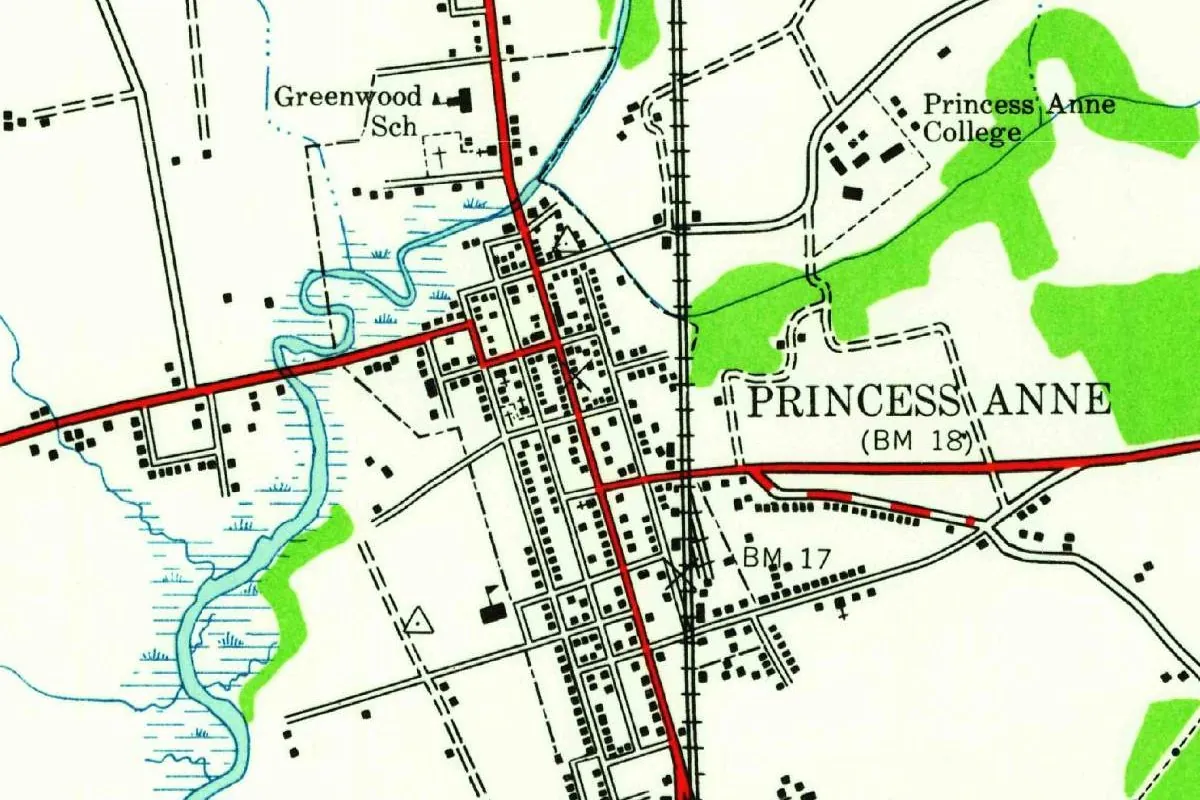
- U.S. Geological Survey, Princess Anne sheet (1942). Surveyed in 1942; the scan is a 1962 printing, cropped to the grid of streets along the railroad.
Spot something wrong, or know more? Tell us here. You can also email us or use our contact page. Corrections are noted here with their date, never made silently.