How Did St. Michaels, Maryland, Get Its Name?
St. Michaels took its name from the church of St. Michael's Parish on the Miles River. Samuel A. Harrison's Talbot County history says the church was the first house built and the village around it took its name. The parish honored Saint Michael the Archangel, and Harrison thought Miles River was probably a shortened St. Michaels.
The church came first
St. Michaels took its name from its parish church of St. Michael, which a Talbot County history calls the first building in the village. Nobody named a town and then built a church in it. It went the other way around.
Talbot County historian Samuel A. Harrison wrote a chapter on the town that the book dates to 1883. It was published in 1915 in his History of Talbot County, put together from his papers by Oswald Tilghman. Harrison puts the order of events in one sentence:
“The church was the first house erected, and around it gathered the village which took its name.”
So when you say “St. Michaels,” you’re really naming a parish. The village borrowed the church’s name.
How old is the parish?
Here the sources don’t agree, and it’s better to show you both than to pick a year.
The town’s website says that “In 1677 an Episcopal Parish was established on the banks of the Miles River and named after Saint Michael the Archangel.” Harrison is more cautious. He writes that the date the first church went up “has not been preserved.” Depositions taken in 1736 said the two acres for the church came from John Hatton or Edward Elliot, and Harrison thought there was “reasonable ground to believe that this occurred as early at least as 1672.” That’s when the Rev. James Clayland was serving as minister of the Reformed Church, before the Church of England became the colony’s established church. In another chapter, the book notes that the parish’s first recorded baptism took place in 1672.
The earliest mention of the place itself that Harrison turned up is a horse race run “at St. Michaels” in 1680, recorded in the county’s book of judgments.
Why Saint Michael?
Harrison adds a footnote that explains the choice of saint. Every land grant in colonial Maryland came with a small yearly rent, called a quit rent, owed to the Lord Proprietary, and it was due on Michaelmas, September 29. In his words, “Saint Michaels may be regarded the patron saint, or guardian angel of Maryland, for all patents required the payment of the quit rents to the Lord Proprietary on the Feast of Saint Michael and all angels.”
The same saint is probably hiding in the river next to town, though the book isn’t of one mind about it. In a footnote to the 1883 chapter, Harrison writes that “The proper name for the creek or river, commonly called Miles River, is Saint Michaels.” He thought the change to Miles “probably originated in the habit, common to all people of abbreviating names,” and added that “Possibly the custom of the Quakers in dropping the word Saint, may have favored this habit.” Then he offered a second idea. In 1687 a John Miles of Anne Arundel County sold land “upon the upper waters of the St. Michaels river,” and Harrison asked: “May we not have here the origin of the alternate name.”
A later chapter on Talbot place names, written around 1914 for the published book, is blunter: “Miles River, or St. Miles River, is a corruption of Saint Michaels, its original name.” It puts the change down to the Quakers, who had no reverence for saints, quotes a 1667 commission that writes “St. Miles rivers,” and shrugs: “So we find authority for St. Michaels and Michaels, St. Miles and Miles; take your choice.”
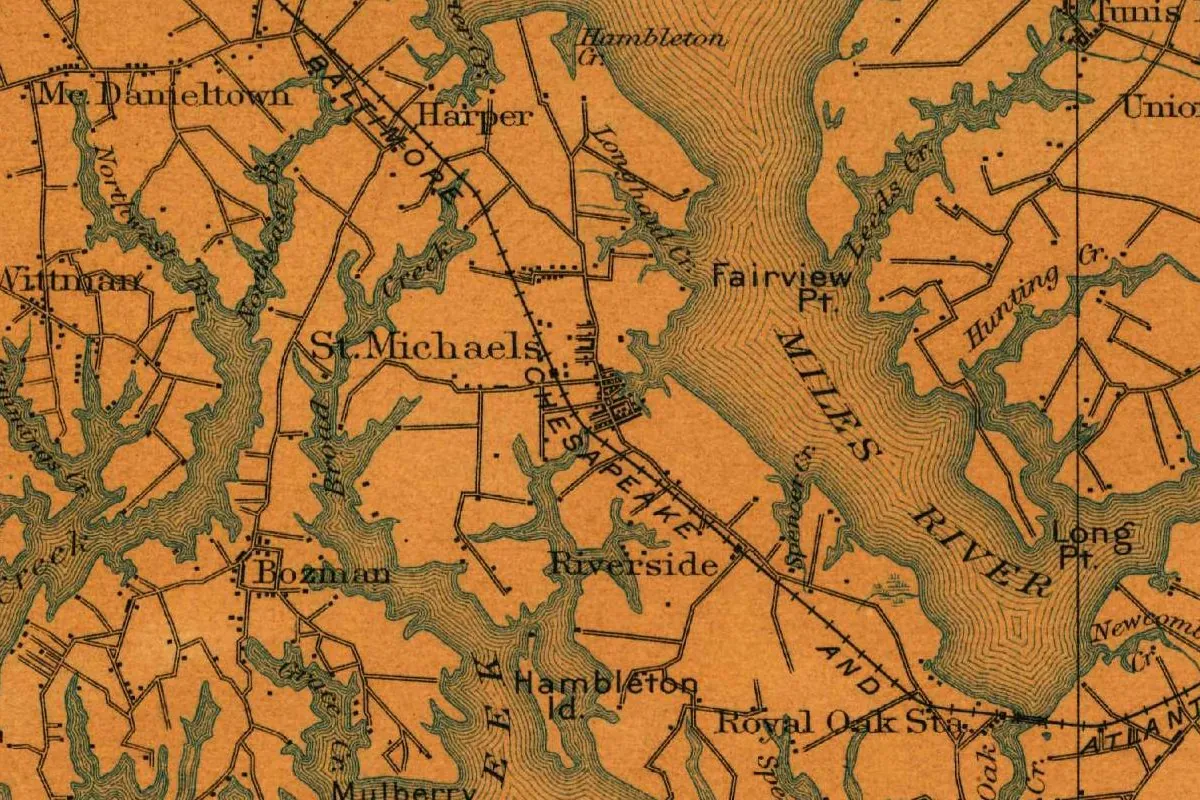
You can see both names on the 1898 survey map that goes with this article. It labels the village St. Michaels and the water beside it MILES RIVER.
From village to town
The church gave the place its name, but a planned town came much later. Harrison writes that in 1778 James Braddock, agent for the Liverpool merchants Gildart & Gawith, laid off town lots there, though the plat was never recorded. John Thompson, Braddock’s heir, laid out and sold more lots in 1783. The town’s website says Braddock’s plan was built around a central square.
Residents then asked for a charter. Their petition and bill went to the Maryland legislature at its November session of 1804, and Harrison says the bill became law on January 19, 1805. The Maryland Manual lists it as Chapter 82 of the Acts of 1804. The act describes “the village now known by the name of St. Michaels” and orders a resurvey of “those lands and bounds laid off by a certain James Braddock about the year 1778 for the purpose of a town by the name of Saint Michaels.”
By then the name had been around for well over a century. The law just made it official.
Quick answers
Who is St. Michaels, Maryland, named after?
Saint Michael the Archangel, by way of the parish church. Harrison’s Talbot County history says the village gathered around the church and took its name, and the town’s website says the parish was named for Saint Michael the Archangel.
Is the Miles River named for the same saint?
Probably. Harrison wrote that the river’s proper name is Saint Michaels and that Miles was likely a shortened form, but he also wondered whether a landowner named John Miles, recorded there in 1687, gave the river its other name.
When was St. Michaels founded?
It depends on what you count. The town dates the parish to 1677, Harrison thought the church land was set apart by 1672, Braddock laid out lots about 1778, and the charter became law on January 19, 1805.
Key dates
- 1672The parish's first recorded baptism. Harrison thinks the church land was set apart at least this early.
- 1677The year the town's website gives for the founding of the Episcopal parish named for Saint Michael the Archangel.
- 1680A horse race "at St. Michaels" is the earliest mention of the place Harrison found in the county records.
- 1778About this year James Braddock, agent for Liverpool merchants, lays off lots for a town "by the name of Saint Michaels."
- 1783John Thompson, Braddock's heir, lays off and sells more lots.
- 1804-1805A petition for a town charter goes to the November 1804 session; the act becomes law on January 19, 1805.
Getting there
Open St. Michaels in Google Maps
Opens in a new tab. The pin is the center of St. Michaels in the USGS place-name record.
The closest airports, Amtrak stations and intercity bus stops, measured in a straight line from the center of St. Michaels.
Airports
- Baltimore/Washington International Thurgood Marshall (BWI) Glen Burnie 36 mi 58 km
- Ronald Reagan Washington Ntl (DCA) Arlington 44 mi 71 km
Amtrak trains
- New Carrollton station (NCR) 37 mi 59 km
- BWI Marshall Airport station (BWI) 38 mi 61 km
Intercity buses
- BayRunner Shuttle Easton 9 mi 14 km
- FlixBus Annapolis 20 mi 32 km
- OurBus Baltimore, MD (BWI Thurgood Marshall Rail Station - 7 Amtrak Way in front of ticket office on northbound side opposite parking garage) 38 mi 61 km
Distances are as the crow flies, not by road. We don't list schedules or fares because they change; check with the airline, Amtrak or the bus company before you go. Official data (FAA commercial service airports (2025), FAA airport locations, Amtrak stations and Intercity Bus Atlas) from the FAA and the U.S. Bureau of Transportation Statistics, checked Nov 13, 2026.
Sponsored
Staying in St. Michaels?
Compare hotels in St. Michaels, Maryland, on Expedia.
See hotels in St. MichaelsWe may earn a commission if you buy through this link. It never changes what we write. Read our affiliate disclosure
Sponsored
Want the spooky side of St. Michaels?
The name has its story above. For the ghost stories, US Ghost Adventures runs walking ghost tours in St. Michaels.
See ghost tours in St. MichaelsWe may earn a commission if you book through this link. It never changes what we write. Read our affiliate disclosure
Historical Sources & References
- Samuel A. Harrison, History of Talbot County, Maryland, 1661-1861, comp. Oswald Tilghman, vol. 2 (1915), pp. 311, 316, 375-377, 381-383. The first recorded baptism in 1672 (p. 311); the place-names chapter written around 1914, with the Miles River as “a corruption of Saint Michaels,” the Quakers and “take your choice” (p. 316); the church as the first house, the quit rents due on the Feast of Saint Michael, the 1736 depositions and the 1672 estimate (pp. 375-376); Harrison’s footnote on Miles River, with the John Miles sale of 1687, and the 1680 horse race (pp. 376-377); Braddock’s lots, Thompson’s sale, the 1804 petition and the act’s text (pp. 381-383).
- Town of St. Michaels: History. The 1677 parish named after Saint Michael the Archangel and Braddock’s street plan around a central square.
- Maryland Manual On-Line: St. Michaels. Incorporated 1804, Chapter 82, Acts of 1804.
- GNIS feature 591218 (U.S. Geological Survey). Lists the town under the spelled-out form Saint Michaels, in Talbot County.
- U.S. Geological Survey, Choptank sheet (1898). The 1898 survey we cropped to show St. Michaels and MILES RIVER printed side by side.
Spot something wrong, or know more? Tell us here. You can also email us or use our contact page. Corrections are noted here with their date, never made silently.