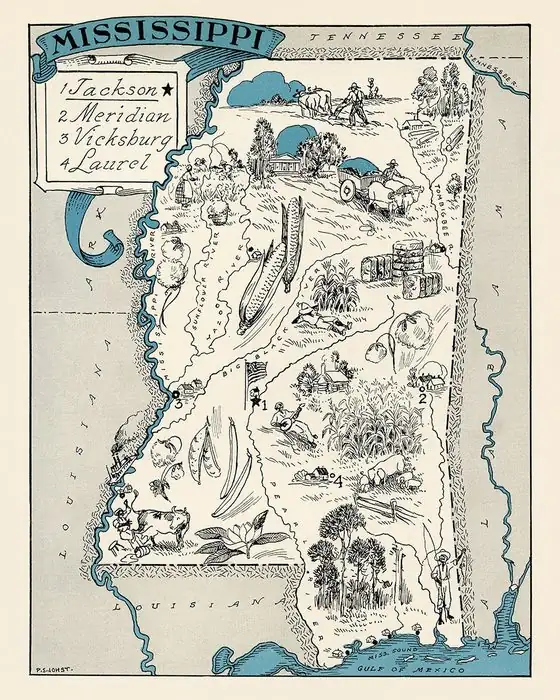
Tupelo, Mississippi: Named for a Gum Tree or a Battle?
Sources disagree. The Advisory Council on Historic Preservation says Tupelo was named after the gum trees in the marshy land where the railroad was laid, and a 1938 WPA guide says residents renamed Gum Pond to honor those trees. An SAH Archipedia essay says the 1870 name honored the local Civil War battle instead.
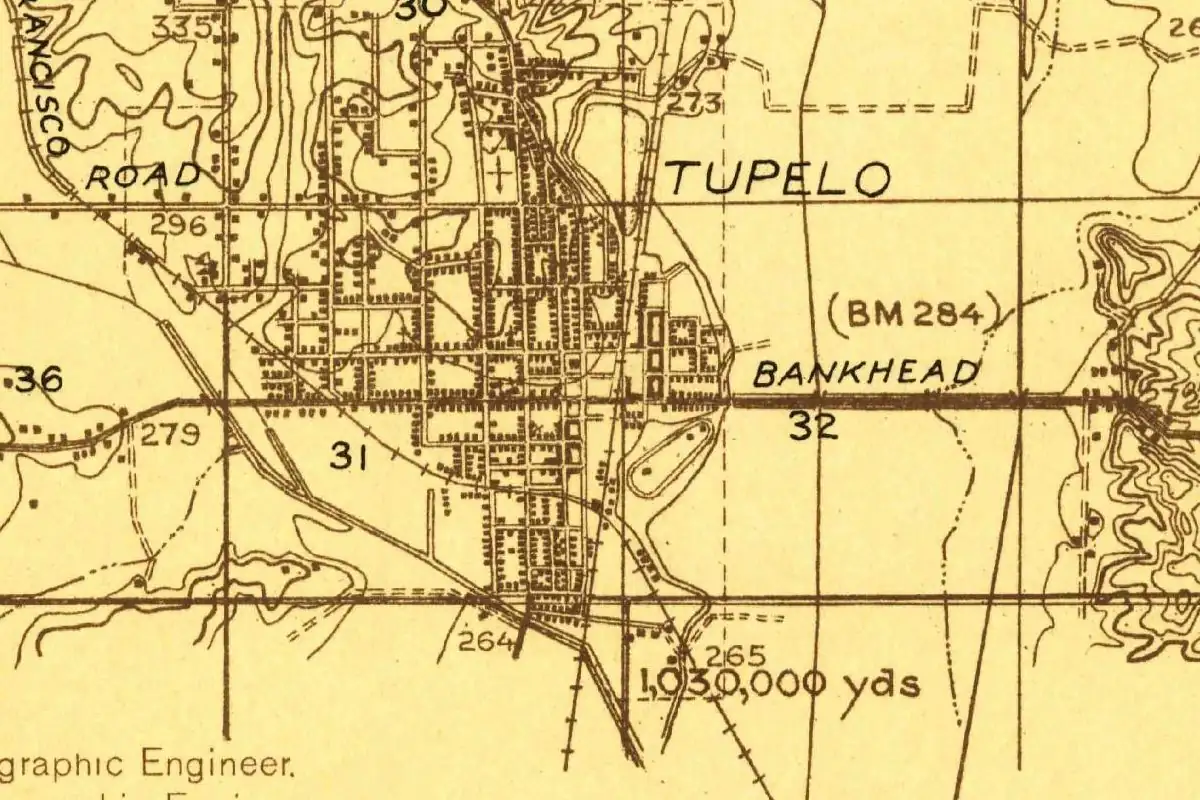
Tupelo, Mississippi, is named for tupelo gum trees, most accounts say, but an essay for the Society of Architectural Historians credits a Civil War battle. Both stories start in the same marshy spot beside a new railroad, and they part ways over one word: why.
Harrisburg came first
Before there was a Tupelo, there was Harrisburg. Dunbar Rowland’s 1907 cyclopedia of Mississippi describes it as an old village built on land belonging to Judge W. R. Harris, “a wealthy planter,” and “named in his honor.” The 1938 WPA guide to the state places it on the upper slope of a ridge.
Then the railroad came through. According to the Advisory Council on Historic Preservation, the Mobile and Ohio wanted a right-of-way through Verona, 5 miles (8 km) to the south, and Verona refused. So the tracks went “two miles east of Harrisburg, in a marshy land covered with Tupelo trees.” Rowland puts the gap at a mile and a half (2.4 km) and says the road was completed to Tupelo in 1860, when “it absorbed the business of the old village of Harrisburg.” The WPA guide dates the tracks to 1859 and says people moved down “into the flat, marshy bottoms.”
Keep the two towns apart, because they really were separate places. The National Park Service says that in 1864 Harrisburg “was a more substantial town than nearby Tupelo,” though Tupelo was the one on the railroad. Over the years, the Park Service says, Tupelo grew and Harrisburg was overtaken by it.
Gum Pond, then Tupelo
The newcomers didn’t call their stop Tupelo at first. The WPA writers say that by the end of the first year there was a store, a temporary railroad station and two saloons, all on the east side of the tracks. Their guide, published in 1938, tells it this way:
“Because of the nearness of a small pond lined with tupelo gum trees, the new station was called Gum Pond. But later the first citizens wished to honor the trees that had supplied the timber for their homes, so they changed the name to Tupelo”
So in that telling, the trees got the name twice: once for the pond, and again for the houses. The ACHP agrees on the trees, saying the community grew up around the tracks and was “named after the gum trees.”
The battle version
SAH Archipedia, the Society of Architectural Historians’ online guide to American buildings, tells a different story. Its essay on Tupelo, by Jennifer V.O. Baughn and Michael W. Fazio with Mary Warren Miller, agrees that land speculators following the new railroad laid out a town in 1860, “calling it Gum Pond for the stand of tupelo trees.” Then, it says, citizens incorporated in 1870 and “renamed it Tupelo, not for the trees but for the local Civil War battle.”
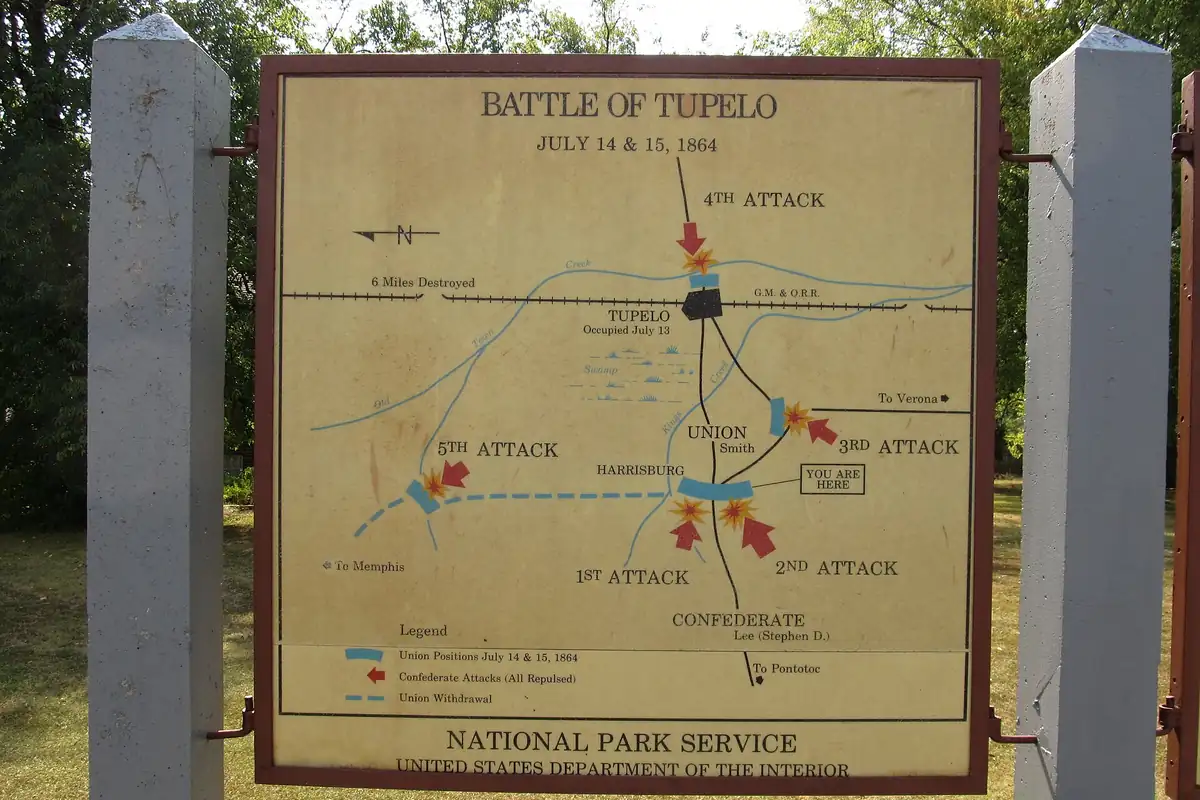
That battle was fought on July 14, 1864, between Union troops under Gen. A. J. Smith and Confederates under Gen. Stephen D. Lee and Gen. N. B. Forrest, Rowland says. The Park Service notes that it’s also known as the Battle of Harrisburg, and the WPA guide says the armies met “on the hilltop where the village of Harrisburg had been.”
Rowland, writing in 1907, says Confederate troops fell back to Tupelo after the battle of Shiloh and camped there through the summer of 1862, and the WPA guide says the same about General Beauregard’s army. The Park Service also calls the 1864 railroad town Tupelo. None of these sources says when the name was chosen.
What the word means
Even the word is unsettled. Right after the name, the WPA guide adds a short note in parentheses: “(Ind., lodging place).” In the guide’s shorthand, that’s an Indian word meaning “lodging place,” but it doesn’t say which language.
Merriam-Webster traces the tree’s name another way. Its entry says “tupelo” comes “perhaps from Creek,” from words for “tree” and “swamp,” and dates the first known use in English to about 1730. That “perhaps” is the dictionary’s, and it’s worth keeping.
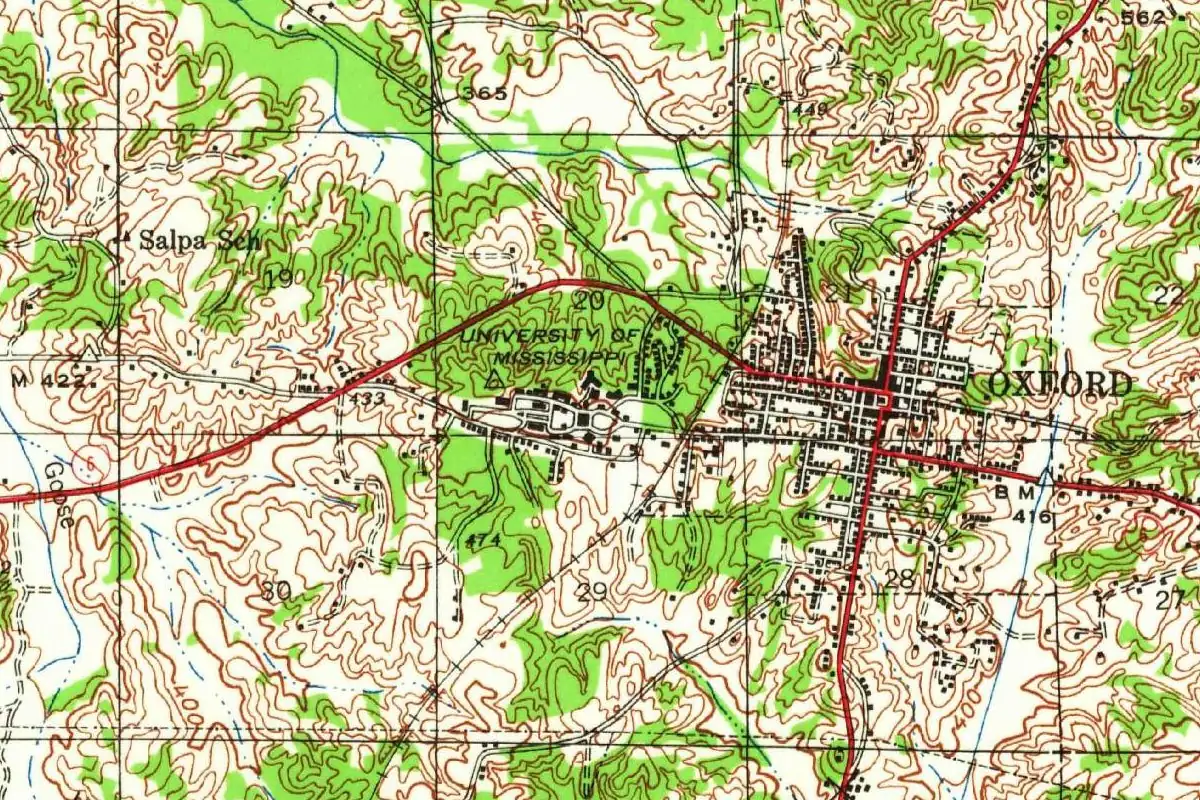
Neither source ties the word to the Chickasaw, who were the first people in the Tupelo region, according to the ACHP. The 1832 Treaty of Pontotoc transferred their land here to government ownership. For another north Mississippi town on former Chickasaw land, see Oxford.
A county seat by vote
The town’s fortunes changed after the war. Lee County was formed in 1866 from parts of Itawamba and Pontotoc counties, and Rowland says an election on April 15, 1867, chose Tupelo as the county seat. The ACHP and the SAH essay both date the incorporation to 1870, and the SAH writers add that the Kansas City, Memphis and Birmingham Railroad arrived in 1886 and made the town a transportation hub.
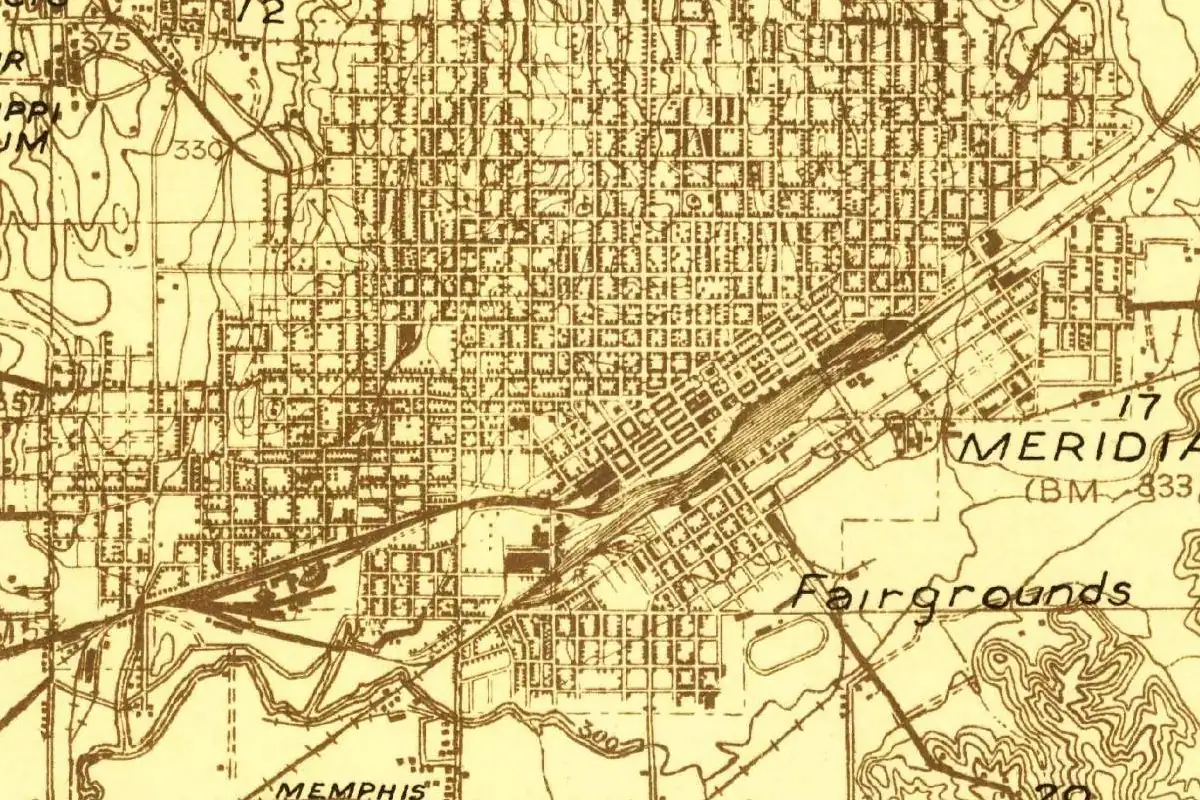
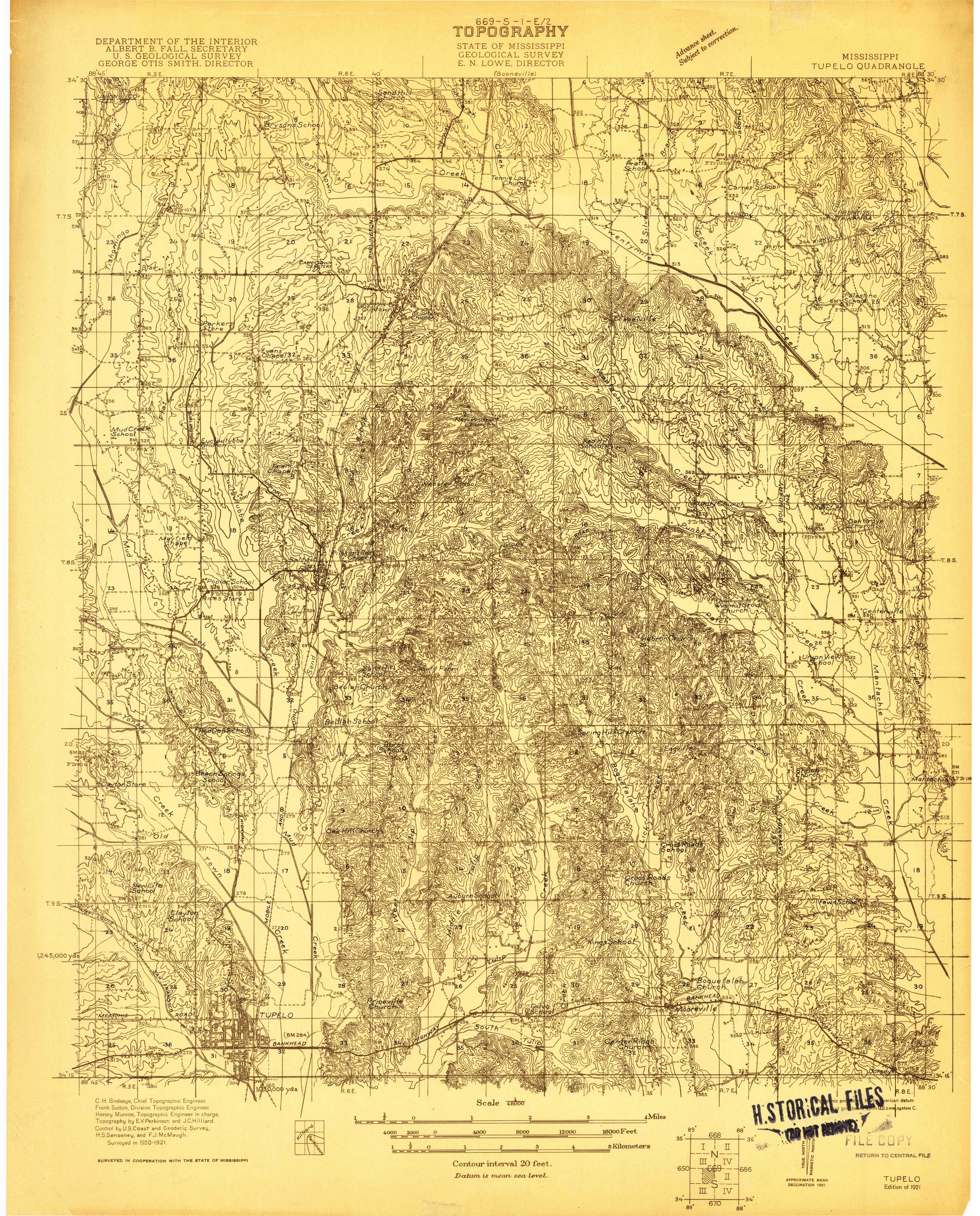
You can see the result on the 1921 map at the top of this page, surveyed in 1920 and 1921. The railroads cross in the middle of town, the tail end of a railroad name, “…rancisco,” runs along the upper left, and a road labeled “Bankhead” heads east. Rowland says the St. Louis & San Francisco crossed the Mobile & Ohio right here. The spot elevations in this crop run from 264 to 335 feet (80 to 102 m).
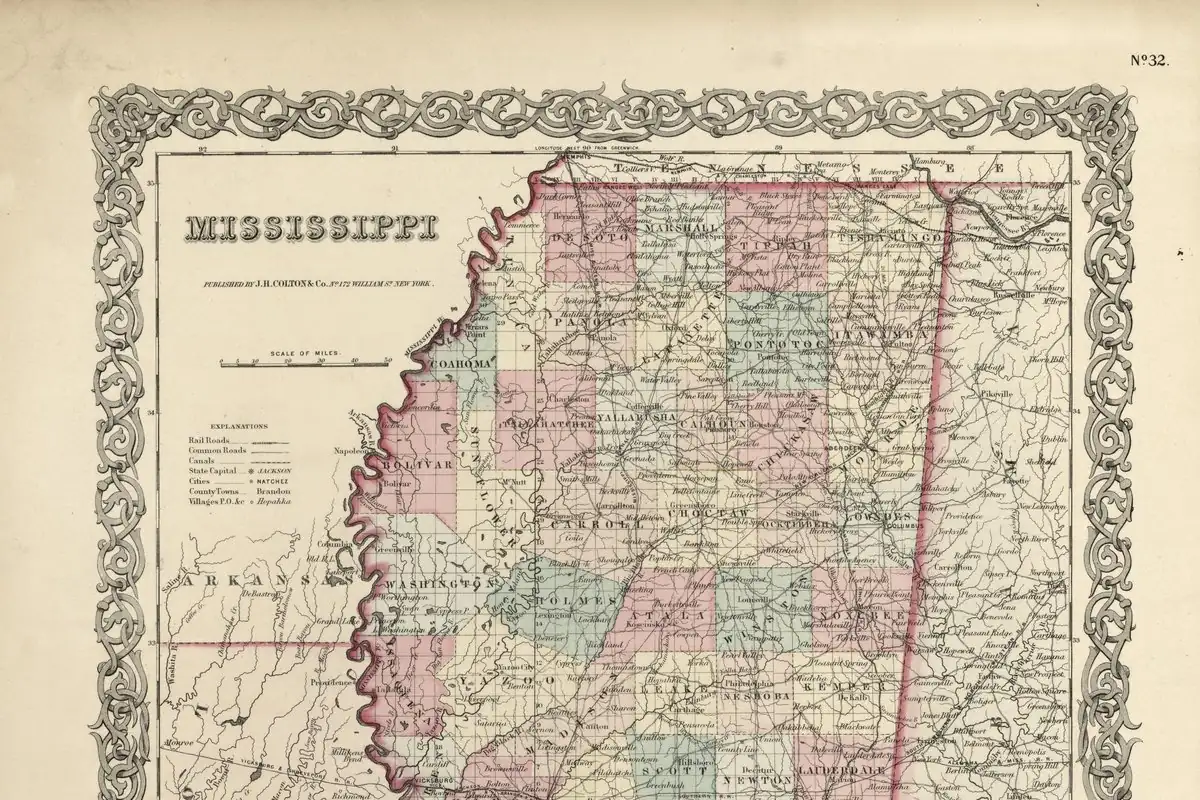
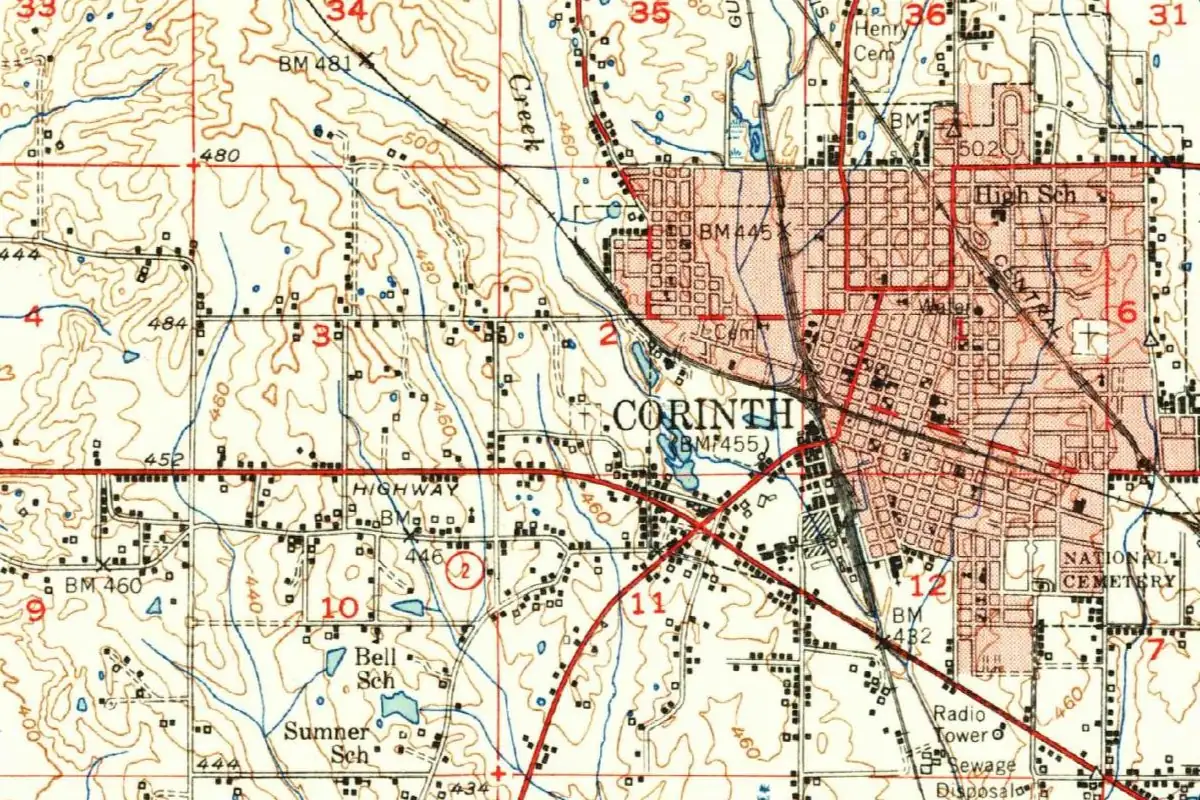
There’s more on the state’s town names on our Mississippi page. Another railroad town in the state’s northeast corner, Corinth, went looking for its name in ancient Greece.
Quick answers
Why is Tupelo, Mississippi, called Tupelo?
Most sources say it’s for tupelo gum trees. The ACHP says the town was “named after the gum trees,” and the 1938 WPA guide says residents renamed Gum Pond to honor them. An SAH Archipedia essay says the 1870 name honored the local Civil War battle.
What was Tupelo called before?
Gum Pond, according to both the WPA guide and SAH Archipedia. Harrisburg, which often comes up in the same story, was a separate village to the west.
What does the word tupelo mean?
There’s no single answer. The WPA guide glosses it as an Indian word for “lodging place,” without naming a language. Merriam-Webster says the tree’s name comes “perhaps” from Creek words for tree and swamp.
Is the Battle of Tupelo the same as the Battle of Harrisburg?
Yes. The National Park Service says the July 1864 battle is also known as the Battle of Harrisburg.
Key dates
- 1832The Treaty of Pontotoc transfers the Chickasaw land around Tupelo to government ownership, according to the ACHP.
- 1860The Mobile & Ohio Railroad reaches Tupelo and draws the business of Harrisburg, according to Rowland (the WPA guide puts the tracks in 1859).
- 1862Confederate troops fall back to Tupelo after Shiloh and camp there for the summer, according to Rowland and the WPA guide.
- 1864The Battle of Tupelo, also called the Battle of Harrisburg, is fought on July 14.
- 1866Lee County is formed; Tupelo is chosen as county seat at an election on April 15, 1867.
- 1870Tupelo is incorporated.
Things to do in Tupelo, Mississippi
Elvis Presley Birthplace
The two-room house where Elvis Presley was born on January 8, 1935, built by his father, grandfather and uncle. The church his family attended has been moved to the park, and a bronze statue shows Elvis at 13.
Tupelo National Battlefield
A one-acre memorial site for the 1864 battle the Park Service says is also known as the Battle of Harrisburg. It has no staff on site; the NPS visitor center is at milepost 266 of the Natchez Trace Parkway, 6 miles (10 km) north.
Natchez Trace Parkway
A 444-mile (715 km) scenic byway headquartered in Tupelo, which the city's tourism office calls one of the top 10 most visited national parks in the country.
Elvis' Tupelo Driving Tour
A downloadable itinerary, offered in English and several other languages, through the Tupelo places in Elvis Presley's early life, including the former Tupelo Hardware Company, where his mother bought him a guitar for his 11th birthday.
Getting there
Open Tupelo in Google Maps
Opens in a new tab. The pin is the center of Tupelo in the USGS place-name record.
The closest airports, Amtrak stations and intercity bus stops, measured in a straight line from the center of Tupelo.
Airports
- Tupelo Regional (TUP) 4 mi 6 km
- Golden Triangle Regional (GTR) Columbus 56 mi 91 km
Amtrak trains
- Marks station (MKS) 90 mi 144 km
- Memphis station (MEM) 98 mi 158 km
Intercity buses
- Greyhound Tupelo Brothers Quick Stop 2 mi 3 km
Distances are as the crow flies, not by road. We don't list schedules or fares because they change; check with the airline, Amtrak or the bus company before you go. Official data (FAA commercial service airports (2025), FAA airport locations, Amtrak stations and Intercity Bus Atlas) from the FAA and the U.S. Bureau of Transportation Statistics, checked Nov 14, 2026.
Sponsored
Staying in Tupelo?
Compare hotels in Tupelo, Mississippi, on Expedia.
See hotels in TupeloWe may earn a commission if you buy through this link. It never changes what we write. Read our affiliate disclosure
Historical Sources & References
- Advisory Council on Historic Preservation, “Tupelo, Mississippi”. The Chickasaw as first inhabitants and the 1832 Treaty of Pontotoc; Verona’s refusal; the tracks “two miles east of Harrisburg”; the community “named after the gum trees”; Lee County (1866) and incorporation (1870).
- Federal Writers’ Project, Mississippi: A Guide to the Magnolia State (1938), pp. 262-263. Harrisburg and the move to the bottoms (p. 262); the quoted passage on Gum Pond and the change to Tupelo, “(Ind., lodging place),” Beauregard’s camp in 1862 and the battle on the Harrisburg hilltop (p. 263). Checked against the page image.
- Baughn and Fazio, with Miller, “Tupelo,” SAH Archipedia. The 1860 town called Gum Pond, its renaming in 1870 “not for the trees but for the local Civil War battle,” and the railroad of 1886.
- Dunbar Rowland, ed., Mississippi, vol. 2 (1907), p. 829. The railroad completed to Tupelo in 1860, Harrisburg a mile and a half west, the battle of July 14, 1864, the 1862 camp and the county-seat election of 1867. Checked against the page image.
- Dunbar Rowland, ed., Mississippi, vol. 1 (1907), p. 843. Harrisburg, on Judge W. R. Harris’s land and “named in his honor.” Checked against the page image.
- National Park Service, Tupelo National Battlefield FAQ. The Battle of Harrisburg as another name for the battle, and Harrisburg as “a more substantial town than nearby Tupelo” in 1864.
- Merriam-Webster, “tupelo”. The tree’s name “perhaps from Creek,” and its first known use about 1730.
- GNIS feature 678931 (U.S. Geological Survey). The USGS names database lists Tupelo, Lee County, with its coordinates.
- U.S. Geological Survey, Tupelo sheet (1921). The 1:48,000 map, surveyed in 1920-1921, that the image at the top of this page was cropped from.
Sponsored
Put this 1921 map on your wall
The 1921 USGS Tupelo sheet is in the public domain. Download the full-size scan for free, then have it printed on canvas with CanvasOnTheCheap.
Print a map on canvasDownload the full-size mapWe may earn a commission if you buy through this link. It never changes what we write. Read our affiliate disclosure
Spot something wrong, or know more? Tell us here. You can also email us or use our contact page. Corrections are noted here with their date, never made silently.