Springfield, Missouri: Spring, Field or Jug of Whiskey?
A pioneer story says Springfield, Missouri, got its name from a trader with a tent, a jug of whiskey and a Massachusetts hometown he wanted to honor. It’s one of three versions, though, and nobody can settle it: the oldest one says the town was simply named for a spring at the bottom of a hill and a field at the top, and another credits a settler from Springfield, Tennessee.
A spring under the hill and a field on top
The town grew up around water. The 1883 History of Greene County, quoting the recollections of an early settler’s son, John H. Miller, says John P. Campbell’s party reached “the natural well (a short distance north of the present public square of Springfield)” and camped there on the night of March 4, 1830. Campbell’s daughter, writing in the Springfield Leader in 1876, remembered that her father had picked out land where there were four springs, “whose branches uniting formed Wilson creek,” with that deep natural well in the middle. The newcomers cleared ground by the branch and also “a field on the top of the hill, where the city now stands.”
That’s pretty much the whole first version. The same county history says “the town took its name from the circumstance of there being a spring under the hill, on the creek, while on top of the hill, where the principal portion of the town lay, there was a field.” Henry Gannett’s 1905 book on American place names, published by the U.S. Geological Survey, gives the short form. He lumps Springfield, Missouri, in with towns in Nebraska and Ohio, all “so named because of the numerous springs.”
So the plain reading is that Springfield means what it says. You’ll notice nobody in that version actually chooses the name, though.
Kindred Rose and the Tennessee Springfield
The second version came from a newspaper editor who didn’t buy the first one. On November 11, 1881, J. G. Newbill of the Springfield Express wrote that the spring-and-field story was “not a correct version.” When “the authorized persons” met to pick a name, he said, several early settlers handed in their favorites, and Kindred Rose “presented the winning name” to honor his old hometown, Springfield, in Robertson County, Tennessee. The 1883 history printed Newbill’s paragraph right after its own spring-and-field explanation and left it at that.
By 1915, Jonathan Fairbanks and Clyde Edwin Tuck, writing their own county history, told both stories and shrugged: “Whichever version is correct, the name was given to the little hamlet at a very early date, and no one has ever suggested changing it.” Newbill didn’t name a source, and he was writing about 50 years after the fact.
Wilson’s tent and the whiskey vote
The third version is the best story and the hardest to check. Starting in 1907, Martin J. Hubble hosted an old settlers’ dinner at his home in Springfield every March 31 and printed what was said. In his own talk, under the heading “How Springfield was named,” he described “an Indian trader, named Wilson,” who was living among the Delaware people when the settlers came and who pitched a tent on the south side of the public square.
When everybody in the area was invited to vote on a name for the county seat, Hubble says, Wilson took each newcomer over to his tent and explained that he’d been “born and raised in a beautiful town in Massachusetts named Springfield.” Then he brought out “a jug of white whiskey,” the voter helped himself, “and of course went and voted to name the town Springfield.” Hubble’s informant was Captain Lucius A. Rountree, who always ended the story the same way: “I was 17 years old and was ‘much of a man.’” Hubble added, “There is no doubt that this story is true.”
A graduate student named Robert Lee Meyers sided with Hubble. His 1930 University of Missouri thesis on the place names of southwest Missouri, now part of the State Historical Society of Missouri’s place-names file, calls the Hubble story “by far the most satisfactory one” among “conflicting stories.” But it rests on one man’s memory of a vote, told to Hubble decades later, and neither county history mentions Wilson’s tent or the jug.
Which story holds up
None of the three comes with a record from the day the name was picked. The county seat fight itself is murky. The 1883 history says the county judges first leaned toward a spot near today’s Mount Vernon, which the 1915 history puts about 35 miles (56 km) west, until, as the story goes, Campbell, their new clerk, entertained them so well that they agreed on “Campbell’s spring.” The name was already in use by March 1833, when Greene County’s first court met at Campbell’s house and ordered a road laid out “from Springfield westwardly.” In 1835 Campbell laid off the town on 50 acres he gave to the county.
The spring-and-field version was going around before 1881, since Newbill was arguing with it, and it fits the land the settlers described. The Tennessee and Massachusetts versions each name a person, but they showed up in print about 50 and 75 years later. That’s why we call the origin disputed. If you’re looking for one answer, the honest one is that the springs show up in the earliest version, and the hometowns only in later ones.
Where Route 66 ran past the Gillioz
Almost a century after the naming fight, Springfield was on another kind of road. The National Park Service says Route 66 runs about 317 miles (510 km) across Missouri, through the Ozarks, and that it grew out of older roads, including the Kickapoo or Osage Trail, which became the Old Wire Road. Its list of Missouri Route 66 places on the National Register includes three in Springfield: the Gillioz Theater, the Rock Fountain Court Historic District and the Henry Schneider Building.
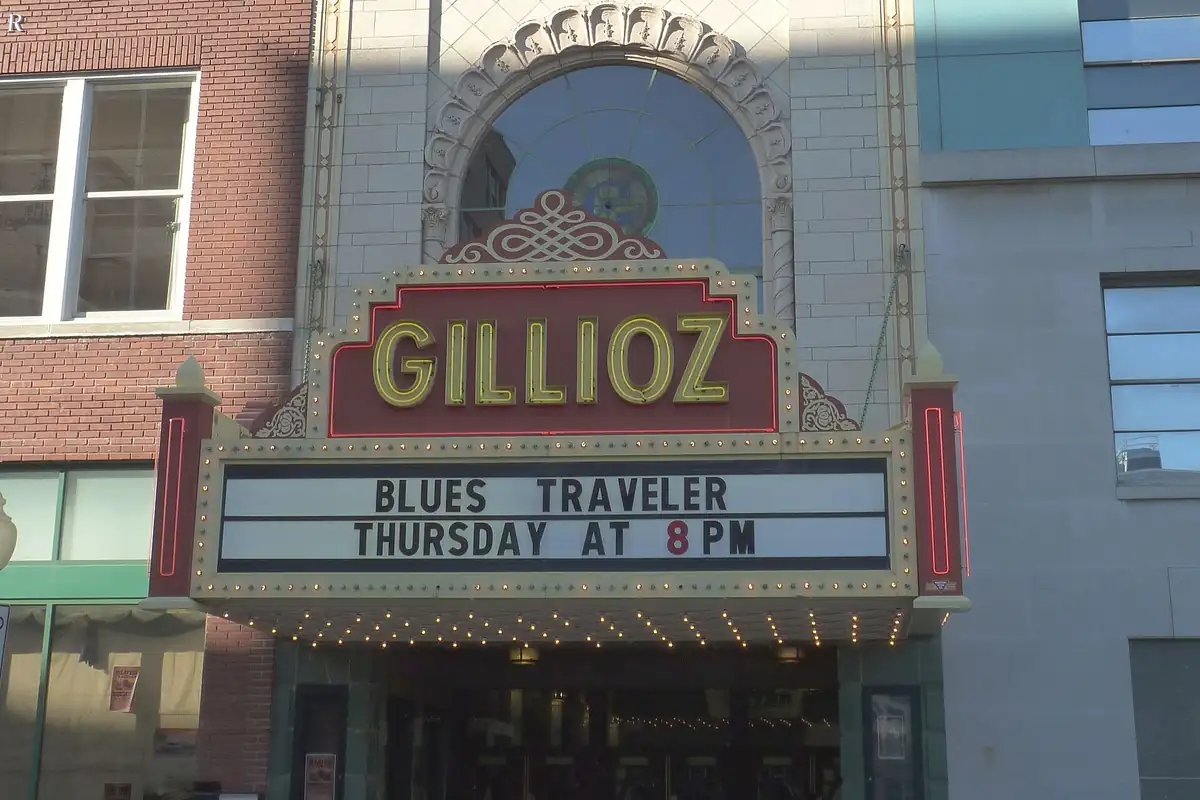
The Gillioz, in the photo below, opened in 1926. The Park Service says that later that year Springfield was “dubbed the Birthplace of Route 66,” and that “the Federal highway ran right in front of Springfield’s premier entertainment venue.” Out on West College Street, Rock Fountain Court went up in 1945: nine cabins faced with Ozark sandstone, set in a half circle. The rock fountain itself is long gone, and today the cabins are rented out as apartments.
Don’t mix it up with Springfield, Illinois, another Route 66 town, whose name was picked by county commissioners in 1821. Both are in our Route 66 towns collection, and two Springfields on one highway make a good case for our same name, different places collection too.
Whichever version you pick, the water keeps showing up. The springs Campbell found ran into Wilson Creek, and according to Hubble, that creek was named for the man with the jug.
Quick answers
Was Springfield, Missouri, named after Springfield, Massachusetts?
Possibly, but it’s not proven. Martin J. Hubble wrote in 1908 that a trader named Wilson, who said he was born in Springfield, Massachusetts, got voters to pick the name with a jug of whiskey. Older accounts credit a spring and a field, or a settler from Springfield, Tennessee.
Does the name come from springs?
That’s the oldest version. The 1883 county history says the town was named for “a spring under the hill, on the creek” and a field on the hilltop, and Gannett (1905) says “numerous springs.” Neither says who chose the name.
Who founded Springfield, Missouri?
John P. Campbell, according to the 1883 county history, which calls him “the founder of the town.” He camped at the natural well in March 1830 and laid off the town in 1835 on 50 acres he gave to the county.
Is Springfield, Missouri, the Birthplace of Route 66?
That’s its nickname. The National Park Service says Springfield “was dubbed the Birthplace of Route 66” in 1926, the year the Gillioz Theatre opened downtown, and that the highway ran right in front of the theater.
Key dates
- 1830March 4: John P. Campbell's party camps at the natural well, just north of the public square.
- 1833March: Greene County's first court meets at Campbell's house and orders a road "from Springfield westwardly."
- 1835Campbell lays off the town on 50 acres he gives to the county.
- 1881November 11: The Springfield Express credits Kindred Rose and Springfield, Tennessee, with the name.
- 1883The county history says the town was named for a spring under the hill and a field on top.
- 1905Henry Gannett's federal place-names book says "numerous springs."
- 1908Martin J. Hubble prints the story of Wilson, the whiskey jug and Springfield, Massachusetts.
- 1926The Gillioz Theatre opens downtown, on what the Park Service calls historic Route 66.
- 1945Rock Fountain Court, nine stone-veneered tourist cabins, is built along Route 66.
Getting there
The closest airports, Amtrak stations and intercity bus stops, measured in a straight line from the center of Springfield.
Airports
- Springfield-Branson Ntl (SGF) 5 mi 9 km
- Joplin Regional (JLN) 66 mi 107 km
Intercity buses
- Greyhound Springfield Cu Transit Center under 1 mi 0.7 km
- Jefferson Lines Springfield under 1 mi 0.7 km
Distances are as the crow flies, not by road. We don't list schedules or fares because they change; check with the airline, Amtrak or the bus company before you go. Official data (FAA commercial service airports (2025), FAA airport locations, Amtrak stations and Intercity Bus Atlas) from the FAA and the U.S. Bureau of Transportation Statistics, checked Nov 2, 2026.
Historical Sources & References
- R. I. Holcombe, ed., History of Greene County, Missouri (Western Historical Company, 1883). The camp at the natural well on March 4, 1830, the field on the hilltop and Mrs. Rush C. Owen’s 1876 letter about the four springs and Wilson Creek (pp. 137-139); the first county court and the road “from Springfield westwardly” (pp. 158-159); the judges, Campbell and “Campbell’s spring” (p. 725); the spring-and-field origin, Newbill’s 1881 Kindred Rose version and the 1835 town plat (p. 727); Campbell as “the founder of the town” (p. 728).
- Jonathan Fairbanks and Clyde Edwin Tuck, Past and Present of Greene County, Missouri (1915), vol. 1. Both the springs-and-field and Kindred Rose versions, with “Whichever version is correct” and the county seat first favored near Mount Vernon, “some thirty-five miles to the west” (p. 686).
- Martin J. Hubble, Fragments of the Early History of Springfield and Greene County, Mo. (1908). “How Springfield was named”: the trader Wilson, his tent, the jug of white whiskey and Springfield, Massachusetts, as told by Lucius A. Rountree (p. 33). Also online: the 1914 reprint, Personal Reminiscences and Fragments of the Early History of Springfield and Greene County, pp. 45-46.
- State Historical Society of Missouri, Ramsay Place Names File: Greene County. Robert Lee Meyers’s 1930 thesis entry calling the Hubble story “by far the most satisfactory one,” and the entry for Wilson Creek.
- Henry Gannett, The Origin of Certain Place Names in the United States (USGS, 1905), p. 288. Springfield in Greene County, Missouri, “so named because of the numerous springs.”
- National Park Service, “Route 66: Missouri”. About 317 miles (510 km) of Route 66 in Missouri, the Kickapoo or Osage Trail and the Old Wire Road, and the three Springfield sites on its National Register list.
- National Park Service, “Missouri: Gillioz Theatre”. The 1926 opening, Springfield “dubbed the Birthplace of Route 66,” and the highway in front of the theater.
- National Park Service, “Missouri: Rock Fountain Court”. The nine Ozark sandstone cabins built in 1945 and their use today.
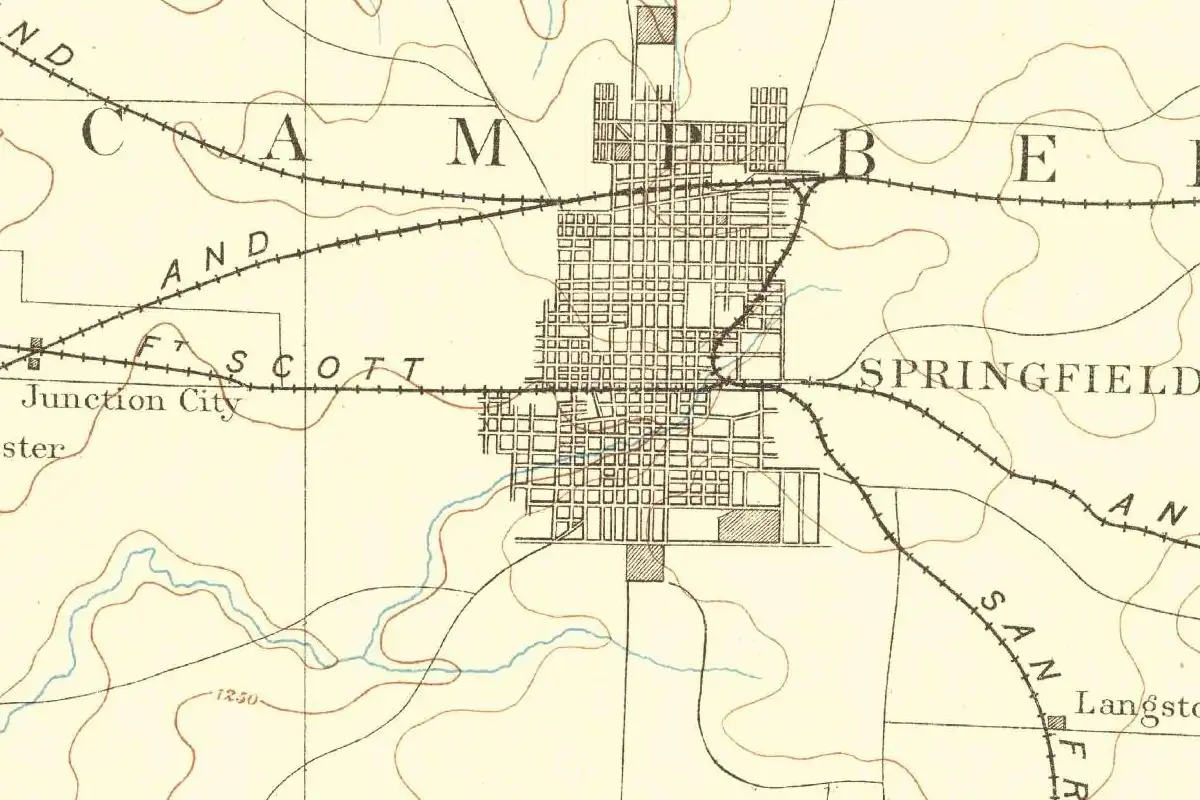
- U.S. Geological Survey, Springfield sheet (1884). The map at the top of this page.
- GNIS feature 735864, Springfield (U.S. Geological Survey). The official name, county and coordinates of the city.
Spot something wrong, or know more? Tell us here. You can also email us or use our contact page. Corrections are noted here with their date, never made silently.