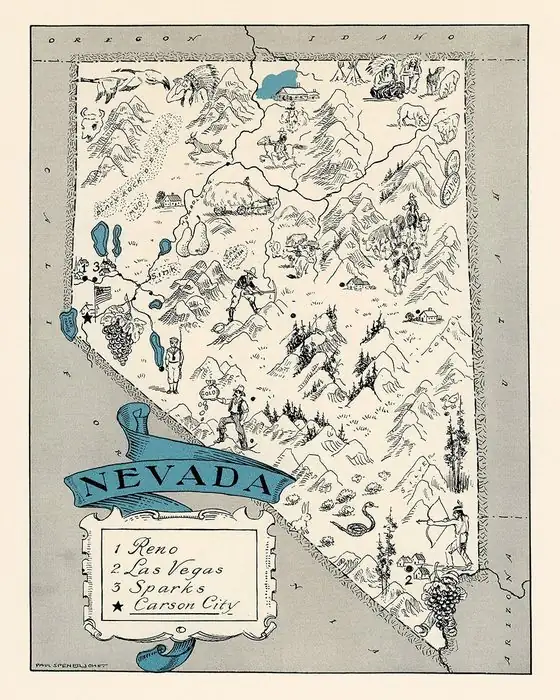
Ely, Nevada: Which Mr. Ely Gave the Copper Town Its Name?
The sources disagree. F. F. Thomas wrote in 1909 that he named Ely himself for Smith Ely, an investor in the local copper claims. Sam Davis's 1913 state history said the likeliest namesake was John Ely of Pioche's Raymond and Ely mine. Others pointed to a rancher or to Ely, Vermont.
A town named Ely, and too many Elys
Ely, Nevada, is named for a man called Ely, but which one has been argued since 1909: a copper investor, a Pioche mine owner and a rancher all had backers. One of the men who was there wrote a letter saying he named it himself. That should have settled it, and it didn’t.
Sam P. Davis didn’t pretend it was simple in his two-volume History of Nevada of 1913. “Numerous stories have been circulated as to the source from which Ely received its name,” he wrote. “At least half a dozen persons have been mentioned.” Four versions show up in the sources we could open, and you’ll find them below.
The copper claims in Robinson Canyon
First, the place. The Robinson Mining District, in what’s now White Pine County, was organized on March 16, 1868, and named for Thomas Robinson, the historian Russell R. Elliott wrote in 1956. Prospectors came for gold and silver and kept running into copper. By 1873, Elliott says, there was enough copper ore for the Selby Company to build a small furnace in the canyon, under an engineer named Joseph Long. It didn’t last.
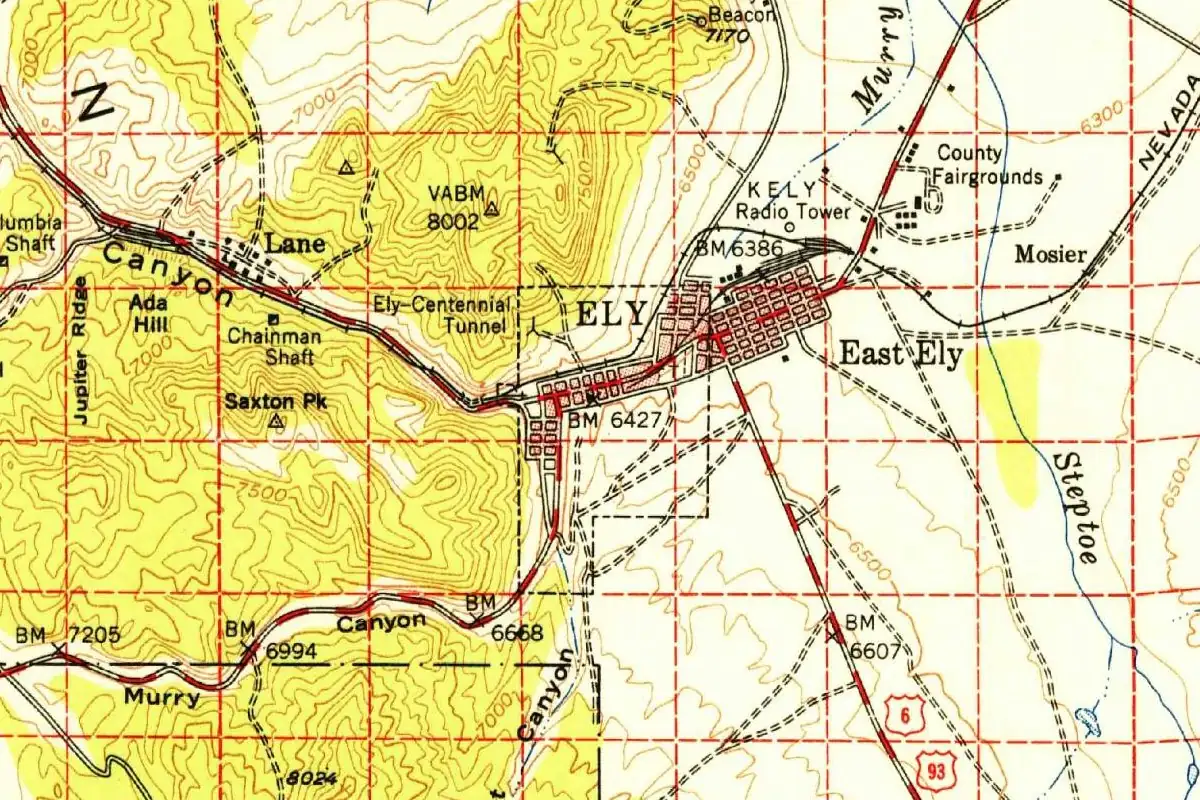
The camp at the mouth of the canyons, on Murry Creek, became the district’s center. The City of Ely says it started in the 1870s as a stagecoach stop and trading post called Murray Station. It stayed small until 1885, when fire destroyed the courthouse at Hamilton, the county seat. In 1887 the legislature voted to move the seat to Ely, and the town was surveyed that April. The old map at the top of this page shows what it grew into: Ely and East Ely in the valley, and the mining camps up the canyon.
Version one: Smith Ely, in the cabin
On January 2, 1909, the Mining and Scientific Press in San Francisco ran an article by Courtenay De Kalb on copper mining at Ely. He wrote that the name had nothing to do with Ely, Vermont. Two weeks later the magazine printed a reply from F. F. Thomas, writing from Berkeley, who said he could correct the record “with assurance, as the place was named by myself.”
Thomas said that more than 30 years earlier, he and Thomas H. Selby, a nephew of the founder of the Selby smelting works, held most of the copper claims in the district. They sold a half interest for $35,000 to Smith Ely, of Ely, Vermont, through Ely’s copper expert, Joseph Long. The ranch they bought on the creek covered the site of the town, and they needed a post office right away, so they needed a name. Thomas, Selby, Long and a metallurgist named Lewis Williams talked it over in their cabin. On page 114, Thomas wrote:
“None of us cared to be immortalized in this connection, and so I suggested the name of Ely, as a compliment to Smith Ely.”
Nobody in the cabin wanted the town named after himself, so they named it after the money. Thomas added that Long and Williams were dead, and that Selby, living in Mexico, could back him up. De Kalb answered on the next page that he was “glad to have the correction.”
Version two: John Ely and the borrowed $5,000
Davis, four years later, still preferred a different Ely. His “most probable story” was John Ely, a native of Illinois and a big, colorful frontiersman who’d made a fortune with William Raymond in the Raymond and Ely mine at Pioche, then lost it and made another. In this version, Ely loaned $5,000 to A. J. Underhill to buy the land for the town site, and Underhill, grateful, christened the new county seat Ely.
John Ely was real, and his name really was on a Nevada mining district. Hubert Howe Bancroft’s 1890 History of Nevada says a district near Pioche was reorganized in 1869 and “named Ely district, in honor of John H. Ely.” Thomas, answering De Kalb, wrote that he’d known “the Mr. Ely of whom Mr. De Kalb speaks” and took him for the man of the Raymond and Ely mine. That Ely, he said flatly, “had nothing to do with the naming of Ely in White Pine County,” though his name survived in the mine and in the district near Pioche.
Versions three and four: a hometown and a ranch
De Kalb’s original article had its own explanation, which he dropped after Thomas wrote in. He said cattlemen came to the valley first, including “one Ely from ‘down in Maine,’” and that “Ely’s Ranch became simple Ely.”
Then there’s Vermont. Elliott says some people held that Long named the town after his own hometown of Ely, Vermont, and that W. Y. McGill, son of a White Pine pioneer, told him in 1953 that this was the version his family accepted.
Which Ely carries the weight?
Elliott weighed all of it and sided with Smith Ely. In a long footnote, he lists three reasons. Thomas Rockhill, who was in the district before the town was named, told the White Pine News in 1906 that Long named it for the man who paid for the copper smelter. Thomas’s 1909 letter describes the naming as an eyewitness. And the newspaper’s 1906 story doesn’t mention the Underhill version at all. Elliott adds one more point: the Ward Reflex called the village “Ely City” in September 1878 and March 1879, years before Underhill bought land there in 1887.
That timing is the strongest clue you’ll find. If the name was in print by 1878, a loan for an 1887 land purchase can’t have inspired it. Still, we haven’t seen the 1878 paper ourselves, and Davis wrote his John Ely story after Thomas’s letter was already in print. So the fair call is “disputed,” with Smith Ely ahead on the evidence.
A copper town on the Loneliest Road
Whichever Ely it was, the copper paid off in the end. The Nevada State Historic Preservation Office’s marker says major copper discoveries made the area grow dramatically, and that the Nevada Northern Railway, headquartered in East Ely, linked Ely to the transcontinental railroad 150 miles (241 km) north. A bench mark in town on the old map reads 6,427 feet (1,959 m).
Nevada mining towns have a way of getting named in a hurry, by whoever was standing there. Virginia City got its name from a miner’s nickname and a broken whiskey bottle, and in Caliente, ranchers who sold hay to the Pioche camps watched postal officials trim their town’s name. For more, see our Nevada page.
Quick answers
Who is Ely, Nevada, named after?
The sources disagree. F. F. Thomas wrote in 1909 that he named it for Smith Ely, who bought into the local copper claims; Sam Davis’s 1913 history favored John Ely of the Raymond and Ely mine at Pioche.
Is Ely, Nevada, named after Ely, Vermont?
Not directly, by the best-documented account. Thomas said the namesake, Smith Ely, was “of Ely, Vermont,” but named the town for the man. A family account Elliott recorded in 1953 says Joseph Long named it for his Vermont hometown.
Who was Smith Ely?
The investor who bought a half interest in the Selby copper claims for $35,000 through his copper expert, Joseph Long, according to F. F. Thomas’s 1909 letter. Thomas said the town was named “as a compliment to Smith Ely.”
When did Ely become the county seat?
In 1887. The Nevada legislature moved the White Pine County seat from Hamilton to Ely after the 1885 courthouse fire, and the town site was surveyed that April.
Key dates
- 1868The Robinson Mining District is organized on March 16, named for Thomas Robinson.
- 1869A mining district near Pioche is renamed Ely district for John H. Ely, Bancroft writes.
- 1878The Ward Reflex calls the village Ely City, according to historian Russell Elliott.
- 1887The legislature moves the White Pine County seat from Hamilton to Ely, and the town site is surveyed in April.
- 1906Thomas Rockhill tells the White Pine News that Joseph Long named the town for the man who paid for the smelter, Elliott says.
- 1909F. F. Thomas writes to the Mining and Scientific Press that he named Ely himself, for Smith Ely.
- 1913Sam Davis's History of Nevada calls John Ely the most probable namesake.
Things to do in Ely, Nevada
Nevada Northern Railway Museum
A National Historic Landmark that calls itself America's best-preserved standard-gauge short line and a complete rail facility, with more than 70 buildings, 30 miles (48 km) of track and historic locomotives.
White Pine Public Museum
A county history museum in Ely with exhibits from prehistoric times to the pioneers, including Lilly, a replica of a cave bear found in White Pine County.
Ward Charcoal Ovens State Historic Park
Six beehive-shaped charcoal ovens in the Egan Range, used from 1876 to 1879 to help process silver ore, later a shelter for travelers with a reputation as a stagecoach bandits' hideout. You can walk among them.
Cave Lake State Park
A 32-acre reservoir stocked with rainbow trout, with hiking trails like the Steptoe Creek Trail in summer and ice fishing, skating and cross-country skiing in winter.
Great Basin National Park
From the 13,063-foot (3,982 m) summit of Wheeler Peak to the sagebrush foothills, with ancient bristlecone pines, Lehman Caves and very dark night skies for stargazing.
Getting there
Open Ely in Google Maps
Opens in a new tab. The pin is the center of Ely in the USGS place-name record.
The closest airports, Amtrak stations and intercity bus stops, measured in a straight line from the center of Ely.
Airports
- Elko Regional (EKO) 119 mi 192 km
- Cedar City Regional (CDC) 144 mi 232 km
Distances are as the crow flies, not by road. We don't list schedules or fares because they change; check with the airline, Amtrak or the bus company before you go. Official data (FAA commercial service airports (2025), FAA airport locations, Amtrak stations and Intercity Bus Atlas) from the FAA and the U.S. Bureau of Transportation Statistics, checked Nov 14, 2026.
Sponsored
Staying in Ely?
Compare hotels in Ely, Nevada, on Expedia.
See hotels in ElyWe may earn a commission if you buy through this link. It never changes what we write. Read our affiliate disclosure
Historical Sources & References
- F. F. Thomas, letter “Ely, Nevada,” Mining and Scientific Press, vol. 98 (January 16, 1909), pp. 114-115. “The place was named by myself”; the claims held with Thomas H. Selby, the half interest sold to Smith Ely of Ely, Vermont, through Joseph Long, the ranch on the creek, the meeting in the cabin and the name “as a compliment to Smith Ely”; the Ely De Kalb mentioned, whose name survived in the Raymond and Ely mine, “had nothing to do with the naming.” On the next page, De Kalb accepts the correction.
- Courtenay De Kalb, “Copper Mining at Ely, Nevada,” Mining and Scientific Press, vol. 98 (January 2, 1909), p. 58. The name “not transferred from Vermont”; the rancher Ely “from ‘down in Maine’” and “Ely’s Ranch.”
- Sam P. Davis, The History of Nevada, vol. II (1913), pp. 1049-1050. “At least half a dozen persons have been mentioned”; John Ely as the “most probable” namesake, his Raymond and Ely mine at Pioche and the $5,000 loan to A. J. Underhill.
- Russell R. Elliott, History of Nevada Mines Division, Kennecott Copper Corporation (1956). The Robinson District of 1868, the Selby furnace and Joseph Long, the courthouse fire of 1885, the county seat law of 1887 and the April 1887 survey (pp. 2-4); note 8 (p. 154) with the versions, the Rockhill interview of 1906, the Ward Reflex of 1878 and 1879 and the McGill family’s Vermont version.
- Hubert Howe Bancroft, History of Nevada, Colorado, and Wyoming (1890), p. 272. The district near Pioche “named Ely district, in honor of John H. Ely,” in 1869.
- City of Ely, Nevada. The town’s start in the 1870s as a stagecoach stop and trading post called Murray Station.
- Nevada State Historic Preservation Office, “Ely: Forging the Link”. County seat in 1887, the copper discoveries and the Nevada Northern Railway’s 150-mile route north to the transcontinental railroad.
- GNIS feature 859671 (U.S. Geological Survey). The U.S. names file puts Ely in White Pine County, as a populated place.
- U.S. Geological Survey, Ely sheet (1952). The 1:125,000 quadrangle the map at the top of this page was cropped from, with the 6427-foot bench mark in town.
Spot something wrong, or know more? Tell us here. You can also email us or use our contact page. Corrections are noted here with their date, never made silently.