Tonopah, Nevada: The Spring Behind a Silver Camp's Name
The town took its name from a spring that Indians called Tonopah, where prospector James L. Butler camped in 1900 before locating rich mining claims. Butler wrote in 1902 that the word meant "a small stream." Later sources give "water brush" or "thorny bush, hiding spring," so the exact meaning isn't settled.
A spring with a name already
Long before prospector James L. Butler camped there in 1900 and found ore nearby, Tonopah was the name Indians used for a desert spring. The mining camp, and then the town, kept the spring’s name, but what the word meant is still argued over.
You don’t have to take anyone’s word second-hand on that, because Butler wrote it down himself. On November 19, 1902, he answered a request for the story of the discovery, and Thomas Wren printed the letter in his 1904 A History of the State of Nevada, calling it “an authentic account.” It opens with the name, on page 149:
“Tonopah is an Indian name which, I learned when a boy, signifies ‘a small stream.’ The Indians on their periodical trips from the Cowich mountains and other places to Rhodes’ Salt Marsh, camped at this spring.”
So in Butler’s version the name belonged to a watering place on a travel route. He also says he’d long thought the mountains near the spring looked promising for prospecting, but he kept getting pulled away by other work.
The trip out of Belmont
Butler lived in Belmont, then the seat of Nye County. His letter says he left there in May 1900, crossed the Manhattan mountains, left Rye Patch, and “traveled all day to the springs known by the Indians as Tonopah, near which I found quartz.” He took samples, went on about four miles (6 km), and camped on May 19 near what later became the Gold Mountain mines.
The first assay of his Tonopah ore came back at 395 ounces of silver and 15½ ounces of gold to the ton. He went back on May 26 and took about 75 pounds more. Then he went home to his office duties and his hay, and didn’t return to stake the ground until August 25, 1900. Mrs. Butler came along and, in his words, “assisted materially in locating the claims.” His first location was the Desert Queen, then the Burro, and then he told his wife to name one. She called it the Mizpah, which he says turned out to be the richest of the lot.
The dates wobble depending on who’s telling it. J. E. Spurr’s 1905 U.S. Geological Survey report on the district says Butler left Belmont in April 1900, heading for a camp called Southern Klondike, and puts the claim locations on August 27. Bessie Beatty’s Who’s Who in Nevada (1907) has the samples taken on May 19 and the locations made on the 26th. If you want the earliest word, it’s Butler’s own letter: May and August 25.
Who gave the camp its name
Beatty’s book adds one line you won’t find in Butler’s letter: “Mrs. Butler named the camp Tonopah.” That doesn’t really clash with his story. His letter credits her with naming the Mizpah claim and says nothing about who chose the camp’s name. Either way, Butler’s letter ties the word to the spring, and none of the early accounts gives it any other source.
The Nevada historical marker in town tells it the same way. It says Indians “originally used the name Tonopah for a small spring in the nearby San Antonio Mountains, long before Butler camped in this area in May 1900.”
Three readings of one word
The sources part ways on this one, so it’s worth seeing all of them side by side:
- “A small stream.” Butler, 1902, from what he learned as a boy.
- “Water brush.” Spurr’s 1905 report, in a footnote on page 27, says the name is Indian and means “water brush, a desert shrub whose presence points to moisture in the soil beneath.”
- “Thorny bush, hiding spring.” The 1941 Origin of Place Names: Nevada, put together by the state’s Writers’ Project, repeats “water brush,” then says “Tono” means thorny and “pah” means water, and that a local Indian defined the name as “thorny bush, hiding spring.”
All three versions tie the word to water, which fits a name for a spring in dry country. But none of these sources names the language or cites a linguist, so it’s safer to treat the exact translation as open than to pick one.
From mining camp to county seat
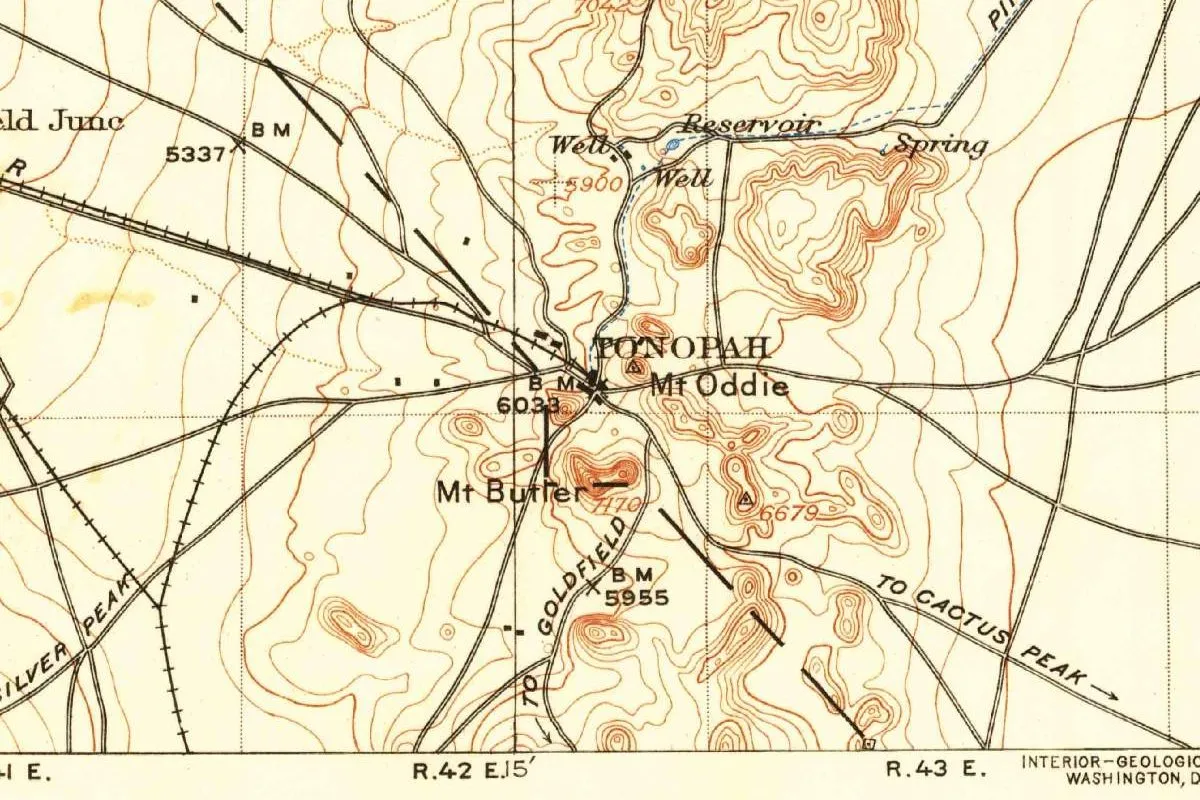
The strike filled the hills with claims fast. Wren says Butler, “now known as the ‘Father of Tonopah,’” and his partners T. L. Oddie and W. Brougher had finished their locations by that November. On the 1907 survey sheet above, two peaks right next to the town carry the names Mt Oddie and Mt Butler.
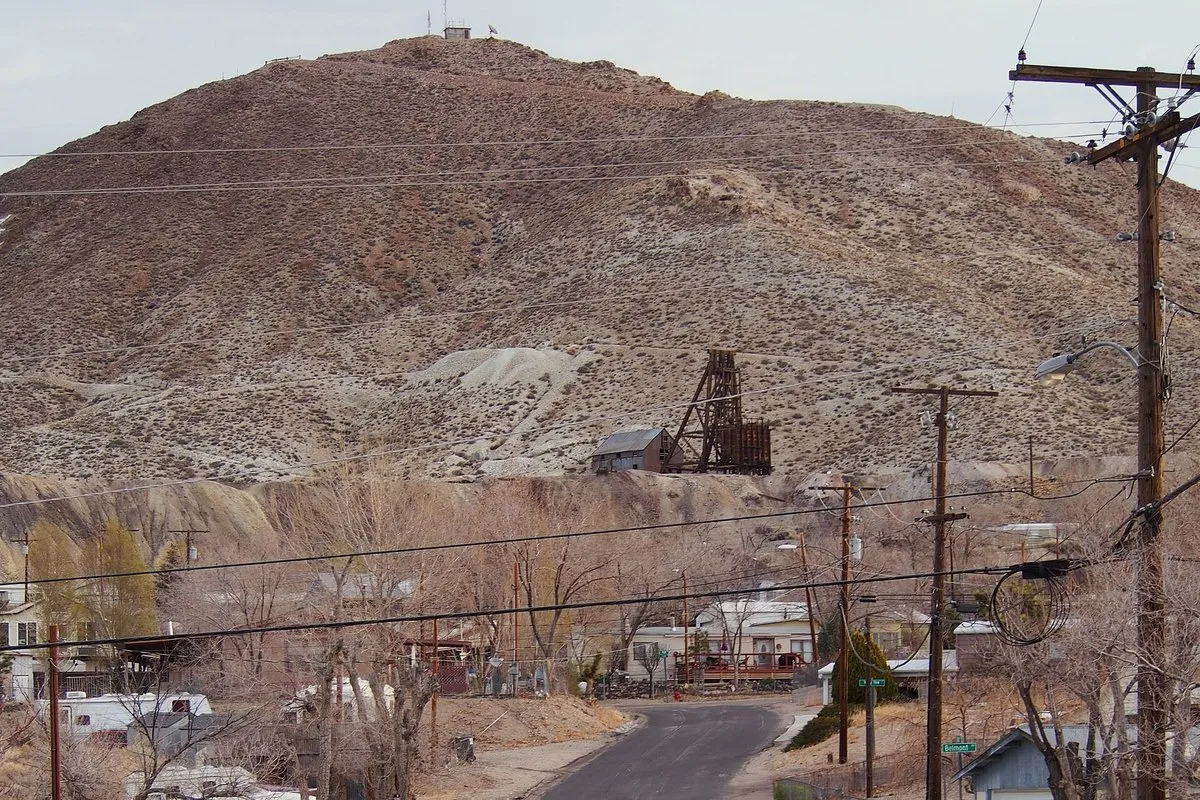
The 1941 WPA guide says Tonopah was incorporated in 1903 and disincorporated in 1923. The marker says it took over from Belmont as the Nye County seat in 1905, so the old home base of the prospector who found the ore lost the county seat to the camp he started. Today you can see a wooden headframe on the hill above Tonopah’s streets, a reminder of the strike that put a spring’s name on the map of Nevada.
Quick answers
Did the Butlers make up the name Tonopah?
No. Butler’s 1902 letter says Tonopah was already the Indian name of a spring; Beatty’s 1907 book credits Mrs. Butler with naming the camp.
What does Tonopah mean?
Sources differ. Butler wrote “a small stream” in 1902, Spurr’s 1905 USGS report says “water brush,” and the 1941 WPA guide gives “thorny bush, hiding spring.”
When was Tonopah founded?
In 1900. Butler found ore near the spring that May and came back to locate the first claims in late August; sources give the 25th, 26th or 27th.
Key dates
- 1900Butler leaves Belmont and reaches the springs the Indians called Tonopah. His letter says May; a 1905 USGS report says April.
- 1900August: the Butlers locate the first claims, starting with the Desert Queen. Sources give the 25th, 26th or 27th.
- 1902November 19: Butler writes that Tonopah is an Indian name meaning "a small stream."
- 1903Tonopah is incorporated, according to the 1941 WPA guide to Nevada place names.
- 1905Tonopah replaces Belmont as the Nye County seat. A USGS report says the name means "water brush."
- 1923Tonopah is disincorporated, according to the 1941 WPA guide.
Getting there
Open Tonopah in Google Maps
Opens in a new tab. The pin is the center of Tonopah in the USGS place-name record.
The closest airports, Amtrak stations and intercity bus stops, measured in a straight line from the center of Tonopah.
Airports
- Bishop (BIH) 78 mi 126 km
Distances are as the crow flies, not by road. We don't list schedules or fares because they change; check with the airline, Amtrak or the bus company before you go. Official data (FAA commercial service airports (2025), FAA airport locations, Amtrak stations and Intercity Bus Atlas) from the FAA and the U.S. Bureau of Transportation Statistics, checked Nov 13, 2026.
Sponsored
Staying in Tonopah?
Compare hotels in Tonopah, Nevada, on Expedia.
See hotels in TonopahWe may earn a commission if you buy through this link. It never changes what we write. Read our affiliate disclosure
Sponsored
Want the spooky side of Tonopah?
The name has its story above. For the ghost stories, US Ghost Adventures runs walking ghost tours in Tonopah.
See ghost tours in TonopahWe may earn a commission if you book through this link. It never changes what we write. Read our affiliate disclosure
Historical Sources & References
- J. L. Butler, letter of November 19, 1902, in Thomas Wren, A History of the State of Nevada (1904), pp. 149-150. Tonopah as an Indian name meaning “a small stream,” the camping place on the way to Rhodes’ Salt Marsh, the May 1900 trip from Belmont, the camp of May 19, the return on May 26, the claims of August 25 and the Mizpah named by Mrs. Butler; Wren’s note on Butler as “Father of Tonopah” and on the locations finished by November.
- J. E. Spurr, Geology of the Tonopah Mining District, Nevada (USGS, 1905), pp. 25-27. The April 1900 departure from Belmont, the August 27 locations and the footnote giving the name as “water brush.”
- Bessie Beatty, Who’s Who in Nevada (1907), p. 48. The May 19 samples, the locations on the 26th and the line “Mrs. Butler named the camp Tonopah.”
- Nevada State Writers’ Project, Origin of Place Names: Nevada (1941), p. 60. The pronunciation tō’nō pä, incorporation in 1903 and disincorporation in 1923, “water brush,” “tono” and “pah,” and “thorny bush, hiding spring.”
- Nevada State Historic Preservation Office, Historical Marker No. 15. The Indian name for a small spring in the San Antonio Mountains and the move of the county seat from Belmont in 1905.
- GNIS feature 845985 (U.S. Geological Survey). Tonopah’s record in the USGS names file, under Nye County.
- U.S. Geological Survey, Tonopah sheet (dated 1907). The 1907 sheet the map above is cut from, with Mt Oddie and Mt Butler next to town.
Spot something wrong, or know more? Tell us here. You can also email us or use our contact page. Corrections are noted here with their date, never made silently.