Cape May, NJ: Named for a Dutch Captain Called Mey
Cape May takes its name from the cape that Dutch captain Cornelius Jacobsen Mey named for himself. Lewis Townsend Stevens's 1897 county history says he christened it Cape Mey in 1623; the city's website gives 1621 on one page and 1611 to 1614 on another. The town itself was called Cape Island until 1869.
Mey, not May
Cape May isn’t named for the month but for Cornelius Jacobsen Mey, a Dutch captain, and the city’s own website gives two different dates for his visit. On its “History of Cape May” page, the City of Cape May writes of a “sighting by Sir Henry Hudson in 1609, and exploration by Cornelius Jacobsen Mey in 1621.” On its “About Cape May” page, it says the city “was named for Dutch captain Cornelius Jacobsen Mey, who explored and chartered the area from 1611 to 1614.”
Both pages agree on the man, so you can take that part as settled. The year is the slippery bit, and an old county history adds a third one.
The captain who named the coast after himself
Lewis Townsend Stevens, who published The History of Cape May County in 1897, puts Mey’s naming on a voyage in 1623. Stevens says Mey sailed in the ship Blyde Broodschap, or Glad Tidings, reached Manhattan in May 1623 and was styled the first director of New Netherland. Then he went south:
“It was during this voyage in 1623, to Delaware Bay, that Captain Mey gave to the Cape his name, and christened it Cape Mey…” (Stevens, The History of Cape May County, p. 16)
Mey wasn’t shy with his own name. Stevens says he called the bay of New York “Port Mey” and the Delaware “New Port Mey,” named the northern cape of the Delaware Cape Mey and the southern one Cape Cornelius, and built Fort Nassau on Timber Creek. Only one of those names lasted, Stevens notes, with the “e” changed to an “a.”
The spelling wandered in other places too. The county and city were named “from the cape named for Cornelis Jacobse May, a navigator in the employ of the Dutch West Indian Company,” according to the Geological Survey’s 1905 roundup of name origins by Henry Gannett. Its entry for the cape itself calls him Cornelius Jacobson May.
Cape Island first
The town at the tip of the cape didn’t carry the cape’s name for a long time. The city’s history speaks of “this area now known as Cape Island,” home to the Kechemeche, a Lenni-Lenape people, and dates the start of the resort to 1766.
John P. Snyder’s 1969 study of New Jersey’s civil boundaries gives the legal steps. Cape Island became a borough, formed from Lower Township, on March 8, 1848. It became a city on March 10, 1851. Then, on March 9, 1869, Snyder records the change plainly: “Became Cape May city.” Stevens adds that the borough form didn’t suit the people there, which is why they got a city charter in 1851. The city says the railroad had reached Cape Island in 1863, and a fire swept through the resort in 1878.
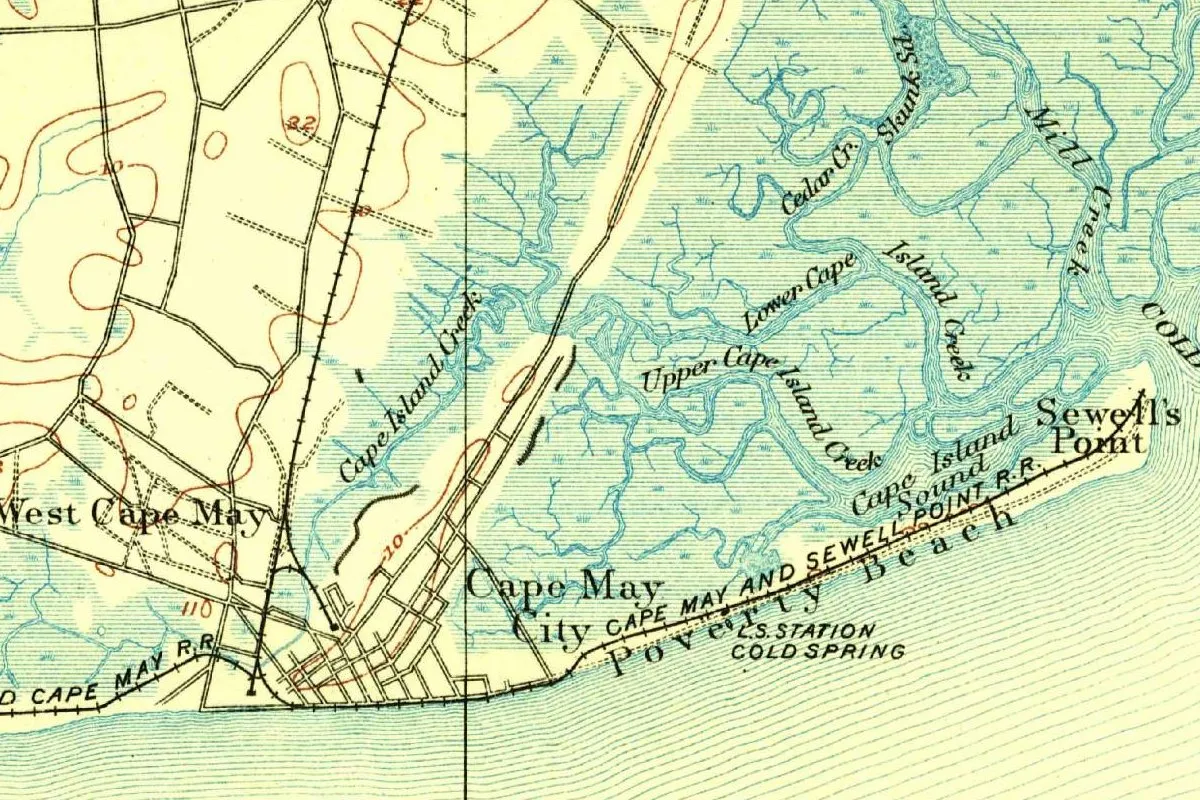
The old name hung on after the switch. On the 1888 survey map at the top of this page, you’ll see “Cape May City” printed next to Cape Island Creek and Cape Island Sound.
Quick answers
Is Cape May named after the month of May?
No. It’s named for Cornelius Jacobsen Mey, a Dutch captain who gave the cape his own name, Cape Mey, according to Stevens’s 1897 county history and the City of Cape May.
What was Cape May called before?
Cape Island. It became a borough under that name in 1848 and a city in 1851, and the city of Cape Island became the city of Cape May on March 9, 1869.
Who was Cornelius Jacobsen Mey?
A Dutch sea captain. Stevens says he reached Manhattan in 1623 in the ship Blyde Broodschap and was styled the first director of New Netherland; Gannett says he worked for the “Dutch West Indian Company.”
Key dates
- 1609Henry Hudson sights the area, according to the City of Cape May.
- 1621The city's history page dates Cornelius Jacobsen Mey's exploration to this year; another city page says 1611 to 1614.
- 1623Stevens's county history says Mey reaches Manhattan in May and, on the same voyage, names the cape Cape Mey.
- 1766The city dates the start of Cape Island as a resort to this year.
- 1848March 8: the borough of Cape Island is formed from Lower Township.
- 1851March 10: Cape Island becomes a city.
- 1863The railroad reaches Cape Island.
- 1869March 9: the city of Cape Island becomes the city of Cape May.
- 1878A fire burns through the resort.
Getting there
Open Cape May in Google Maps
Opens in a new tab. The pin is the center of Cape May in the USGS place-name record.
The closest airports, Amtrak stations and intercity bus stops, measured in a straight line from the center of Cape May.
Airports
- Atlantic City International (ACY) 40 mi 65 km
- Salisbury-Ocean City Wicomico Regional (SBY) 52 mi 84 km
- Philadelphia International (PHL) 67 mi 108 km
Amtrak trains
- Atlantic City station (ACY) 39 mi 62 km
- Absecon station (ABN) 40 mi 65 km
Intercity buses
- OurBus Cape May, NJ (Downtown - NW corner of Lyle Lane & Decatur St in front of Comfort Station across Rotary Park - approx address 308 Decatur St (transfer required at Galloway with hired car or rideshare)) under 1 mi 1 km
- FlixBus Dover 7-Eleven 37 mi 60 km
- Greyhound Atlantic City Pacific Ave 38 mi 61 km
Distances are as the crow flies, not by road. We don't list schedules or fares because they change; check with the airline, Amtrak or the bus company before you go. Official data (FAA commercial service airports (2025), FAA airport locations, Amtrak stations and Intercity Bus Atlas) from the FAA and the U.S. Bureau of Transportation Statistics, checked Nov 13, 2026.
Sponsored
Staying in Cape May?
Compare hotels in Cape May, New Jersey, on Expedia.
See hotels in Cape MayWe may earn a commission if you buy through this link. It never changes what we write. Read our affiliate disclosure
Sponsored
Want the spooky side of Cape May?
The name has its story above. For the ghost stories, US Ghost Adventures runs walking ghost tours in Cape May.
See ghost tours in Cape MayWe may earn a commission if you book through this link. It never changes what we write. Read our affiliate disclosure
Historical Sources & References
- City of Cape May, “History of Cape May”. Hudson in 1609, Mey’s exploration “in 1621,” the Kechemeche, “this area now known as Cape Island,” the resort from 1766, the railroad in 1863 and the fire of 1878.
- City of Cape May, “About Cape May”. The city “was named for Dutch captain Cornelius Jacobsen Mey, who explored and chartered the area from 1611 to 1614.”
- Lewis Townsend Stevens, The History of Cape May County, New Jersey (1897). Mey’s voyage in the Blyde Broodschap, his arrival at Manhattan in May 1623, the naming of Cape Mey and his other names, and Fort Nassau (pp. 15-17); the borough of Cape Island and the city charter of 1851.
- John P. Snyder, The Story of New Jersey’s Civil Boundaries, 1606-1968 (1969), pp. 113-114. Cape Island borough on March 8, 1848, Cape Island city on March 10, 1851, and “Became Cape May city” on March 9, 1869.
- Henry Gannett, The Origin of Certain Place Names in the United States (USGS, 1905), pp. 68, 203. The county and city “named from the cape named for Cornelis Jacobse May” (p. 68) and the cape named for “Cornelius Jacobson May” (p. 203).
- GNIS feature 875189 (U.S. Geological Survey). Pinned as a populated place in Cape May County, with the coordinates used for this page.
- U.S. Geological Survey, Cape May sheet (1888). The source of the map at the top of this page, with Cape May City beside Cape Island Creek.
Spot something wrong, or know more? Tell us here. You can also email us or use our contact page. Corrections are noted here with their date, never made silently.