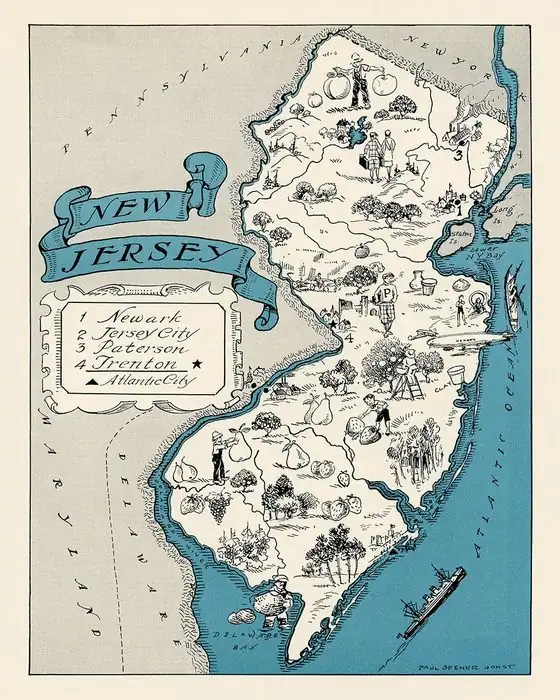
Camden, New Jersey: How Cooper's Ferries Got a Lord's Name
Camden is named for Charles Pratt, Earl of Camden, a British lord who sided with the American colonies before the Revolution. In 1773 Jacob Cooper, a Philadelphia merchant, laid out forty acres at the crossing known as Cooper's Ferries into streets and lots and named the new town after him. Camden County took the same name in 1844.
King Street, Queen Street, Camden
Camden, New Jersey, was laid out in 1773 with a King Street and a Queen Street, yet named for Lord Camden, the British peer who opposed the king’s policy. That’s the mix you get when a Philadelphia merchant draws up a town on the eve of a revolution. Loyal-sounding street names, and a town name that tipped its hat to the colonies’ best friend in London.
The man with the pen was Jacob Cooper, and the place he drew it on had already been busy for nearly a century. It just didn’t have a town name yet. People called it the Ferries.
A century of ferries
The Lenape lived along this part of the Delaware long before Europeans arrived, as Bonny Beth Elwell of the Camden County Historical Society points out. Quakers from England and Ireland started settling the creeks on the Jersey side in 1675. One of them, a London blacksmith named William Cooper, settled at the mouth of Coopers Creek in 1681.
By 1682, Elwell writes, settlers were already ferrying across the river from Cooper’s landing to Philadelphia, and the Cooper family soon became the main ferry operators. An old account of the ferries says there was a ferry at Cooper’s Point before 1708, when William Cooper deeded it to his son Joseph “including the ferry at Cooper’s Point.” The ferry landings shipped timber, crops and livestock across to Philadelphia. Elwell also records a darker trade: from 1727 to 1765, a few hundred enslaved Africans were offered for sale at the Cooper’s Ferry landings.
A history of the city written in 1928, Span of a Century, sums up what the place was then. “The settlement was known as ‘The Ferries’ or ‘Cooper’s Ferries.’” For a long time, it says, Camden “was the only passageway by which the travel of West Jersey found an entrance into Philadelphia,” and all that comprised it were a few houses.
Jacob Cooper draws a town
George R. Prowell’s History of Camden County, published in 1886, picks up the story with Jacob Cooper, a merchant in Philadelphia. Cooper guessed that the great crossing place known as Cooper’s Ferries “would be a town of considerable importance,” and on April 23, 1764, he got a hundred acres on the river from his father.
Then, Prowell writes, “in the year 1773 he laid out forty acres of this tract into streets and lots, and named it after the Earl of Camden.” He drew 160 lots, a public square at Market and Third, and a set of streets running back from the river: King, Queen, Whitehall, Cherry, Cedar and Pine. The old road along the north side became Cooper Street.
If you walk the city today, you won’t find King or Queen there. Prowell notes that those names were changed when Camden became a city in 1828. King turned into Front Street, Queen into Second, Whitehall into Third.
Why the Earl of Camden?
Prowell doesn’t leave the choice unexplained. In his opening to the city’s history, he says Cooper was “imbued with the same patriotic spirit as his friends and associates,” and so “he named his new town Camden, in honor of Charles Pratt, Earl of Camden.” He describes Pratt as a lawyer and statesman, Lord Chancellor of England in 1766, who “boldly opposed the policy of the King and his ministers, and openly expressed his sympathy for the Americans.”
The 1928 book says much the same thing in warmer words. The name, it says, “was chosen in the spirit of patriotism and gratitude,” because Pratt “had uniformly befriended the colonists in their struggle for independence.” In 1905, the government’s place-name compiler, Henry Gannett, put the county and the city in one entry with other Camdens around the country, all named for “Chief Justice Pratt, Earl of Camden, a friend of the colonies during the Revolution.”
So a town begun with King Street ended up honoring the lord who opposed the King’s policy. The timing helps explain both. In 1773 the colonies were angry but not yet at war.
The war, then the city
The war arrived two years later. When the British occupied Philadelphia in 1777 and 1778, Elwell says, British and Hessian troops passed through Cooper’s Ferry and later occupied it, crossing one last time as they left Philadelphia in June 1778.
Afterward the town kept growing in pieces. Elwell lists Cooper Village added in 1793 and Camden Village in 1820, and the city was incorporated on February 14, 1828. The 1928 history says the new city was really five villages, with Cooper’s Point still remembered as “William Cooper’s Ferry.” In 1844, New Jersey carved Camden County out of Gloucester County and gave it the same name.
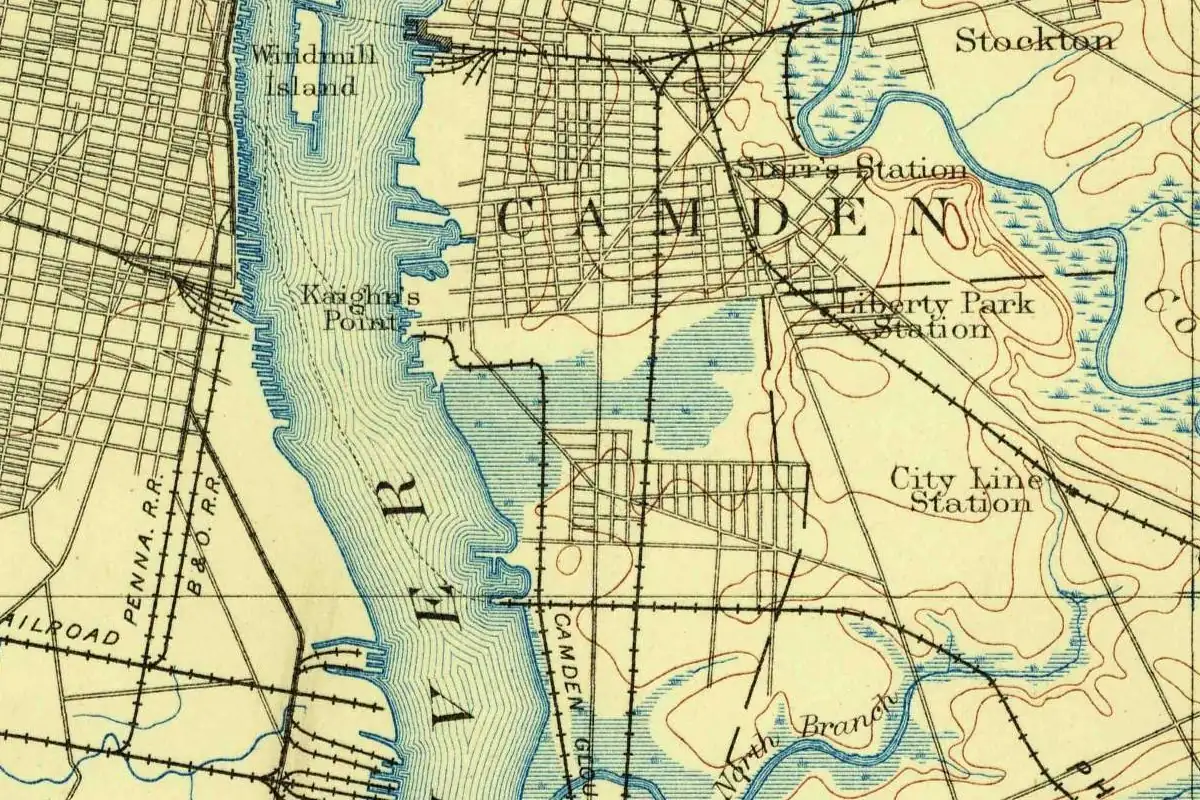
The ferries kept running too. The old ferry account says a canal was cut across Windmill Island in 1838 so boats could stop detouring around it, and you can see the island in the middle of the river on the 1891 map at the top of this page. Rail followed: the Camden and Atlantic Railroad ran from here to the beach and gave Atlantic City its start. Then in 1926 the Delaware River Bridge, later renamed the Benjamin Franklin Bridge, linked Camden to Philadelphia by road.
One lord, many towns
Camden wasn’t the only American town to borrow Charles Pratt’s title. Up the coast, Camden, Maine, had the name by 1768 and spelled it Cambden for decades. Elwell’s article sits in a London society’s guide to all of them, and it ends with a fitting footnote: in 1975 the mayor of Camden, New Jersey, gave a symbolic golden key to the mayor of the London Borough of Camden. More stories from this state are on our New Jersey page.
The ferry is what made Camden. The name is what Jacob Cooper chose to put on it, in the years just before the war, when an English lord could still be the colonies’ champion.
Quick answers
Who named Camden, New Jersey?
Jacob Cooper, a Philadelphia merchant. Prowell’s 1886 county history says he laid out the town in 1773 and named it after the Earl of Camden.
What was Camden, NJ, called before it was Camden?
The settlement was known as “The Ferries” or “Cooper’s Ferries,” after the Cooper family’s ferry landings across the river from Philadelphia.
Why did a colonial town have a King Street?
Jacob Cooper’s 1773 plan included King, Queen and Whitehall streets. Prowell says those names were changed when Camden became a city in 1828; King Street is now Front Street.
Is Camden County named after the city?
Not directly. Elwell writes that Camden County, created in 1844, was named for Charles Pratt, 1st Earl Camden, and the city became its county seat in 1848.
Key dates
- 1681William Cooper, a Quaker blacksmith from London, settles at the mouth of Coopers Creek.
- 1764On April 23, Jacob Cooper gets from his father a hundred acres on the river at Cooper's Ferries.
- 1773Jacob Cooper lays out forty acres into streets and lots and names the town after the Earl of Camden.
- 1828On February 14, Camden is incorporated as a city, and the King and Queen streets get new names.
- 1844Camden County is created, also named for the Earl of Camden.
Things to do in Camden, New Jersey
Battleship New Jersey
A nonprofit museum and memorial on the Camden Waterfront where you can tour America's most decorated battleship, with self-guided and guided tours and hands-on exhibits.
Adventure Aquarium
An aquarium on Riverside Drive in Camden, minutes from Center City Philadelphia, with more than 5,000 aquatic animals, what it calls the largest collection of sharks in the Northeast, and hippos.
Ben Franklin Bridge Pedestrian Walkway
A walkway on the bridge between Philadelphia and Camden for walkers, runners and cyclists. On the New Jersey side you reach it at 4th and Pearl Street.
Camden County Historical Society
The county's historical society on Park Boulevard, with Pomona Hall, a historic house from 1726, and a historical and genealogical research library.
Getting there
Open Camden in Google Maps
Opens in a new tab. The pin is the center of Camden in the USGS place-name record.
The closest airports, Amtrak stations and intercity bus stops, measured in a straight line from the center of Camden.
Airports
- Philadelphia International (PHL) 7 mi 12 km
- Trenton Mercer (TTN) 29 mi 47 km
Amtrak trains
- Philadelphia station (PHL) 4 mi 6 km
- Cherry Hill station (CRH) 4 mi 7 km
Intercity buses
- Greyhound Camden Walter Rand Trans Center 1 mi 2 km
- OurBus Philadelphia, PA (Oregon Market, 320 Oregon Ave, Philadelphia, PA 19148, United States) 2 mi 3 km
- Peter Pan Bus Lines Philadelphia (Bus Terminal) 3 mi 4 km
Distances are as the crow flies, not by road. We don't list schedules or fares because they change; check with the airline, Amtrak or the bus company before you go. Official data (FAA commercial service airports (2025), FAA airport locations, Amtrak stations and Intercity Bus Atlas) from the FAA and the U.S. Bureau of Transportation Statistics, checked Nov 14, 2026.
Sponsored
Staying in Camden?
Compare hotels in Camden, New Jersey, on Expedia.
See hotels in CamdenWe may earn a commission if you buy through this link. It never changes what we write. Read our affiliate disclosure
Historical Sources & References
- George R. Prowell, The History of Camden County, New Jersey (1886), p. 403. The town planned “imbued with the same patriotic spirit,” named Camden “in honor of Charles Pratt, Earl of Camden,” Lord Chancellor in 1766, who “boldly opposed the policy of the King and his ministers.”
- George R. Prowell, The History of Camden County, New Jersey (1886), p. 418. Jacob Cooper the Philadelphia merchant, his land of April 23, 1764, the forty acres laid out in 1773 and “named it after the Earl of Camden,” the 160 lots, the public square, and King, Queen and Whitehall streets renamed in 1828.
- Bonny Beth Elwell, Camden County Historical Society, “Camden & Camden County, New Jersey”. In the Camden History Society’s guide to American Camdens: the Lenape, William Cooper in 1681, the ferry by 1682, the enslaved people sold at the landings in 1727-1765, Jacob Cooper’s town of 1773, the British occupation, the city of 1828, the county of 1844 and the county seat in 1848, the bridge of 1926 and the golden key of 1975.
- Camden NJ History, “Span of a Century: Intro”. The 1928 introduction: the name “chosen in the spirit of patriotism and gratitude,” “The Ferries” or “Cooper’s Ferries,” Camden as West Jersey’s passage to Philadelphia, and the five villages of the 1828 city.
- Camden NJ History, “Old Ferries”. The ferry at Cooper’s Point before 1708 and the 1838 canal across Windmill Island.
- Henry Gannett, The Origin of Certain Place Names in the United States (USGS, 1905), p. 65. The county and city in New Jersey among the Camdens “named for Chief Justice Pratt, Earl of Camden, a friend of the colonies during the Revolution.”
- GNIS feature 875105 (U.S. Geological Survey). The federal listing for Camden, a populated place in Camden County.
- U.S. Geological Survey, Philadelphia sheet (1891). The 1:62,500 quadrangle the map at the top of this page was cut from.
Spot something wrong, or know more? Tell us here. You can also email us or use our contact page. Corrections are noted here with their date, never made silently.