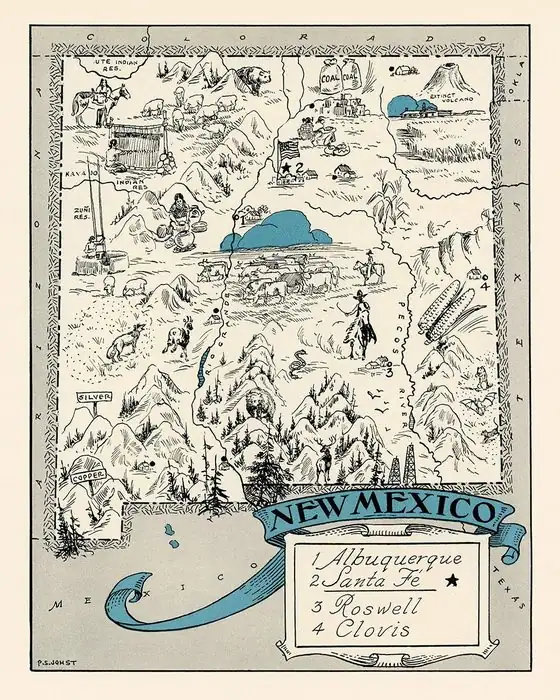
Gallup, New Mexico: Named for the Railroad's Paymaster
Gallup is named for David L. Gallup, an officer of the Atlantic and Pacific Railroad. In 1880 the railroad set up his headquarters on the construction line, and workers collecting their wages said they were "going to Gallup." When the town was established in 1881, it took his name. A 1907 history calls him one of the company's auditors.
“Going to Gallup”
Gallup, New Mexico, is named for the railroad man who handled the pay: Atlantic and Pacific workers said they were “going to Gallup” to get paid. The phrase turned into the name of the town.
The man was David L. Gallup. What exactly his job was depends on which book you open, and that’s where the story gets a little more interesting.
A headquarters on the construction line
In 1880 the Atlantic and Pacific Railroad was building a southern transcontinental line across New Mexico. That year, according to Visit Gallup, the city’s tourism office, the railroad built a headquarters for its paymaster, David L. Gallup, in what was then rural country along the route. The Gallup Economic Development Corporation tells it the same way: Gallup set up headquarters along the construction right-of-way.
Railroad crews had to go to him to collect their wages. “Workers started using the phrase ‘going to Gallup’ when they discussed picking up their paychecks,” Visit Gallup says. In 1881, when a town was established on the spot, “Gallup was chosen as the name.” The development corporation sums it up even faster: the workers began “going to Gallup” to get their pay, “thus a town was born and named in 1881.”
You’ll find the same story in the Albuquerque Journal, which in March 2026 described the city as “named after Atlantic & Pacific paymaster David Gallup.”
Paymaster or auditor?
Go back a century and the job title shifts. In 1907, Pacific States Publishing put out a two-volume History of New Mexico, with local histories county by county. Its Gallup section, which runs onto page 837, says the town was settled shortly before the Atlantic & Pacific line reached the spot in 1881, and that “the town was named in honor of one of the auditors of the company engaged in the construction of the road.”
That book doesn’t give his first name, and it doesn’t use the word paymaster or tell the “going to Gallup” story. The modern accounts don’t say where the phrase was first recorded either. So here’s what you can count on: a railroad officer named Gallup, whose office was on the construction line, gave the town its name in 1881. Whether you call him a paymaster or an auditor, the paychecks and the name both ran through the railroad’s books.
The first settlers by the section house
The 1907 history fills in who came first. The first permanent settler, it says, was J. W. Swartz, who arrived on December 15, 1881, with a bridge-building crew run by his brother. Swartz, his wife and their son, Frank, lived upstairs in the rough section house, and for several months Mrs. Swartz was the only white woman in the new town. Swartz later opened a store, served as the first justice of the peace and, from 1883 to 1885, as Gallup’s first postmaster. In 1883 he and two neighbors became trustees of the first school district, and the book adds that their one-room schoolhouse “is claimed” to have been the first public school opened in New Mexico.
The town was incorporated on July 9, 1891. Ten years later, when McKinley County was carved out of Bernalillo County with Gallup as its seat, the same book says people had expected the new county to be called Summit, “but the popularity of the martyred president carried the day.” The martyred president was William McKinley, and the county still carries his name.
Coal, the Santa Fe and Route 66
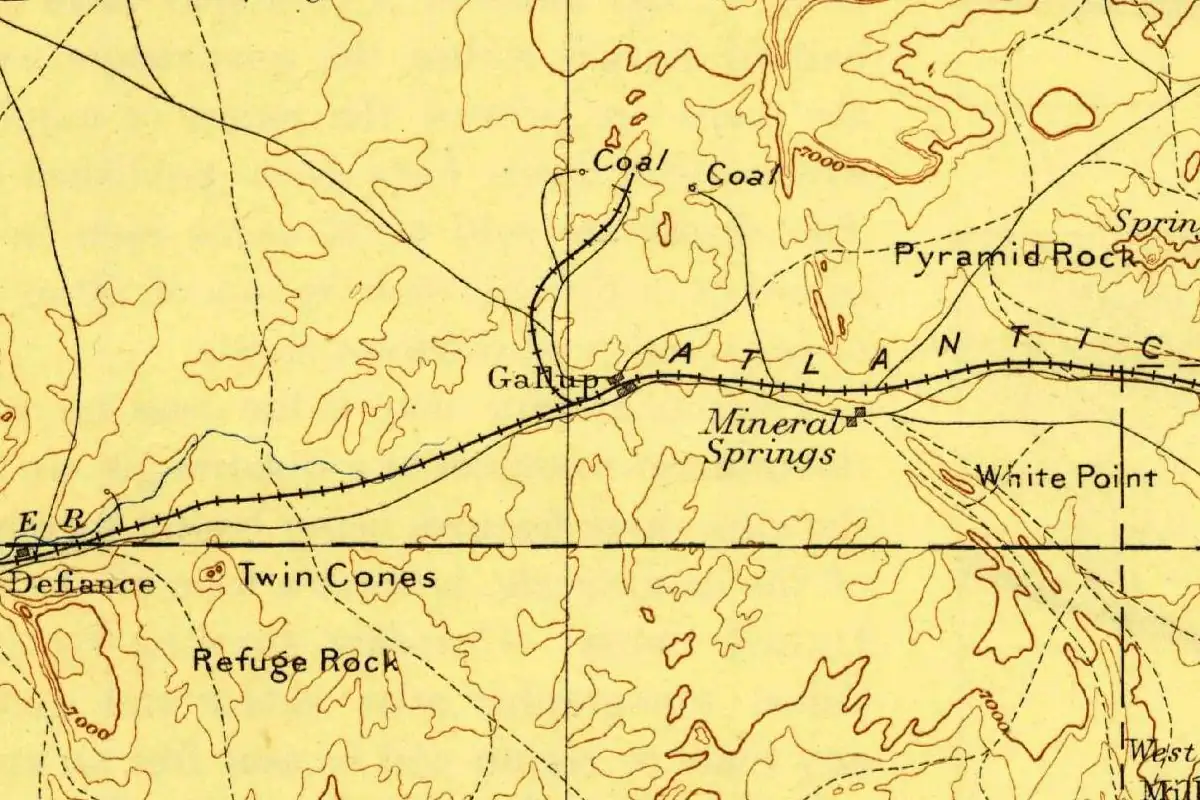
The railroad gave Gallup its name, and coal gave it a reason to grow. Visit Gallup says the discovery of coal in the nearby hills turned the town into a mining center, with dozens of camps around it and the nickname “Carbon City.” The mines kept going until the last ones closed in 1952. The old map at the top of this page shows that early setup: a tiny station on the line marked “Atlantic,” with a branch track heading north toward two spots labeled “Coal.”
The Atchison, Topeka & Santa Fe chose Gallup as a division point in 1895 and built shops and a depot hotel, Visit Gallup says. Later came Mary Colter’s El Navajo, a Fred Harvey hotel designed in 1916 and finished in 1923. Colter skipped the Mission Revival look of some of her other work and went with Pueblo Revival, in honor of the town’s Native American ties, and filled the inside with Native American art. It was one of the biggest Harvey Houses on the line and one of the main training grounds for Harvey Girls. It closed and was torn down in 1957, and the Gallup Skate Park now sits where it stood. The old Santa Fe depot survived, and it still serves Amtrak’s Southwest Chief. Today the line is part of BNSF’s Southern Transcon from Chicago to Los Angeles.
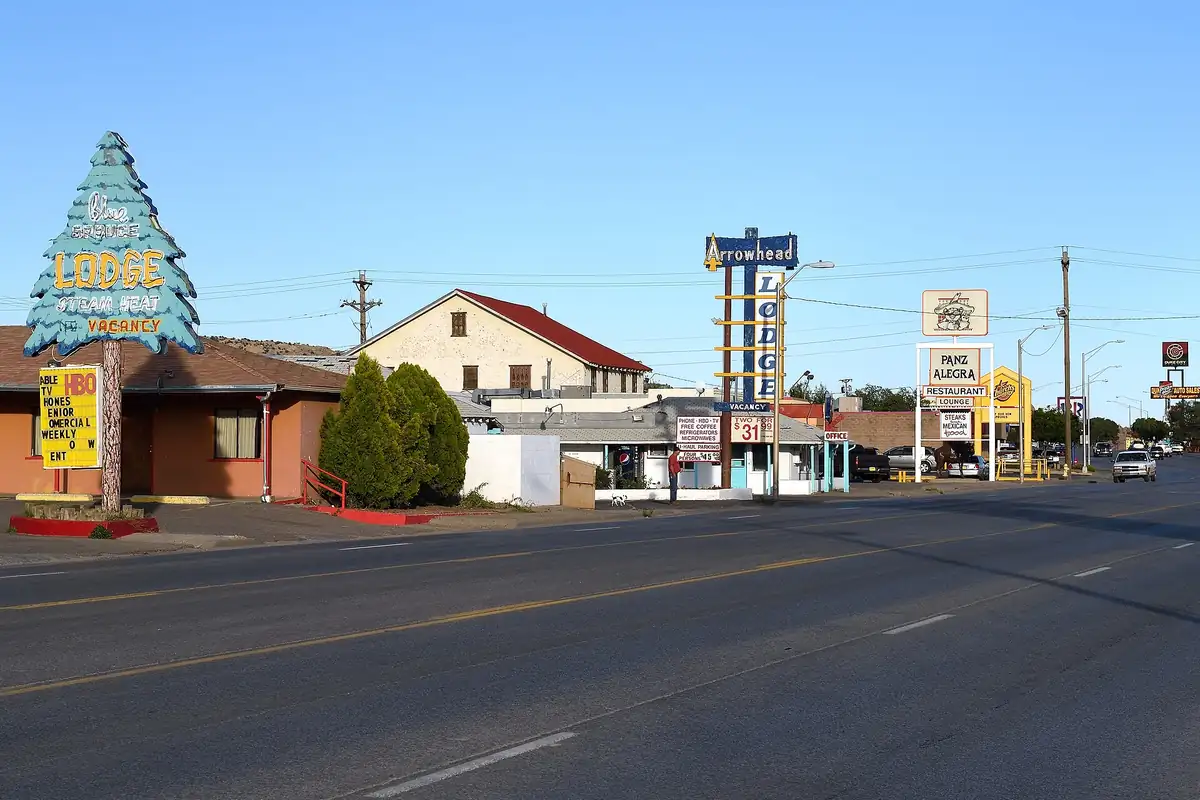
Then came the highway. By 1926 Route 66 ran straight through Gallup, Visit Gallup says, and its stretch of the former “Old Trail Highway” was fully paved by 1934. From 1945 to 1956 the town glowed with neon as Route 66 became the main road from Chicago to Los Angeles. The vintage motel signs in the photo at the bottom of this page still give you a feel for that stretch.
Older than the railroad
None of this started the history of the place. Visit Gallup puts the town in the middle of Native American ancestral homelands, with the Navajo Nation next door, Zuni Pueblo to the south and the Hopi Reservation in Arizona. Ancestral Puebloans lived in the region from roughly 300 BCE to 1250 CE. The railroad name is a recent layer on very old country.
Gallup isn’t the only town on this stretch of the Atlantic and Pacific that carries a railroad man’s name. Out in Arizona, Winslow is named for the president of one of the railroad’s partner lines. Back in New Mexico, Tucumcari started out as a rail camp with a much rowdier name. There’s more on our New Mexico page.
Quick answers
Who is Gallup, New Mexico, named after?
David L. Gallup, an officer of the Atlantic and Pacific Railroad. Today’s sources call him the paymaster; a 1907 history calls him “one of the auditors” and doesn’t give his first name.
Why do people say “going to Gallup”?
Because that’s what railroad workers reportedly said when they went to collect their pay at his headquarters, according to Visit Gallup and the Gallup Economic Development Corporation. Neither cites an early record of the phrase.
When was Gallup founded?
In 1881. The railroad set up Gallup’s headquarters in 1880, the town was established and named in 1881, and it was incorporated on July 9, 1891.
Why is Gallup in McKinley County?
McKinley County was created in 1901 with Gallup as its seat. The 1907 history says it was expected to be called Summit, but the name of the martyred president, William McKinley, won out.
Key dates
- 1880The Atlantic and Pacific Railroad sets up headquarters for David L. Gallup along its construction line.
- 1881The town is established and takes the name Gallup; J. W. Swartz, the first permanent settler, arrives on December 15.
- 1891Gallup is incorporated on July 9.
- 1901McKinley County is created with Gallup as its seat, named for the martyred president instead of the expected "Summit."
- 1952The last coal mines around Gallup close.
Things to do in Gallup, New Mexico
George Galanis Multicultural Center
Set in the historic Santa Fe depot, still an Amtrak stop, with exhibits on Native American cultures, Gallup's trains, coal mining and the Inter-Tribal Indian Ceremonial, plus a collection on the Navajo Code Talkers.
Red Rock Park
Gallup's most popular hikes: the 3-mile (4.8 km) Pyramid Rock Trail to a summit with wide views and the 2-mile (3.2 km) Church Rock Trail, plus the Red Rock Museum with Hopi, Navajo and Zuni art.
Downtown Gallup
Native American art galleries and trading posts selling Navajo and Zuni jewelry, pottery and rugs, murals, Route 66 landmarks and the El Rancho Hotel of 1937, known for its Hollywood guests.
El Morro National Monument
A sandstone bluff with a hidden waterhole that made it a campsite for centuries, where ancestral Puebloan, Spanish and American travelers carved more than 2,000 signatures, dates, messages and petroglyphs.
Getting there
Open Gallup in Google Maps
Opens in a new tab. The pin is the center of Gallup in the USGS place-name record.
The closest airports, Amtrak stations and intercity bus stops, measured in a straight line from the center of Gallup.
Airports
- Show Low Regional (SOW) 113 mi 182 km
- Durango-La Plata County (DRO) 125 mi 201 km
- Albuquerque International Sunport (ABQ) 125 mi 201 km
Amtrak trains
- Gallup station (GLP) under 1 mi 0.2 km
Intercity buses
- Greyhound Gallup Nks Truck Stop 5 mi 9 km
Distances are as the crow flies, not by road. We don't list schedules or fares because they change; check with the airline, Amtrak or the bus company before you go. Official data (FAA commercial service airports (2025), FAA airport locations, Amtrak stations and Intercity Bus Atlas) from the FAA and the U.S. Bureau of Transportation Statistics, checked Nov 14, 2026.
Sponsored
Staying in Gallup?
Compare hotels in Gallup, New Mexico, on Expedia.
See hotels in GallupWe may earn a commission if you buy through this link. It never changes what we write. Read our affiliate disclosure
Historical Sources & References
- Visit Gallup, “Rails & Trains”. The 1880 headquarters for paymaster David L. Gallup; “going to Gallup”; “Gallup was chosen as the name” in 1881; the Santa Fe division point of 1895; El Navajo, 1916-1957, its Pueblo Revival style, the Harvey Girls and the skate park on its site; the depot, Amtrak and BNSF’s Southern Transcon.
- Visit Gallup, “The History of Gallup, New Mexico”. Founded in 1881 on the southern transcontinental line; the Navajo Nation, Zuni Pueblo and Hopi; the Ancestral Puebloans; coal, “Carbon City” and the last mines in 1952; Route 66 through Gallup by 1926, paved by 1934, and the neon years of 1945-1956.
- Gallup Economic Development Corporation, “City of Gallup”. “In 1880, a paymaster for the Atlantic and Pacific Railroad, David L. Gallup, established headquarters along the construction right-of-way”; “thus a town was born and named in 1881.”
- Gregory R. C. Hasman, Albuquerque Journal (2026). “Named after Atlantic & Pacific paymaster David Gallup.”
- History of New Mexico: Its Resources and People, vol. 2 (1907), pp. 834 and 836-838. “Named in honor of one of the auditors of the company”; J. W. Swartz and the first settlers; the first postmaster, 1883-1885; the 1883 school district; incorporation on July 9, 1891 (pp. 836-838); McKinley County, 1901, and “Summit” (p. 834).
- GNIS feature 902825 (U.S. Geological Survey). The USGS listing for Gallup, a populated place in McKinley County.
- U.S. Geological Survey, Wingate sheet (1892). The 1:250,000 sheet titled Wingate, cropped for the railroad-and-coal map above.
Spot something wrong, or know more? Tell us here. You can also email us or use our contact page. Corrections are noted here with their date, never made silently.