Raton, New Mexico: Willow Springs Takes the Pass's Name
Raton, New Mexico, grew up at a watering stop called Willow Springs and later took the name of Raton Pass, the mountain crossing just to the north. The word itself is Spanish for a small animal, and the books don’t agree on which one.
A watering place on the trail
The Federal Writers’ Project’s guide to New Mexico, in its revised 1962 edition, tells the early story in a paragraph. In the 1860s, a government forage station was set up “at the Willow Springs Ranch on Raton (formerly Willow) Creek.” Its small water supply made it “the logical watering place between the Wootton Ranch on the Pass and the Canadian River to the south.”
In May 1871, Charles B. Thacker moved his family down from Colorado into “a small vacant jacal,” which the guide explains as a hut of plaited wood and mud. He sank a well to add to the thin water supply and started raising cattle.
The railroad comes down the mountain
The trains came over the pass at the end of the 1870s. The same guide says the first locomotive crossed Raton Pass on December 7, 1878, and that New Mexico wasn’t really open to rail service until the Raton tunnel, 2,011 feet (613 m) through Raton Mountain, was finished in the fall of 1879.
That year, the guide says, “the railroad was built to Otero, five miles south of Willow Springs Station.” That’s about 8 km. But Willow Springs “developed so rapidly as a railroad junction that the population of Otero moved here.” The guide then adds four words that settle the naming: “Raton, renamed for the Pass.” It doesn’t say who chose the new name or in what year.
The same railroad, the Atchison, Topeka and Santa Fe, kept building south and reached Santa Fe on February 9, 1880, with a spur from Lamy.
Rat, mouse or squirrel?
So the town is named for the pass, which sits about 7 miles (11 km) north of the town center by the federal gazetteer’s coordinates. The pass is where the sources split. According to the WPA guide, the state line on the highway is 15 miles (24 km) south of Trinidad, Colorado, “over Raton Pass, so named for the many pack rats on the mountainside.” Henry Gannett, in his 1905 place-name bulletin for the Geological Survey, has an entry for a Raton in Colorado and calls it “a Spanish word meaning ‘mouse.’” Jim Berry Pearson’s 1961 history of the Maxwell Land Grant goes another way. A footnote there starts, “‘Raton’ means squirrel or mouse, and the mountains may have been so named because of the grotesque but squirrel-like…” and that’s where the excerpt we saw stops. Pearson is talking about how the mountains look, not about animals living on them. We didn’t see the rest of the note.
So the WPA puts real pack rats on the slopes, Gannett gives a dictionary meaning, and Pearson thinks the mountains may have reminded someone of a squirrel. None of them says who first put the name on the mountains. If you want a one-word translation, you’ll have to pick.
Goat Hill
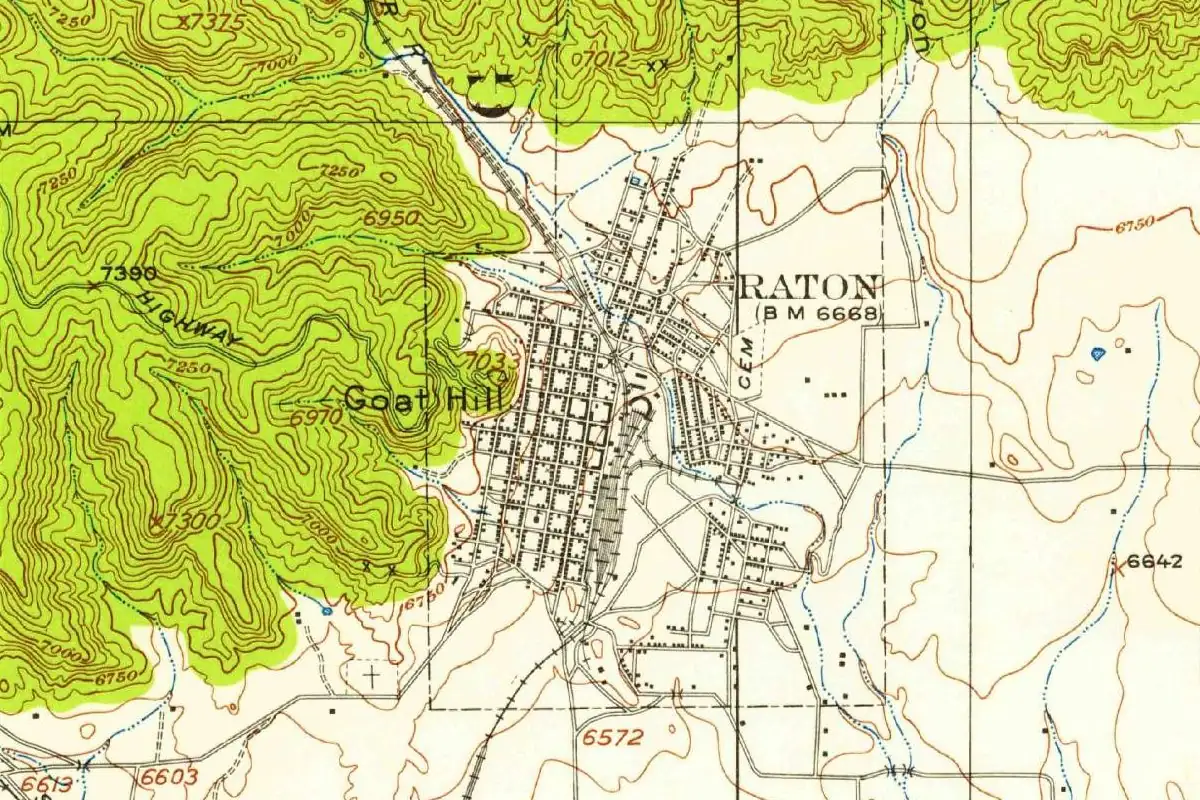
On the 1912 survey map, the town’s grid stops against the hills to the west, and one of them is labeled Goat Hill. The WPA writers put it “somewhat more than a mile from Raton,” or about 2 km, and said that from up there you got “a very fine view of vast plains, lava-capped rocks and the lofty peaks of the Culebra (snake) Mountains.”
Quick answers
What does Raton mean in Spanish?
It depends on the source. Gannett (1905) says “mouse,” the WPA guide ties the pass to “the many pack rats on the mountainside,” and Pearson (1961) says “squirrel or mouse,” perhaps for the shape of the mountains.
What was Raton, New Mexico, called before?
Willow Springs. The forage station of the 1860s was at the Willow Springs Ranch, according to the WPA guide, and the place was “renamed for the Pass” after the railroad arrived in 1879.
Is Raton named after Raton Pass?
Yes. The state’s Federal Writers’ Project guide uses those very words. The town took the pass’s name after Otero’s people moved up to Willow Springs.
Key dates
- 1860sA government forage station opens at the Willow Springs Ranch on what was then Willow Creek.
- 1871May: Charles B. Thacker moves his family into a small jacal here, digs a well and starts raising cattle.
- 1878December 7: the first locomotive comes over Raton Pass.
- 1879The railroad reaches Otero, 5 miles (8 km) south; Otero's people move to Willow Springs, later renamed for the pass. The Raton tunnel is done that fall.
Getting there
Open Raton in Google Maps
Opens in a new tab. The pin is the center of Raton in the USGS place-name record.
The closest airports, Amtrak stations and intercity bus stops, measured in a straight line from the center of Raton.
Airports
- San Luis Valley Regional/Bergman Field (ALS) Alamosa 87 mi 140 km
- Santa Fe Regional (SAF) 128 mi 206 km
Amtrak trains
- Raton station (RAT) under 1 mi 0.3 km
- Trinidad station (TRI) 19 mi 31 km
Intercity buses
- Greyhound Raton Amtrak Station under 1 mi 0.3 km
- Limousine Express Raton 1 mi 2 km
- Bustang Outrider Bustang · Trinidad 19 mi 31 km
Distances are as the crow flies, not by road. We don't list schedules or fares because they change; check with the airline, Amtrak or the bus company before you go. Official data (FAA commercial service airports (2025), FAA airport locations, Amtrak stations and Intercity Bus Atlas) from the FAA and the U.S. Bureau of Transportation Statistics, checked Nov 6, 2026.
Sponsored
Staying in Raton?
Compare hotels in Raton, New Mexico, on Expedia.
See hotels in RatonWe may earn a commission if you buy through this link. It never changes what we write. Read our affiliate disclosure
Historical Sources & References
- Federal Writers’ Project, New Mexico: A Guide to the Colorful State, rev. ed. (1962), pp. 96, 227 and 230. The first locomotive over Raton Pass on December 7, 1878, and the Raton tunnel of 1879 (p. 96); the pass “so named for the many pack rats” (p. 227); Willow Springs, Charles B. Thacker in 1871, Otero, and “Raton, renamed for the Pass” (p. 230).
- Henry Gannett, The Origin of Certain Place Names in the United States, 2nd ed. (1905), p. 258. The entry for Raton, Colorado: “A Spanish word meaning ‘mouse.’”
- Jim Berry Pearson, The Maxwell Land Grant (1961). Seen only in a search excerpt from a footnote, cut off mid-sentence: “‘Raton’ means squirrel or mouse, and the mountains may have been so named because of the grotesque but squirrel-like…” The full note wasn’t seen.
- GNIS feature 902335 (U.S. Geological Survey). Raton’s page in the national names system, Colfax County, with no history note.
Spot something wrong, or know more? Tell us here. You can also email us or use our contact page. Corrections are noted here with their date, never made silently.