Southport, North Carolina: When Smithville Wanted a Port
Southport was Smithville, named for Benjamin Smith, a Revolutionary officer and later governor, from its founding in 1792. The legislature changed the name to Southport on March 4, 1887. A 1979 National Register report ties the new name to hopes of becoming a great seaport, and the North Carolina Gazetteer says it was the state's southernmost seaport.
Southport, North Carolina, was Smithville, named for Benjamin Smith, until 1887, when it took a new name for the great seaport it hoped to become. The legislature made the change on March 4, 1887.
Why is it called Southport, North Carolina?
The change came by act of the legislature. Chapter 76 of the Private Laws of 1887, ratified on March 4, 1887, says it plainly: “the name of the town of Smithville, in the county of Brunswick, be changed to Southport.” The same act erased “Smithville” from the town’s charter, which it dates to November 15, 1792.
The act gives no reason, but Southport’s 1979 National Register nomination does. Its author, Carl Lounsbury, wrote that “in 1887 the small coastal village of Smithville was rechristened Southport in eager anticipation of the day when it would emerge as the great seaport of the southeast.” Closing off an inlet and dredging the Cape Fear, he explains, had just given the town a natural harbor. He quotes the Southport Leader: “the old town of Smithville can scarcely be recognized in the new and ambitious City of Southport.” He adds that many people could see the town would never grow into a big port without a rail line to Wilmington and the markets inland.
The North Carolina Gazetteer gives a shorter reason: the name changed “because it was the southernmost seaport in the state.” It dates the change to 1889; the act that made it was ratified in 1887. What the legislature passed in 1889, in Chapter 78 of the Private Laws, ratified on March 5, was a new charter, under which the corporation would be called “The City of Southport.”
The old name came from Benjamin Smith. The state’s essay for highway marker D-85 says Smith held a federal contract to rebuild and enlarge Fort Johnston “at Smithville (now Southport), the town established and named in his honor in 1792.” Smith served as governor in 1810-1811, gave land to the state university, and in 1789 bought the tract where the river meets the sea that became known as Smith Island. He died in Smithville, nearly penniless, on January 26, 1826. The Southport Historical Society calls him “a Continental general during the Revolution, who later became the governor of North Carolina.”
Southport, NC history
The fort came before the town. State marker D-11, on Bay Street in Southport, says Gov. Gabriel Johnston ordered the fort built in 1745, that colonists burned it in 1775 and that it was rebuilt later. Johnston is the same governor who renamed Wilmington for his patron. The city’s history page for the fort gives 1749 as the year it was built, and the Gazetteer says 1748-64.
Lounsbury’s nomination says the 1792 act was passed to “lay off and establish a town near Fort Johnston,” and that Smith and Joshua Potts laid it out in 100 lots of half an acre (0.2 ha) each. The Gazetteer gives 1805 for the incorporation and 1808 for the move of the county seat to Smithville. It stayed the seat until 1978, when Brunswick County opened a new government center near Bolivia.
Southport isn’t the only town that took the name. Kenosha, Wisconsin, was Southport from 1837 to 1850, a name its residents chose because it was Wisconsin’s southernmost port on the lake. Farther down the Atlantic coast, Myrtle Beach, South Carolina, dropped the name New Town in a contest in 1900.
Southport on the 1946 map
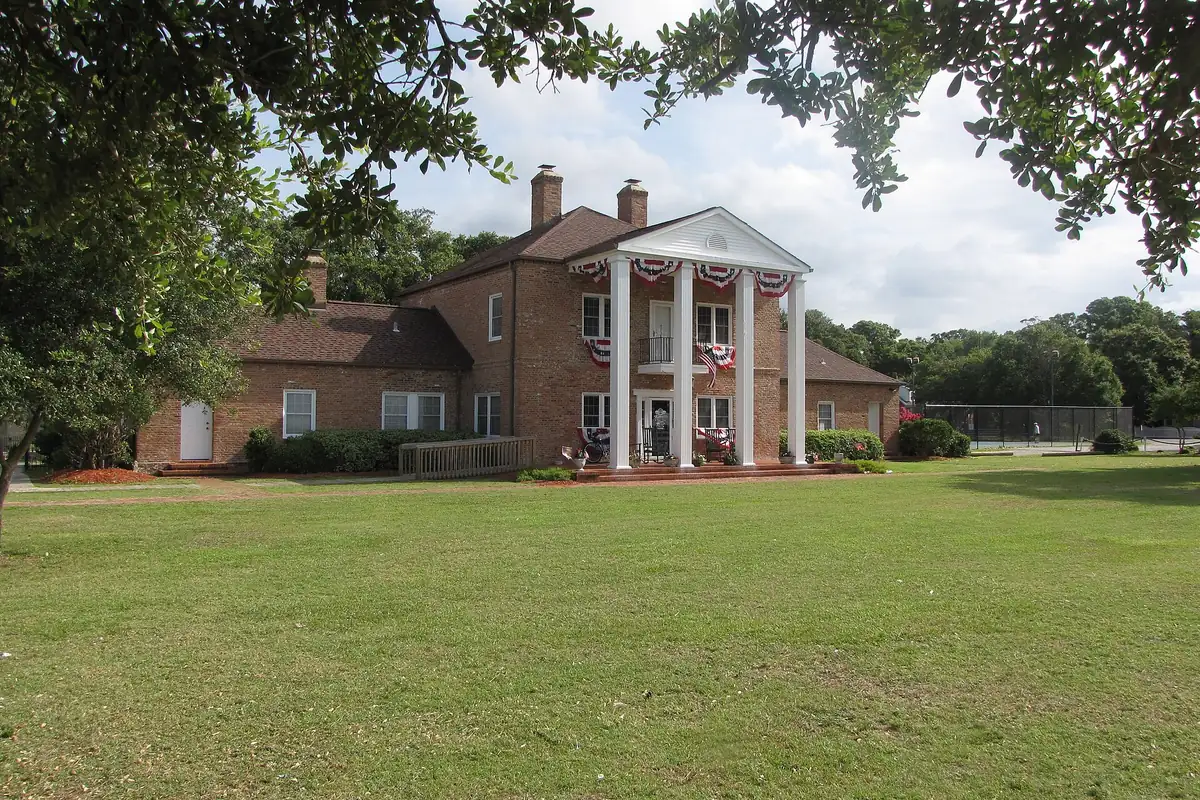
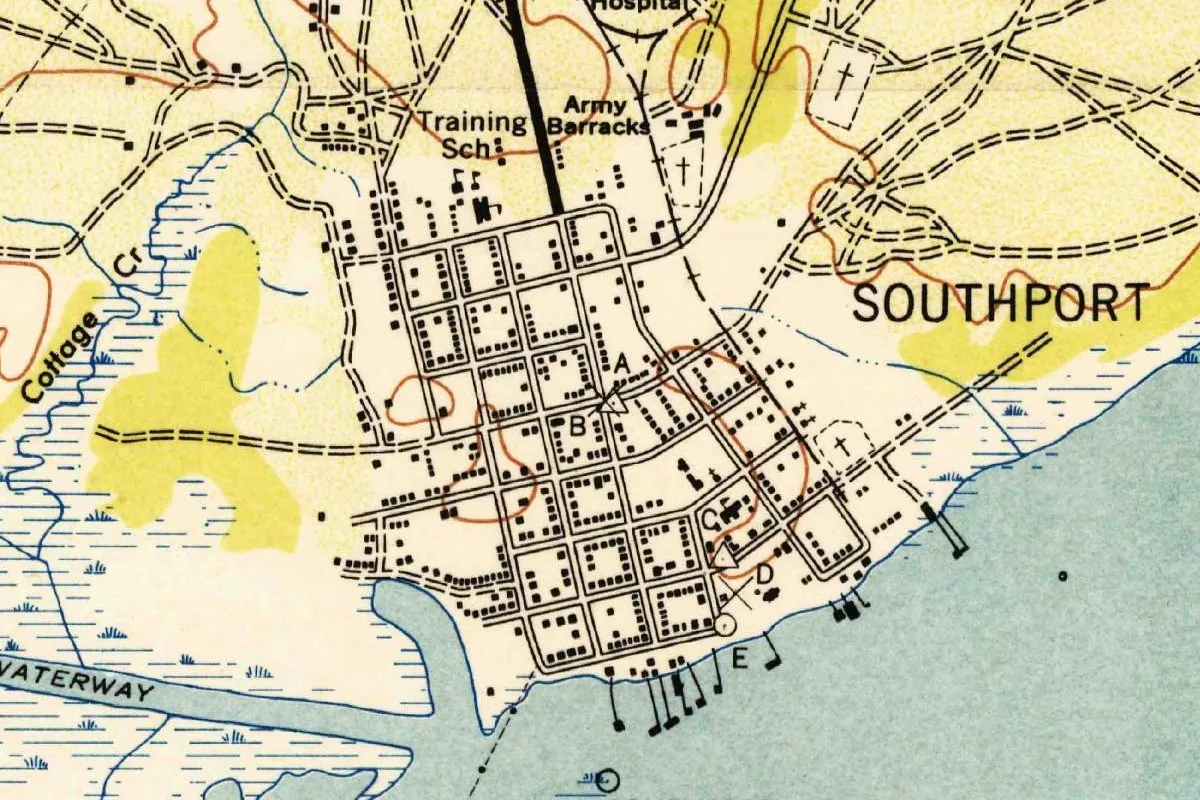
The map at the top is a 1:24,000 sheet made by the Army Map Service, marked “First Edition (AMS 1), 1944; (AMS 2), 1946.” Its margin says it was copied from a 1944 Army map whose original the Coast and Geodetic Survey compiled, mapped from aerial photographs of 1942 and field-checked in 1943. It was “reprinted from military edition for civil use,” and the Geological Survey sold it. Southport’s grid of streets runs down to the water, with Army Barracks, a training school and a hospital marked in town, and the waterway along the shore. The photo below shows part of Fort Johnston on Bay Street.
Quick answers
What was Southport, North Carolina, called before?
Smithville. The town was chartered under that name on November 15, 1792, and kept it until 1887.
Who was Southport, North Carolina, named for as Smithville?
Benjamin Smith, who fought in the Revolution and was governor of North Carolina in 1810-1811. The state’s marker essay says the town was named for him when it was set up in 1792.
When did Southport, North Carolina, get its name?
In 1887. The legislature ratified the name change on March 4, 1887. The Gazetteer says 1889, the year of a new city charter.
Key dates
- 1745Gov. Gabriel Johnston orders a fort built at the mouth of the Cape Fear, by the date on state marker D-11.
- 1792November 15: The General Assembly grants the charter of the town of Smithville, named for Benjamin Smith.
- 1808Smithville becomes the county seat of Brunswick County, the Gazetteer says.
- 1826January 26: Benjamin Smith dies in Smithville, a virtual pauper.
- 1887March 4: The legislature ratifies the act that changes the name of Smithville to Southport.
- 1889March 5: A new charter makes the corporation "The City of Southport."
- 1978The county government moves to a new center near Bolivia, and Southport stops being the county seat.
Things to do in Southport, North Carolina
North Carolina Maritime Museum at Southport
A state museum of the Lower Cape Fear's history on the water, in the officers' quarters on the Fort Johnston grounds at 204 E. Moore Street. Admission is free.
Fort Johnston-Southport Museum and Visitors' Center
The city's museum and visitors' center at 203 E. Bay Street, in the Garrison House that went up during the fort's renovation of 1810, looking out on the mouth of the Cape Fear River.
Old Smithville Burying Ground
The town cemetery at Nash and Rhett streets, under big oaks, where the historical society counts 1,093 burials, among them ship captains and river pilots.
Southport Monument and Marker Tour
One of four self-guided tours the historical society and the city put on the free PocketSights app, leading to 38 monuments and markers around the historic parts of town.
Getting there
Open Southport in Google Maps
Opens in a new tab. The pin is the center of Southport in the USGS place-name record.
The closest airports, Amtrak stations and intercity bus stops, measured in a straight line from the center of Southport.
Airports
- Wilmington International (ILM) 25 mi 40 km
- Myrtle Beach International (MYR) 55 mi 88 km
- Charleston AFB/International (CHS) 136 mi 219 km
Amtrak trains
- Dillon station (DIL) 85 mi 136 km
- Fayetteville station (FAY) 93 mi 149 km
Intercity buses
- Sunway Charters Amtrak Connecting Service · Wilmington Amtrak Station 24 mi 39 km
- Greyhound Wilmington NC (WMN) 24 mi 39 km
Distances are as the crow flies, not by road. We don't list schedules or fares because they change; check with the airline, Amtrak or the bus company before you go. Official data (FAA commercial service airports (2025), FAA airport locations, Amtrak stations and Intercity Bus Atlas) from the FAA and the U.S. Bureau of Transportation Statistics, checked Nov 27, 2026.
Sponsored
Staying in Southport?
Compare hotels in Southport, North Carolina, on Expedia.
See hotels in SouthportWe may earn a commission if you buy through this link. It never changes what we write. Read our affiliate disclosure
Historical Sources & References
- The North Carolina Gazetteer, “Southport,” via NCpedia. Smithville for Benjamin Smith, the southernmost seaport, incorporation in 1805, the county seat from 1808 to 1978, and the fort of 1748-64.
- Private Laws of 1887, chapter 76, p. 926. The name change, ratified March 4, 1887, and the charter of November 15, 1792.
- Private Laws of 1889, chapter 78, pp. 634-655. “The City of Southport,” ratified March 5, 1889.
- National Register nomination, Southport Historic District (1979). The seaport hopes of 1887, the Southport Leader, the act of 1792 and the 100 lots.
- N.C. Department of Natural and Cultural Resources, “Benjamin Smith, D-85”. The town named for Smith in 1792, Fort Johnston, Smith Island and his death in 1826.
- North Carolina Highway Historical Marker Program, Guide (2019), pp. 25 and 27. Markers D-11 (Fort Johnston) and D-85 (Benjamin Smith).
- Southport Historical Society, “Southport Historic Tours”. Smith as a Continental general and governor, the change of 1887, and the tours in the things-to-do list.
- City of Southport, “History of Fort Johnston”. The fort built in 1749 and the Garrison House of 1810.
- Fort Johnston-Southport Museum and Visitors’ Center, the N.C. Maritime Museum at Southport and the Smithville Burying Ground. The details in the things-to-do list.
- GNIS feature 1022722 (U.S. Geological Survey). Southport in Brunswick County, with the coordinates for this page.
- Army Map Service, Southport sheet (1946). The sheet the map at the top was cropped from.
Spot something wrong, or know more? Tell us here. You can also email us or use our contact page. Corrections are noted here with their date, never made silently.