Why Is It Called Duck, North Carolina? Ducks on the Sound
Duck is named for the wild ducks of Currituck Sound. The North Carolina Gazetteer says so, and postal historians tie the name to the Duck post office. One account says Lloyd A. Toler looked out at a sound full of ducks and wrote Duck on the form. Sources give 1900, 1908 or 1909 for it.
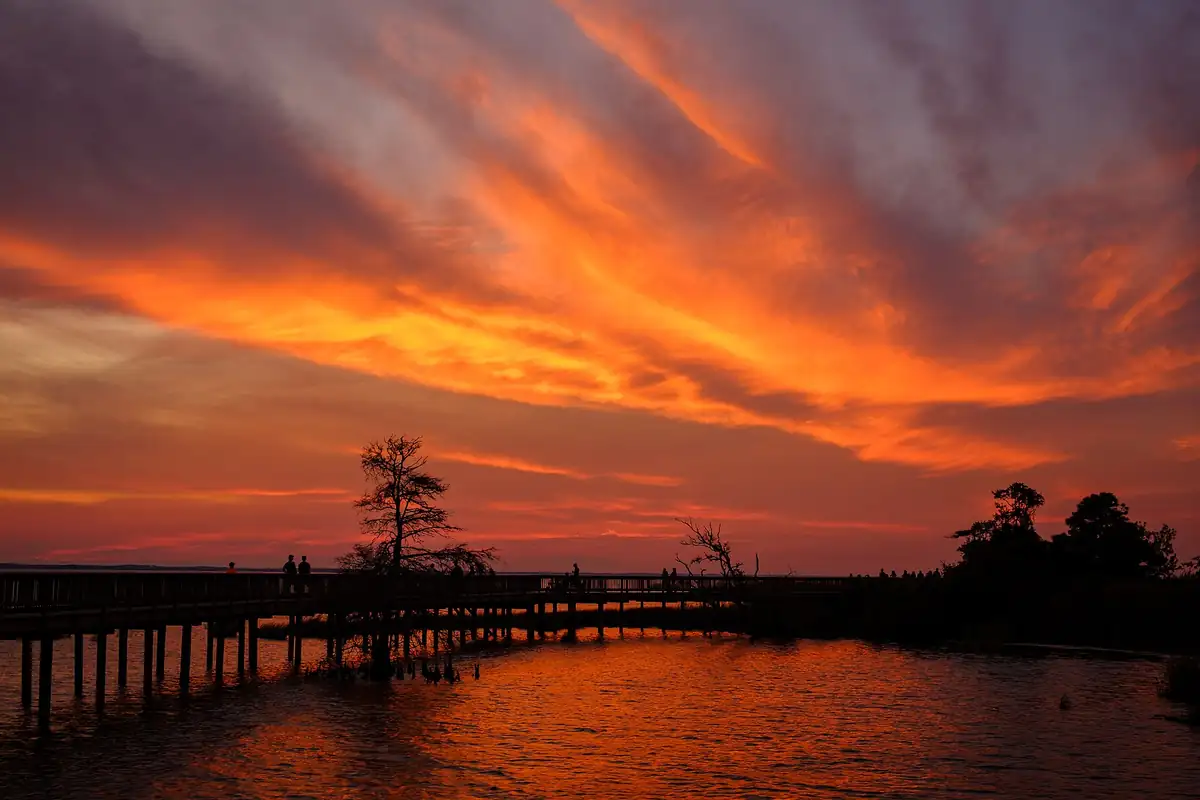
Duck, North Carolina, is named for the wild ducks of Currituck Sound, and the name came with a little post office on the North Banks. The sources agree on the birds. Where they part ways is the year.
Why is it called Duck, North Carolina?
The North Carolina Gazetteer keeps it short. Duck is a community on the North Banks “Situated next to Currituck Sound,” and it was “Named for wild ducks in the area.”
The fuller story is a postal one. In 1988 the newsletter of the North Carolina Postal History Society ran a postal history of Dare County by Tony Crumbley and Darrell Ertzberger. They write that the Duck post office opened in 1900 in a little settlement up the banks from Nags Head, and that it took its name from the ducks that stopped on the sound during their migrations. For a while, they add, people on the banks shot ducks and sold them to processing plants in Norfolk and other towns on the mainland.
The society’s journal came back to Duck in 2002, when Scott Troutman summed up a new book, Duck: An Outer Banks Village, by Judith D. Mercier. In that telling, the name came in 1908. Lloyd A. Toler sent a petition to Washington for a post office, and the forms that came back asked what the place should be called. “Choose a name neither too long nor too hard to spell,” the form said. From where he stood, Troutman writes, Toler could see the sound covered with ruddies, teals and canvasbacks, so he printed “Duck” and mailed it off. In Mercier’s telling, Toler came back from the mainland on June 28, 1908, holding a locked metal box with the contents of a post office, and the next morning he was the area’s first postmaster, with the post office in his store.
Washington had a say in other town names, too. Our story on Sedona, Arizona quotes the Sedona Heritage Museum on a Postmaster General who “had a prejudice for one-word names for postmarks.” Another resort town is named for the animals people found there: Big Bear Lake, California, is named for the grizzlies Benjamin D. Wilson’s party ran into in 1845.
When was Duck, North Carolina, named?
You’ll find three years for that post office, depending on where you look. The 1988 history’s table of Dare County post offices says Duck opened on June 29, 1900, and closed on August 31, 1941, with its mail sent to Kitty Hawk. Mercier’s account, through Troutman, puts the name in 1908. And when Duck asked the General Assembly to make it a town, the petition included in the state’s 2001 report said the name “originated with the establishment of the Duck Post Office on June 29, 1909.” Two of those share a month and day but not a year, and none of these sources explains the difference.
The ducks themselves had a reason to be there. Troutman writes that the inlets through the North Banks closed one by one until the last one shut during a hurricane in 1828. After that, Currituck Sound slowly turned to fresh water, and ducks and geese arrived by the hundreds of thousands.
Duck, NC history
Duck wasn’t always in Dare County. Both postal histories say that in 1920 a strip of the northern banks with Duck and Kitty Hawk moved from Currituck County to Dare. Troutman adds that the people of Duck weren’t consulted, and that a trip to the courthouse became a day’s journey to Manteo.
The petition of 2001 describes Duck as a small fishing community between Caffey’s Inlet and Martin’s Point for decades, until, in the two decades before the petition, the community was “discovered” and building took off. The Town of Duck’s history picks up from there. A survey by the Duck Civic Association drew 1,051 responses in 2000, most of them for incorporation. The Joint Legislative Commission on Municipal Incorporations finished its review of the petition in February 2001, and House Bill 882, “An Act to Incorporate the Town of Duck,” became Session Law 2001-394 on August 29, 2001. Voters approved it on November 6, 2001, and Duck became a town on May 1, 2002, the sixth in Dare County.
Duck on the Currituck Sound map
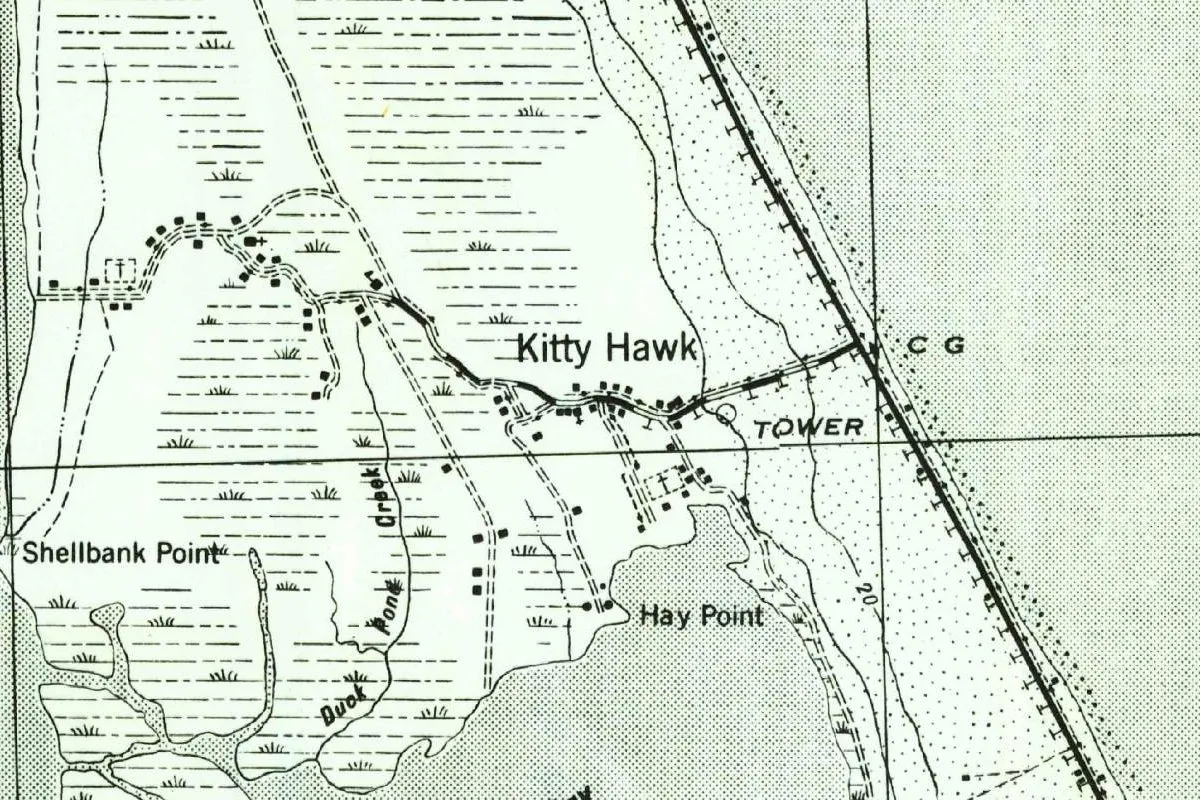
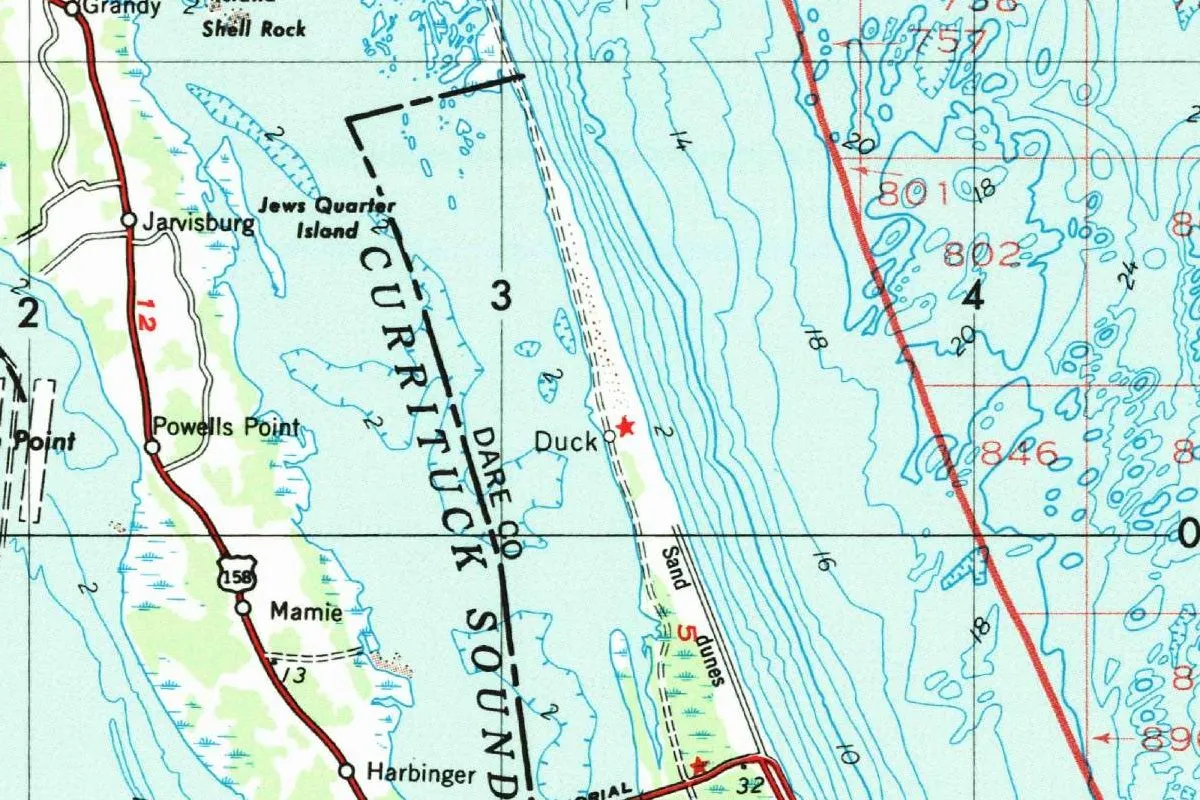
Duck doesn’t show up on the oldest topographic sheet that covers it. The 1940 Powells Point sheet reaches the spot but doesn’t print the name, so the map at the top of this page comes from a later one. It’s the Currituck Sound sheet, a 1:250,000 map made by the Geological Survey and the National Ocean Survey. Its margin dates it 1946, “Revised 1969,” with “Shoreline revised and bathymetry added 1980,” and the imprint reads “Interior—Geological Survey, Reston, Virginia—1980.” The base map, it says, was put together by the Defense Mapping Agency from quadrangles dated 1900 to 1946.
You’ll see Duck as a small circle on the thin strip of sand between the sound and the ocean, with Jarvisburg, Powells Point and Mamie across the water. The red numbers out in the ocean are offshore survey blocks, which the margin credits to the Bureau of Land Management.
Quick answers
Is Duck, North Carolina, really named after ducks?
Yes. The North Carolina Gazetteer says it was named for the wild ducks in the area, and the 1988 postal history says the post office was named for the ducks that visited the sound.
Who named Duck, North Carolina?
Lloyd A. Toler, in Judith D. Mercier’s account as summed up by Scott Troutman. He applied for the post office, wrote “Duck” on the form and became the first postmaster.
When did Duck, North Carolina, become a town?
On May 1, 2002, according to the Town of Duck. The General Assembly passed the act to incorporate it in 2001, and voters approved it that November.
Key dates
- 1828The last inlet through the North Banks closes in a hurricane, and Currituck Sound slowly turns fresh, the NCPHS Postal Historian says.
- 1900June 29: The Duck post office opens, by the date in a 1988 postal history of Dare County.
- 1908Lloyd A. Toler brings the post office home and becomes Duck's first postmaster, in Judith D. Mercier's account.
- 1909June 29: The 2001 incorporation petition dates the Duck post office, and the name, to this day.
- 1920Duck and Kitty Hawk move from Currituck County to Dare County, according to the 1988 postal history.
- 1941August 31: The Duck post office closes and its mail goes to Kitty Hawk, the 1988 table says.
- 2002May 1: Duck becomes a town, the sixth in Dare County, under Session Law 2001-394.
Things to do in Duck, North Carolina
Duck Town Park
About 11 acres (4.5 ha) on the sound in the middle of town, with trails through maritime forest and willow swamp, a kayak and canoe launch, and an amphitheater.
Duck Boardwalk
A boardwalk 10 feet (3 m) wide that runs nearly a mile (1.6 km) along Currituck Sound from the park through the village's shops and restaurants.
Duck Trail
A path for walkers and cyclists about six miles (10 km) long that covers the whole length of town, mostly on the ocean side of Duck Road.
Wright Brothers National Memorial
The National Park Service site down the banks in Kill Devil Hills, where the First Flight Boulder and the Flight Line together show where each of the December 17, 1903, flights started and ended.
Getting there
Open Duck in Google Maps
Opens in a new tab. The pin is the center of Duck in the USGS place-name record.
The closest airports, Amtrak stations and intercity bus stops, measured in a straight line from the center of Duck.
Airports
- Norfolk International (ORF) 56 mi 90 km
- Newport News/Williamsburg International (PHF) 78 mi 126 km
Amtrak trains
- Norfolk station (NFK) 55 mi 88 km
- Newport News station (NPN) 78 mi 126 km
Intercity buses
- Greyhound Elizabeth City Edgewood Dr 26 mi 42 km
- FlixBus Virginia Beach 48 mi 78 km
- Amtrak Chartered Vehicle Amtrak Connecting Service · Virginia Beach Amtrak Bus Stop 48 mi 78 km
Distances are as the crow flies, not by road. We don't list schedules or fares because they change; check with the airline, Amtrak or the bus company before you go. Official data (FAA commercial service airports (2025), FAA airport locations, Amtrak stations and Intercity Bus Atlas) from the FAA and the U.S. Bureau of Transportation Statistics, checked Nov 27, 2026.
Sponsored
Staying in Duck?
Compare hotels in Duck, North Carolina, on Expedia.
See hotels in DuckWe may earn a commission if you buy through this link. It never changes what we write. Read our affiliate disclosure
Historical Sources & References
- William S. Powell and Michael Hill, eds., The North Carolina Gazetteer (2010), “Duck,” via NCpedia. On the North Banks next to Currituck Sound, incorporated in 2002, “Named for wild ducks in the area.”
- Tony Crumbley and Darrell Ertzberger, “A Postal History of Dare County,” NCPHS Newsletter (Winter 1988), pp. 3, 5 and 10. The move from Currituck County in 1920, the table with the Duck post office (June 29, 1900, to August 31, 1941), and the ducks on their migrations.
- Scott Troutman, “Duck,” NCPHS Postal Historian (Winter 2002-2003), pp. 13-14. Mercier’s account of Lloyd A. Toler and the post office form of 1908, the inlet that closed in 1828, and the county change of 1920.
- Joint Legislative Commission on Municipal Incorporations, Proposed Town of Duck (2001). The petition’s statement that the name began with the Duck post office on June 29, 1909, and its picture of the old fishing community.
- Session Law 2001-394 and the Town of Duck’s history. The act that created the Town of Duck, the survey of 2000, the vote of November 6, 2001, and the town’s start on May 1, 2002.
- Town of Duck, Town Park & Boardwalk; 2026 town brochure; Wright Brothers National Memorial, Basic Information. The details in the things-to-do list.
- GNIS feature 1025292 (U.S. Geological Survey). Duck in Dare County, with the coordinates for this page.
- Currituck Sound sheet (1:250,000), 1946, revised 1969 and 1980. The sheet the map at the top was cropped from.
Spot something wrong, or know more? Tell us here. You can also email us or use our contact page. Corrections are noted here with their date, never made silently.