Why Is It Called Big Bear Lake? Grizzlies, Then a Dam
Big Bear Lake takes its name from the grizzly bears that Benjamin D. Wilson's party found in the valley in 1845, so many that 22 men roped 11 of them, by one 1922 account. The name first went to the valley and a natural lake; today's reservoir came from a dam built in 1884.
Big Bear Lake is named for the grizzlies a posse ran into in the San Bernardino Mountains in 1845, four decades before a dam made the lake you see today. The name, in other words, is older than the lake.
Why is it called Big Bear Lake?
Because of grizzly bears, and a lot of them. The story comes from a 1922 county history edited by John Brown Jr., with James Boyd. In the fall of 1845, it says, Benjamin D. Wilson led an expedition into the mountains “in pursuit of a band of marauding Indians,” and the men “found a lake in the mountains at which the grizzlies were so numerous that twenty-two men lassoed eleven bears.” On the way back, at the same camp, they did it again, “making twenty-two bears killed in the locality.”
Wilson was a Tennessean who’d hunted and trapped in New Mexico and bought part of the Jurupa Rancho in 1843, according to the City of San Bernardino’s history page. That page also says the naming of the valley and lake “has been ascribed by John Brown Jr., to Benjamin D. Wilson.” Visit Big Bear, the valley’s tourism office, goes further and says Wilson “gave the area the name it carries today.”
Not every account puts a name on it. San Bernardino County’s history series says the lake “was named by ranchers who rode into the mountains and found the lush green valley swarming with bears.” The numbers drift too: Visit Big Bear gives Wilson “a posse of 20 men,” not 22.
Grizzlies turn up in other place-name stories as well. On the northern plains, fur trader Alexander Henry wrote about grizzly bears at “Lac du Diable,” the lake behind the name of Devils Lake, North Dakota.
Which lake was the bear lake?
Here’s the twist: the lake Wilson’s men saw wasn’t the one called Big Bear Lake now. Visit Big Bear says the name first “referred to what is now Baldwin Lake,” and that today’s Big Bear Lake wasn’t there until dams flooded the valley, the first of them in 1884. Brown’s history, writing in 1922, says the same thing from the other direction: “Big Bear Lake is artificial,” while to the northeast lies a natural lake, “Baldwin Lake,” named for “Lucky Baldwin.”
So the grizzlies named a valley and a natural lake, and the reservoir picked up the name afterward.
A lake made by a dam
The reservoir was built to water Redlands. Brown’s history says that in 1883 the new Redlands colony needed more water, and F. E. Brown, together with Hiram Barton, looked over Bear Valley and decided the answer was to hold back the mountain runoff. A company was incorporated on October 2, 1883. Work on the permanent dam began June 17, 1884, and was done that November, at a cost of about $75,000.
That’s the same Frank E. Brown who founded Redlands with E. G. Judson, and who later wrote that the town’s name was meant to tell buyers its soil was good for oranges.
The California Office of Historic Preservation, which lists the old dam as state landmark No. 725, says Frank Brown’s single-arch granite dam “formed Big Bear Lake, then the world’s largest man-made lake.” Engineers predicted it would fail, the landmark text says, and called it “The Eighth Wonder of the World” when it held.
It didn’t always hold enough water, though. The county says the lake dried up completely every summer from 1898 through 1900, and again in 1904. In 1912 a multiple-arch concrete dam, 72 feet (22 m) high, went up about 300 feet (91 m) downstream, 20 feet (6 m) taller than the old one, and more than doubled the lake to 73,000 acre-feet (90 million m³). The state’s landmark page also dates it to 1912 but puts it 200 feet (61 m) west. Visit Big Bear’s history page says the current dam was finished in 1911, though its page on local names dates the second dam to 1912.
Big Bear and Little Bear
Where did the “Big” come from? The City of San Bernardino’s page says it got attached when people started telling Bear Valley apart from “Little Bear Lake,” later known as Lake Arrowhead. Brown’s history, in 1922, calls the Little Bear Valley Reservoir “now known as Arrowhead Lake.”
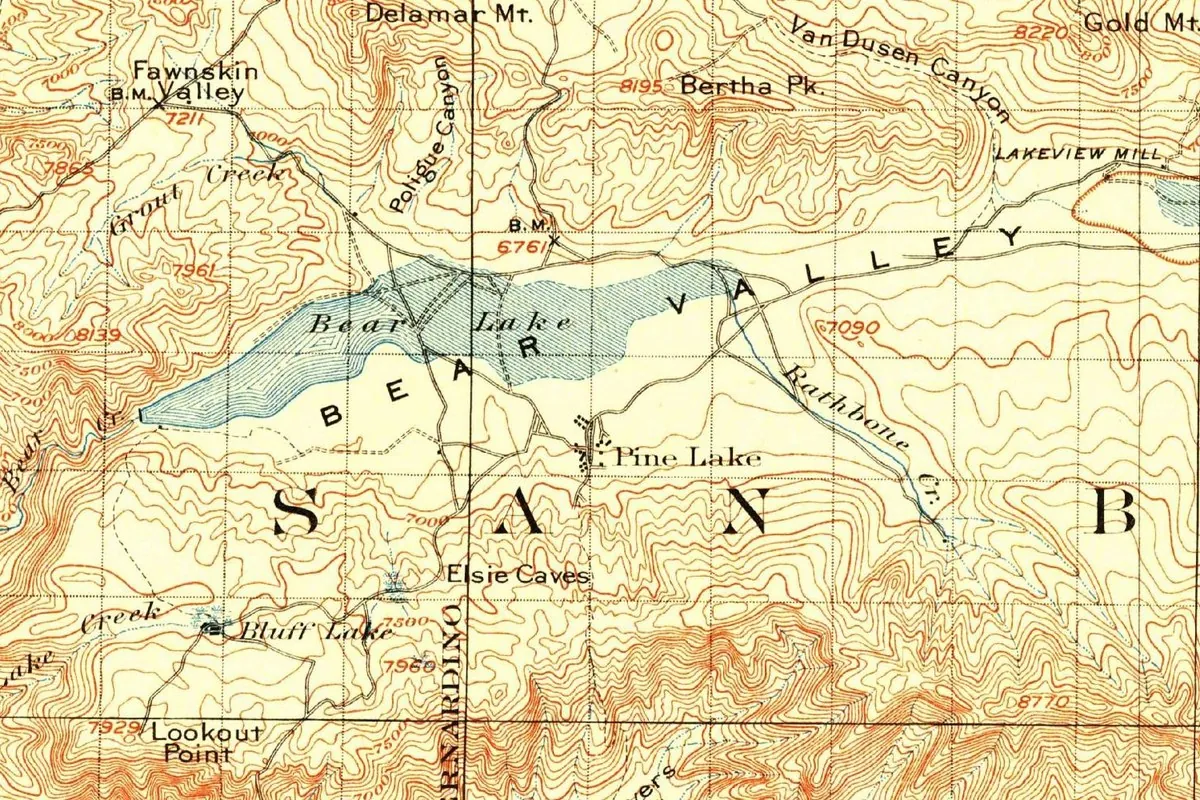
On the map at the top, from 1902, the Geological Survey labels the reservoir just Bear Lake, with no “Big.”
Big Bear Lake history: gold, then visitors
Before any of this, the valley was home to the Yuhaaviatam, a Serrano clan, for about 2,000 years, according to Visit Big Bear, and they called it Yuhaaviat, or “Pine Place.”
If you follow the city’s timeline, gold came next. The City of San Bernardino says prospecting in Bear Valley started in 1858 and gold was found in Holcomb Valley, nearby, in 1860. Visit Big Bear says the area stayed crowded with prospectors until about 1875.
The county also notes that in 1924 a highway bridge went across the top of the new dam’s arches. Then there’s Hollywood: the county lists the lake among the filming locations for movies and TV shows, including Old Yeller, Gone with the Wind and Daniel Boone. That frontiersman’s youngest son, Nathan, is the Boone whose name went on Boone, Iowa, by way of its county.
Today the national names database has Big Bear Lake, the community, on file in San Bernardino County, California, with the same name as the lake.
Big Bear Lake on the 1902 map
Up top is the San Gorgonio quadrangle, drawn at 1:125,000. Its top margin gives the U.S. Geological Survey’s director as Charles D. Walcott. Along the bottom, R. U. Goode is the geographer in charge, E. T. Perkins Jr. did the triangulation and topography, and it says “Surveyed in 1899.” A line under the frame reads “Engraved June 1902 by U.S.G.S.,” the corner says “Edition of Sept. 1902,” and the Survey stamped it September 30, 1902. So this copy was printed in 1902, eighteen years after Brown’s dam went up.
If you look at the full sheet, Bear Lake is on the left side, slightly above center, with Baldwin Lake to the east of it. The crop shows the reservoir labeled just “Bear Lake,” with BEAR VALLEY spelled out along it and Pine Lake, a small cluster of buildings, to the south. Up top you’ll find Fawnskin Valley, Delamar Mountain, Bertha Peak and the Lakeview Mill. Nothing on the sheet is called Big Bear Lake; the only name on that water is Bear Lake.
Quick answers
Why is it called Big Bear Lake?
For the grizzly bears that Benjamin D. Wilson’s party found there in 1845, according to the City of San Bernardino and Visit Big Bear. “Big” was added to tell it apart from Little Bear Lake, now Lake Arrowhead.
Is Big Bear Lake natural?
No. The 1922 county history calls it “artificial,” made by a dam. The first dam was finished in 1884, and the current one went up in 1912, by the county’s date.
Who named Big Bear Lake?
The City of San Bernardino says John Brown Jr. credited Benjamin D. Wilson; the county’s history says ranchers named it.
Which lake was first called Bear Lake?
The natural lake now called Baldwin Lake, according to Visit Big Bear.
Key dates
- 1845Benjamin D. Wilson's party, chasing raiders, finds a mountain lake crowded with grizzlies.
- 1860Gold turns up in nearby Holcomb Valley.
- 1883A reservoir company is incorporated on October 2 to store water in Bear Valley for Redlands.
- 1884Frank E. Brown's single-arch granite dam is finished in November, creating what the state calls the world's largest artificial lake of its day.
- 1902The Geological Survey's San Gorgonio quadrangle labels the reservoir Bear Lake.
- 1912A new multiple-arch dam, 20 feet (6 m) higher, goes up just downstream, by the county's and the state's date.
- 1922Brown and Boyd's county history calls the reservoir Big Bear Lake and notes that it's artificial.
Things to do in Big Bear Lake, California
Big Bear Alpine Zoo
A wildlife rehabilitation center, once Moonridge Animal Park, that opened in 1959 after a wildfire left hurt animals behind. Most patients go back to the wild; the ones on exhibit, from over 85 species, can't be released.
Big Bear Valley Dam (California Historical Landmark 725)
At the lake's west edge, where Highways 18 and 38 meet. The 1884 granite dam that first made the lake sits underwater most of the time, just upstream from the taller dam of 1912.
Gold Fever Trail
A self-guided Forest Service tour by vehicle through Holcomb Valley, where gold was found in 1860. The Forest Service lists it among the most easily reached off-road trails on Big Bear's north side.
Stanfield Cutoff
The causeway across the east end of the lake, which the Forest Service counts among the best places in Big Bear to see wildlife: bald eagles at times, and great blue herons, white pelicans, mergansers and coots.
Getting there
Open Big Bear Lake in Google Maps
Opens in a new tab. The pin is the center of Big Bear Lake in the USGS place-name record.
The closest airports, Amtrak stations and intercity bus stops, measured in a straight line from the center of Big Bear Lake.
Airports
- San Bernardino International (SBD) 21 mi 34 km
- Palm Springs International (PSP) 37 mi 59 km
- Ontario International (ONT) 42 mi 67 km
Amtrak trains
- San Bernardino station (SNB) 25 mi 40 km
- Victorville station (VRV) 30 mi 48 km
Intercity buses
- Greyhound Banning Bus Stop 22 mi 36 km
- Amtrak Chartered Vehicle Amtrak Connecting Service · Cabazon Amtrak Bus Stop 23 mi 37 km
- FlixBus San Bernardino Downtown 24 mi 39 km
Distances are as the crow flies, not by road. We don't list schedules or fares because they change; check with the airline, Amtrak or the bus company before you go. Official data (FAA commercial service airports (2025), FAA airport locations, Amtrak stations and Intercity Bus Atlas) from the FAA and the U.S. Bureau of Transportation Statistics, checked Nov 18, 2026.
Sponsored
Staying in Big Bear Lake?
Compare hotels in Big Bear Lake, California, on Expedia.
See hotels in Big Bear LakeWe may earn a commission if you buy through this link. It never changes what we write. Read our affiliate disclosure
Historical Sources & References
- John Brown Jr. and James Boyd, History of San Bernardino and Riverside Counties, vol. 1 (1922). Wilson’s 1845 expedition and the 22 bears (p. 28); the company of October 2, 1883, F. E. Brown and Hiram Barton, and the dam of 1884 (p. 83, n120); the Little Bear Valley Reservoir, “now known as Arrowhead Lake” (p. 87, n124); “Big Bear Lake is artificial” and Baldwin Lake (p. 255, n292). Checked against the page images.
- City of San Bernardino, “Big Bear”. Wilson as the namer, by John Brown Jr.; prospecting in 1858 and Holcomb Valley gold in 1860; “Big” and Little Bear Lake.
- San Bernardino County, “Big Bear Lake and Dam”. “Named by ranchers”; the dry summers; the dam of 1912 and its size; the 1924 bridge; filming.
- California Office of Historic Preservation, Landmark No. 725. Frank Brown’s 1884 dam, “then the world’s largest man-made lake,” “The Eighth Wonder of the World.”
- Visit Big Bear, “Big Bear History” and “The Origins of Our Names”. The Yuhaaviatam and Yuhaaviat; Wilson’s posse of 20; the name first on Baldwin Lake; the dam “completed in 1911.”
- Big Bear Alpine Zoo; U.S. Forest Service, Gold Fever Interpretive Site and Big Bear Lake. The details in the things-to-do list.
- U.S. Geological Survey, GNIS feature 1652673. Big Bear Lake in San Bernardino County.
- San Gorgonio quadrangle, surveyed 1899, edition of September 1902. The sheet the map at the top was cropped from.
Spot something wrong, or know more? Tell us here. You can also email us or use our contact page. Corrections are noted here with their date, never made silently.