Fontana, California: An Italian Fountain Over Old Rosena
Fontana, California, is named with the Italian word for "fountain." The town was called Rosena until 1913, when it was christened Fontana. San Bernardino County credits developer A. B. Miller with choosing the name, but a 1922 county history lists a Fontana townsite and a Fontana Development Company before Miller bought land there in 1905.
Rosena on the Santa Fe tracks
Fontana, California, carries the Italian word for “fountain,” and the town that took it in 1913 had spent its first years as Rosena. Who first picked the word is a harder question: San Bernardino County credits developer A. B. Miller, but a county history printed in 1922 shows the name already attached to the land before he got there.
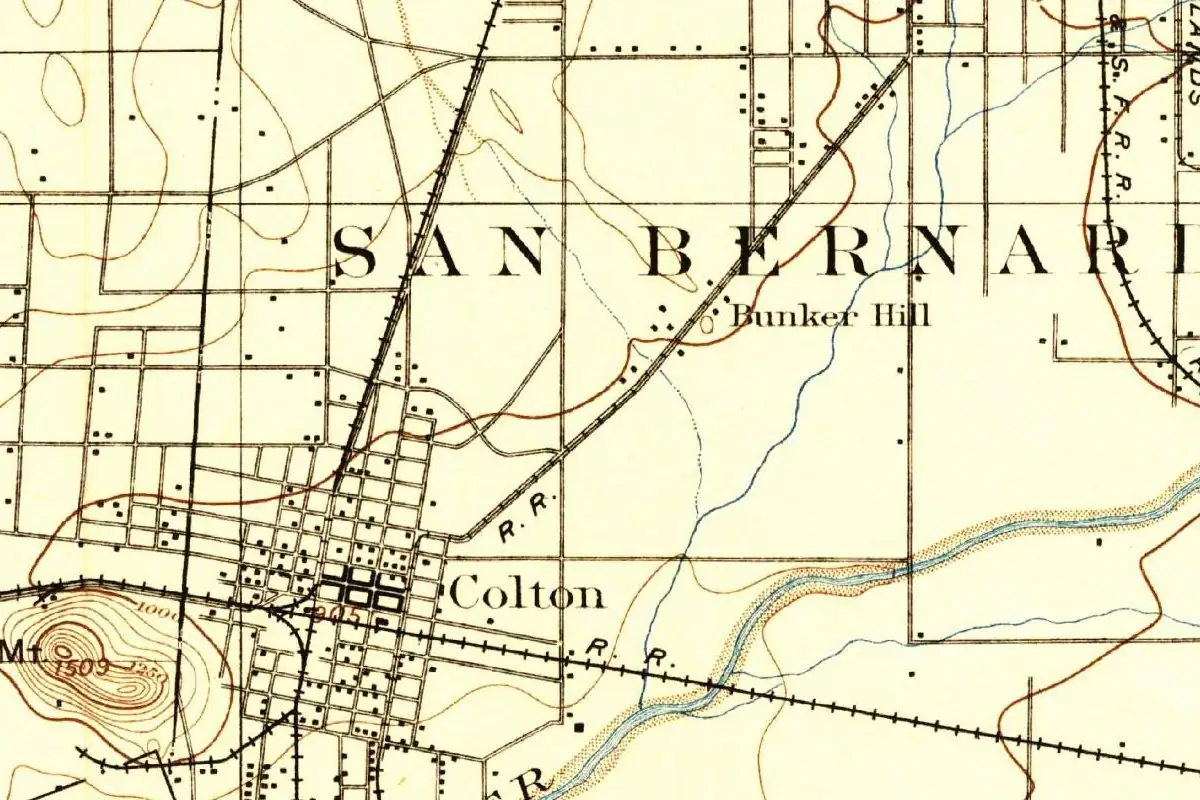
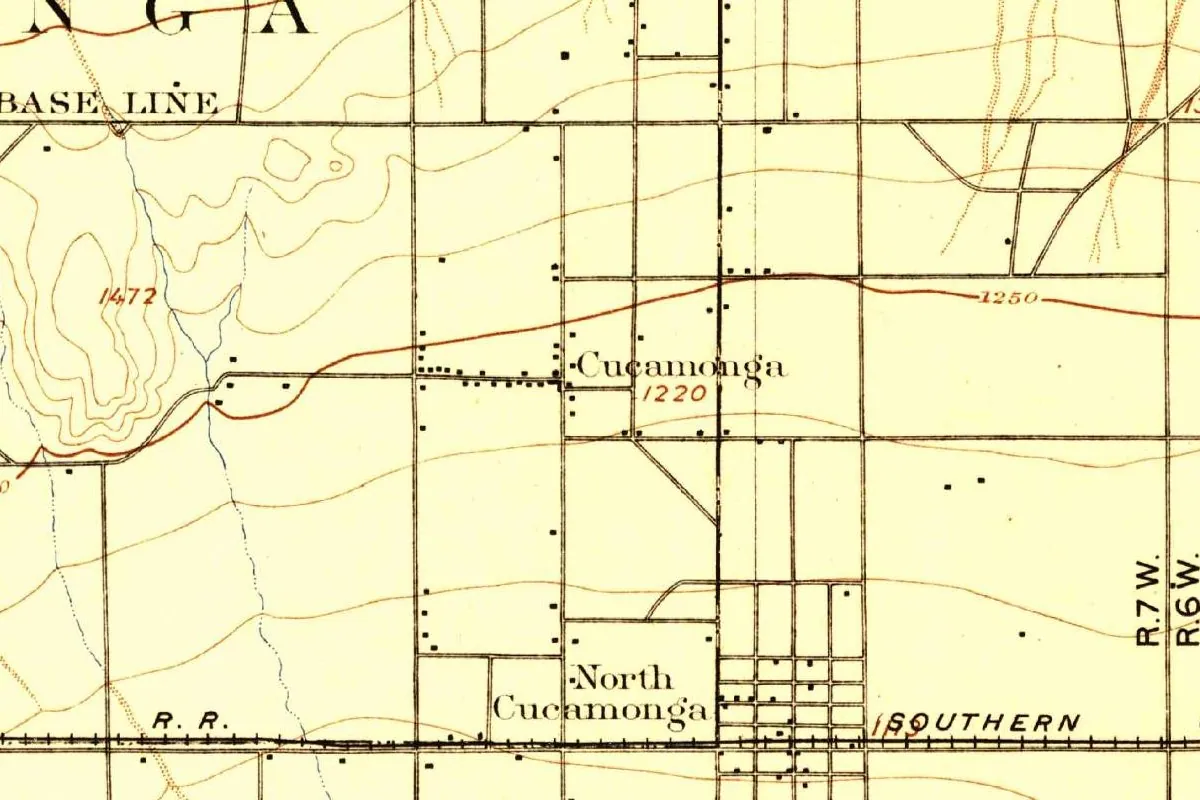
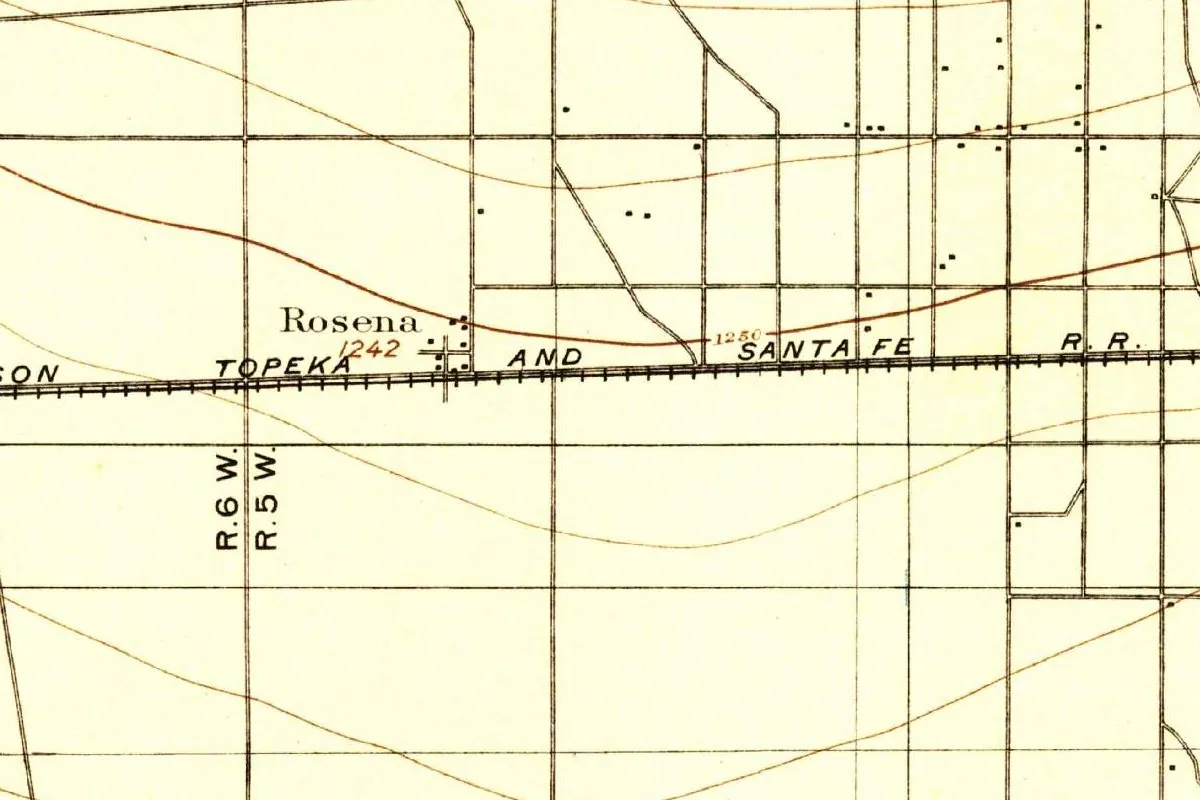
Start with Rosena, because that part is easy to see. San Bernardino County says that by 1890 the Southern California Railroad had put a station and a small town on the site, “which was named Rosena.” An 1896 government survey map, the one at the top of this page, shows exactly that: the word Rosena next to a handful of buildings on the Atchison, Topeka and Santa Fe line, with empty section roads all around.
The City of Fontana’s own timeline picks up the story in 1905. That’s when Azaerial Blanchard Miller, known as A. B., bought 17,000 acres “in what was first called Rosena,” the city says, and turned it toward citrus orchards, poultry farms and cattle. The city adds that he used 200 horses, mules, plows and scrapers to do it. The county tells the same horse-and-mule detail, but it opens that sentence with “According to legend,” so you can take it as a good story rather than a count.
A fountain and a bottle of grape juice
On the name itself, the two modern accounts agree. The county says Miller set up the Fontana Water and Land Company, “choosing the name Fontana, which means ‘fountain’ in Italian.” The city’s timeline says it more briefly: Rosena was renamed Fontana in 1913, and “Translated from Italian, Fontana means Fountain.”
The county also gives the change a date and a scene. On June 7, 1913, Miller’s mother, Eliza, christened the town by striking the base of the flagpole with a bottle of local grape juice, “signaling the end of Rosena.” More than 4,000 people came, the county says, and the day turned into the yearly celebration now called Fontana Days.
What none of these sources says is why a fountain. Henry Gannett’s 1905 federal guide to American place names doesn’t list the California town at all, but it does have a Fontana in Miami County, Kansas, “named from a spring a mile west of the town site.” That’s a different place with its own reason, and it doesn’t tell you anything about Miller’s choice.
The name was on the land before 1913
Here’s where the record gets more interesting. John Brown Jr. and James Boyd’s History of San Bernardino and Riverside Counties, published in 1922, tells the story of the Semi-Tropic Land and Water Company, which formed in 1887, bought some 28,500 acres and water from Lytle Creek, and dug the Rialto Canal. Then, the book says:
“The townsites of Rialto, Fontana, Sansevaine and Bloomington were laid out and the balance of the land was subdivided, mostly into 20-acre tracts, which were sold and were largely set out to deciduous and citrus fruits.”
The same page follows the land after the Semi-Tropic company went under. A San Francisco savings bank took it over, sold it in 1896, and in 1901 “a new company, the Fontana Development Company,” acquired those interests. So by Brown and Boyd’s account, the word Fontana sat on a townsite and on a company name years before Miller’s 1905 purchase.
That doesn’t quite fit the county’s line that Miller chose the name. The records we found don’t settle whether he picked the word himself or kept one the land companies had already used. Both the city and the county agree on the part most people ask about: the town called Rosena officially became Fontana in 1913, and the word means “fountain.”
Oranges first, steel later
If you know Fontana today, you might know it as a steel town. The city’s timeline puts that much later: Henry J. Kaiser opened his mill on the outskirts of town in 1942, and it ran until 1984. Before that, the name belonged to farm country. A 1914 book from the Southern California Panama Expositions Commission described the Fontana tract as 17,000 acres, 500 of them already planted to citrus by the company.
By 1922 the boasting had gone further. Brown and Boyd copied out the metal tablets at Camp Cajon, a roadside camp on what they called “California’s most popular transcontinental highway,” and one pointed travelers 23 miles (37 km) to “Fontana, largest orange grove in the world.” Rosena, by then, was just a name on an old survey sheet.
Quick answers
What does Fontana mean in Italian?
Fountain. Both the City of Fontana and San Bernardino County say the name is the Italian word for “fountain.”
What was Fontana, California, called before?
Rosena. A railroad station and small town by that name stood on the site by 1890, an 1896 survey map shows it on the Santa Fe line, and the city says Rosena was renamed Fontana in 1913.
Did A. B. Miller name Fontana?
That’s not settled. San Bernardino County says Miller chose the name, but a 1922 county history lists a Fontana townsite from the Semi-Tropic company’s years and a Fontana Development Company in 1901, before Miller’s 1905 land purchase.
When did Rosena become Fontana?
In 1913. The county dates the christening to June 7, 1913, when Miller’s mother, Eliza, struck the base of a flagpole with a bottle of local grape juice.
Key dates
- 1887The Semi-Tropic Land and Water Company forms and later lays out townsites, among them one called Fontana, a 1922 county history says.
- 1896A U.S. Geological Survey map shows Rosena as a small stop on the Santa Fe tracks.
- 1901The Fontana Development Company takes over the old Semi-Tropic interests, according to the 1922 history.
- 1905A. B. Miller buys 17,000 acres in what was first called Rosena, the City of Fontana says.
- 1913June 7: Miller's mother, Eliza, christens the town Fontana at the foot of a flagpole, San Bernardino County says.
- 1942Henry J. Kaiser opens his steel mill on the outskirts of town.
Getting there
Open Fontana in Google Maps
Opens in a new tab. The pin is the center of Fontana in the USGS place-name record.
The closest airports, Amtrak stations and intercity bus stops, measured in a straight line from the center of Fontana.
Airports
- Ontario International (ONT) 10 mi 16 km
- San Bernardino International (SBD) 11 mi 18 km
Amtrak trains
- San Bernardino station (SNB) 7 mi 12 km
- Riverside station (RIV) 9 mi 14 km
Intercity buses
- Mexicoach Fontana 2 mi 2 km
- Limousine Express Fontana 2 mi 2 km
- International Bus Lines Fontana 2 mi 2 km
Distances are as the crow flies, not by road. We don't list schedules or fares because they change; check with the airline, Amtrak or the bus company before you go. Official data (FAA commercial service airports (2025), FAA airport locations, Amtrak stations and Intercity Bus Atlas) from the FAA and the U.S. Bureau of Transportation Statistics, checked Nov 13, 2026.
Sponsored
Staying in Fontana?
Compare hotels in Fontana, California, on Expedia.
See hotels in FontanaWe may earn a commission if you buy through this link. It never changes what we write. Read our affiliate disclosure
Historical Sources & References
- City of Fontana, “About Us” (Timeline of Our History). Miller’s purchase of 17,000 acres “in what was first called Rosena” in 1905, the 200 horses and mules, “1913 Rosena is renamed Fontana,” “Translated from Italian, Fontana means Fountain,” and the Kaiser Steel mill from 1942 to 1984.
- San Bernardino County, “San Bernardino County history: A.B. Miller” (2025). The Rosena station and town by 1890, Miller’s Fontana Water and Land Company “choosing the name Fontana, which means ‘fountain’ in Italian,” the horses and mules “According to legend,” and Eliza Miller’s christening of June 7, 1913, before more than 4,000 people.
- John Brown Jr. and James Boyd, History of San Bernardino and Riverside Counties, vol. 1 (1922), pp. 249-250, 259. The Semi-Tropic Land and Water Company of 1887, the townsites “of Rialto, Fontana, Sansevaine and Bloomington,” the sale of 1896, the Fontana Development Company of 1901, and the Camp Cajon tablet “Twenty-three miles to Fontana, largest orange grove in the world.”
- Southern California Panama Expositions Commission, Southern California (1914), p. 187. The Fontana tract of 17,000 acres, 500 of them set to citrus by the company.
- Henry Gannett, The Origin of Certain Place Names in the United States (USGS, 1905), p. 128. Fontana, Kansas, “named from a spring a mile west of the town site,” and no entry for the California town.
- GNIS feature 1652711 (U.S. Geological Survey). Fontana’s record in the national place-name database, which places it in San Bernardino County.
- U.S. Geological Survey, San Bernardino sheet (1896). The source of the map at the top of this page, with Rosena on the Santa Fe tracks.
Spot something wrong, or know more? Tell us here. You can also email us or use our contact page. Corrections are noted here with their date, never made silently.