Rancho Cucamonga, California: A Native Name, Then a Ranch
Rancho Cucamonga takes its name from Rancho Cucamonga, a Mexican land grant of 1839 to Tiburcio Tapia, and the grant took its name from a Native village. A 1916 study gives the word as Kukomo-nga or Kukamo-nga in Gabrielino. The city took the old ranch name when three communities merged in 1977.
A village name, then a ranch
Rancho Cucamonga, California, stacks two names: Cucamonga, from a Native village, and Rancho, from the Mexican land grant that carried it after 1839. The city itself is much younger than either one. It was put together in 1977 out of three farm towns, and it took the old ranch name.
The Cucamonga half is the oldest piece. Nellie Van de Grift Sanchez, who wrote a guide to the state’s Spanish and Indian place names in 1914, put it in two sentences:
“Cucamonga, is an Indian name, derived from a village in San Bernardino County, forty-two miles by rail east of Los Angeles. It was originally applied to the land grant at that place.”
So the ranch didn’t invent the word. It borrowed it from the people who were already living there.
What the word sounded like
Two years later the anthropologist A. L. Kroeber went through California’s Native place names one by one for the University of California. He called Cucamonga a Shoshonean place name and wrote down how it sounded in two neighboring languages: Kukomo-nga or Kukamo-nga in Gabrielino, and Kukumu-nga-bit or Kukamo-na-t in Serrano. He didn’t give a meaning.
That matters, because you’ll see a translation almost everywhere. The Bureau of Land Management says the town was named for the Indian word kukamonga, “meaning ‘sandy place.’” A 1922 history of San Bernardino and Riverside counties lists “Cucamonga—Cucamungabit—‘Sand place’” in a footnote, without saying where it came from. Kroeber, who was the one actually working with the languages, left the meaning blank. Nobody has shown us the linguistic work behind “sandy place,” so treat it as a popular gloss, not a settled fact.
The city’s adopted general plan says a group it calls the Kucamongan Native Americans had a settlement around Red Hill by about A.D. 1200. The name for the larger people depends on who’s writing. Kroeber called the language Gabrielino, the Bureau of Land Management says Tongva, and the city’s plan says the Kucamongans “were part of the Kizh people.”
Tiburcio Tapia’s grant
In 1839 the Mexican governor of California, Juan Bautista Alvarado, granted the Cucamonga land to Tiburcio Tapia, a former soldier who had become one of the richest merchants in Los Angeles. The city puts the grant at 13,045 acres and says it covered parts of today’s Rancho Cucamonga and Upland.
The 1922 county history doesn’t make it a gentle story. It says the Cucamonga Indians had farmed the hills and the mesa below them, that Tapia built a house on one of the highest hills that was “practically a fortress,” set out vineyards and orchards, and that the Indians were pushed off their fields and into the canyons. The same book passes along a legend about Tapia burying a chest of gold coins under an oak tree. It’s careful to add that, “so far as known, no treasure has ever been discovered.”
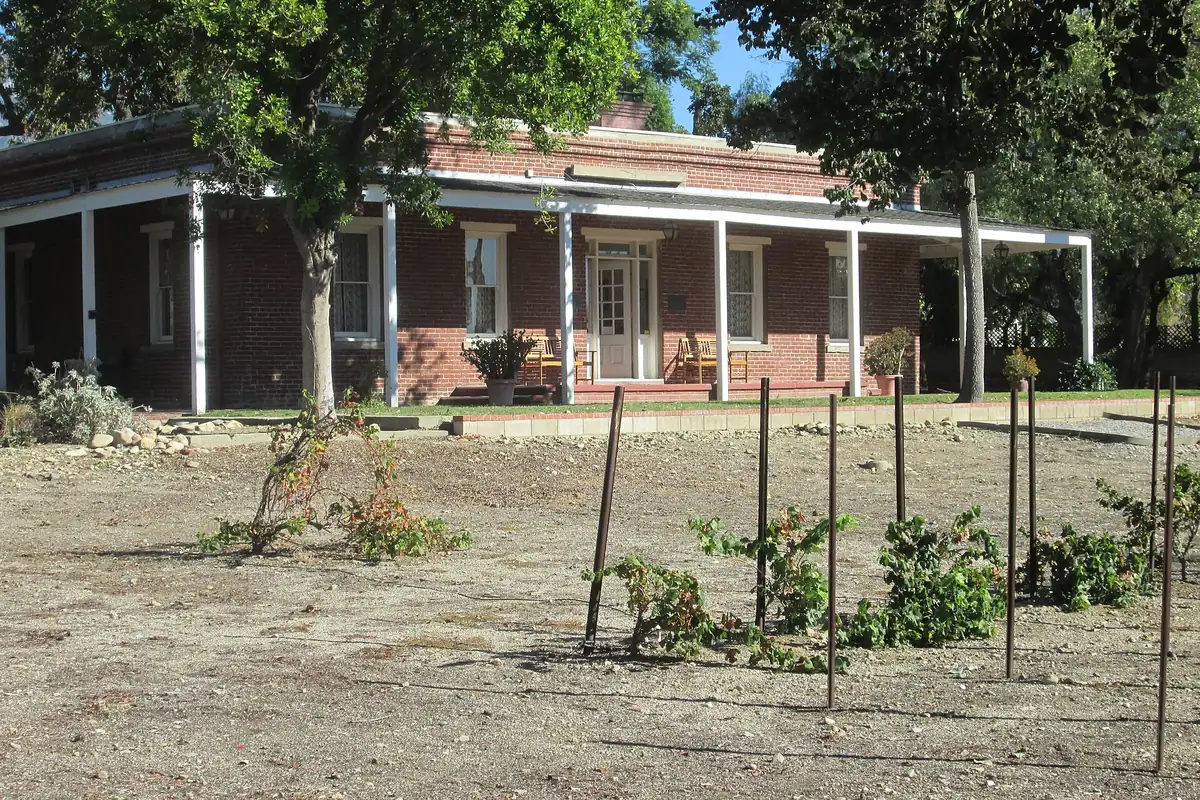
After California became part of the United States, a claim for Rancho Cucamonga was filed in 1852 with the Public Land Commission. In 1857, the 1922 history says, the estate came to John Rains through his marriage to Maria Merced, a daughter of Isaac Williams of the Chino ranch. Rains built a new house, planted more vines, and Cucamonga became a stop that mattered between San Bernardino and Los Angeles, with wines known around the state. A brick house known as the John Rains House still stands, and it’s the one in the photo below.
Three towns, one old name
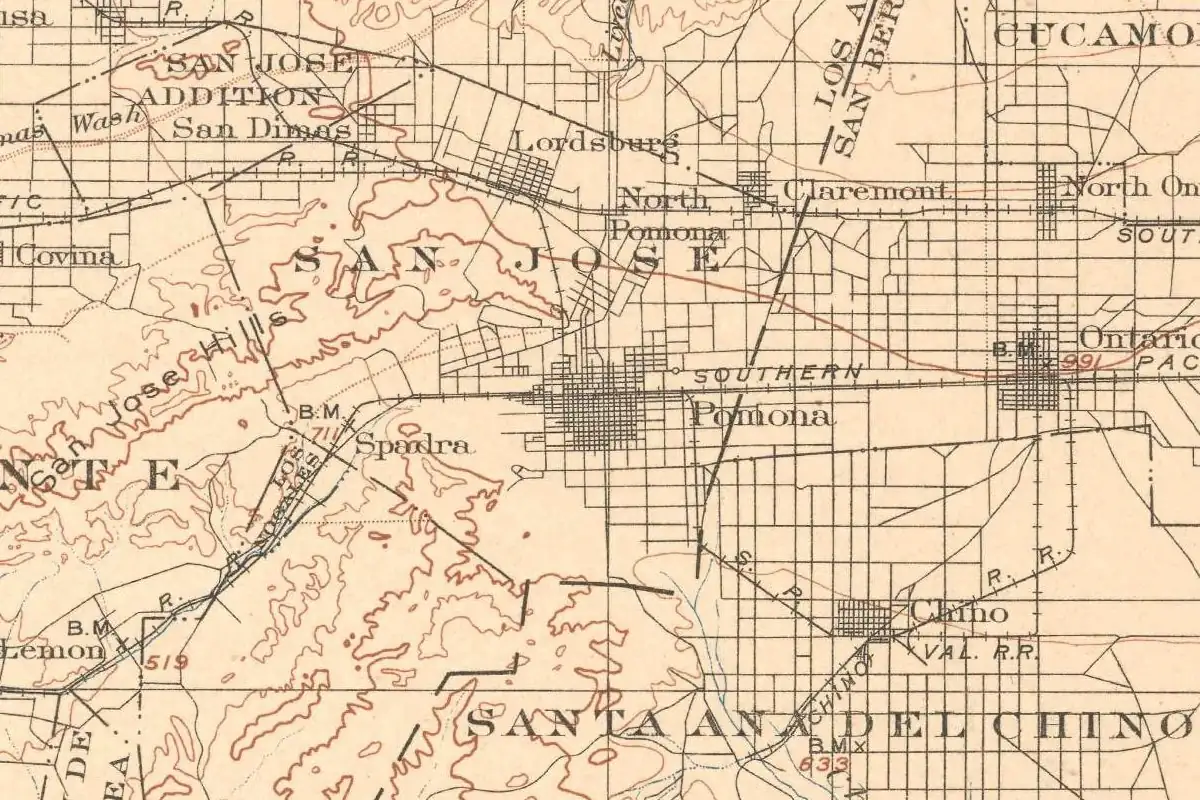
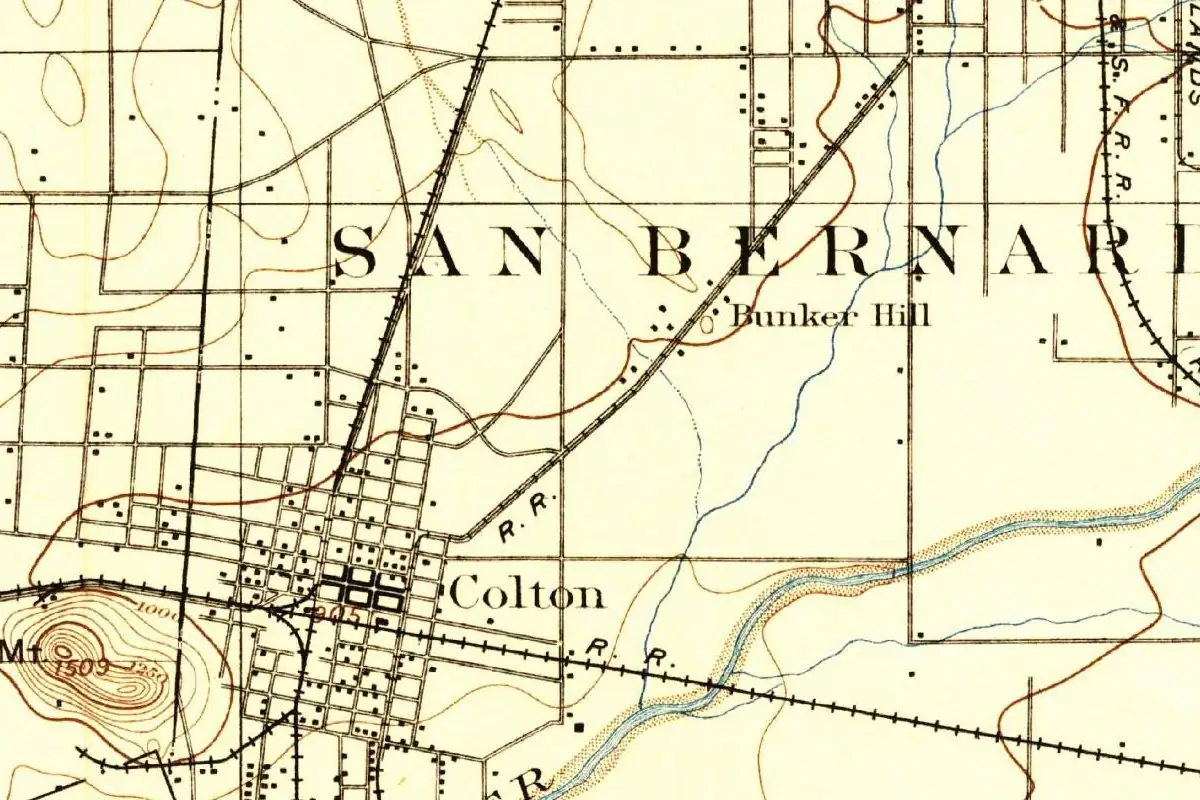
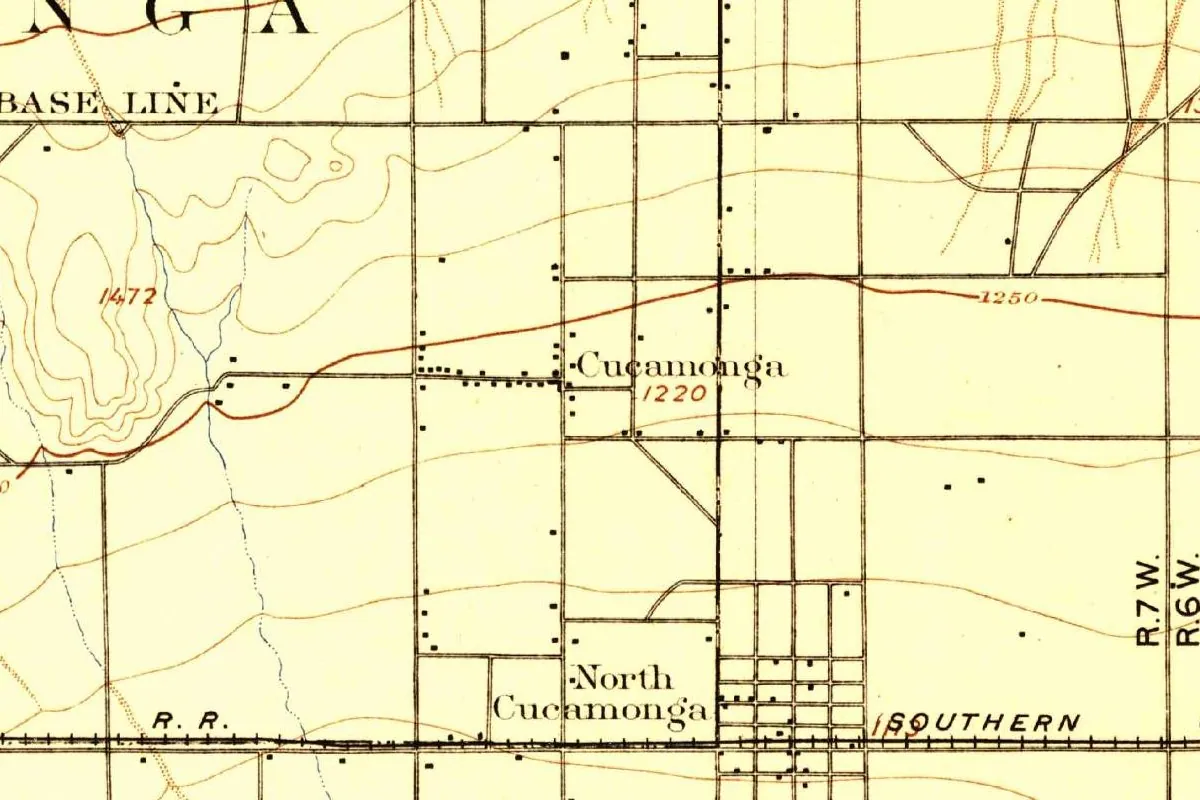
By the time the railroads came, Cucamonga was the name of a district, not just a ranch. The city’s general plan says the town first known as North Cucamonga took its name in relation to South Cucamonga, a settlement on the Southern Pacific line, and that the “North” was dropped by about 1900. Alta Loma and Etiwanda grew up nearby as farm stops of their own. The 1897 government map at the top of this page shows both a Cucamonga and a North Cucamonga.
In 1977 Alta Loma, Cucamonga and Etiwanda incorporated together as the City of Rancho Cucamonga. None of them gave up its own name to the others. The new city took the name of the ranch that had once covered much of the ground under all three, and with it a village name that’s at least as old as the grant of 1839.
The plan still treats Alta Loma, Etiwanda and Cucamonga as neighborhoods with their own character, and calls Alta Loma the most authentically “semi-rural” of them. So if you’re driving around this corner of California, you can pass through all three old towns without ever leaving Rancho Cucamonga. The ranch name sits over the top of them, and the village name sits under the ranch.
Quick answers
Is Rancho Cucamonga named after a person?
No. Cucamonga was the name of a Native village, Sanchez wrote in 1914, and Rancho comes from the land grant that used that name. The grant was made to Tiburcio Tapia, but nothing was named for him.
Does Cucamonga really mean “sandy place”?
Maybe, but it isn’t proven. The Bureau of Land Management says “sandy place” and a 1922 county history says “Sand place,” while Kroeber’s 1916 study of the language forms gave no meaning at all.
Why does the city’s name start with “Rancho”?
Because it’s the name of the 1839 Mexican land grant, Rancho Cucamonga. The city borrowed the ranch’s full name when three communities joined in 1977.
Were Alta Loma and Etiwanda old names for the city?
No. They were separate communities, along with Cucamonga, and all three became the City of Rancho Cucamonga at the same time in 1977.
Key dates
- 1839Governor Juan Bautista Alvarado grants the Cucamonga land, about 13,045 acres, to Tiburcio Tapia of Los Angeles.
- 1852A claim for Rancho Cucamonga is filed with the Public Land Commission, as the Land Act of 1851 required.
- 1857The Cucamonga estate passes to John Rains through his marriage to Maria Merced, daughter of Isaac Williams, a 1922 county history says.
- 1914Nellie Van de Grift Sanchez calls Cucamonga an Indian name, first applied to the land grant.
- 1916A. L. Kroeber records the name as Kukomo-nga or Kukamo-nga in Gabrielino, without a translation.
- 1977Alta Loma, Cucamonga and Etiwanda incorporate together as the City of Rancho Cucamonga.
Getting there
Open Rancho Cucamonga in Google Maps
Opens in a new tab. The pin is the center of Rancho Cucamonga in the USGS place-name record.
The closest airports, Amtrak stations and intercity bus stops, measured in a straight line from the center of Rancho Cucamonga.
Airports
- Ontario International (ONT) 4 mi 6 km
- San Bernardino International (SBD) 21 mi 33 km
Amtrak trains
- Ontario station (ONA) 4 mi 7 km
- Pomona station (POS) 10 mi 15 km
Intercity buses
- Limousine Express Ontario (Convention Center) 3 mi 5 km
- Mexicoach Ontario (Convention Center) 3 mi 5 km
- Amtrak Chartered Vehicle Amtrak Connecting Service · Ontario Amtrak 4 mi 7 km
Distances are as the crow flies, not by road. We don't list schedules or fares because they change; check with the airline, Amtrak or the bus company before you go. Official data (FAA commercial service airports (2025), FAA airport locations, Amtrak stations and Intercity Bus Atlas) from the FAA and the U.S. Bureau of Transportation Statistics, checked Nov 13, 2026.
Sponsored
Staying in Rancho Cucamonga?
Compare hotels in Rancho Cucamonga, California, on Expedia.
See hotels in Rancho CucamongaWe may earn a commission if you buy through this link. It never changes what we write. Read our affiliate disclosure
Historical Sources & References
- A. L. Kroeber, California Place Names of Indian Origin (1916), p. 41. Cucamonga as a Shoshonean place name: Kukomo-nga or Kukamo-nga in Gabrielino, Kukumu-nga-bit or Kukamo-na-t in Serrano, with no meaning given.
- Nellie Van de Grift Sanchez, Spanish and Indian Place Names of California (1914), p. 80. The quoted entry: an Indian name from a village, 42 miles (68 km) by rail east of Los Angeles, first applied to the land grant.
- John Brown Jr. and James Boyd, History of San Bernardino and Riverside Counties, vol. 1 (1922), pp. 9, 28-29. The footnote “Cucamonga—Cucamungabit—‘Sand place’” (p. 9); the Cucamonga Indians, the 1839 grant from Governor Alvarado to Tiburcio Tapia, his fortress-like house, the buried-treasure legend, and John Rains taking over the estate in 1857 (pp. 28-29).
- City of Rancho Cucamonga, PlanRC 2040 General Plan, vol. 1 (adopted December 2021), pp. 24-26. The Kucamongan settlement near Red Hill and the Kucamongans as “part of the Kizh people,” the 13,045-acre grant of 1839, the 1852 land claim, North and South Cucamonga, the 1977 incorporation of Alta Loma, Cucamonga and Etiwanda, and Alta Loma as the most “semi-rural” of the old communities.
- Bureau of Land Management, “Rancho Cucamonga” (2020). The Tongva, the word kukamonga glossed as “sandy place,” and Alvarado’s 1839 grant to Tapia.
- GNIS feature 1667908 (U.S. Geological Survey). Confirms the San Bernardino County location and the latitude and longitude used for the map on this page.
- U.S. Geological Survey, Cucamonga sheet (1897). The source of the map at the top of this page.
Spot something wrong, or know more? Tell us here. You can also email us or use our contact page. Corrections are noted here with their date, never made silently.