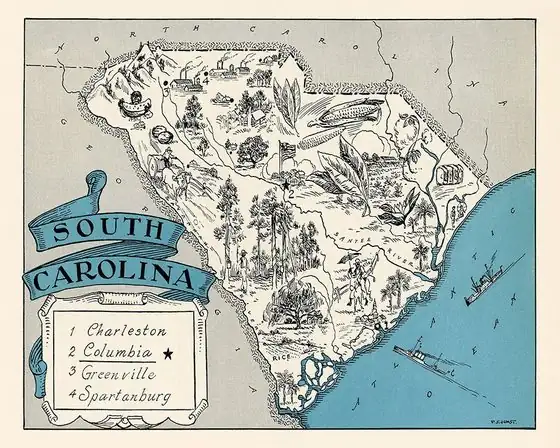
How Did Myrtle Beach, SC, Get Its Name?
Myrtle Beach takes its name from the wax myrtle, a shrub common along that coast. The City of Myrtle Beach says the name won a 1900 contest to rename the settlement then called New Town. Addie Burroughs, widow of Franklin G. Burroughs, suggested it, and "Edgewater" came second.
Myrtle Beach got its name from the wax myrtle, a shrub that grows thick along that stretch of the South Carolina coast, chosen in a contest in 1900. Both the city government and the state encyclopedia agree on the shrub. Only the city tells who picked the name and when, and it even records the runner-up: Edgewater.
Long Bay, Withers and New Town
Before it was Myrtle Beach, this beach went by at least three other names. The City of Myrtle Beach, on its page about the stories behind local place names, lists them in order. The area was called Long Bay when a hurricane swept through in 1822. Later it was known as Withers, for the Withers family, which had owned property there since the late 1700s, and a Withers post office opened in 1888.
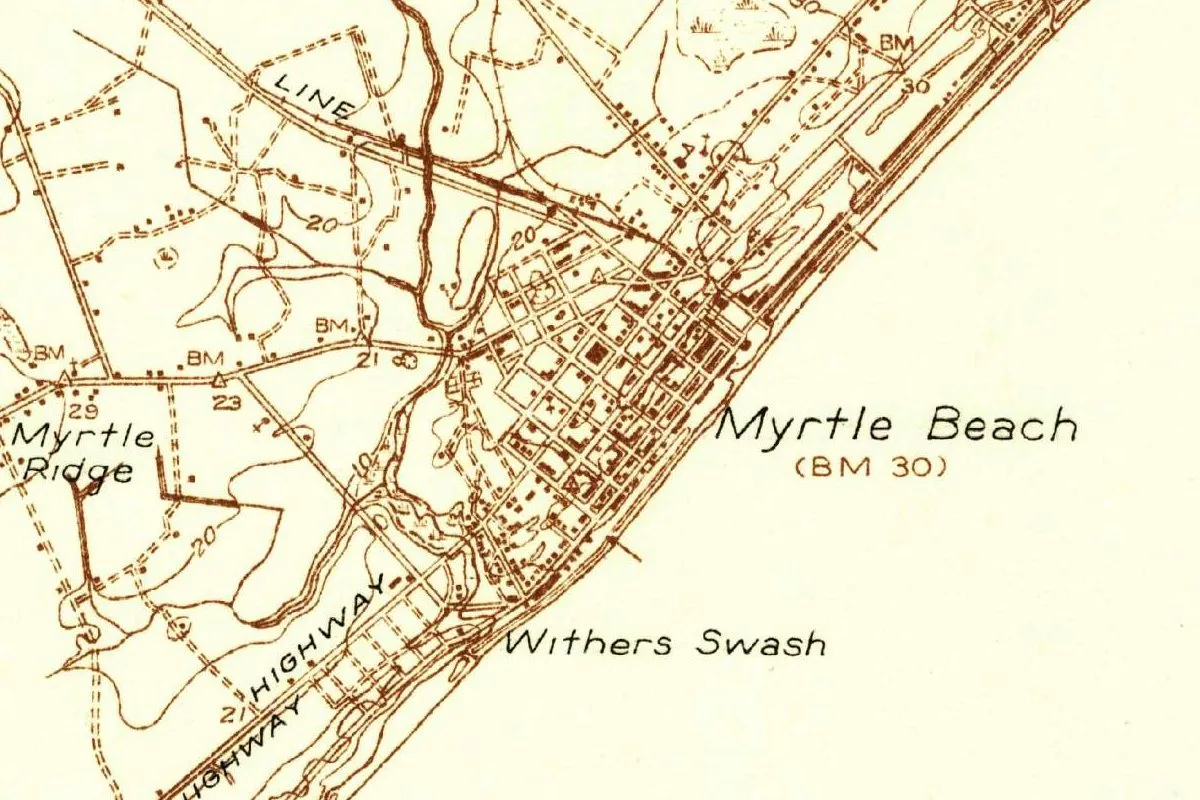
You can still find the family on the map. The 1937 U.S. Geological Survey sheet shows Withers Swash winding to the ocean just south of the town’s street grid, and the city says the swash got its name from that same family.
Then came the timber company. The city says the Burroughs and Collins Company of Conway bought much of the Withers land in 1881. The South Carolina Encyclopedia, in an entry by Eldred E. Prince, Jr., adds that the company slowly built up about seventy thousand acres for their timber, and that the area’s first settlement was a logging camp. In about 1900 the company ran a railroad from Conway to the coast to haul out the timber. The end of the line was called New Town. The city explains the logic: Conway, inland, was “old town.”
A contest and a shrub
The city’s account of the renaming is short:
“In 1900, a contest was held to give New Town an official name, and Addie Burroughs, widow of Franklin G. Burroughs, suggested ‘Myrtle Beach’ because of the wax myrtle bushes growing abundantly. The second-place suggestion was ‘Edgewater.’”
The encyclopedia doesn’t mention the contest or Mrs. Burroughs. It just says the settlement “was renamed Myrtle Beach after the wax myrtle, a shrub common to the region.” So the two sources line up on the reason, and the city alone supplies the who and the when. We didn’t find the contest itself in a newspaper of the time, so the date and the winner rest on the city’s word.
There’s a reason to think the name was settled early, though. You don’t have to take anyone’s word that it was in use within a few years. On August 7, 1903, The Marlboro Democrat, a paper in Bennettsville, about 80 miles (130 km) inland as the crow flies, ran this in its local news:
“Mr. Arthur Douglas has returned from a short stay at Myrtle Beach, Conway county. He was not much struck with that place.”
The paper’s county was off, since the beach lies in Horry County, at the end of the railroad from the town of Conway. And Mr. Douglas wasn’t impressed. But the name was already traveling inland as the name of a place people went to stay. The same page notes another family who had “gone to Myrtle Beach.”
From timber camp to town
The resort side started right away. The encyclopedia says that in 1901 the company built a small hotel, the Seaside Inn, at two dollars a day with meals, along with a general store, and began selling oceanfront lots for twenty-five dollars each. Horry County people came by train for a day, a week or a season. In 1912 Simeon B. Chapin, a northern businessman, bought a half-interest in the venture, which became Myrtle Beach Farms.
Even then, the post office lagged behind the name. The city says the Withers post office wasn’t replaced by the first Myrtle Beach post office until the early 1910s. Myrtle Beach was incorporated in 1938 and became a city in 1957, when its permanent population first passed 5,000.
The city also points out that no other incorporated place in the country carries the name Myrtle Beach. So if you’re walking the sand here, you’re in the only Myrtle Beach in the country, on a stretch of South Carolina that still carries the name of a bush.
Quick answers
Who named Myrtle Beach?
The City of Myrtle Beach says Addie Burroughs, widow of Franklin G. Burroughs, suggested the name in a 1900 contest. The state encyclopedia gives the reason, the wax myrtle, but doesn’t name who chose it.
What was Myrtle Beach called before?
According to the city, the area was known as Long Bay, then Withers, after a local landowning family, and then New Town, the end of the railroad from Conway.
What is a wax myrtle?
It’s the shrub behind the name. The South Carolina Encyclopedia calls it “a shrub common to the region,” and the city describes the bushes as growing abundantly where the town grew up.
What name came in second?
“Edgewater,” according to the city’s account of the 1900 contest.
Key dates
- 1822A hurricane sweeps the coast while the area is still known as Long Bay, the city says.
- 1881The Burroughs and Collins Company of Conway buys much of the Withers family's land, according to the city.
- 1888A post office named Withers opens, according to the city.
- 1900A contest renames New Town; Addie Burroughs suggests "Myrtle Beach" for the wax myrtle, and "Edgewater" comes second.
- 1901The company builds the Seaside Inn and a general store and sells oceanfront lots for $25, the state encyclopedia says.
- 1903August 7: a Bennettsville paper reports Arthur Douglas back from "a short stay at Myrtle Beach."
- 1938Myrtle Beach is incorporated; it becomes a city in 1957, when its population first tops 5,000.
Getting there
Open Myrtle Beach in Google Maps
Opens in a new tab. The pin is the center of Myrtle Beach in the USGS place-name record.
The closest airports, Amtrak stations and intercity bus stops, measured in a straight line from the center of Myrtle Beach.
Airports
- Myrtle Beach International (MYR) 2 mi 4 km
- Florence Regional (FLO) 59 mi 95 km
- Charleston AFB/International (CHS) 86 mi 139 km
Amtrak trains
- Kingstree station (KTR) 54 mi 87 km
- Dillon station (DIL) 58 mi 93 km
Intercity buses
- Greyhound Myrtle Beach Bus Station under 1 mi 0.4 km
Distances are as the crow flies, not by road. We don't list schedules or fares because they change; check with the airline, Amtrak or the bus company before you go. Official data (FAA commercial service airports (2025), FAA airport locations, Amtrak stations and Intercity Bus Atlas) from the FAA and the U.S. Bureau of Transportation Statistics, checked Nov 13, 2026.
Sponsored
Staying in Myrtle Beach?
Compare hotels in Myrtle Beach, South Carolina, on Expedia.
See hotels in Myrtle BeachWe may earn a commission if you buy through this link. It never changes what we write. Read our affiliate disclosure
Sponsored
Want the spooky side of Myrtle Beach?
The name has its story above. For the ghost stories, US Ghost Adventures runs walking ghost tours in Myrtle Beach.
See ghost tours in Myrtle BeachWe may earn a commission if you book through this link. It never changes what we write. Read our affiliate disclosure
Historical Sources & References
- City of Myrtle Beach, “Our Honorary Namesakes”. The earlier names Long Bay, Withers and New Town, the 1822 hurricane, the Withers post office of 1888, the 1881 land purchase, the 1900 contest won by Addie Burroughs with the passage quoted above, “Edgewater” in second place and the first Myrtle Beach post office in the early 1910s.
- City of Myrtle Beach, “About Myrtle Beach”. The wax myrtle as “an abundant local shrub,” the 1900 contest, incorporation in 1938 and city status in 1957.
- Eldred E. Prince, Jr., “Myrtle Beach,” South Carolina Encyclopedia. The Burroughs & Collins landholdings, the logging camp, the railroad to New Town, the Seaside Inn and $25 lots of 1901, the renaming for the wax myrtle and Chapin’s 1912 partnership.
- The Marlboro Democrat, August 7, 1903, p. 6. The local news item quoted above, with “Myrtle Beach” already in print as a place to visit.
- GNIS feature 1249770 (U.S. Geological Survey). Confirms the spelling of the city’s name and places it in Horry County.
- U.S. Geological Survey, Myrtle Beach sheet (1937). Printed in brown in 1937, this is the earliest topographic sheet we found for the spot, and it labels both Myrtle Beach and Withers Swash.
Spot something wrong, or know more? Tell us here. You can also email us or use our contact page. Corrections are noted here with their date, never made silently.