Georgetown, SC: Which King George Is It Named For?
Georgetown is named for a British King George, but sources disagree on which one. Henry Gannett's 1905 USGS study of place names lists both George I and George III for the South Carolina city, and a later summary says Prince George, the future George II. The 1735 deed creating the town, as quoted in 1908, simply says "George Town."
Ask which King George gave Georgetown, South Carolina, its name and you’ll get three answers, two of them from the same page of a 1905 federal book. The one thing nobody disputes is the “George.” The deed that set the town up in 1735 just calls it “George Town” and leaves the rest to you.
One page, two kings
Henry Gannett’s The Origin of Certain Place Names in the United States, published by the U.S. Geological Survey in 1905, has a long run of Georgetowns on page 136. Two of them are this one.
The first entry lumps a town in Sagadahoc County, Maine, together with the “county, and city in same county, in South Carolina,” all “named for George I, King of England.” Two entries later, a second entry covers the same South Carolina county and city again and says they were “named for King George III, of England.” Same book, same page, two different kings.
The South Carolina Encyclopedia’s entry on Georgetown County, by Alexia Jones Helsley, sides with the second line: the county was “Named in honor of King George III of England.” That’s about the county, though, which the encyclopedia dates as a judicial district to the court act of 1769, decades after the town was laid out.
A third answer turns up in the SC Picture Project, a South Carolina landmarks site, which says both the city and the county “were named for Prince George, who later became King George II of England.” It doesn’t say where that comes from. So you’ve got George I, George II and George III, and not one of these sources quotes a document that settles it.
A parish called Prince George
The piece of paper closest to the question comes from early 1722, when the colony’s assembly answered a petition from “the inhabitants at Winyaw” who were too far from any parish church. The act, printed in the Statutes at Large of South Carolina and dated March 10, 1721, old style (March 1722 by today’s calendar), made their settlement a parish that “shall be called by the name of Prince George’s Parish.”
That came before there was any town. Henry A. M. Smith, writing in the South Carolina Historical and Genealogical Magazine in 1908, makes the point the hard way: an early settler may have died in 1713 “in the locality which subsequently became Georgetown,” but “he could not have died in Georgetown, for no town then existed or had that name been bestowed.”
The act doesn’t say which Prince George it meant. Still, the name “George” was attached to this part of the coast years before the streets were drawn, and the town grew up inside that parish.
Elisha Screven’s deed
The South Carolina Encyclopedia says Elisha Screven founded Georgetown in 1729. Smith, who dug through the land records, gives a slightly fuzzier timeline. In early 1729/30, Governor Robert Johnson told the Board of Trade in England that many people had settled on the “Wyneau” River and that a town and a port of entry should be laid out there. Sometime between then and 1734, Screven had a plan drawn on the Sampit River, on land his mother had left him. By late 1734 he was advertising in The South-Carolina Gazette that buyers could get titles from him.
Then, on January 16, 1734 by the old calendar (1735 by ours), Screven signed the deed that made it official, handing the town to three trustees. Smith quotes it:
“for a Town to be called by the name of George Town as the same has been already laid out by said Elisha Screven into lots”
That’s the earliest wording of the name we found, and it’s maddeningly plain. “George Town,” no king, no number. The deed set aside lots for an Anglican church, a Presbyterian meeting house, a Baptist meeting house and a grammar school, but it never stops to explain the name.
So which George?
If you want a single name, the fair summary is that the record doesn’t give one. Gannett offers George I and George III without choosing, the encyclopedia’s county entry picks George III for the county, and the SC Picture Project says Prince George, later George II. The parish of 1721/22 and the deed of 1735 both point to a George without saying which.
What isn’t in doubt is how early the town settled into that name. Smith printed a list of Georgetown’s lot owners as of June 30, 1737, and the encyclopedia says all 224 lots had been sold by then. Georgetown was incorporated in 1805, and the encyclopedia counts it as the third-oldest town in South Carolina.
One more twist from Gannett’s page 136: a few lines below the two Georgetown entries, he says the colony next door, Georgia, was “named by and for King George II.” So the same page that can’t decide on Georgetown’s king has no trouble at all with Georgia’s.
Quick answers
Which King George is Georgetown, SC, named after?
Sources disagree. Gannett’s 1905 entries give both George I and George III, the South Carolina Encyclopedia names George III for the county, and the SC Picture Project says Prince George, later George II.
Who founded Georgetown, South Carolina?
Elisha Screven. The South Carolina Encyclopedia dates the founding to 1729, and Smith’s 1908 article quotes Screven’s deed of January 1735 handing “George Town” to trustees.
Is Georgetown older than the parish of Prince George?
No. The parish was created by an act dated March 10, 1721 (1722 in today’s reckoning), and Smith says no town existed or had the name in 1713; the town plan came between 1729/30 and 1734.
Key dates
- 1721/22An act dated March 10, 1721 (1722 by today's calendar) makes the settlement at Winyaw a parish "called by the name of Prince George's Parish."
- 1729Elisha Screven founds Georgetown, according to the South Carolina Encyclopedia.
- 1735January 16 (1734 by the old calendar): Screven deeds land to trustees "for a Town to be called by the name of George Town."
- 1737A list of Georgetown's lot owners is dated June 30; the encyclopedia says all 224 lots had been sold by then.
- 1805Georgetown is incorporated, according to the South Carolina Encyclopedia.
- 1905Gannett's page 136 lists the South Carolina city twice, once for George I and once for George III.
Getting there
Open Georgetown in Google Maps
Opens in a new tab. The pin is the center of Georgetown in the USGS place-name record.
The closest airports, Amtrak stations and intercity bus stops, measured in a straight line from the center of Georgetown.
Airports
- Myrtle Beach International (MYR) 30 mi 48 km
- Charleston AFB/International (CHS) 54 mi 87 km
Amtrak trains
- Kingstree station (KTR) 37 mi 59 km
- Charleston station (CHS) 53 mi 86 km
Intercity buses
- Greyhound Myrtle Beach Bus Station 32 mi 52 km
Distances are as the crow flies, not by road. We don't list schedules or fares because they change; check with the airline, Amtrak or the bus company before you go. Official data (FAA commercial service airports (2025), FAA airport locations, Amtrak stations and Intercity Bus Atlas) from the FAA and the U.S. Bureau of Transportation Statistics, checked Nov 13, 2026.
Sponsored
Staying in Georgetown?
Compare hotels in Georgetown, South Carolina, on Expedia.
See hotels in GeorgetownWe may earn a commission if you buy through this link. It never changes what we write. Read our affiliate disclosure
Sponsored
Want the spooky side of Georgetown?
The name has its story above. For the ghost stories, US Ghost Adventures runs walking ghost tours in Georgetown.
See ghost tours in GeorgetownWe may earn a commission if you book through this link. It never changes what we write. Read our affiliate disclosure
Historical Sources & References
- Henry A. M. Smith, “Georgetown: The Original Plan and the Earliest Settlers,” South Carolina Historical and Genealogical Magazine 9 (1908), pp. 85-95. The 1705 grants to John and Edward Perrie (pp. 85-86); the line that no town existed or had the name in 1713, Governor Johnson’s report of 1729/30 and Screven’s 1734 notices in the Gazette (p. 88); the deed of January 16, 1734/35 to trustees George Pawley, William Swinton and Daniel LaRoche, with the “George Town” wording quoted above (pp. 88-89), the lots set aside for churches and a grammar school (pp. 89-90); and the list of lot owners as of June 30, 1737 (p. 95).
- Henry Gannett, The Origin of Certain Place Names in the United States (USGS, 1905), p. 136. The two entries for the South Carolina county and city, one “named for George I” and one “named for King George III,” and the Georgia entry on the same page.
- The Statutes at Large of South Carolina, vol. 3 (1838), pp. 171-172. The act making the settlement at Winyaw a parish “called by the name of Prince George’s Parish,” dated March 10, 1721, old style.
- Patricia Davis Doyle, “Georgetown,” South Carolina Encyclopedia. Founding by Elisha Screven in 1729, the trustees of 1735, the 224 lots sold within two years and incorporation in 1805.
- Alexia Jones Helsley, “Georgetown County,” South Carolina Encyclopedia. The county “Named in honor of King George III” and the court act of 1769 that made Georgetown a judicial district.
- SC Picture Project, “Georgetown”. The version naming Prince George, later King George II, for both the city and the county.
- GNIS feature 1247888 (U.S. Geological Survey). One ID for the Georgetown on the Sampit, kept distinct from the long list of other Georgetowns across the country.
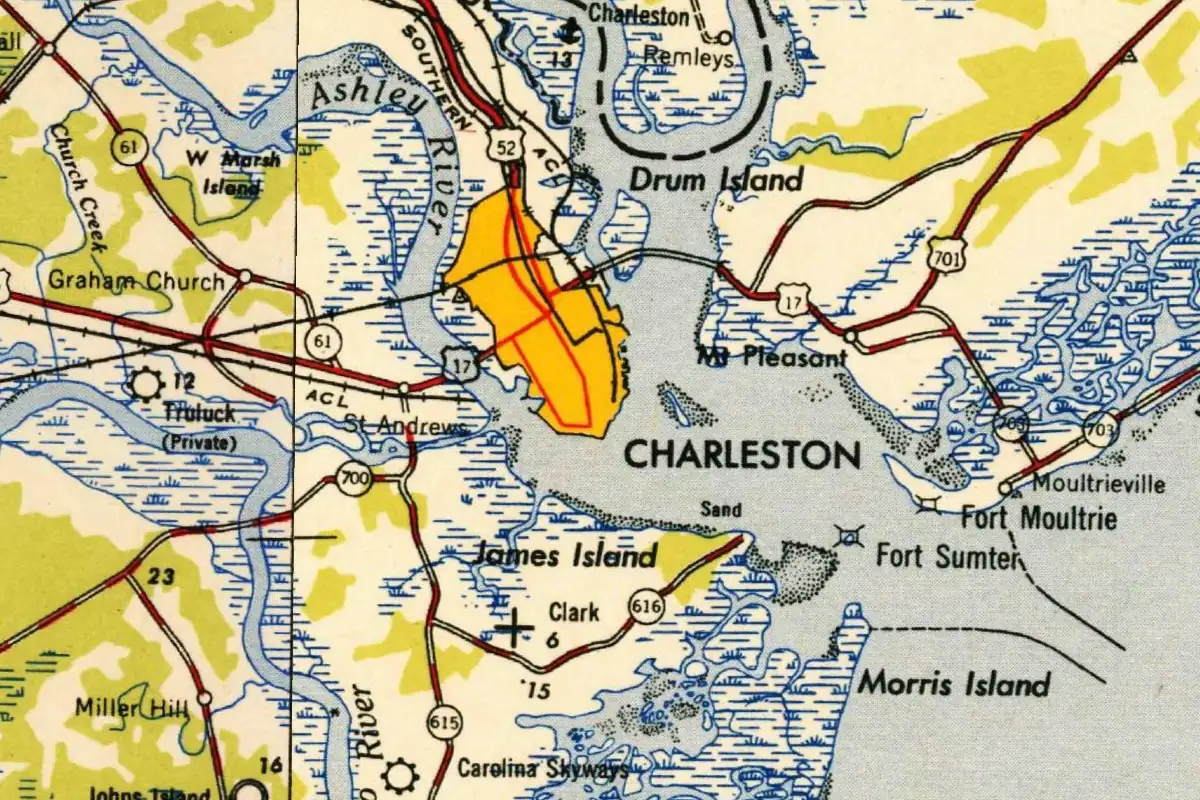
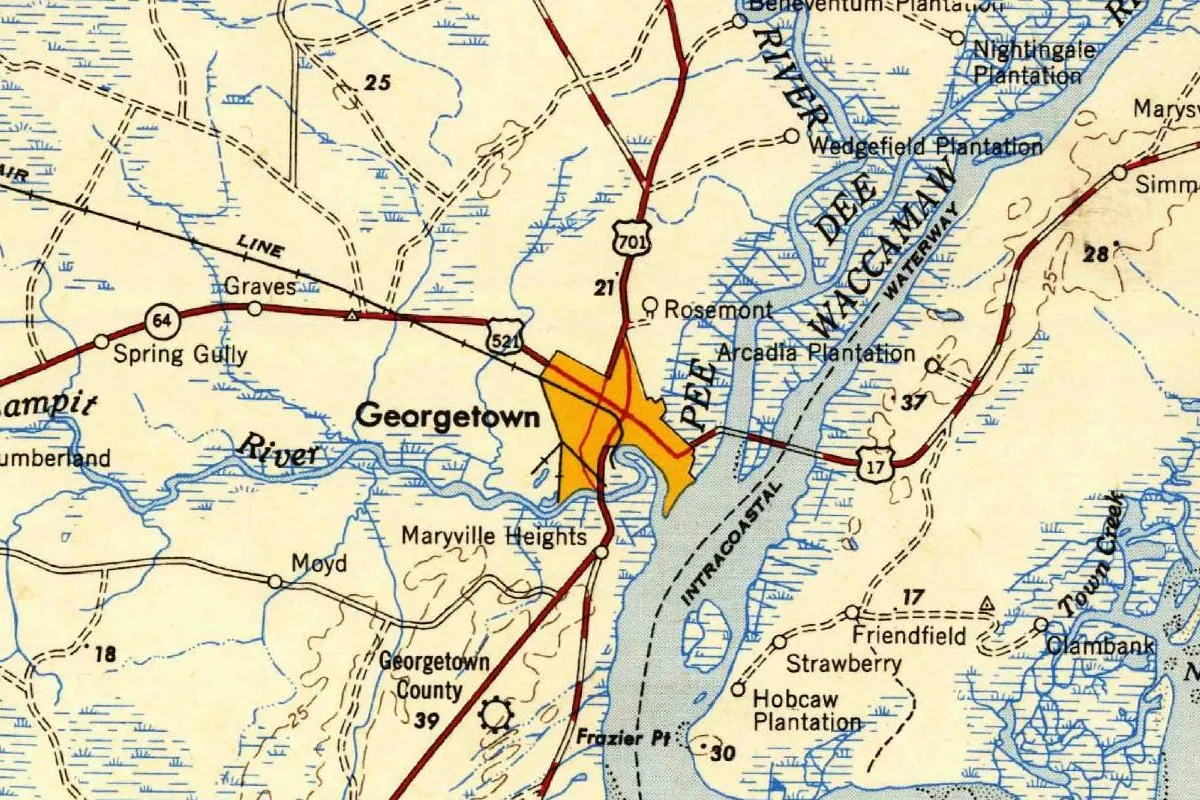
- USGS and U.S. Army Corps of Engineers, Georgetown sheet (1949). A small-scale 1949 sheet, joint work of the two agencies; it’s where the orange town block and the river names in our crop come from.
Spot something wrong, or know more? Tell us here. You can also email us or use our contact page. Corrections are noted here with their date, never made silently.