Which William Aiken Is Aiken, South Carolina, Named For?
Aiken is named for William Aiken Sr., the Charleston merchant who was the largest investor in the South Carolina Canal and Rail Road Company and its president. He died in 1831. The line reached the new town in 1833, and Aiken was incorporated in 1835. A 1905 federal dictionary credited his son, a later governor, instead.
A railroad president who died too soon
The man Aiken, South Carolina, is named for died in 1831, two years before the first train reached the railroad town that carries his name. He was William Aiken Sr., a Charleston cotton merchant and the president of the railroad that made the town in the first place.
The South Carolina Encyclopedia puts it plainly: Aiken was “named for railroad president William Aiken, Sr.” It also says the town “owes its existence to the South Carolina Railroad.” So the name and the town come from the same source, a line of track.
A Charleston merchant bets on a railroad
Aiken Sr. wasn’t from the sandhills. The encyclopedia’s biography says he was born in County Antrim, in what’s now Northern Ireland, in 1778, came to South Carolina with his family as a boy and worked his way up in Charleston’s cotton trade.
By the 1820s Charleston was losing trade to Savannah, and he knew it. In March 1828 he sat on a Chamber of Commerce committee that looked into a railroad from Charleston to the Savannah River near Augusta, Georgia. Later that year he and others got a charter for the South Carolina Canal and Rail Road Company. He was its largest investor, and the company picked him as president. Under his direction, the route was chosen and track went down toward Hamburg, a cotton boomtown across the river from Augusta.
He didn’t get to see it finished. In March 1831 he was thrown from his carriage in Charleston and died of his injuries. “He would not live to see the completion of the railroad,” his biography says.
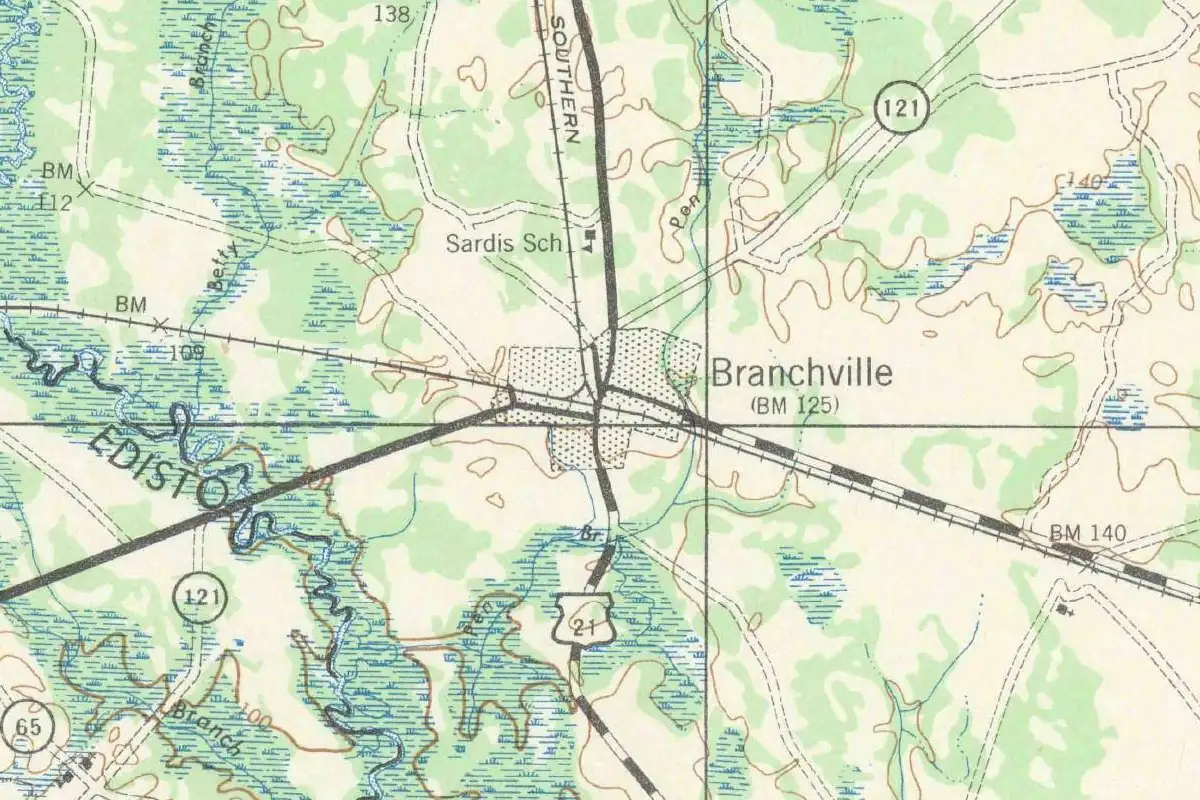
The tracks reached Hamburg in 1833. The Aiken County Historical Society calls it a 136-mile (219 km) railroad, the same line that runs through our story of Branchville. According to the Advisory Council on Historic Preservation, the first train arrived in “the newly established town of Aiken” that same year, and the town was incorporated in 1835. So by the time there was a town to name, the man it honored had been dead for years.
Two William Aikens
Here’s where it gets confusing. There were two William Aikens, father and son, and both were tied to railroads.
The son, William Aiken Jr., was born in Charleston in 1806. He grew rich as a planter, invested in railroads and went into politics. The state encyclopedia says he entered the South Carolina House in 1838, moved to the state Senate in 1842 and was elected governor on December 7, 1844. As governor, he pushed the legislature to put money into railroad companies.
When Henry Gannett, the U.S. Geological Survey’s geographer, wrote his 1905 dictionary of American place names, he picked the son. His entry reads: “Aiken; county, and town in same county, in South Carolina, named for William Aiken, governor of the State in 1844-1846.”
The dates don’t help Gannett’s case. The town was incorporated in 1835, three years before the younger Aiken held any office and nine years before he became governor. The South Carolina Encyclopedia, the Aiken County Historical Society and the federal preservation council all point to the father, the railroad president. Aiken County was a different matter: it wasn’t formed until 1871, and by then the son was a former governor. The county historical society still says both the town and the county “were named for the president of that 136-mile-long railroad, William Aiken.”
If you’ve seen the governor credited somewhere, Gannett’s book is one place that version shows up in print, and the dates don’t back it up.
A love story in the town plan
Aiken has another origin story, and it’s a better one to tell at dinner. It just isn’t about the name.
The state encyclopedia calls it a “local legend.” A railroad surveyor named Alfred Dexter fell for Sara Williams, the daughter of a planter named William Williams. Her father had a condition. “No railroad for me, young man, no girl for you,” Williams is said to have insisted. The couple did marry, and the train did pass through Williams’s property. Whether the bargain had anything to do with it, nobody can say.
Notice what the legend explains: where the tracks went, and so where the town grew. It never claims Dexter or the Williams family gave the place its name. That part stays with the railroad president.
Wide streets and a new reputation
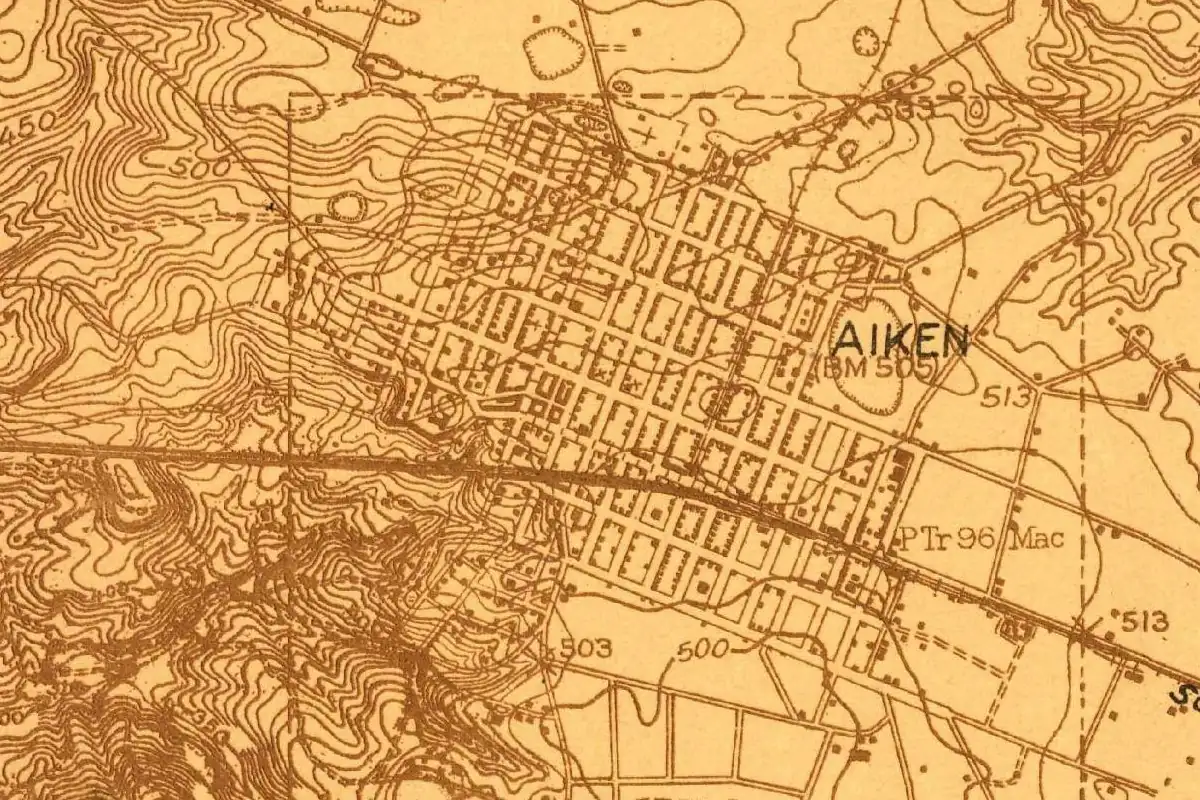
The town that grew around the tracks was planned by the railroad, too. A town plan drawn in 1834 by two railroad engineers laid out wide streets divided by boulevards, which set the city center apart. You can see that tight grid of blocks on the old 1920 U.S. Geological Survey map, with the rail line cutting along the south side.
The high, sandy ground did the rest. At an elevation of 515 feet (157 m), Aiken drew Charlestonians escaping summer heat, then people seeking a healthy climate. After the Civil War, wealthy northerners came for winters of horses and golf, a “winter colony” that the encyclopedia says hit its golden era in the 1890s. In 1871 Aiken became the seat of the new Aiken County.
None of that changed the name. The horse farms, the winter cottages and the 1950s nuclear plant down the road all came later, piled on top of a word that was already on the map. Aiken is still a railroad president’s surname, given to a town he never got to see.
Quick answers
Who is Aiken, South Carolina, named after?
William Aiken Sr., the Charleston merchant who became president of the South Carolina Canal and Rail Road Company, according to the South Carolina Encyclopedia and the Aiken County Historical Society.
Was Aiken named after Governor William Aiken?
Probably not. Gannett’s 1905 book said so, but the governor was the namesake’s son, who didn’t enter politics until 1838. The town was incorporated in 1835, and modern state and local histories credit the father.
Is the Dexter and Williams love story why the town is called Aiken?
No. The South Carolina Encyclopedia calls it a local legend about why the railroad passed through the Williams property, not about the name.
Key dates
- 1828William Aiken Sr. and others receive a state charter for the South Carolina Canal and Rail Road Company. He becomes its president.
- 1831William Aiken Sr. is thrown from his carriage in Charleston in March and dies of his injuries.
- 1833The railroad from Charleston reaches Hamburg, and the first train arrives in the new town of Aiken.
- 1834Two railroad engineers draw the town plan, with wide streets divided by boulevards.
- 1835Aiken is incorporated.
- 1844William Aiken Jr., the namesake's son, is elected governor of South Carolina.
- 1871Aiken becomes the seat of the newly formed Aiken County.
Things to do in Aiken, South Carolina
Aiken Visitors Center & Train Museum
The visitors center sits downstairs, and the train museum upstairs has nine dioramas of the towns along the original South Carolina Canal and Railroad Company line, from Charleston to Hamburg, as they looked in 1916.
Inclined Plane of the South Carolina Canal and Rail Road Company
A replica marks the inclined plane where a stationary engine and a rope cable hauled cars up the hill on the Charleston-to-Hamburg line, with recreated tracks, a frame for the old engine house and kiosks that explain how it worked.
Hitchcock Woods
A 2,100-acre forest in the middle of town, the largest privately owned urban forest in the country, with 70 miles of sandy trails used by walkers and riders since the early 1800s.
Aiken County Historical Museum
Housed in Banksia, a Winter Colony cottage of 32 rooms first built in 1860, the museum changes its exhibits often and tells the story of Aiken's past and present.
Aiken Thoroughbred Racing Hall of Fame and Museum
Horses trained in Aiken that became national champions are enshrined here, along with trophies and photographs of riders, polo players and steeplechase jockeys.
Getting there
Open Aiken in Google Maps
Opens in a new tab. The pin is the center of Aiken in the USGS place-name record.
The closest airports, Amtrak stations and intercity bus stops, measured in a straight line from the center of Aiken.
Airports
- Augusta Regional at Bush Field (AGS) 19 mi 31 km
- Columbia Metro (CAE) 43 mi 70 km
- Charleston AFB/International (CHS) 107 mi 173 km
Amtrak trains
- Denmark station (DNK) 37 mi 59 km
- Columbia station (CLB) 49 mi 79 km
Intercity buses
- Greyhound Aiken Quick Pantry 1 mi 2 km
- FlixBus Augusta Wheeler Rd 23 mi 36 km
Distances are as the crow flies, not by road. We don't list schedules or fares because they change; check with the airline, Amtrak or the bus company before you go. Official data (FAA commercial service airports (2025), FAA airport locations, Amtrak stations and Intercity Bus Atlas) from the FAA and the U.S. Bureau of Transportation Statistics, checked Nov 13, 2026.
Sponsored
Staying in Aiken?
Compare hotels in Aiken, South Carolina, on Expedia.
See hotels in AikenWe may earn a commission if you buy through this link. It never changes what we write. Read our affiliate disclosure
Historical Sources & References
- James O. Farmer Jr., “Aiken,” South Carolina Encyclopedia. The town “named for railroad president William Aiken, Sr.,” incorporated in 1835; tracks to Hamburg in 1833; the Dexter-Williams story labeled a local legend; the 1834 plan by two railroad engineers; the 515-foot elevation; the winter colony; county seat in 1871.
- “Aiken, William Sr.,” South Carolina Encyclopedia. His birth in County Antrim in 1778, the 1828 committee and charter, his role as largest investor and president, and his death after a carriage accident in March 1831, before the railroad was finished.
- “Aiken, William Jr.,” South Carolina Encyclopedia. The son, born in 1806, in the state House from 1838 and the Senate from 1842, elected governor on December 7, 1844, and his push for state money for railroads.
- Aiken County Historical Society, “Brief History of Aiken County”. The town and the county named for William Aiken, president of the 136-mile railroad between Charleston and Hamburg.
- Advisory Council on Historic Preservation, “Aiken, South Carolina”. William Aiken Sr. as president of the railroad, the first train in the new town in 1833 and incorporation in 1835.
- Henry Gannett, The Origin of Certain Place Names in the United States (USGS, 1905), p. 18. The entry that credits “William Aiken, governor of the State in 1844-1846.”
- GNIS feature 1244853 (U.S. Geological Survey). The USGS gazetteer record for Aiken, a populated place in Aiken County.
- U.S. Geological Survey, Aiken sheet (1920). The 1:48,000 map the detail of Aiken’s street grid was cut from.
Spot something wrong, or know more? Tell us here. You can also email us or use our contact page. Corrections are noted here with their date, never made silently.