Abilene, Texas: Named After a Kansas Cattle Town
Abilene, Texas, is named after Abilene, Kansas, the railroad town where Texas trail herds were sold and shipped east starting in 1867. Claiborne W. Merchant, one of the ranchers who arranged the new Texas and Pacific Railway townsite, apparently suggested the name. Lots went on sale on March 15, 1881.
A name borrowed from Kansas
Abilene, Texas, is named after Abilene, Kansas, the railroad town where Texas cattle herds were shipped east, and a local rancher apparently suggested it. The Kansas town was the one at the end of the cattle trails from Texas.
Henry Gannett’s 1905 federal guide to American place names lists both Abilenes in a row, and the Texas entry is as short as it gets:
“Abilene; city in Taylor County, Texas, named from the city in Kansas.”
The Handbook of Texas, the state historical association’s encyclopedia, adds a name and a hedge. “C. W. Merchant apparently suggested the name Abilene, after the Kansas cattle town,” it says. The Handbook doesn’t say how it knows, so if you read somewhere that Merchant definitely named the town, remember that “apparently.”
Why a Kansas cattle town?
The Kansas Abilene was the place Texas cattle went. B. B. Paddock’s history of north and west Texas, published in 1906, tells how it got that job. In 1867, Joseph G. McCoy chose “the embryo town and station of Abilene,” on the brand-new Kansas Pacific Railroad, as the spot where the cattle trails from the south should meet the trains. “Abilene was no more than a name at the time,” Paddock wrote. McCoy built huge cattle pens, and by the next year “all the trail-herds were pointed toward Abilene.” Paddock’s book puts the count at about 75,000 Texas cattle marketed there in 1868, and twice that the year after.
That’s the connection. The Kansas Abilene was a railroad shipping point built around Texas cattle, which is just what a group of Taylor County ranchers were hoping to get.
The Kansas town’s own name came from somewhere else entirely. Gannett says it was “named from the province of ancient Syria,” and that “the word means ‘grassy plain.’” That’s about the Kansas name, though. The Texas town didn’t reach back to ancient Syria. It took the name from Kansas.
Ranchers meet the railroad
Taylor County was organized in 1878, with Buffalo Gap as its county seat. Then in 1880 the Texas and Pacific Railway started pushing west. According to the Handbook, a group of ranchers and businessmen, Claiborne W. Merchant, John Merchant, John N. Simpson, John T. Berry and S. L. Chalk, met with H. C. Whithers, the railroad’s track and townsite locator. They arranged for the line to skip Buffalo Gap and run across the northern part of the county, which happened to be their own land. A new town would go up between Cedar and Big Elm creeks, east of Catclaw Creek.
The tracks reached the site in January 1881, and the railroad started calling the place the “Future Great City of West Texas.” J. Stoddard Johnston and other railroad officials platted the town. Several hundred people showed up before a single lot had been sold. When the lots were auctioned on March 15, 1881, buyers took more than 300 in two days, and Abilene was officially established.
“A city of fifteen hundred people”
Paddock quoted someone who saw the new town in May 1881, just a few months later:
“Three months ago,” to use the language of one who saw Abilene in May, 1881, “Simpson’s ranch was the only house in this country where the weary cowboy could find shelter. Not a tent had been stretched, and nothing but the bark of the prairie dog and the lowing of cattle disturbed the stillness. Now a city of fifteen hundred people adorns the broad level prairie.”
Paddock’s verdict was that Abilene, like other West Texas stock towns on the line, “had their origin in a depot and cattle pens.” That was pretty much the Kansas Abilene’s story too, so the borrowed name fit. Paddock’s list of businesses from that time even includes a “J. D. Merchant & Co.”
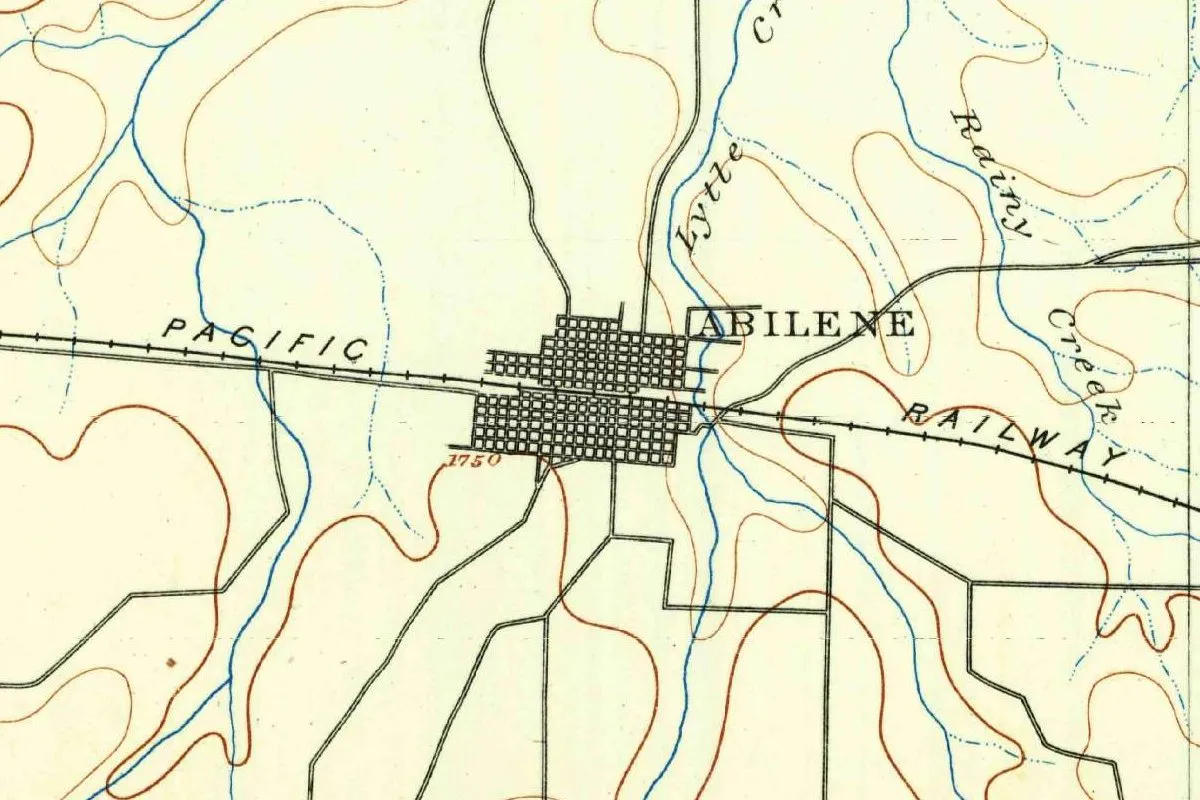
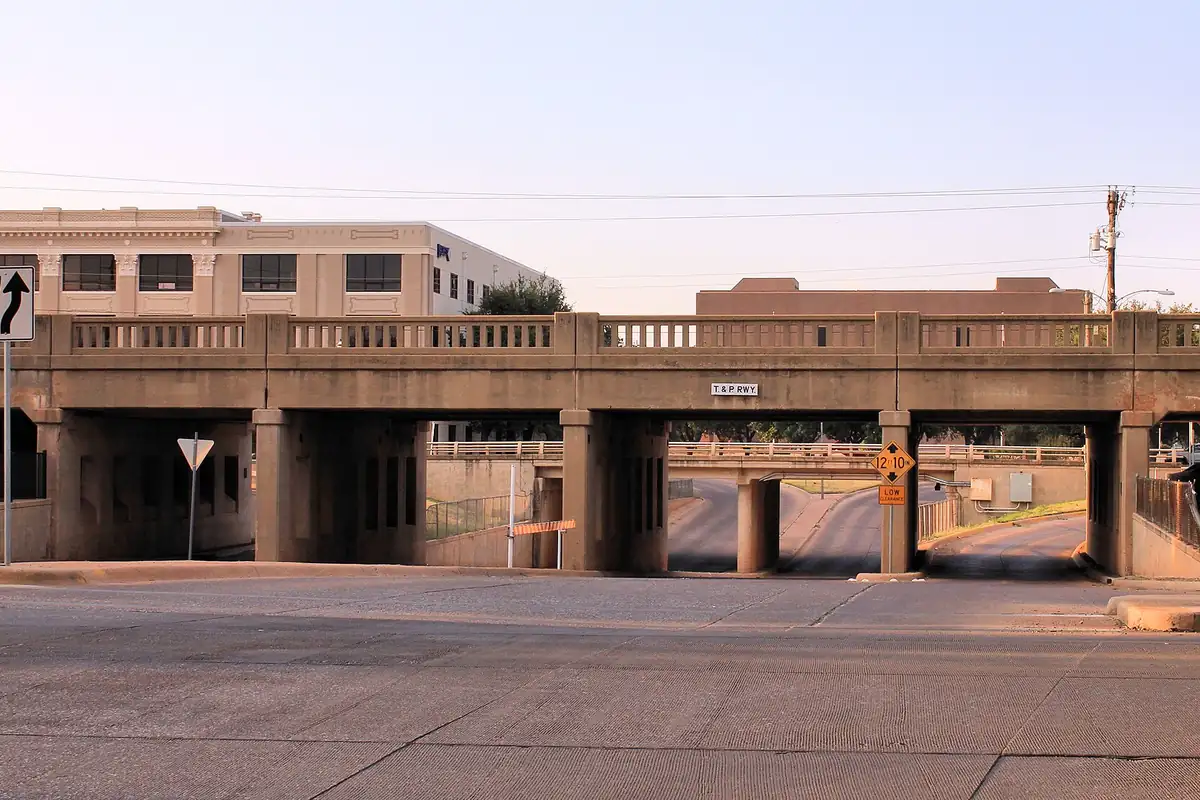
The plan to bypass Buffalo Gap worked. Abilene residents voted to incorporate on January 2, 1883, and on October 23, 1883, the town won an election for the county seat. You can see how small and tidy it still was on the 1890 government map at the top of this page: a little grid of streets sitting right on the railroad. The Texas and Pacific’s Pine Street underpass downtown, shown in the photo at the bottom of this page, still carries the railroad’s initials.
Quick answers
Is Abilene, Texas, named after Abilene, Kansas?
Yes. Gannett’s 1905 guide says the Texas city was “named from the city in Kansas,” and the Handbook of Texas says Claiborne W. Merchant “apparently suggested the name Abilene, after the Kansas cattle town.”
Who named Abilene, Texas?
The Handbook credits C. W. Merchant, one of the ranchers who brought the Texas and Pacific Railway across their land in 1880. The word “apparently” in that sentence means it isn’t nailed down.
When was Abilene, Texas, founded?
In 1881. The railroad reached the site in January 1881, and lots were sold at auction on March 15, 1881, when Abilene was officially established. It incorporated in 1883.
What does Abilene mean?
Gannett said the Kansas town was named for a province of ancient Syria and that the word means “grassy plain.” Abilene, Texas, got the name from Kansas, not straight from ancient Syria.
Key dates
- 1867Joseph G. McCoy picks Abilene, Kansas, on the Kansas Pacific Railroad as a shipping point for Texas cattle.
- 1868About 75,000 Texas cattle are marketed at Abilene, Kansas.
- 1878Taylor County is organized, with Buffalo Gap as its county seat.
- 1880Ranchers and businessmen arrange with the Texas and Pacific to run its line, and a new town, across their land.
- 1881January: the railroad reaches the site. March 15: town lots are auctioned and Abilene is officially established.
- 1883January 2: residents vote to incorporate. October 23: Abilene wins the county seat in an election.
Getting there
Open Abilene in Google Maps
Opens in a new tab. The pin is the center of Abilene in the USGS place-name record.
The closest airports, Amtrak stations and intercity bus stops, measured in a straight line from the center of Abilene.
Airports
- Abilene Regional (ABI) 4 mi 6 km
- San Angelo Regional/Mathis Field (SJT) 88 mi 141 km
Intercity buses
- Greyhound Abilene 7-Eleven 3 mi 5 km
Distances are as the crow flies, not by road. We don't list schedules or fares because they change; check with the airline, Amtrak or the bus company before you go. Official data (FAA commercial service airports (2025), FAA airport locations, Amtrak stations and Intercity Bus Atlas) from the FAA and the U.S. Bureau of Transportation Statistics, checked Nov 13, 2026.
Sponsored
Staying in Abilene?
Compare hotels in Abilene, Texas, on Expedia.
See hotels in AbileneWe may earn a commission if you buy through this link. It never changes what we write. Read our affiliate disclosure
Historical Sources & References
- Henry Gannett, The Origin of Certain Place Names in the United States (USGS, 1905), p. 15. Abilene, Texas, “named from the city in Kansas,” and Abilene, Kansas, “named from the province of ancient Syria,” with “grassy plain” as the meaning.
- B. B. Paddock, ed., A Twentieth Century History and Biographical Record of North and West Texas, vol. 1 (1906), pp. 149-150, 255. McCoy’s choice of Abilene, Kansas, in 1867 and the 75,000 cattle of 1868 (pp. 149-150); the May 1881 description of Abilene, Texas, “a depot and cattle pens,” and J. D. Merchant & Co. (p. 255).
- Fane Downs, “Abilene, TX,” Handbook of Texas Online. Taylor County in 1878, the 1880 deal with H. C. Whithers, Merchant’s suggestion of the name, the railroad in January 1881, the lot sale of March 15, 1881, and incorporation and the county seat in 1883.
- Larry D. Moore, Texas and Pacific Railway Pine Street underpass, Wikimedia Commons. The photo at the bottom of this page.
- GNIS feature 1329173 (U.S. Geological Survey). Used to confirm Taylor County and to locate the 1890 sheet.
- U.S. Geological Survey, Abilene sheet (1890). The map at the top of this page.
Spot something wrong, or know more? Tell us here. You can also email us or use our contact page. Corrections are noted here with their date, never made silently.