Amarillo, Texas: Where the First Houses Were Painted Yellow
Most of the first houses in Amarillo, Texas, were painted yellow to mark the town’s new name, which is simply the Spanish word for yellow. The name came from a lake and a creek nearby, and the town had started out as Oneida.
A lake, a creek and a color
Long before there was a town, there was water. The Handbook of Texas, published by the Texas State Historical Association, describes Amarillo Lake as a playa, also called Wild Horse Lake, that mustangs, buffalo and other game used to visit because it held water fairly reliably. It was a landmark for Native people, Comancheros, Spanish explorers and trailblazers, and Josiah Gregg’s party camped beside it on March 14, 1840.
The lake and the creek got their name from New Mexican traders and pastores, or shepherds, the Handbook says, “probably for the yellow soil along the creek banks or the yellow wildflowers that were abundant during the spring and summer.” Its short entry on West Amarillo Creek is less careful and simply says the creek and the town “were named for the color of the soil.” So you’ll find two answers to why it’s yellow, and the fuller account won’t pick one.
By the spring of 1888, the new town was selling itself on that water. An ad in the Fort Worth Daily Gazette for a May 29 sale of town lots, with excursion trains from Fort Worth, said Amarillo sat on the Fort Worth and Denver City Railroad “and at the headwaters of the Amarillos, beautiful streams of living, never-failing water.” The ad even called the creeks “the Amarillos,” plural.
From Oneida to Amarillo
In 1887 the Fort Worth and Denver City Railway was building across the Panhandle, and a group of merchants from Colorado City picked a spot along the tracks for their stores. That April, J. T. Berry came from Abilene to lay out the town on a section of school land that held the lake. He wanted it to be the Potter County seat. Since most of the voters worked for the LX Ranch, Berry promised every cowhand a business lot and a house lot if his site won, and on August 30, 1887, it did.
According to the Handbook, the settlement “was originally called Oneida but was by majority consent renamed Amarillo after the nearby lake and creek.” The Handbook adds that most of the town’s first houses were painted yellow to celebrate the change. That detail rests on the Handbook alone, though, since we didn’t find an account from the 1880s that mentions it. We also didn’t find who picked Oneida, or why.
The newspapers of 1887 make the story a little messier. A Gazette roundup from August 25 already mentions “Amarillo, a new town in the Panhandle,” getting its first shipment of furniture. Then on September 10, a letter from Mobeetie reported that “Amarillo was defeated for the county seat and a section five miles east on the Fort Worth and Denver Railway was chosen instead.” That doesn’t match the Handbook’s account, and we couldn’t work out which site the writer meant. What’s clear is that the name was in print before the August 30 vote.
“Never again will it be Ah-mah-ree-yoh”
Not everyone liked how the railroad crowd said it. Charles F. Rudolph, editor of the Tascosa Pioneer, blamed Fort Worth and Denver City employees for ignoring the word’s Spanish pronunciation. The Handbook quotes a line he wrote in 1888, “Never again will it be Ah-mah-ree-yoh,” and calls it prophetic. We couldn’t check it against the Pioneer itself.
Rudolph wasn’t exactly neutral. He’d hoped Tascosa would be the big city of the Panhandle, and the railroad missed it by a mile (1.6 km). By Christmas Day 1889, though, he was publishing the Amarillo Daily Northwest in Amarillo itself.
The town that moved a mile
Berry’s Amarillo didn’t stay put. Henry B. Sanborn, part owner of the Frying Pan Ranch, argued that the town sat on low ground that would flood in a hard rain. He and his partner, Joseph F. Glidden, the barbed-wire man Sanborn had once sold for, set out to move Amarillo out of its “mudhole.” On June 19, 1888, they bought four sections to the east and offered to swap lots and help pay to move buildings. Sanborn put up the 40-room Amarillo Hotel, and when heavy rains nearly flooded “Old Town” in the spring of 1889, more people followed him.
A St. Louis Globe-Democrat story, reprinted in a 1906 history of North and West Texas, describes how it went. “Every week or two he drove over to old Amarillo, bought a store, put it on wheels and hauled it over to new Amarillo.” The courthouse had to stay behind, since the law kept a county seat in place for five years, and the story pictured it standing “alone on the prairie.”
By 1890 the center of town was about 1 mile (1.6 km) east, in the Glidden and Sanborn addition, and an 1893 election moved the county seat there too. The federal place-names database sums it up as “Founded in 1887 and incorporated in 1899,” which skips all the moving. The town changed spots, but it took the yellow name along.
Yellow on Route 66
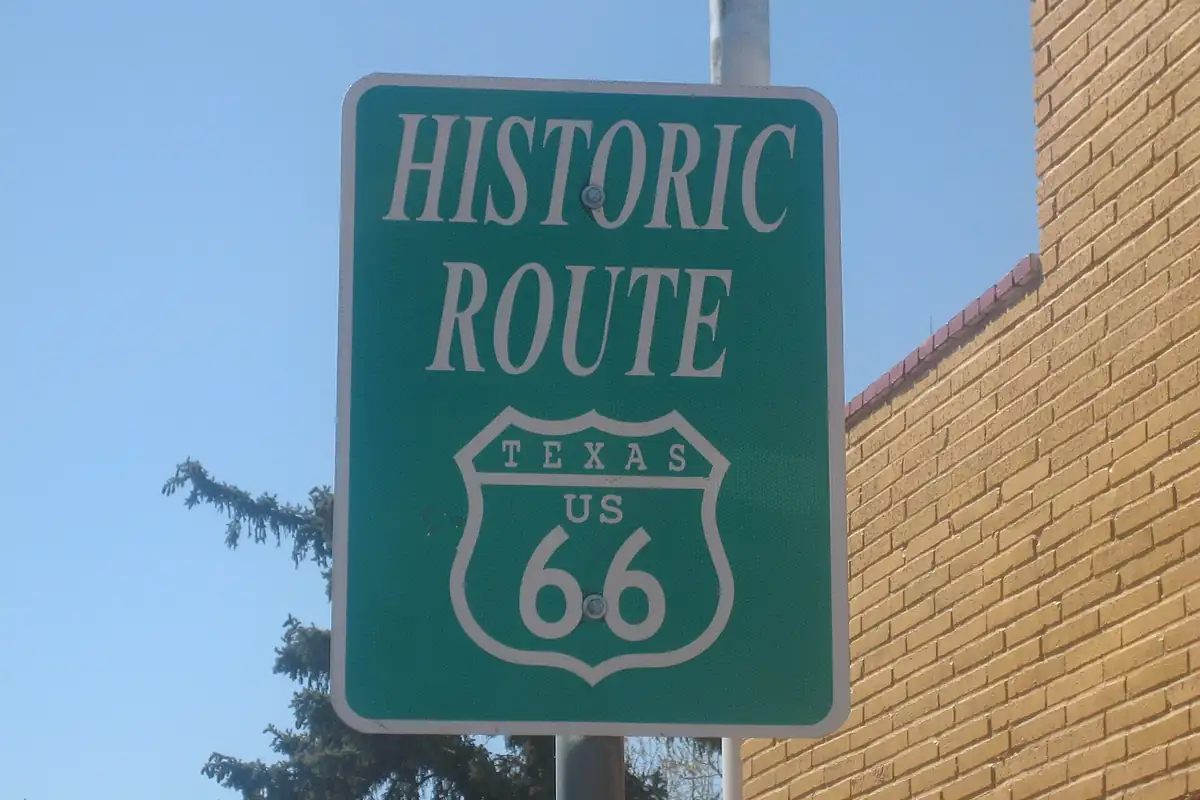
Decades later, a different road put Amarillo on the map for travelers. The Handbook notes that four U.S. highways, 60, 87, 287 and “the fabled Route 66,” met at Amarillo and made it a big tourist stop, with plenty of motels, restaurants and curio shops. The National Park Service calls Amarillo the cultural and economic center of the Texas Panhandle, “named for the color yellow in Spanish,” and says Route 66 once formed an important commercial corridor through it. Its list of Route 66 sites in Texas includes Amarillo’s Ranchotel and the U.S. Route 66-Sixth Street Historic District.
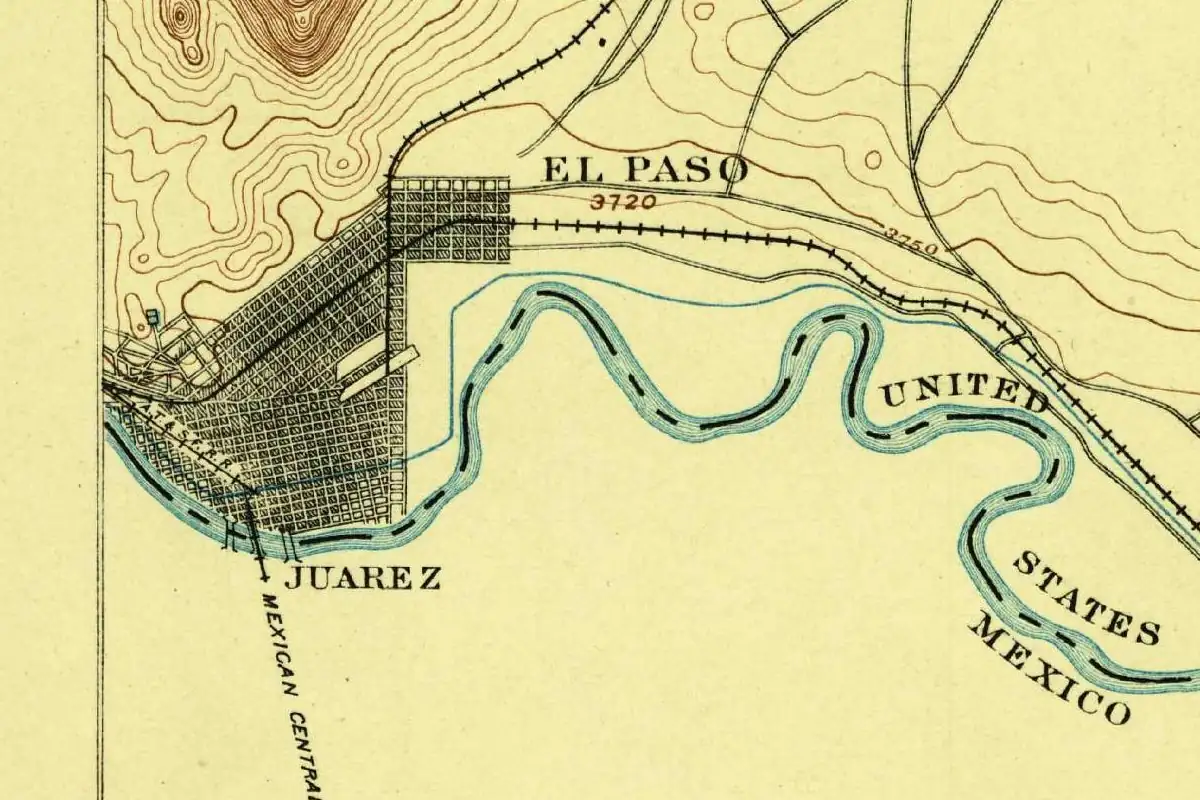
If you drive the old road west, the same Park Service series lists Albuquerque on Route 66 in New Mexico. Heading east, it lists sites in Oklahoma City. You can follow the whole road, town by town, in our collection of Route 66 towns. And if you like Texas towns that started under another name, El Paso used to be Franklin.
A gold shield for a yellow town
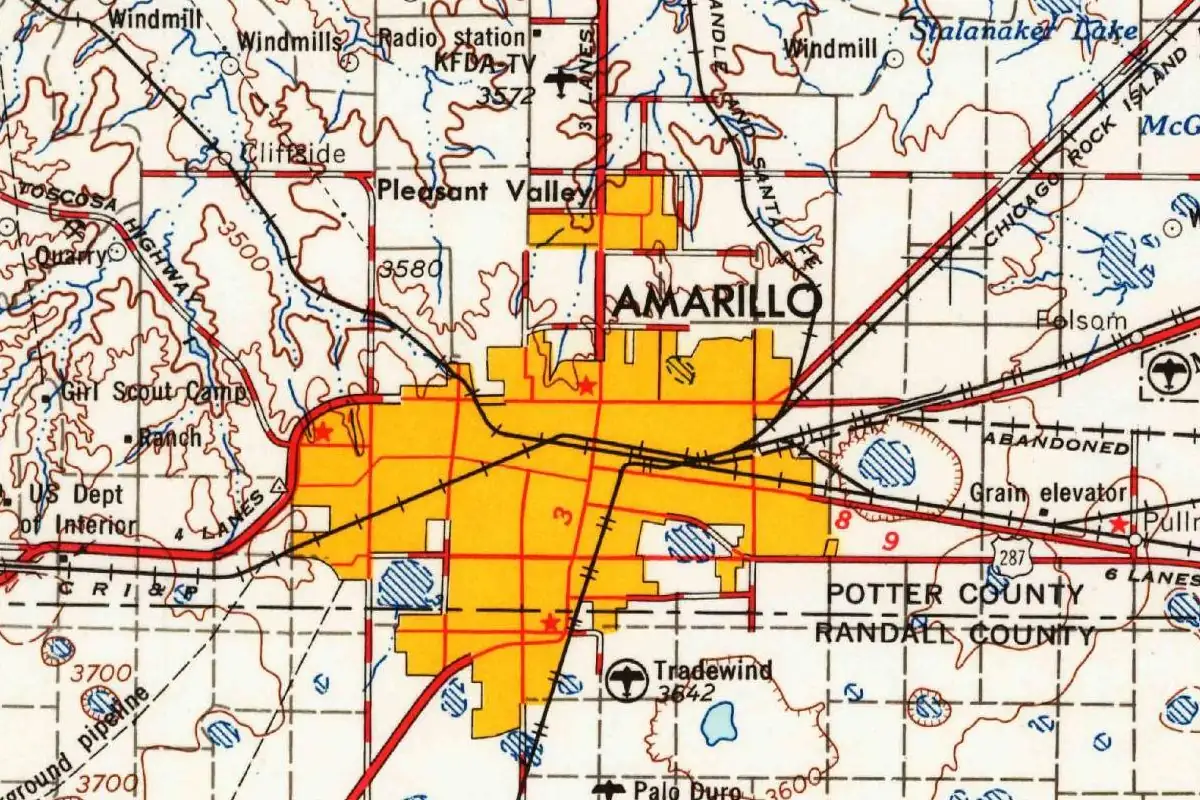
The color stuck in places you might not expect. When the Catholic Church set up a diocese at Amarillo, its coat of arms got a gold background. Pierre de Chaignon la Rose, writing about the arms of new American bishops in 1929, explained why: “as the name ‘Amarillo’ means ‘yellow,’ the field is of gold, its heraldic equivalent.” On the 1954 map at the top of this page, the city happens to come out yellow too. From the first painted houses to a bishop’s shield, the town has been taking its name pretty literally.
Quick answers
What does Amarillo mean in English?
Yellow. The National Park Service says the city is “named for the color yellow in Spanish,” and the Handbook of Texas agrees.
Why is Amarillo, Texas, called Amarillo?
It’s named after nearby Amarillo Lake and Amarillo Creek. The Handbook says New Mexican traders and shepherds named them, probably for the yellow soil along the creek or the yellow wildflowers that grew there in spring and summer.
What was Amarillo’s original name?
Oneida. The Handbook says the settlement was first called Oneida and renamed Amarillo “by majority consent.” A Fort Worth newspaper was already printing the name Amarillo in August 1887.
Did people ever say Amarillo the Spanish way?
Not for long. According to the Handbook of Texas, Tascosa editor Charles F. Rudolph blamed railroad employees for ignoring the Spanish pronunciation, and in 1888 he predicted, “Never again will it be Ah-mah-ree-yoh.”
Key dates
- 1840March 14: Josiah Gregg's party camps beside the playa later known as Amarillo, or Wild Horse, Lake.
- 1887April: J. T. Berry arrives to plat a new town on the section of school land that holds the lake.
- 1887August 30: Potter County votes on its county seat. The Handbook of Texas says Berry's townsite won.
- 1888May 29: Town lots in Amarillo are auctioned, with excursion trains running from Fort Worth.
- 1888June 19: Henry B. Sanborn and Joseph F. Glidden buy four sections of land to the east.
- 1893A new county-seat election moves the title to Sanborn's town, about 1 mile (1.6 km) east of the first site.
- 1929A heraldry article explains that the arms of the Diocese of Amarillo have a gold field because the name means yellow.
Getting there
The closest airports, Amtrak stations and intercity bus stops, measured in a straight line from the center of Amarillo.
Airports
- Rick Husband Amarillo International (AMA) 7 mi 11 km
- Clovis Regional (CVN) 90 mi 144 km
Intercity buses
- FlixBus Amarillo Multimodal Transfer Sta 2 mi 2 km
- Greyhound Hereford Stripes 41 mi 66 km
Distances are as the crow flies, not by road. We don't list schedules or fares because they change; check with the airline, Amtrak or the bus company before you go. Official data (FAA commercial service airports (2025), FAA airport locations, Amtrak stations and Intercity Bus Atlas) from the FAA and the U.S. Bureau of Transportation Statistics, checked Nov 2, 2026.
Historical Sources & References
- Hugh Allen Anderson, “Amarillo, TX,” Handbook of Texas Online. The heart of this story: Berry’s townsite and the August 30, 1887, election, the name Oneida and the renaming “by majority consent,” the New Mexican traders and pastores, the yellow soil or wildflowers, the yellow houses, Rudolph’s 1888 line, Sanborn’s move and the 1893 election, and the four highways that met at Amarillo.
- “Amarillo Lake,” Handbook of Texas Online. The playa also known as Wild Horse Lake, its use as a landmark, and Josiah Gregg’s camp there on March 14, 1840.
- “West Amarillo Creek,” Handbook of Texas Online. Says the creek and the town “were named for the color of the soil after the Spanish word meaning ‘yellow.’”
- Hugh Allen Anderson, “Rudolph, Charles Francis,” Handbook of Texas Online. Rudolph’s hopes for Tascosa, the railroad missing it by a mile, and his Amarillo Daily Northwest, started on Christmas Day 1889.
- Hugh Allen Anderson, “Sanborn, Henry Bradley,” Handbook of Texas Online. Sanborn as Glidden’s barbed-wire salesman and his partner in the Frying Pan Ranch.
- Fort Worth Daily Gazette, August 25, 1887, p. 2. “Amarillo, a new town in the Panhandle,” gets its first furniture, days before Potter County organized.
- Fort Worth Daily Gazette, September 10, 1887, p. 6. A letter from Mobeetie: “Amarillo was defeated for the county seat and a section five miles east on the Fort Worth and Denver Railway was chosen instead.”
- Fort Worth Daily Gazette, May 17, 1888, p. 6. The ad for the May 29 lot sale, placing Amarillo “at the headwaters of the Amarillos.”
- B. B. Paddock, ed., A Twentieth Century History and Biographical Record of North and West Texas, vol. 1 (1906), pp. 305-306. Reprints the St. Louis Globe-Democrat story of Sanborn hauling old Amarillo’s stores to the new site on wheels.
- Pierre de Chaignon la Rose, “Recent Episcopal Arms,” The Ecclesiastical Review, August 1929, p. 184. Why the Diocese of Amarillo’s arms have a gold field.
- National Park Service, “Route 66: Texas”. Amarillo “named for the color yellow in Spanish,” Route 66 as a commercial corridor through it, and the Ranchotel and the U.S. Route 66-Sixth Street Historic District. Also online: “Route 66: Oklahoma” and “Route 66: New Mexico”, for Oklahoma City and Albuquerque.
- U.S. Geological Survey, Amarillo sheet (1954). The map at the top of this page.
- GNIS feature 1351066, Amarillo (U.S. Geological Survey). The official name and coordinates, and the note “Founded in 1887 and incorporated in 1899.”
Spot something wrong, or know more? Tell us here. You can also email us or use our contact page. Corrections are noted here with their date, never made silently.