College Station, Texas: The Stop Conductors Called Out
College Station, Texas, got its name from train conductors who called out the stop for the new Agricultural and Mechanical College before it had a depot. The name says exactly what the place was: the station for the college.
A stop with no station
In 1871 the governor’s commissioners went looking for a site for the new Agricultural and Mechanical College of Texas. According to the 1993 marker for the town’s railroad depots, they picked this spot “in large part because of the existence of the Houston and Texas Central (H&TC) Railroad line,” which ran on north to Bryan, 5 miles (8 km) away.
The college opened in 1876, and the trains stopped for its students and faculty, but there was nothing to stop at. The marker says plainly that “no railroad depot existed here” yet. What the stop had was a name, and the conductors supplied it. Their announcements calling the stop “College Station,” the marker says, “gave rise to the name of the surrounding community.”
The post office makes it official
The Handbook of Texas adds the paperwork. In 1877 a post office called College Station opened in a building near the tracks, and in Mark Odintz’s words, “the community took its name from the post office.” So you get the same name twice, once from the conductors and once from the government. The two accounts don’t fight each other: a stop called College Station got a post office called College Station.
The railroad caught up in 1883, when the Houston and Texas Central finally built a depot at the stop, and it replaced that building with a new one about 1900. The marker and the Handbook give the same 1883 date.
The town came last
The timeline has an odd twist. The college was there in 1876, the name by 1877 and the depot by 1883, but College Station didn’t incorporate as a city until 1938. Faculty members generally lived on campus in housing the college provided, the Handbook notes, and the last of them weren’t told to move off until 1939.
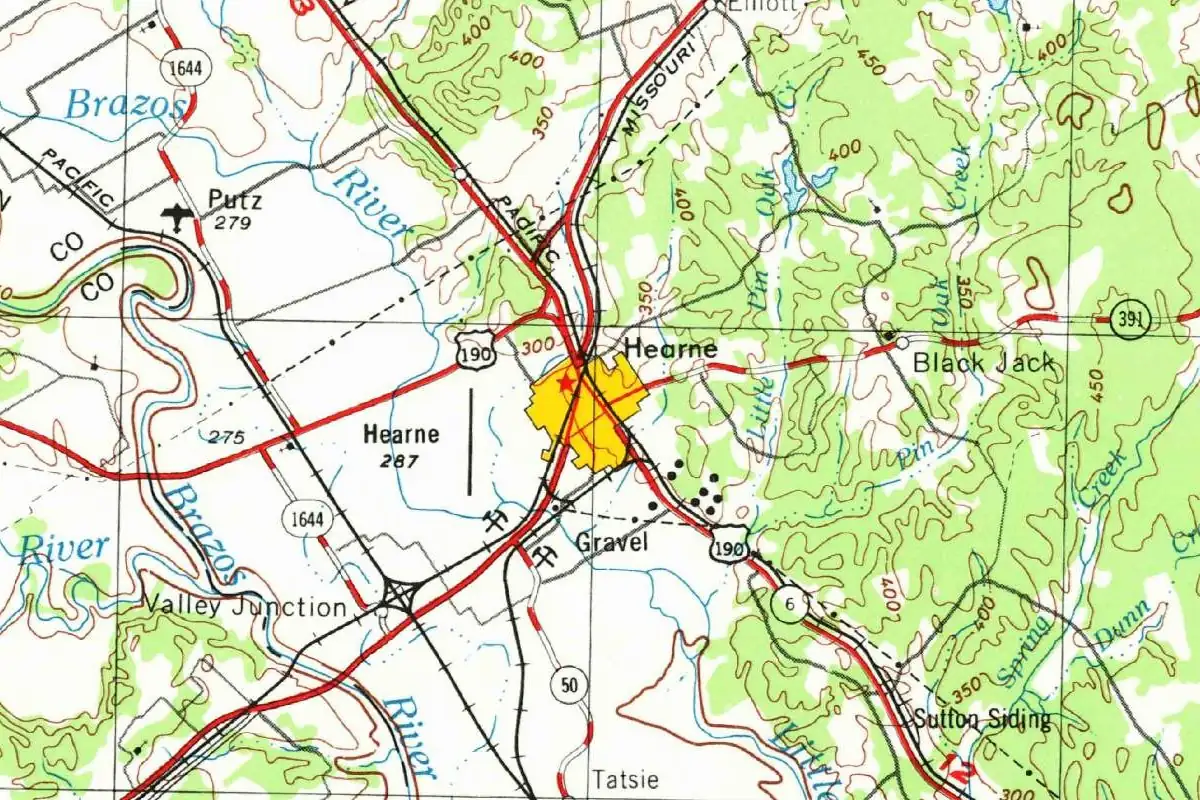
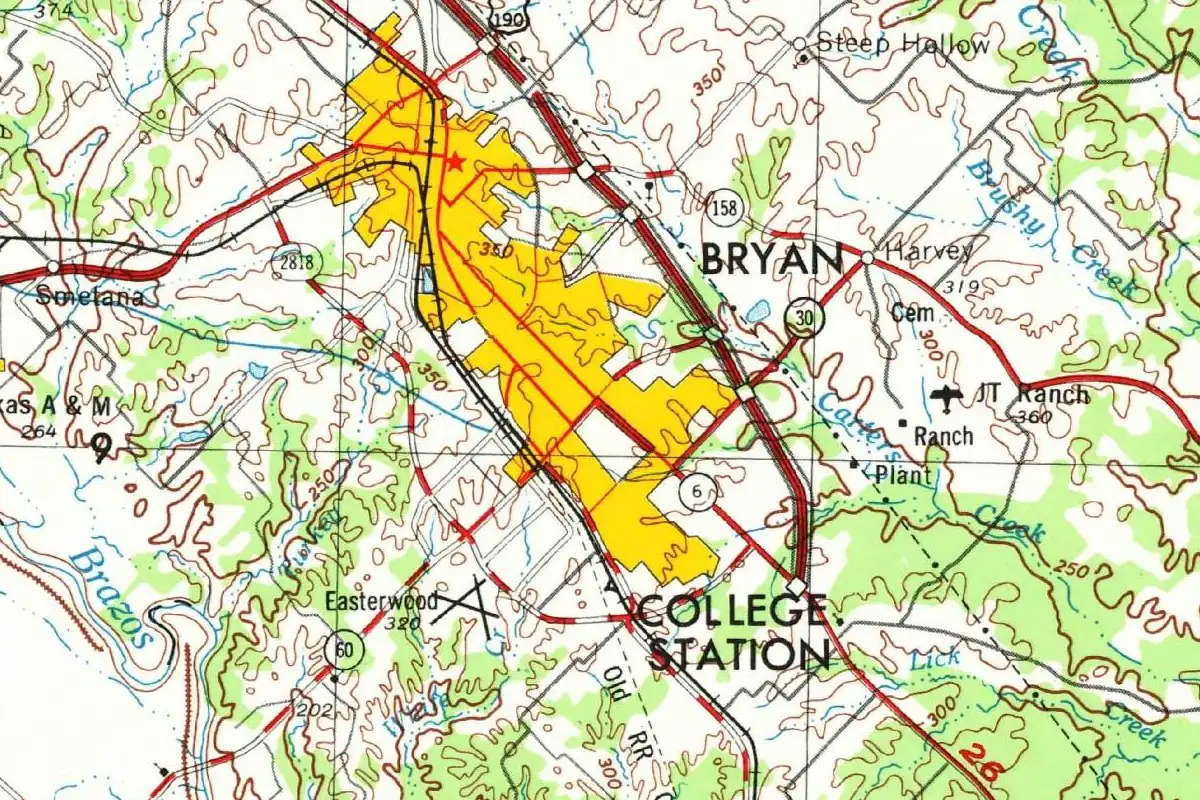
In 1940 the Federal Writers’ Project still listed College Station mainly as the home of the college, “commonly called Texas A. & M.” Passenger trains kept stopping there until 1959, and in 1966 the last of the depot buildings came down, the marker says. You can still follow the logic on the 1954 USGS sheet, where the railroad runs south out of Bryan and down past the College Station label.
Quick answers
Why is it called College Station?
Because it was the railroad’s stop for the Agricultural and Mechanical College of Texas. Houston and Texas Central conductors announced the stop as “College Station,” and that gave the community its name, according to a Texas Historical Commission marker.
Did College Station have a train depot when Texas A&M opened?
No. Trains stopped there for students and faculty from 1876, but the railroad didn’t build a depot until 1883.
When did College Station become a city?
In 1938. The post office named College Station had opened back in 1877.
Key dates
- 1871Commissioners pick the site for the Agricultural and Mechanical College of Texas, largely because the Houston and Texas Central line runs through it.
- 1876The college opens; trains stop for students and faculty, though there's no depot yet.
- 1877A post office named College Station opens near the tracks.
- 1883The Houston and Texas Central builds a depot at the stop.
- 1938College Station incorporates as a city.
Getting there
Open College Station in Google Maps
Opens in a new tab. The pin is the center of College Station in the USGS place-name record.
The closest airports, Amtrak stations and intercity bus stops, measured in a straight line from the center of College Station.
Airports
- Easterwood Field (CLL) College Station 3 mi 5 km
- George Bush Intcntl/Houston (IAH) 74 mi 119 km
Amtrak trains
- Taylor station (TAY) 64 mi 103 km
- Temple station (TPL) 68 mi 110 km
Intercity buses
- FlixBus College Station 1 mi 2 km
- Greyhound Bryan TX (BRY) 1 mi 2 km
Distances are as the crow flies, not by road. We don't list schedules or fares because they change; check with the airline, Amtrak or the bus company before you go. Official data (FAA commercial service airports (2025), FAA airport locations, Amtrak stations and Intercity Bus Atlas) from the FAA and the U.S. Bureau of Transportation Statistics, checked Nov 6, 2026.
Sponsored
Staying in College Station?
Compare hotels in College Station, Texas, on Expedia.
See hotels in College StationWe may earn a commission if you buy through this link. It never changes what we write. Read our affiliate disclosure
Historical Sources & References
- Texas Historical Commission, “College Station Railroad Depots” marker, 1993 (Atlas 5041008674). The 1871 site choice, stops without a depot from 1876, the conductors’ “College Station” announcements, the 1883 depot and its replacement about 1900, passenger service until 1959 and the razing in 1966.
- Mark Odintz, “College Station, TX,” Handbook of Texas Online (TSHA). The 1877 post office near the tracks, “the community took its name from the post office,” the 1883 depot, faculty housing on campus and the 1938 incorporation.
- Federal Writers’ Project, Texas: A Guide to the Lone Star State (1940), p. 570. College Station as the home of the Agricultural and Mechanical College, “commonly called Texas A. & M.”
- GNIS feature 1354786 (U.S. Geological Survey). The federal place-name file for College Station, with coordinates, in Brazos County.
Spot something wrong, or know more? Tell us here. You can also email us or use our contact page. Corrections are noted here with their date, never made silently.