Tyler, Texas: Named for the President Who Signed Annexation
Tyler is named for President John Tyler. The Handbook of Texas says the new seat of Smith County, authorized in 1846, was named for him in recognition of his support for admitting Texas to the United States, and a 1968 state marker says the first Texas Legislature named it for the president who signed the annexation resolution.
Tyler, Texas, honors President John Tyler, who signed the resolution annexing Texas, but Smith County around it is named for a Texas Revolution hero. So the city and the county wear two different men’s names, picked in the same year for two different chapters of Texas history.
A county seat with a president’s name
The Handbook of Texas, the state historical association’s encyclopedia, tells the founding in a few lines. In Christopher Long’s entry for the city, Tyler “was authorized on April 11, 1846, when the Texas legislature voted to establish Smith County and a corresponding county seat.” A panel of commissioners appointed by the legislature picked a townsite near the geographic center of the county, and it “was named for President John Tyler in recognition of his support for admitting Texas to the United States.”
The City of Tyler’s own history uses nearly the same words: “The county seat was named Tyler for President John Tyler.” Both tie the name to one thing: annexation.
Two names, two men
The county is another story. The Handbook’s Smith County entry says it was marked off from the Nacogdoches District in July 1846 “and named for Gen. James Smith, a hero of the Texas Revolution and a prominent military figure in the Republic of Texas.” So if you’re keeping score, the county looks back to Texas independence and its seat looks ahead to statehood.
That same legislature handed out other names from the same moment. As our Dallas page explains, it created Dallas County that spring, a county the Handbook says was named “probably” for Polk’s vice president, George Mifflin Dallas.
What the courthouse marker says
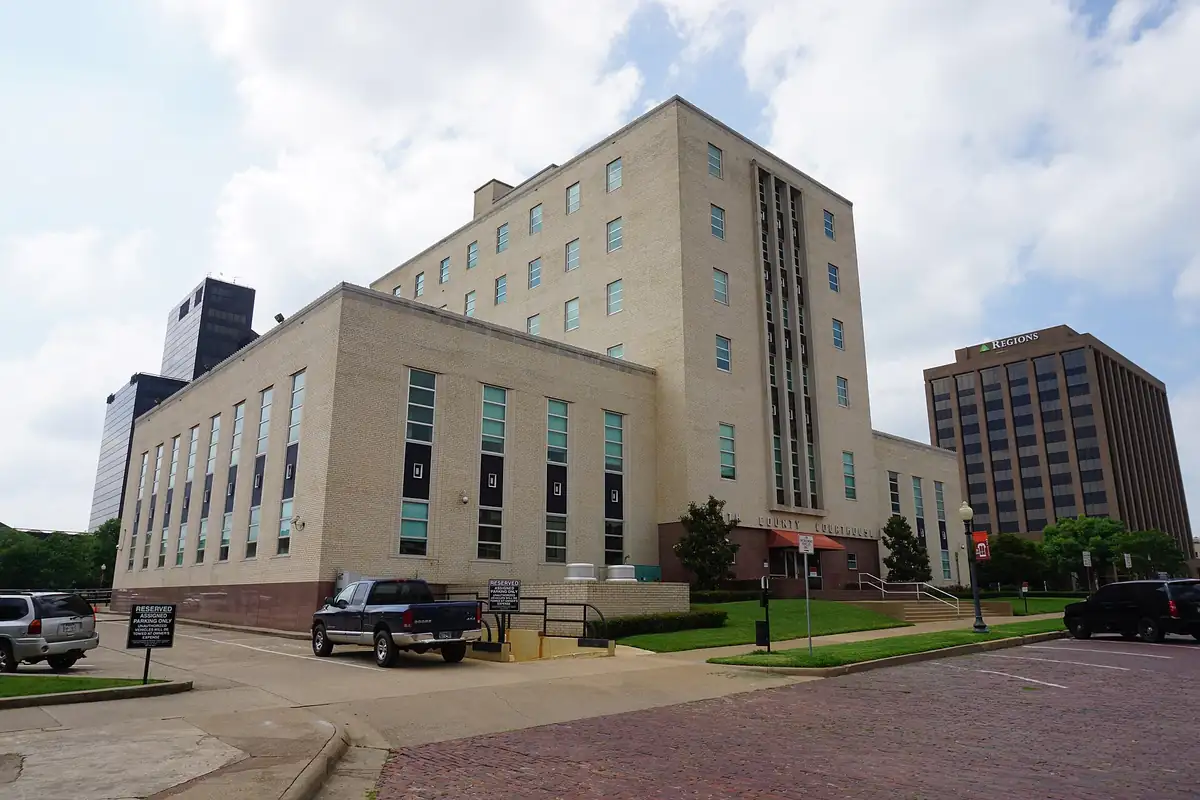
The Texas Historical Commission put the city’s story on a marker in 1968, on the courthouse lawn at Broadway and West Erwin Street. It puts the naming this way:
“The first Legislature of the state of Texas named the town (founded 1846) for President John Tyler, who signed the resolution annexing Texas to the United States.”
The Handbook stresses Tyler’s support, and the marker stresses his signature. Both point to the same reason.
The marker starts even earlier, with an area “opened 1839 to white settlers by Republic of Texas victories over Cherokee Indians.” The Handbook’s county entry describes the same turning point as the Cherokee War of 1839, which “led to the removal of the tribe.”
Laying out the town
The commissioners didn’t buy land until the next winter. On February 6, 1847, the Handbook says, they purchased a 100-acre (40 ha) site from Edgar Pollett for $150 and laid out twenty-eight blocks around a central square. A log courthouse on the north side of the square doubled as meeting hall and church. Another log courthouse went up on the center of the square in 1847, and a brick one replaced it in 1852.
The city’s history adds an earlier date. Voters elected the first Smith County officials on August 8, 1846, among them a county judge, a sheriff and three commissioners. Tyler was incorporated on January 29, 1850, according to the Handbook, with McDonald Lorance as its first mayor.
The other Tyler in Texas
Henry Gannett left the city out of his 1905 Geological Survey bulletin, but the name turns up there in this line: “Tyler; county in Texas, named for John Tyler, President of the United States.” That’s Tyler County, a different county from the one the city sits in. So Texas honored the same president twice: once with a county, and once with a county seat.
Tyler is the seat of Smith County, and the Handbook says it “has remained so” since it was designated.
After the naming
The marker sketches what came next. By 1860, it says, Tyler “was known for good schools, churches and cultured citizens.” After mid-1863 it was transportation headquarters for the Confederacy’s Trans-Mississippi Department, and Camp Ford, four miles (6 km) northeast of town according to the Handbook, was “the largest P.O.W. post west of the Mississippi.” The Handbook adds that by 1850 Smith County had 4,292 people, 717 of them enslaved.
The railroads nearly passed the town by. According to the Handbook, the Texas and Pacific and the International railroads both bypassed Tyler in the early 1870s, but the Houston and Great Northern opened a branch line to town in April 1874. Local leaders then pushed for a narrow-gauge spur to Ferguson, or Big Sandy, called the Tyler Tap Railroad, finished in 1877. With workers flocking to the railroad shops, the city’s population nearly tripled between 1880 and 1890. The marker also counts three governors among the statesmen Tyler “furnished” Texas: Richard B. Hubbard, O. M. Roberts and James Stephen Hogg. After the East Texas oil field was found in 1931, the marker says, Tyler became an investment, banking and servicing center.
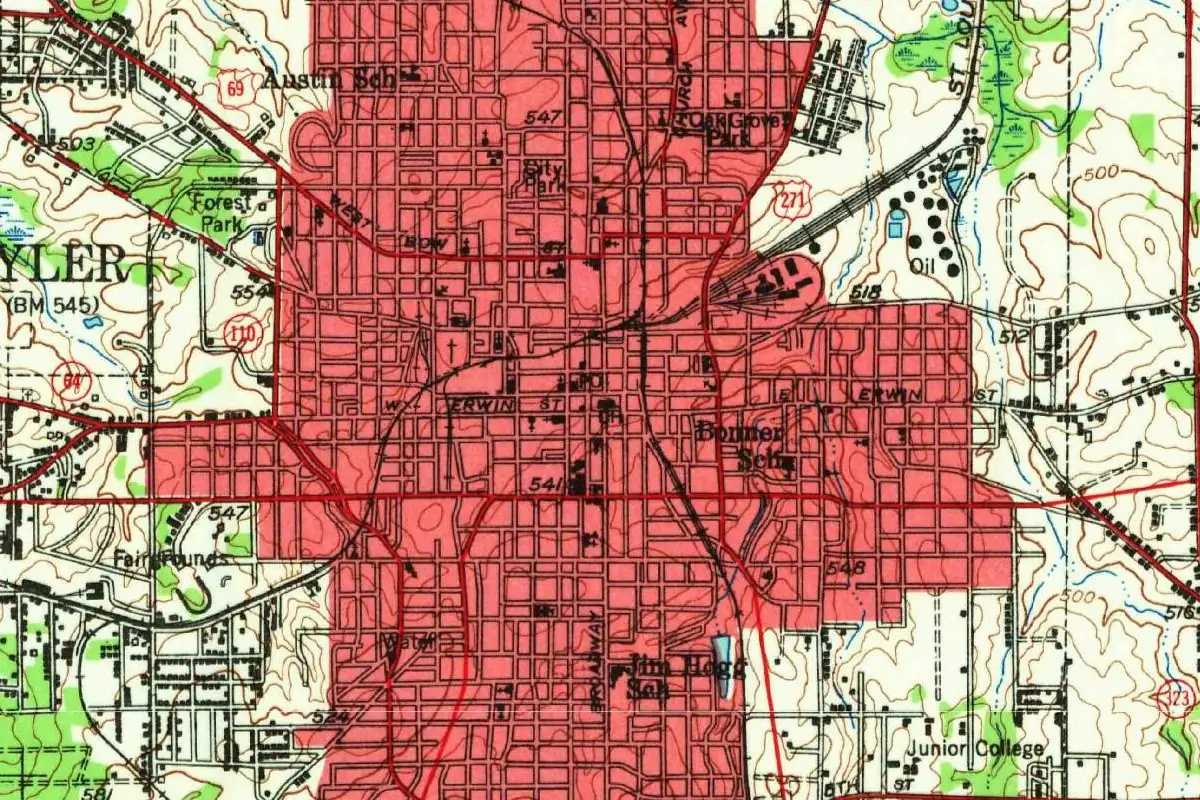
You can see traces of that on the 1948 map at the top of this page. Round tanks labeled “Oil” sit northeast of downtown, a “Junior College” label appears at the lower right (the marker calls Tyler the home of Tyler Junior College), and Erwin Street crosses Broadway near the middle of town, the corner where the marker stands. The spot elevations in this crop run from 500 to 581 feet (152 to 177 m).
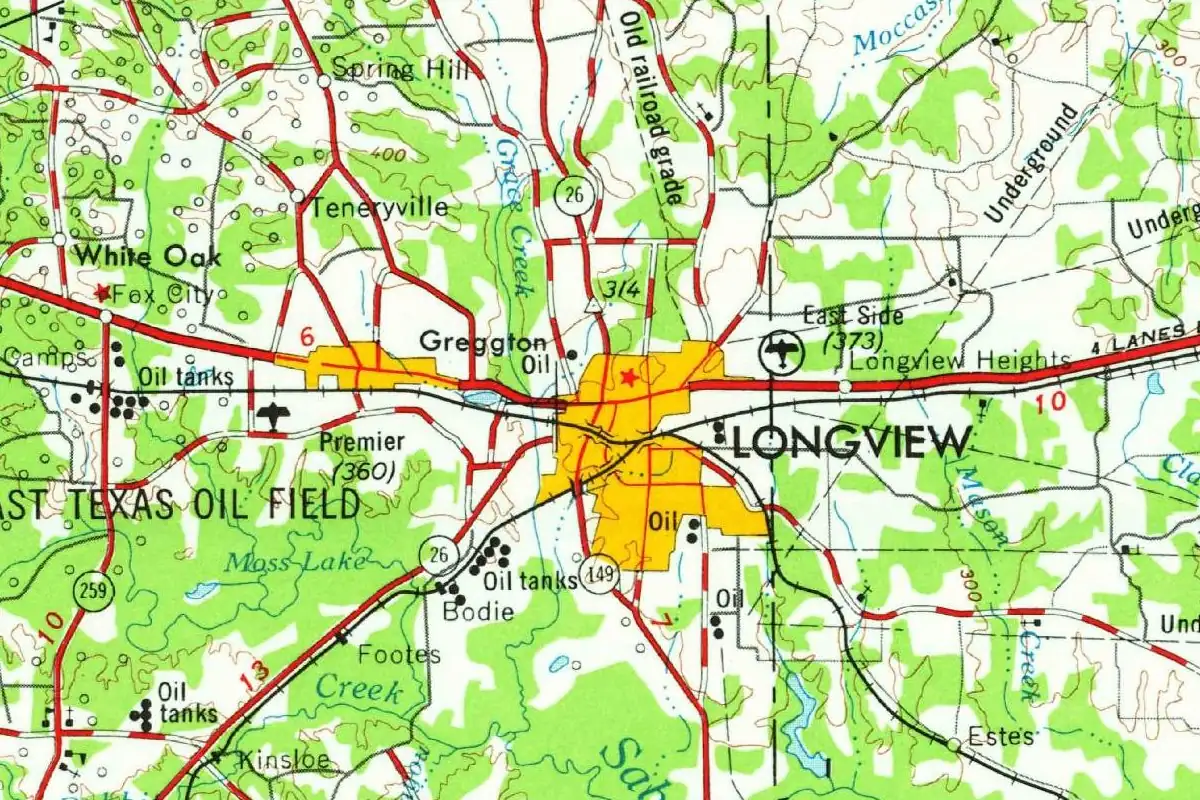
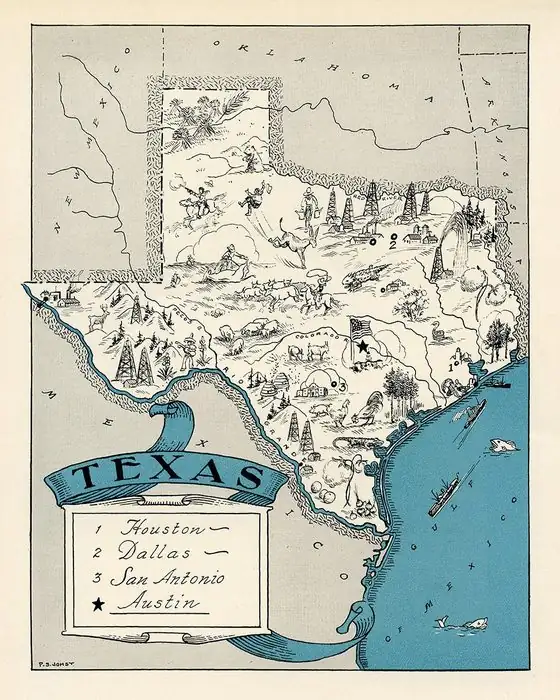
East Texas has another presidential name in Jefferson, named for Thomas Jefferson, and a neighbor with a very different story in Longview. For more of the state’s names, see our Texas page.
Quick answers
Who is Tyler, Texas, named after?
President John Tyler. The Handbook of Texas, the Texas Historical Commission and the City of Tyler all say so.
Why was Tyler, Texas, named after John Tyler?
For annexation. The Handbook says it was “in recognition of his support for admitting Texas to the United States,” and the 1968 state marker says he “signed the resolution annexing Texas.”
Is Tyler, Texas, in Tyler County?
No. Tyler is the seat of Smith County, named for Gen. James Smith. Tyler County is a separate Texas county that Henry Gannett, in 1905, said was also named for President John Tyler.
When was Tyler, Texas, founded?
The legislature authorized it on April 11, 1846. The commissioners bought the townsite on February 6, 1847, and the city was incorporated on January 29, 1850.
Key dates
- 1846On April 11 the Texas Legislature votes to create Smith County and a county seat, named Tyler for President John Tyler.
- 1847On February 6 the commissioners buy a 100-acre townsite from Edgar Pollett for $150.
- 1850Tyler is incorporated on January 29.
- 1863Tyler becomes transportation headquarters for the Confederacy's Trans-Mississippi Department, according to the state marker.
- 1931Discovery of the East Texas oil field makes Tyler an investment, banking and servicing center, the marker says.
- 1968The Texas Historical Commission's "City of Tyler" marker goes up on the courthouse lawn.
Things to do in Tyler, Texas
Tyler Municipal Rose Garden and Museum
More than 450 varieties of roses bloom here, including antique ones in the Heritage Rose and Sensory Garden. It's the site of the annual Texas Rose Festival, and the museum shows Rose Queens' gowns and the history of the rose industry.
Goodman-LeGrand House and Museum
A Greek Revival cottage built in 1859 and named Bonnie Castle by its first owner, Samuel Gallatin Smith. Refugee families stayed here after New Orleans fell in 1862, and the Goodman family owned it from 1866.
Tyler State Park
A park in the pines with a 64-acre (26 ha) spring-fed lake and more than 13 miles (21 km) of trails, including the Whispering Pines Nature Trail, laid out more than 85 years ago by the Civilian Conservation Corps.
Caldwell Zoo
A Tyler zoo whose habitats include Amazon River's Edge, home to capybaras, a jaguar habitat with a pool, and a giant river otter habitat with a flowing river.
Getting there
Open Tyler in Google Maps
Opens in a new tab. The pin is the center of Tyler in the USGS place-name record.
The closest airports, Amtrak stations and intercity bus stops, measured in a straight line from the center of Tyler.
Airports
- Tyler Pounds Regional (TYR) 6 mi 10 km
- East Texas Regional (GGG) Longview 34 mi 55 km
- Dallas Love Field (DAL) 96 mi 155 km
Amtrak trains
- Mineola station (MIN) 24 mi 39 km
- Longview station (LVW) 35 mi 56 km
Intercity buses
- Greyhound Tyler TX (TYL) under 1 mi 0.4 km
- Amtrak Chartered Vehicle Amtrak Connecting Service · Longview 35 mi 56 km
- FlixBus Sulphur Springs Travel Center 57 mi 91 km
Distances are as the crow flies, not by road. We don't list schedules or fares because they change; check with the airline, Amtrak or the bus company before you go. Official data (FAA commercial service airports (2025), FAA airport locations, Amtrak stations and Intercity Bus Atlas) from the FAA and the U.S. Bureau of Transportation Statistics, checked Nov 14, 2026.
Sponsored
Staying in Tyler?
Compare hotels in Tyler, Texas, on Expedia.
See hotels in TylerWe may earn a commission if you buy through this link. It never changes what we write. Read our affiliate disclosure
Historical Sources & References
- Christopher Long, “Tyler, TX,” Handbook of Texas Online. The April 11, 1846, authorization, the commissioners, the name “in recognition of his support for admitting Texas,” the Pollett purchase of February 6, 1847, the square, the courthouses and the 1850 incorporation.
- “Smith County,” Handbook of Texas Online. The county named for Gen. James Smith, the Cherokee War of 1839 and the 1850 population.
- Texas Historical Commission, “City of Tyler” marker (1968). The quoted marker text on the first Legislature and President John Tyler, its location on the courthouse lawn, the Trans-Mississippi headquarters, Camp Ford, the 1931 oil field and Tyler Junior College.
- City of Tyler, “Tyler History”. The county seat “named Tyler for President John Tyler” and the election of August 8, 1846.
- Henry Gannett, The Origin of Certain Place Names in the United States, 2nd ed. (1905), p. 306. Tyler County, Texas, “named for John Tyler, President of the United States.” Checked against the page image.
- GNIS feature 1348998 (U.S. Geological Survey). The federal names database entry for Tyler, Smith County, with its coordinates.
- U.S. Geological Survey, Tyler sheet (1948). The 1:62,500 map that the image at the top of this page was cropped from.
Spot something wrong, or know more? Tell us here. You can also email us or use our contact page. Corrections are noted here with their date, never made silently.