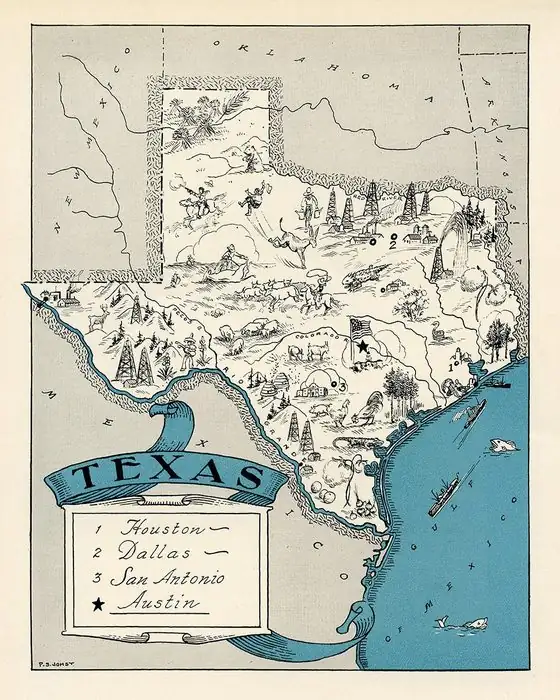
Nacogdoches, Texas: A Caddo People's Name, and a Twin Legend
The town takes its name from the Nacogdoche, a Caddo tribe of the Hasinai group that lived in the area in the 1600s and 1700s. Spain founded the mission of Nuestra Señora de Guadalupe de los Nacogdoches in their main settlement in 1716, and the town grew up on that mission site in 1779.
Nacogdoches, Texas, carries the name of the Nacogdoche, a Caddo people of the Hasinai group who lived there before Spain built a mission in 1716. That much the historians agree on. What they don’t give you is a translation. Ask what the word means and you’ll find a local legend about twin brothers, but no dictionary answer.
The Nacogdoche people
The Handbook of Texas says it in one line. In his entry on the town, Archie P. McDonald writes: “It was named for the Nacogdoche Indians, a Caddo group.” People had been there a long time. Archeologists, he says, have dated mounds in the area to about A.D. 1250, when lodges stood along Lanana and Bonita creeks, which meet just south of town.
Thomas N. Campbell’s entry on the tribe fills in who they were: “a Caddoan tribe of the Hasinai group in eastern Texas,” living near present-day Nacogdoches in the 1600s and 1700s. He lists the spellings Europeans tried, among them Nacadocheeto, Nacodissy, Nagodoche, Naugdoche and Nocodosh. Disease and war had greatly reduced the tribe by 1800. Many Nacogdoche, Campbell says, seem to have been absorbed into the Spanish town after 1779, while others joined nearby Hasinai tribes that were later moved to what’s now Oklahoma. Their descendants are “probably included” among the Hasinai who live in Caddo County, Oklahoma, today.
Caddo country didn’t stop at today’s state line. The founders of Shreveport, Louisiana, bought a piece of land that Caddo chiefs had set aside in their treaty giving up that area, as J. Fair Hardin, a Shreveport lawyer, wrote in the Louisiana Historical Quarterly in 1927.
A 1905 Geological Survey bulletin on where American place names come from, Henry Gannett’s, agrees on the source. It describes Nacogdoches County as “named from the former inhabitants, a subtribe of the Caddo Indians.”
The Hasinai left their mark on more than one name. The word Texas itself comes from a Hasinai word for “friends,” as our Texas page explains.
A mission with the tribe’s name
Europeans came early. The expedition of René Robert Cavelier, Sieur de La Salle, visited the area in 1687, McDonald says. But the name went on paper with the Spanish. In 1716, McDonald writes, Louis Juchereau de St. Denis came back to East Texas with Domingo Ramón to found Nuestra Señora de Guadalupe de los Nacogdoches and five other missions. Campbell says it stood “in the principal Nacogdoche settlement.” The mission was abandoned in 1718 over fears of a French invasion and reopened by the Marqués de Aguayo in 1721.
Then Spain pulled back. In 1772, new regulations for the frontier recommended recalling missions and settlers to San Antonio, and in 1773 soldiers forced every Spanish subject in East Texas to go there. San Antonio was the end of that road.
Back to the old mission in 1779
The settlers didn’t stay. Antonio Gil Ibarvo, who also appears as Gil Y’Barbo, got permission for them to come partway back, and they set up a community called Bucareli on the Trinity River. They stayed four years, until floods and raids drove them out; then, McDonald says, Ibarvo led them in 1779 “to the abandoned mission site at Nacogdoches.” The pueblo that grew there went by the mission’s name, Nacogdoches. The city’s own history calls Nacogdoches “the oldest town in Texas”; that’s the city’s claim, and the Handbook doesn’t make it.
Ibarvo built a stone house where he did business. It came to be called the Old Stone Fort, though Stephen F. Austin State University says it was “never a true fort.” It was torn down in 1902 and rebuilt as a replica on the campus in 1936.
The old county was huge. When Dallas was founded, it was still in Nacogdoches County, and Tyler’s Smith County was carved out of the Nacogdoches District in 1846.
The legend of the twin brothers
Visit Nacogdoches, the town’s visitor bureau, tells a different kind of origin, and it labels it plainly: “A local legend says the Caddo Indians founded Nacogdoches.” In the story, an old Caddo chief living near the Sabine River had twin sons, one dark and one blond. When they grew up, he sent one three days toward the rising sun and the other three days toward the setting sun.
“The twin who settled three days toward the setting sun was the blond-haired brother, Nacogdoches. Natchitoches, the dark-haired twin, settled three days to the east in Louisiana.” The road between the two brothers, the legend goes, became a trade route and the eastern end of El Camino Real.
It’s a legend, not a source for the name, but the pairing is real enough. Natchitoches, Louisiana, also takes its name from a Caddo tribe, and St. Denis, who came back with Ramón to found the Nacogdoches mission, is credited with founding Natchitoches in 1714.
Nacogdoches on the 1952 map
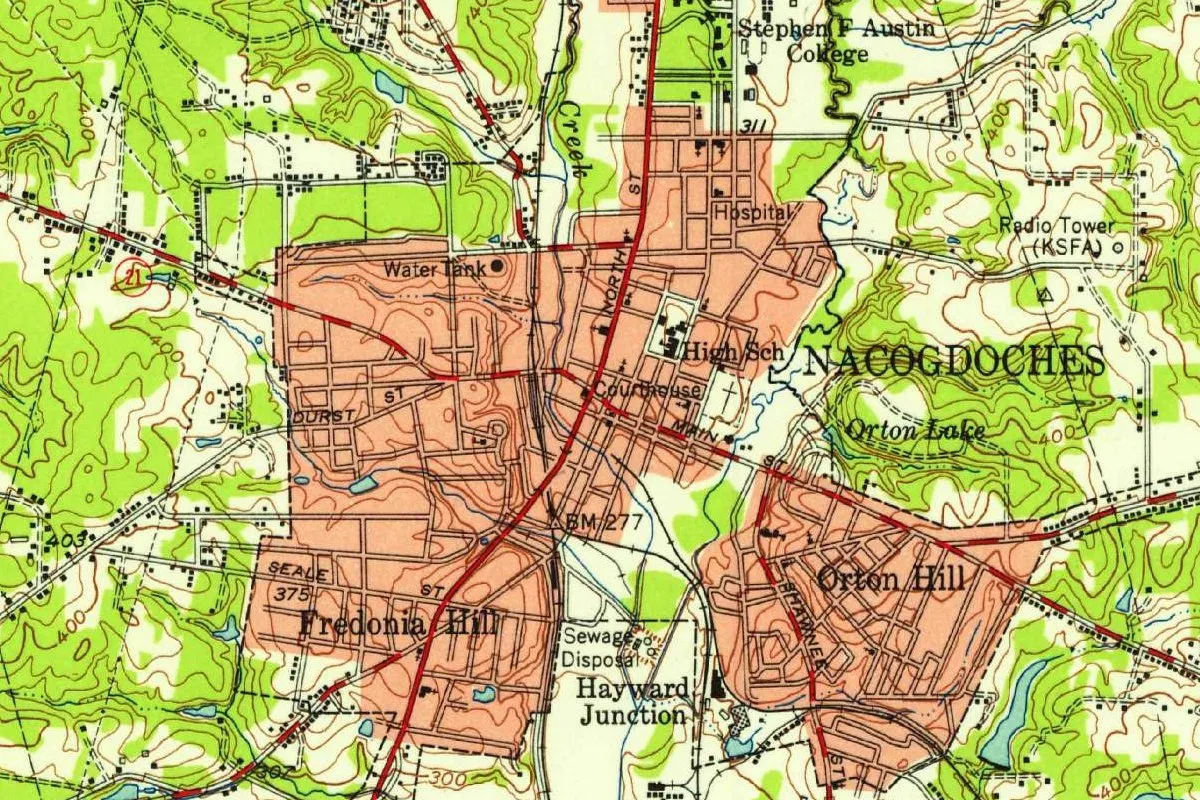
The map at the top is from the Geological Survey’s Nacogdoches quadrangle, made from aerial photographs taken in 1947 and field checked in 1952. This copy is a printing from 1958. You can pick out Stephen F. Austin College at the top, the courthouse in the middle, and two neighborhoods labeled Fredonia Hill and Orton Hill. There’s even a street marked Durst, a name you’ll meet again at the Durst-Taylor house. The town’s altitude, the Handbook says, runs from 150 to 600 feet (46 to 183 m).
Quick answers
What is Nacogdoches named after?
The Nacogdoche, a Caddo tribe of the Hasinai group that lived in the area in the 1600s and 1700s. The Spanish mission founded in their main settlement in 1716 carried their name.
What does Nacogdoches mean?
None of the sources we found translates the word. The Handbook of Texas lists old spellings like Nacodissy and Nocodosh but gives no meaning. The town’s visitor bureau tells a legend about twin brothers named Nacogdoches and Natchitoches, and it calls it a legend.
Is Nacogdoches the oldest town in Texas?
The city says it’s “considered to be the oldest town in Texas.” The Handbook of Texas dates the town to 1779, when settlers returned to the old mission site, and the mission itself to 1716.
Who founded Nacogdoches?
Antonio Gil Ibarvo led the settlers who returned to the abandoned mission site in 1779, according to the Handbook of Texas. The mission there had been founded in 1716.
Key dates
- 1250About this time, people build lodges and mounds along Lanana and Bonita creeks, where the town now stands.
- 1687The expedition of René Robert Cavelier, Sieur de La Salle, visits the area.
- 1716The mission of Nuestra Señora de Guadalupe de los Nacogdoches is founded in the main Nacogdoche settlement.
- 1773Spanish soldiers force all Spanish subjects in East Texas to move to San Antonio.
- 1779Antonio Gil Ibarvo leads the settlers back from Bucareli, on the Trinity River, to the abandoned mission site at Nacogdoches.
- 1837Nacogdoches is incorporated.
- 1902The stone house Gil Ibarvo built, by then called the Old Stone Fort, is demolished.
- 1923Stephen F. Austin State Teachers College opens in Nacogdoches.
- 1936A replica of the Old Stone Fort is built on the college campus for the Texas Centennial.
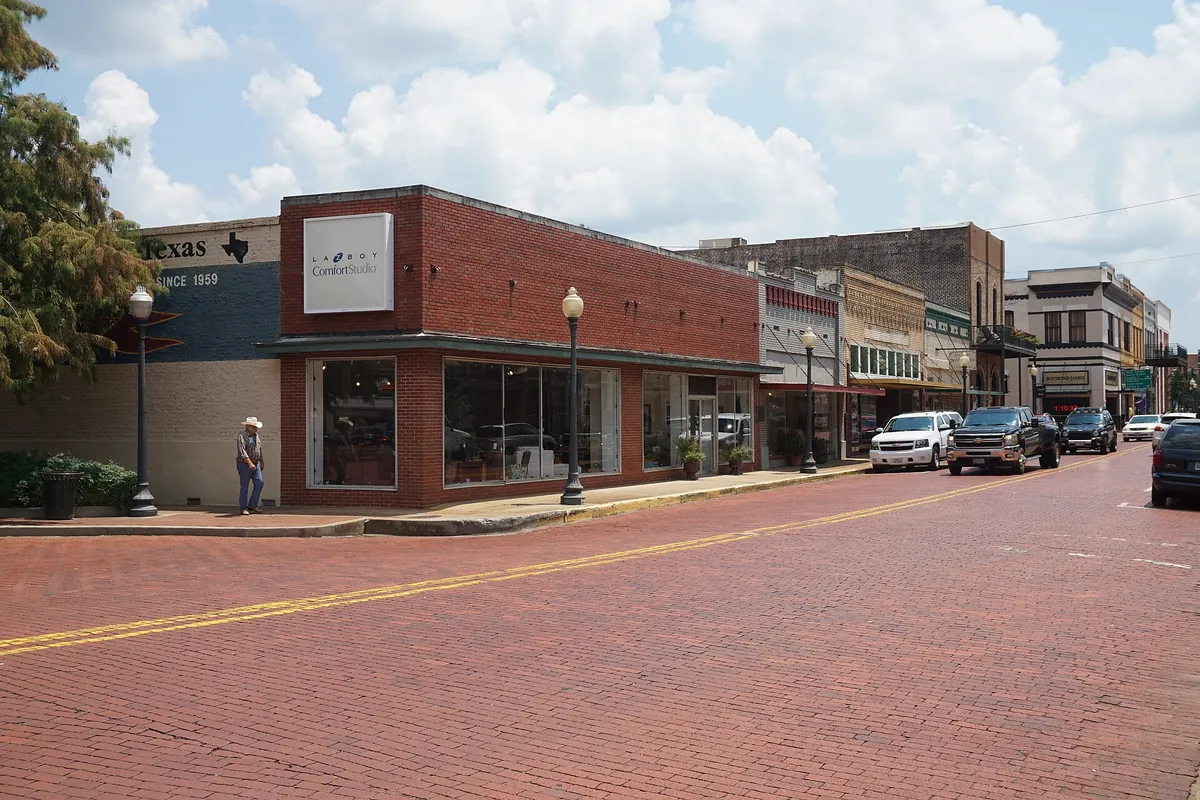
Things to do in Nacogdoches, Texas
Durst-Taylor Historic House and Gardens
A wood-frame house from about 1835, which the city calls the second oldest building in Nacogdoches, near the old crossing of El Camino Real de los Tejas and La Calle del Norte. It has a working smokehouse, a blacksmith shop, heirloom gardens and a sugarcane mill.
Nacogdoches Railroad Depot
A depot the Southern Pacific built in 1911 after the wooden one burned. It's on the National Register of Historic Places and now holds a museum about the railroad, its passengers and the people who worked on it.
Stone Fort Museum
A replica, on the Stephen F. Austin State University campus, of the house Antonio Gil Y'Barbo built between 1788 and 1791 on the Camino Real. It was rebuilt in 1936 thanks to the Cum Concilio Club, a women's literary group, and holds artifacts from East Texas before 1900.
SFA Gardens
The university's gardens and trails on campus, including the Ruby Mize Azalea Garden, the Pineywoods Native Plant Center and Hinds Park.
Getting there
Open Nacogdoches in Google Maps
Opens in a new tab. The pin is the center of Nacogdoches in the USGS place-name record.
The closest airports, Amtrak stations and intercity bus stops, measured in a straight line from the center of Nacogdoches.
Airports
- East Texas Regional (GGG) Longview 54 mi 87 km
- Tyler Pounds Regional (TYR) 68 mi 109 km
- George Bush Intcntl/Houston (IAH) 119 mi 192 km
Amtrak trains
- Longview station (LVW) 62 mi 99 km
- Marshall station (MHL) 68 mi 109 km
Intercity buses
- Greyhound Nacogdoches Sunshine 3 mi 4 km
- Amtrak Chartered Vehicle Amtrak Connecting Service · Nacogdoches Amtrak Bus Stop 7 mi 11 km
Distances are as the crow flies, not by road. We don't list schedules or fares because they change; check with the airline, Amtrak or the bus company before you go. Official data (FAA commercial service airports (2025), FAA airport locations, Amtrak stations and Intercity Bus Atlas) from the FAA and the U.S. Bureau of Transportation Statistics, checked Nov 17, 2026.
Sponsored
Staying in Nacogdoches?
Compare hotels in Nacogdoches, Texas, on Expedia.
See hotels in NacogdochesWe may earn a commission if you buy through this link. It never changes what we write. Read our affiliate disclosure
Historical Sources & References
- Archie P. McDonald, “Nacogdoches, TX,” Handbook of Texas Online. “It was named for the Nacogdoche Indians, a Caddo group,” the mounds of about A.D. 1250, the 1716 mission, the move to San Antonio in 1773, Bucareli, the return of 1779, the Old Stone Fort, incorporation in 1837 and the college of 1923.
- Thomas N. Campbell, “Nacogdoche Indians,” Handbook of Texas Online. The tribe as Hasinai Caddo, its spellings, the mission “in the principal Nacogdoche settlement,” and descendants “probably” in Caddo County, Oklahoma.
- Henry Gannett, The Origin of Certain Place Names in the United States (1905), p. 219. The county “named from the former inhabitants, a subtribe of the Caddo Indians.” Checked against the page image.
- Visit Nacogdoches, “History of the Nine Flags”. “A Local Legend”: the twin sons, Nacogdoches and Natchitoches.
- City of Nacogdoches, “History of Nacogdoches”. “Considered to be the oldest town in Texas.”
- Durst-Taylor House; Railroad Depot; Stone Fort Museum; SFA Gardens. The details in the things-to-do list, and the Stone Fort’s demolition in 1902 and rebuilding in 1936.
- GNIS feature 1363573 (U.S. Geological Survey). Nacogdoches’s listing as a populated place in Nacogdoches County and its coordinates.
- Nacogdoches quadrangle, field checked 1952, printed 1958. The sheet the map at the top was cropped from, mapped from 1947 aerial photographs, field checked in 1952 and printed in 1958.
Spot something wrong, or know more? Tell us here. You can also email us or use our contact page. Corrections are noted here with their date, never made silently.