Moab, Utah: The Bible Name Some Residents Tried to Drop
Moab is named for the biblical land of Moab. An early settler, William Pierce, suggested it, and Utah's state history office glosses it as "land beyond the Jordan." Grand County's history describes the biblical Moab as a dry, sandy wilderness like the Utah valley. Later, residents tried to change the name, and every attempt failed.
A name straight out of the Bible
Moab, Utah, took its name from the Bible, and some of its own residents objected so strongly that 59 of them asked the county to rename the town Vina. They lost. The man who picked the name in the first place was an early settler named William Pierce, and his choice has outlasted every attempt to get rid of it.
Utah’s state history office tells the story in a 1995 History Blazer piece by Jeffrey D. Nichols. “William Pierce, one of the newly arrived settlers,” Nichols wrote, “decided to call the new settlement ‘Moab,’ or ‘land beyond the Jordan,’ a Biblical land where Semitic relatives of the Hebrews dwelled.” Grand County’s own history page adds the detail that Pierce was “a local farmer, and occasional dentist.”
Why Moab?
The two accounts give slightly different reasons, so it’s worth reading them side by side.
Nichols goes with the geography of the Bible: Moab as the land across the Jordan. Grand County, whose page follows the Moab Museum’s wording almost line for line, goes with the climate. “In its biblical reference,” the county says, “Moab was a dry, sandy wilderness whose climate mirrored the arid climate of the Utahn settlement.”
You don’t have to pick one. Both credit Pierce, and both point to the Bible. What neither source does is quote Pierce himself, so his exact reasoning stays secondhand. Pierce did get a reward of sorts. Once the name won government approval, the county and the museum say, he became the first postmaster of the newly named town.
A mission that came first
The name came late in the valley’s settler history. Nichols traces the first attempt back to 1855, when forty men were called at the April conference of the Latter-day Saints to start a mission to the Utes in what was still known as Spanish Valley, after the Old Spanish Trail that ran through it. They were the Elk Mountain Mission, named for the range just east, today’s La Sal Mountains.
Led by Alfred Billings, they left Salt Lake City on May 7, 1855, and camped about half a mile (0.8 km) north of present-day Moab. They built a stone fort, a stockade and a log corral, and planted crops in soil they found highly fertile. At first the Utes were friendly. Nichols says the prominent chief Arapeen greeted the missionaries and preached to his own people in both Ute and Navajo, and fifteen Utes accepted baptism. But the missionaries were preaching peace while building defenses, and the Utes, by Nichols’s account, were confused about what they really wanted. It didn’t last. Nichols says that on September 23, Utes attacked the fort, killing three missionaries and wounding Billings, and the survivors abandoned the mission.
Permanent settlers didn’t come back until 1877, Nichols writes. Two of the first were William Granstaff and a French-Canadian trapper remembered only as “Frenchie,” who split the old fort between them. Granstaff later ran afoul of the authorities, who accused him of selling liquor to the Indians, and he moved to Colorado in 1881. Other settlers kept coming and spread through the valley, and Pierce was one of them.
What the old map shows
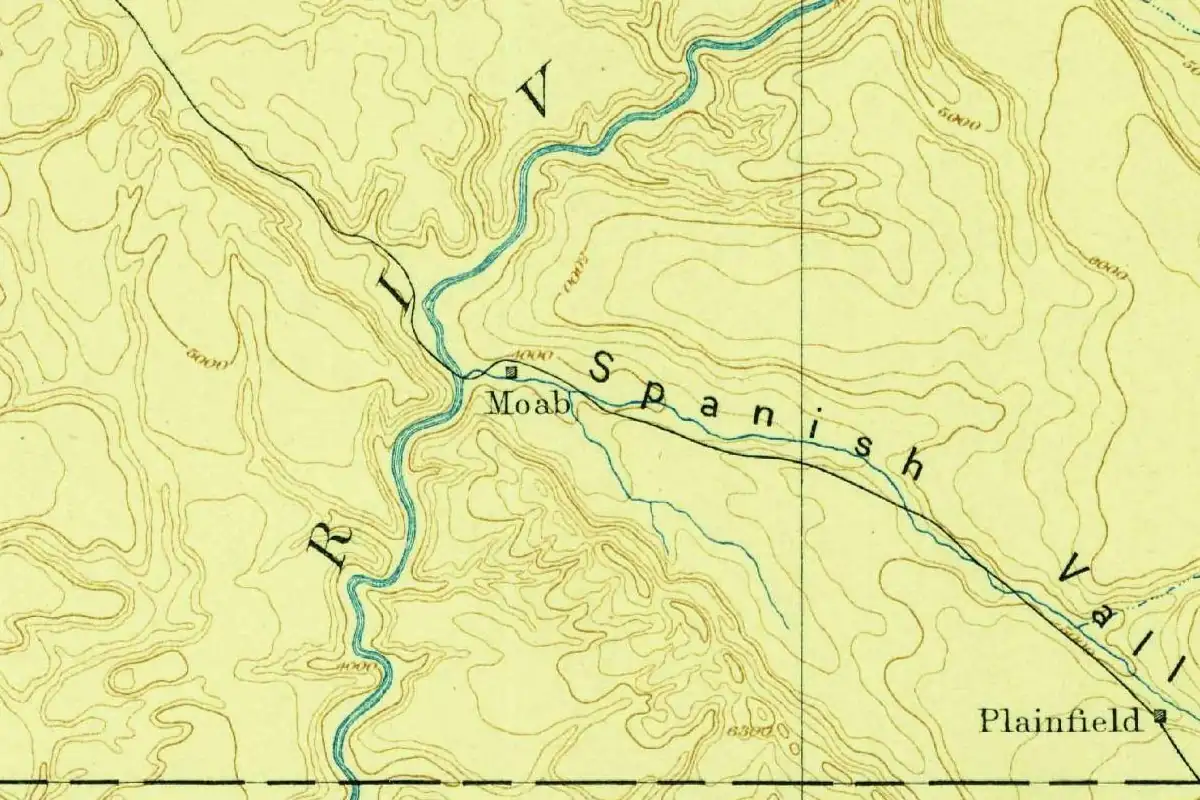
The map at the top of this page is the U.S. Geological Survey’s La Sal sheet, dated 1885, and if you look closely you’ll find “Moab,” a tiny square beside a bend in the river, with “Spanish Valley” lettered along the road to the southeast and another little settlement, Plainfield, farther up the valley.
That matters because the dates don’t line up neatly. Grand County and the Moab Museum place the need for a post office, and the naming committee that went with it, in the 1890s, when mining and a new railroad were filling the valley. Yet the name was already on a federal map dated 1885. The sources we could open don’t settle when Pierce first proposed it, so we don’t give a year.
The fight to rename Moab
Not everybody in town liked the name. Nichols says that right after Grand County was created on March 3, 1890, with Moab as its seat, 59 residents complained to the new County Court. He quotes their petition, which called the name
“so unfavorably commemorative of the character of an incestuous and idolatrous community existing 1897 years before the Christian era…”
The petitioners wanted something “more appropriate, significant, or expressive of moral decency and manly dignity,” and their candidate was Vina, apparently, Nichols suggests, for the fruit crops the valley was growing. They didn’t have the votes.
Grand County and the Moab Museum tell a version with a different leader. Within five years of the naming, they say, Henry G. Crouse, “also a postmaster,” tried to change the name. The county says Crouse argued that the biblical Moab was where the wicked cities of Sodom and Gomorrah stood; the museum puts that complaint in the mouths of other residents. Either way, “each time it was brought to a vote, the name change failed.”
Still Moab
There’s one more name change hiding in this story. The county Moab anchors is Grand County, named, Nichols says, for the Grand River that cut through it, and in 1921 that river was renamed the Colorado. It’s the same switch that explains the “Grand” in Grand Junction, upstream in Colorado. The river lost its old name. The town that people kept trying to rename never did, and it’s still Moab on every map of Utah.
Quick answers
What does the name Moab mean?
It comes from the Bible. Utah’s state history office glosses it as “land beyond the Jordan,” and Grand County describes the biblical Moab as “a dry, sandy wilderness” like the Utah valley.
Who named Moab, Utah?
William Pierce, an early settler described by Grand County as a farmer and occasional dentist. Both the state history office and the county credit him with the name.
Did Moab try to change its name?
Yes, more than once. In 1890, 59 residents petitioned the new county to change it to Vina, and the county’s own history says a postmaster, Henry G. Crouse, pushed for a change too. Every vote failed.
Why didn’t some people like the name Moab?
Because of what they read about Moab in the Bible. The 1890 petition called the name a reminder of “an incestuous and idolatrous community,” and Crouse or other residents linked it with Sodom and Gomorrah.
Key dates
- 1855The Elk Mountain Mission builds a stone fort about half a mile north of today's Moab; it's abandoned after a Ute attack on September 23.
- 1877Permanent settlers begin arriving in Spanish Valley.
- 1885The name Moab appears on the U.S. Geological Survey's La Sal map sheet.
- 1890Grand County is created on March 3 with Moab as county seat; 59 residents ask the county to rename the town Vina.
Things to do in Moab, Utah
Arches National Park
A red-rock park with more than 2,000 natural stone arches, hundreds of soaring pinnacles, massive rock fins and giant balanced rocks.
Island in the Sky, Canyonlands National Park
A mesa on sheer sandstone cliffs more than 1,000 feet (304 m) above the land around it, with overlooks all along the top and the 100-mile (161 km) White Rim Road looping below.
Moab Museum
A cultural and natural history museum devoted to the stories of Moab and the greater Canyonlands region.
Mill Canyon Dinosaur Bone and Track Sites
Two BLM sites just north of Moab: a boardwalk over more than 200 dinosaur footprints about 112 million years old, found in 2009, and a trail past bones about 150 million years old, including Allosaurus and Camarasaurus.
Getting there
Open Moab in Google Maps
Opens in a new tab. The pin is the center of Moab in the USGS place-name record.
The closest airports, Amtrak stations and intercity bus stops, measured in a straight line from the center of Moab.
Airports
- Canyonlands Regional (CNY) Moab 17 mi 27 km
- Grand Junction Regional (GJT) 67 mi 108 km
Amtrak trains
- Green River station (GRI) 44 mi 71 km
- Grand Junction station (GJT) 63 mi 101 km
Intercity buses
- Salt Lake Express Moab under 1 mi 1 km
- Greyhound Green River 43 mi 70 km
Distances are as the crow flies, not by road. We don't list schedules or fares because they change; check with the airline, Amtrak or the bus company before you go. Official data (FAA commercial service airports (2025), FAA airport locations, Amtrak stations and Intercity Bus Atlas) from the FAA and the U.S. Bureau of Transportation Statistics, checked Nov 14, 2026.
Sponsored
Staying in Moab?
Compare hotels in Moab, Utah, on Expedia.
See hotels in MoabWe may earn a commission if you buy through this link. It never changes what we write. Read our affiliate disclosure
Historical Sources & References
- Jeffrey D. Nichols, “The Founding and Naming of Moab,” History Blazer (1995). The Elk Mountain Mission of 1855, Alfred Billings, the camp half a mile north of Moab, the September 23 attack; permanent settlers from 1877, William Granstaff and “Frenchie”; William Pierce choosing “Moab,” or “land beyond the Jordan”; Grand County created on March 3, 1890, and the Grand River renamed the Colorado in 1921; the petition of 59 residents, quoted as Nichols transcribes it, and the proposed name Vina. We didn’t see the original petition.
- Grand County, Utah, “History”. The 1890s post office and naming committee; Pierce as “a local farmer, and occasional dentist”; Moab as “a dry, sandy wilderness”; Pierce as first postmaster; Henry G. Crouse’s attempt to change the name, his Sodom and Gomorrah argument and the failed votes.
- Moab Museum, “Moab Beginnings & Development”. Nearly the same account as the county’s: the committee, Pierce, the post office, Crouse and the failed votes, with the Sodom and Gomorrah complaint put in other residents’ mouths.
- GNIS feature 1430389 (U.S. Geological Survey). The official name record for Moab, in Grand County.
- U.S. Geological Survey, La Sal sheet (1885). The 1:250,000 sheet the map at the top of this page was cropped from, showing Moab, Spanish Valley and Plainfield.
Spot something wrong, or know more? Tell us here. You can also email us or use our contact page. Corrections are noted here with their date, never made silently.