Port Angeles, Washington: Our Lady of the Angels, Shortened
Port Angeles, Washington, is a shortened Spanish name: in 1791 Francisco de Eliza called its harbor Puerto de Nuestra Señora de los Angeles. That means “Port of Our Lady of the Angels,” and it took a British captain to trim it down to the two words you see on the map today.
Eliza’s harbor, 1791
The harbor came first. A sand spit about 3 miles (5 km) long, Ediz Hook, curls out into the Strait of Juan de Fuca and forms it. A 1954 National Park Service handbook on Olympic National Park says the Spanish captain Juan Francisco de Eliza entered the strait in 1791 and named “the harbor, where the present Port Angeles is situated, ‘Puerto de Nuestra Senora de Los Angeles,’ which means ‘Port of Our Lady of the Angels.’”
HistoryLink, Washington’s online encyclopedia of state history, adds that Eliza’s expedition sailed in two Spanish naval vessels, the San Carlos and the Santa Saturnina, and that they were the first non-Indians to reach the two big Klallam villages on the harbor. Those villages were already old. HistoryLink says people had lived around this harbor for more than 2,700 years.
Eliza, or Galiano and Valdés?
Edmond Meany’s 1923 book on Washington place names tells it two ways. His “Port Angeles” entry agrees with the park handbook: Eliza named “the peculiar harbor” in 1791, and in 1792 the Spanish captains Galiano and Valdés “contracted it to ‘Porto de los Angeles.’” But his entry for Ediz Hook says the bay “was discovered and named ‘Puerto de los Angelos’” by Galiano and Valdés in 1792. His entry for the town itself, which follows the name step by step, the park handbook and HistoryLink all credit Eliza, so that’s the version this story follows.
Henry Gannett’s place-name books for the U.S. Geological Survey, in 1902 and again in 1905, also give the credit to “Don Francisco Elisa.” They call him “a Mexican,” though, while the park handbook calls him a Spanish captain.
Vancouver’s short version
The name kept shrinking. Meany says Captain George Vancouver, the British explorer who charted these waters in 1792, “shortened it still further” that year “and gave the form now in use.” HistoryLink puts it the same way: Vancouver shortened and anglicized Eliza’s name. So Port Angeles is half English, half Spanish, and all that’s left of “Our Lady of the Angels” is “Angeles.”
You’ll find the same thing farther down the coast in Los Angeles, another long Spanish name that only kept its angels.
For a while, the harbor had a borrowed English name, too. In 1852 the U.S. Coast Survey charted it as “False Dungeness,” for its resemblance to New Dungeness nearby. The Coast Survey’s George Davidson later explained, in Meany’s quote, that they first heard it “from traders who did not know the proper name of the harbor.” The federal place-names database still keeps False Dungeness as a variant name for Ediz Hook.
“Cherbourg of the Pacific”
The first American settlers, according to HistoryLink, were four men who arrived in 1856 or 1857, depending on the account. In 1859 three of them and a few newcomers formed a land company to sell lots, and they took its name from Isaac Stevens, the former governor of Washington Territory, who saw the harbor as a future navy base and called it a “Cherbourg of the Pacific.” That’s the French naval port. The federal place-names database lists Cherbourg as a variant name for the town.
Then came Victor Smith, the customs collector for Puget Sound. HistoryLink says he won an 1862 act of Congress moving the port of entry from Port Townsend to “Cherbourg” or Port Angeles, and got President Abraham Lincoln to set aside 3,520 acres there as a federal reserve “for lighthouse, military, and naval purposes.” The Army Corps of Engineers laid out a townsite on it.
The boom didn’t last. Smith died in a shipwreck in 1865, lots offered for sale in 1864 found few takers, and the port of entry went back to Port Townsend in 1866. Port Angeles didn’t really grow until the late 1880s, and it incorporated as a city in June 1890.
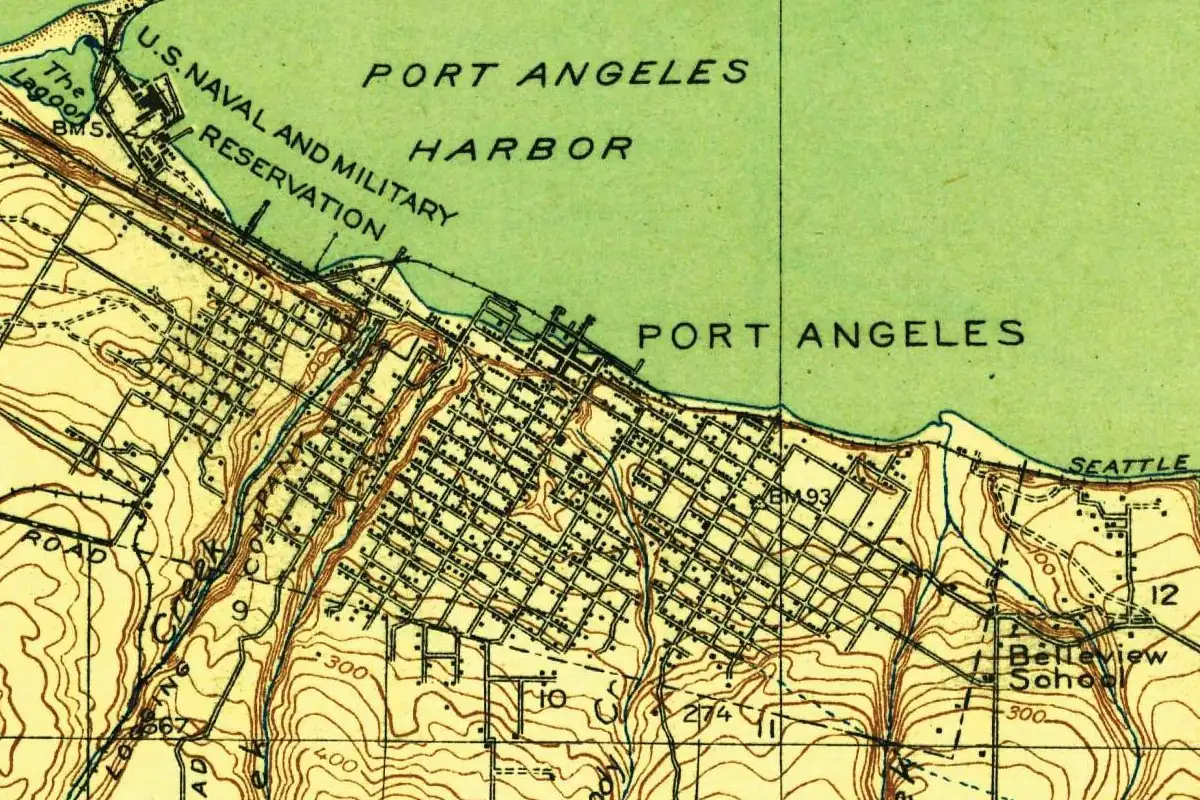
The next month, HistoryLink says, settlers fed up that most of the federal reserve was still off limits “jumped the Reserve,” and an 1891 law opened it to homesteading. On the 1918 map at the top of this page, you can see “U.S. Naval and Military Reservation” printed along the western waterfront, though the map doesn’t say whether that strip is a leftover piece of Lincoln’s reserve. The name that stuck was the Spanish one, in Vancouver’s short form.
The older name on Ediz Hook
The spit that makes the harbor may carry an even older name. Meany says Ediz Hook comes “probably” from Yennis, a Clallam word, in one entry, and “undoubtedly” in another, and the Smithsonian’s Handbook of American Indians lists Yennis, “good place,” as “a Clallam village at Port Angeles or False Dungeness.” HistoryLink gives the village as I’e’nis, “reported to mean ‘good beach,’” and says both Ediz Hook and Ennis Creek get their names from it. The Jamestown S’Klallam Tribe writes the village’s name ʔiʔínəs and places it at the mouth of Ennis Creek, one of three S’Klallam villages inside Ediz Hook, without giving a translation.
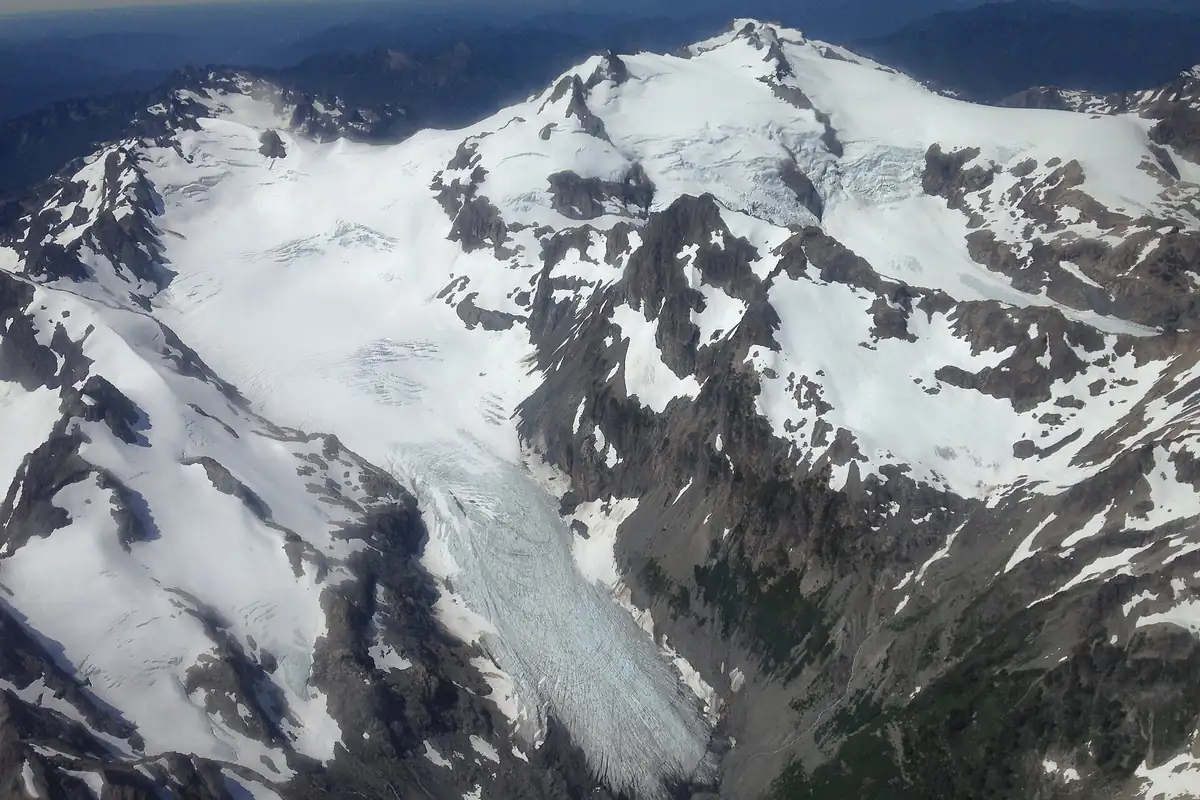
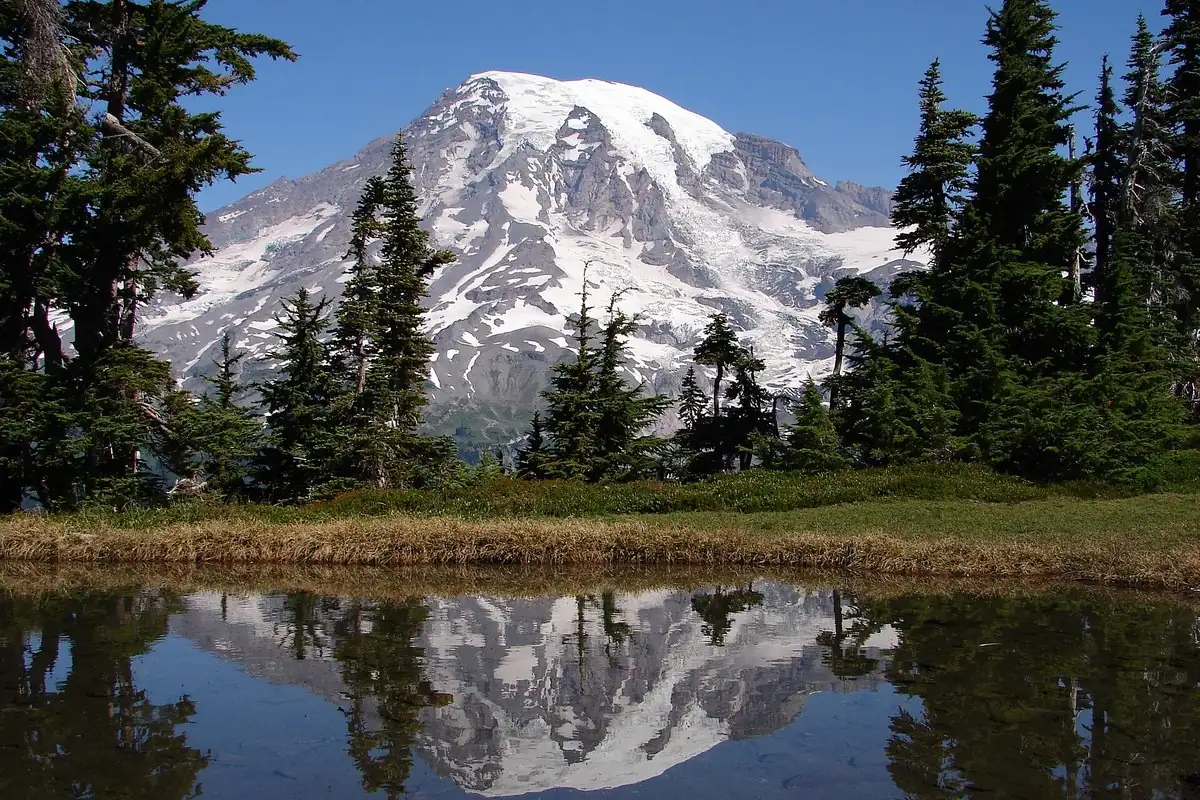
So the harbor’s two names sit side by side. The town took the Spanish one, shortened by an Englishman, and the spit that shelters it most likely kept a Klallam one. Behind the town rise the Olympic Mountains, named for a peak an English trader called Mount Olympus in 1788. The park handbook says the first real attempt to explore them, an Army expedition in 1885, started at Port Angeles, one more way the town and the mountains are tied together in Washington’s story.
Quick answers
What does Port Angeles mean?
“Port of the Angels,” more or less. The National Park Service’s 1954 handbook says the Spanish named the harbor Puerto de Nuestra Señora de Los Angeles, “Port of Our Lady of the Angels,” and Vancouver later shortened it to Port Angeles.
Who named Port Angeles?
The Spanish captain Francisco de Eliza, in 1791, according to the park handbook, HistoryLink and Meany’s main entry. One other entry in Meany’s 1923 book credits the captains Galiano and Valdés in 1792 instead.
When was Port Angeles founded?
In 1862, says HistoryLink, the year Victor Smith had the customs port of entry moved there. The first American settlers had arrived in 1856 or 1857, and the city incorporated in June 1890.
Was Port Angeles ever called Cherbourg?
Sort of. In 1859 settlers formed the Cherbourg Land Company, named after Isaac Stevens’s phrase “Cherbourg of the Pacific,” and the federal place-names database still lists Cherbourg as a variant for the town. Port Angeles is the name that lasted.
Key dates
- 1791Francisco de Eliza names the harbor Puerto de Nuestra Señora de los Angeles.
- 1792Galiano and Valdés shorten it to Puerto de los Angeles, and George Vancouver to Port Angeles.
- 1852The U.S. Coast Survey charts the harbor as False Dungeness.
- 1859Settlers form the Cherbourg Land Company, after Isaac Stevens's "Cherbourg of the Pacific."
- 1862Victor Smith gets the customs port of entry moved to Port Angeles.
- 1890June: Port Angeles incorporates as a city.
Getting there
The closest airports, Amtrak stations and intercity bus stops, measured in a straight line from the center of Port Angeles.
Airports
- Friday Harbor (FHR) 34 mi 54 km
- Seattle Paine Field International (PAE) Everett 55 mi 89 km
- Seattle-Tacoma International (SEA) 70 mi 112 km
Amtrak trains
- Stanwood station (STW) 51 mi 81 km
- Edmonds station (EDM) 53 mi 85 km
Intercity buses
- Dungeness Line Travel Washington · Port Angeles Gateway Transit Center under 1 mi 0.2 km
- Greyhound Mount Vernon Bus Stop 54 mi 88 km
- Amtrak Chartered Vehicle Amtrak Connecting Service · Mount Vernon Amtrak Station 55 mi 88 km
Distances are as the crow flies, not by road. We don't list schedules or fares because they change; check with the airline, Amtrak or the bus company before you go. Official data (FAA commercial service airports (2025), FAA airport locations, Amtrak stations and Intercity Bus Atlas) from the FAA and the U.S. Bureau of Transportation Statistics, checked Nov 1, 2026.
Historical Sources & References
- Edmond S. Meany, Origin of Washington Geographic Names (1923). “Port Angeles” (pp. 225–226): Eliza’s “Porto de Nuestra Senora de los Angeles” (1791), Galiano and Valdés’s “Porto de los Angeles” (1792), Vancouver’s short form and “False Dungeness” (1852). “Ediz Hook” (pp. 76–77): the 1792 Galiano and Valdés version, Davidson on False Dungeness and Yennis, “good place.”
- Gunnar O. Fagerlund, Olympic National Park, Washington (NPS Natural History Handbook No. 1, 1954). Juan Francisco de Eliza, “a Spanish captain,” named the harbor in 1791 “‘Puerto de Nuestra Senora de Los Angeles,’ which means ‘Port of Our Lady of the Angels’”; first permanent settlers in 1857.
- Kit Oldham, “Port Angeles – Thumbnail History,” HistoryLink.org (2007). Eliza’s ships and the Klallam villages I’e’nis and Tse-whit-zen; Vancouver’s anglicized name; the first settlers of 1856 or 1857; the Cherbourg Land Company (1859) and Stevens’s “Cherbourg of the Pacific”; Victor Smith, the 1862 port of entry and the 3,520-acre reserve; the city’s founding in 1862 and incorporation in June 1890.
- Henry Gannett, The Origin of Certain Place Names in the United States (USGS, 1905), p. 250. Port Angeles “named by Don Francisco Elisa, a Mexican.” Also online: the 1902 first edition, p. 212, with the same wording.
- Frederick Webb Hodge, ed., Handbook of American Indians, part 2 (BAE Bulletin 30), pp. 996–997. Yennis, “good place,” “a Clallam village at Port Angeles or False Dungeness.”
- Jamestown S’Klallam Tribe, “S’Klallam Villages”. The three S’Klallam villages inside Ediz Hook, including ʔiʔínəs (Ennis) at the mouth of Ennis Creek.
- GNIS feature 1524581, Port Angeles (U.S. Geological Survey). The federal record and coordinates for the city, with Cherbourg as a variant. Also online: Port Angeles Harbor, feature 1524583, with “Puerto de Nuestra Senora de Los Angeles” as a variant, and Ediz Hook, feature 1519191, with False Dungeness.
Spot something wrong, or know more? Tell us here. You can also email us or use our contact page. Corrections are noted here with their date, never made silently.