Rock Springs, Wyoming: Named for a Salty Spring
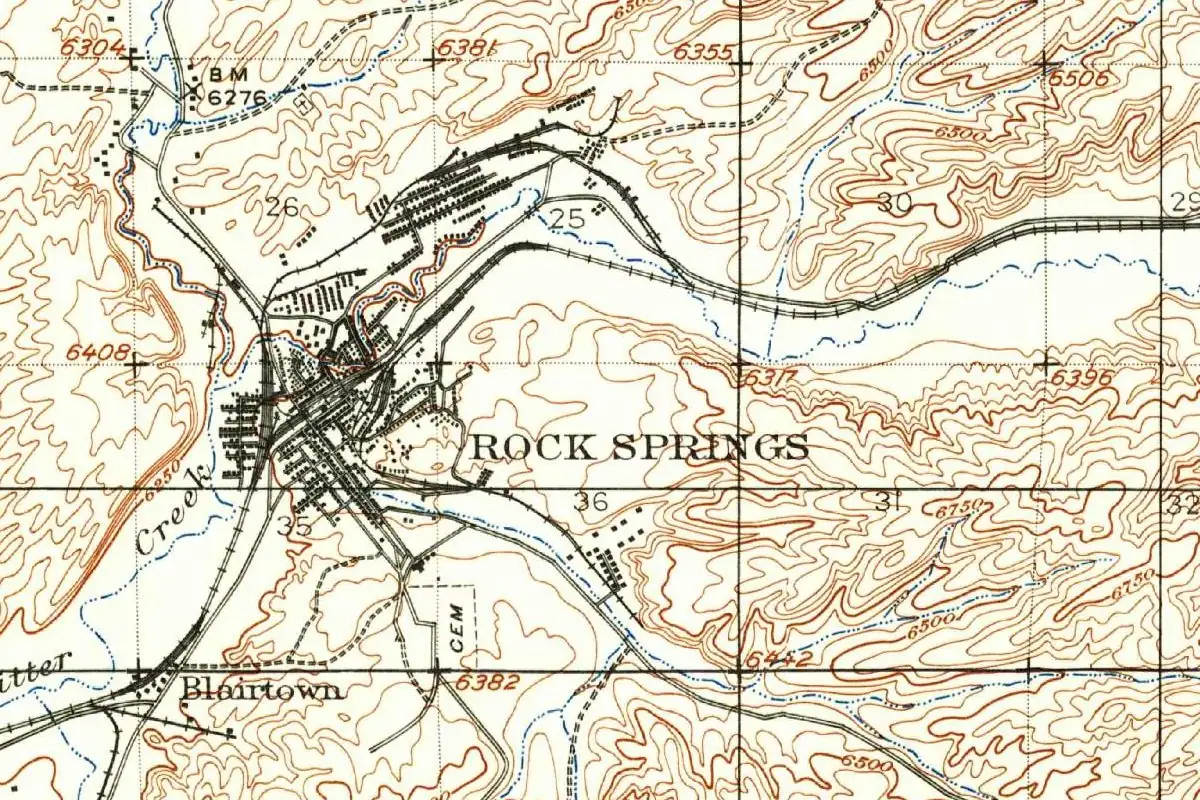
Rock Springs, Wyoming, took its name from a spring of salty water, and by 1915 the town pumped its drinking water 15 miles (24 km) from the Green River. The spring was good enough for stagecoaches, though, and it gave the coal town its name before there was a coal town.
A stage stop in the desert
The first documented mention of coal around here comes from an Army survey party in 1850. Its commander, Howard Stansbury, wrote, “We found a bed of bituminous coal cropping out of the north bluff of the valley,” as Chris Propst quotes it in his history of the city on WyoHistory.org. Nobody did much about it at the time. What brought the first real settlement, Propst says, was Ben Holladay’s Overland Stage Company, which put a stage stop here “because of the springs, a valuable source of water in the midst of the desert.”
Archibald and Duncan Blair took over that stop and, by Propst’s account, opened the first coal mine in 1868, just as the Union Pacific Railroad arrived. Their own little settlement, Blairtown, was named for the two brothers, and the Annals of Wyoming noted in 1942 that “By 1875 Rock Springs had completely absorbed the little town.” It still shows up as a separate label on the 1908 map at the top of this page, southwest of the main tangle of tracks along Bitter Creek.
The spring under the bluff
The Geological Survey’s 1915 guidebook to the Overland Route, written for people riding the Union Pacific, explains the name in one sentence: “The city of Rock Springs derives its name from a large spring of saline water that issues at the base of a bluff of the water-bearing sandstone.” The railroad’s own 1922 booklet, Along the Union Pacific System, says the same: Rock Springs was “named for large springs of saline water in the vicinity.”
That salt is the twist. The guidebook goes straight on to say that “water for domestic use as well as for use at the mines in this vicinity is pumped from Green River, a distance of 15 miles, with a lift of 179 feet.” So if you’d poured a glass of water in Rock Springs back then, it wouldn’t have come from the springs on the sign. It came from a river 15 miles (24 km) away, pumped uphill 179 feet (55 m).
A one-horse town that became a coal city
The guidebook calls Rock Springs “one of the most important coal-mining centers of the West,” with mines worked since 1868 and nearly a million tons of coal a year. A 1918 history of the state, edited by I. S. Bartlett, remembers a humbler start. Forty years earlier, it says, the place was “generally referred to as a ‘one horse town,’” and the name fit, “as there was really but one horse and wagon there.” They belonged to the Beckwith-Quinn Company, which, Bartlett says, “opened the first coal mines” (Propst gives that credit to the Blairs) and ran the company store, and the wagon did everything from delivering groceries to serving as the hearse.
Propst quotes Union Pacific president Charles Adams calling the mines the “salvation of the UP.” If you want the railroad’s version of why the town mattered, that’s it. The spring just put a dot on the map first. The federal gazetteer still lists a Board on Geographic Names decision on the name, dated 1943.
Quick answers
Why is it called Rock Springs?
For a large spring of salty water at the base of a sandstone bluff, according to a 1915 Geological Survey guidebook and a 1922 Union Pacific booklet. The Overland Stage put a stop there because of the springs.
Where did Rock Springs get its water?
At first from the springs: Propst says the stage stop was put there because they were “a valuable source of water in the midst of the desert.” By 1915, the guidebook says, water for homes and mines was pumped about 15 miles (24 km) from the Green River.
What was Blairtown?
A small settlement named for Archibald and Duncan Blair, who, Propst says, opened the first coal mine at Rock Springs in 1868. By 1875, the Annals says, Rock Springs had swallowed it.
Key dates
- 1850Howard Stansbury's Army survey party notes coal in the bluffs of the area.
- 1868The Blair brothers open the first coal mine as the Union Pacific arrives.
- 1875By now, Rock Springs has absorbed the little town of Blairtown.
- 1915A Geological Survey guidebook says the town's water is pumped from the Green River.
- 1943The Board on Geographic Names rules on the name.
Getting there
Open Rock Springs in Google Maps
Opens in a new tab. The pin is the center of Rock Springs in the USGS place-name record.
The closest airports, Amtrak stations and intercity bus stops, measured in a straight line from the center of Rock Springs.
Airports
- Southwest Wyoming Regional (RKS) Rock Springs 7 mi 11 km
- Vernal Regional (VEL) 81 mi 131 km
Intercity buses
- Greyhound Rock Springs WY (RSY) 3 mi 5 km
Distances are as the crow flies, not by road. We don't list schedules or fares because they change; check with the airline, Amtrak or the bus company before you go. Official data (FAA commercial service airports (2025), FAA airport locations, Amtrak stations and Intercity Bus Atlas) from the FAA and the U.S. Bureau of Transportation Statistics, checked Nov 6, 2026.
Sponsored
Staying in Rock Springs?
Compare hotels in Rock Springs, Wyoming, on Expedia.
See hotels in Rock SpringsWe may earn a commission if you buy through this link. It never changes what we write. Read our affiliate disclosure
Historical Sources & References
- Willis T. Lee and others, Guidebook of the Western United States, Part B: The Overland Route (USGS Bulletin 612, 1915), p. 71. The name from “a large spring of saline water,” the water pumped from the Green River, and coal mining since 1868. Scan of the 1916 reprint.
- Union Pacific System, Along the Union Pacific System (1922), p. 23. Rock Springs “named for large springs of saline water in the vicinity.”
- Chris Propst, “Rock Springs, Wyoming,” WyoHistory.org. Stansbury’s coal in 1850, the Overland Stage stop built because of the springs, the Blair brothers’ mine in 1868 and Charles Adams on the mines.
- “Wyoming Place Names,” Annals of Wyoming 14, no. 3 (July 1942), p. 229. Blairtown, named for Archibald and Duncan Blair and absorbed by Rock Springs by 1875.
- I. S. Bartlett, ed., History of Wyoming, vol. 1 (1918), p. 600. The “one horse town” and the Beckwith-Quinn Company’s wagon.
- GNIS feature 1593588 (U.S. Geological Survey). The official listing for Rock Springs, which records a Board on Geographic Names decision dated 1943.
Spot something wrong, or know more? Tell us here. You can also email us or use our contact page. Corrections are noted here with their date, never made silently.