Newcastle, Wyoming: Named for an English Coal Port?
Newcastle, Wyoming, is said to take its name from Newcastle upon Tyne, the English coal port, hometown of the mine boss who is credited with the choice. No early record confirms it, but the story fits: that boss ran the coal mines just up the canyon, at a camp that already had a British name of its own.
Coal first, then a town
The Chicago, Burlington and Quincy was building toward the Northwest in the 1880s, and its owners wanted a route with coal along the way to fuel the engines. Coal had just turned up on the southern edge of the Black Hills, just west of the Dakota line. Nicole Lebsack, who grew up in Newcastle and wrote its history for WyoHistory.org, says the mining settlement of Cambria was set up there in 1887, and the plan was to build a town where a spur would leave the main line and head north to the mines.
Lebsack writes that the name came from J. H. Hemingway, superintendent of the Cambria Coal Company, who was “recalling his own coal-shipping hometown of Newcastle-upon-Tyne, in England.” The Weston County Museum District’s website tells the same story in a sentence, without naming him, but that’s a modern retelling too, and Lebsack cites no older record; the 1918 state history and the 1942-1943 place-name lists say nothing about who chose the name. It’s a fitting pick for a coal town. The camp up the spur had the same kind of name: a 1943 supplement to the state’s list of place names says Cambria was named by Kilpatrick Bros., the railroad contractors who opened its first mine, “after Welch coal mines.”
If you look for the town in the 1905 dictionary of names Henry Gannett compiled for the Geological Survey, you’ll only find a group entry: some twenty Newcastles in the United States, “generally so called from the town in England or for the Duke of Newcastle.” Lebsack’s account points to the town, not the duke.
The day Tubb Town moved in
Bartlett’s History of Wyoming (1918) says the town was projected by Kilpatrick Brothers & Collins, coal operators, once the railroad had been finished to Crawford, Nebraska, about ninety miles (145 km) southeast. The first lot sale was on September 10, 1889, and Bartlett has the railroad built through the town “a year later.” Lebsack adds that the land company asked high prices, and that on the same day Tubb Town, a squatters’ settlement nearby, moved “lock, stock and barrel into the new city in its entirety.” Newcastle held its first election that November 12.
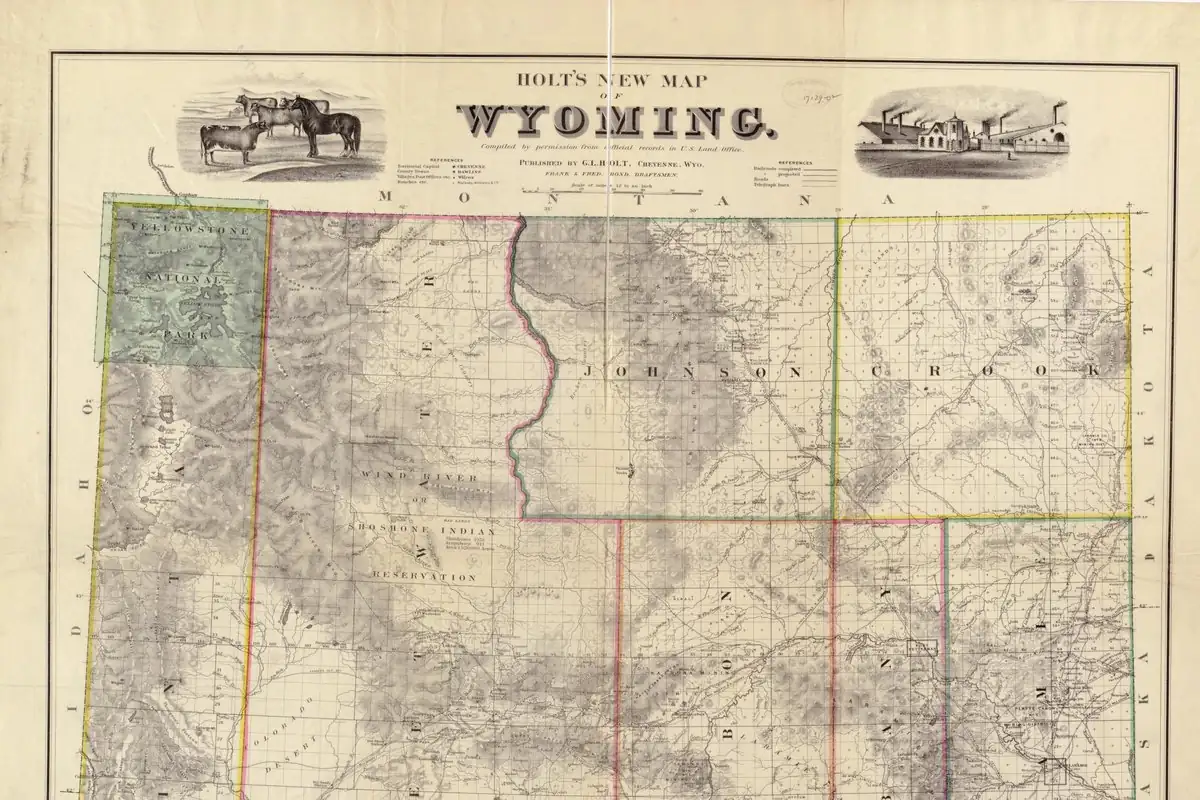
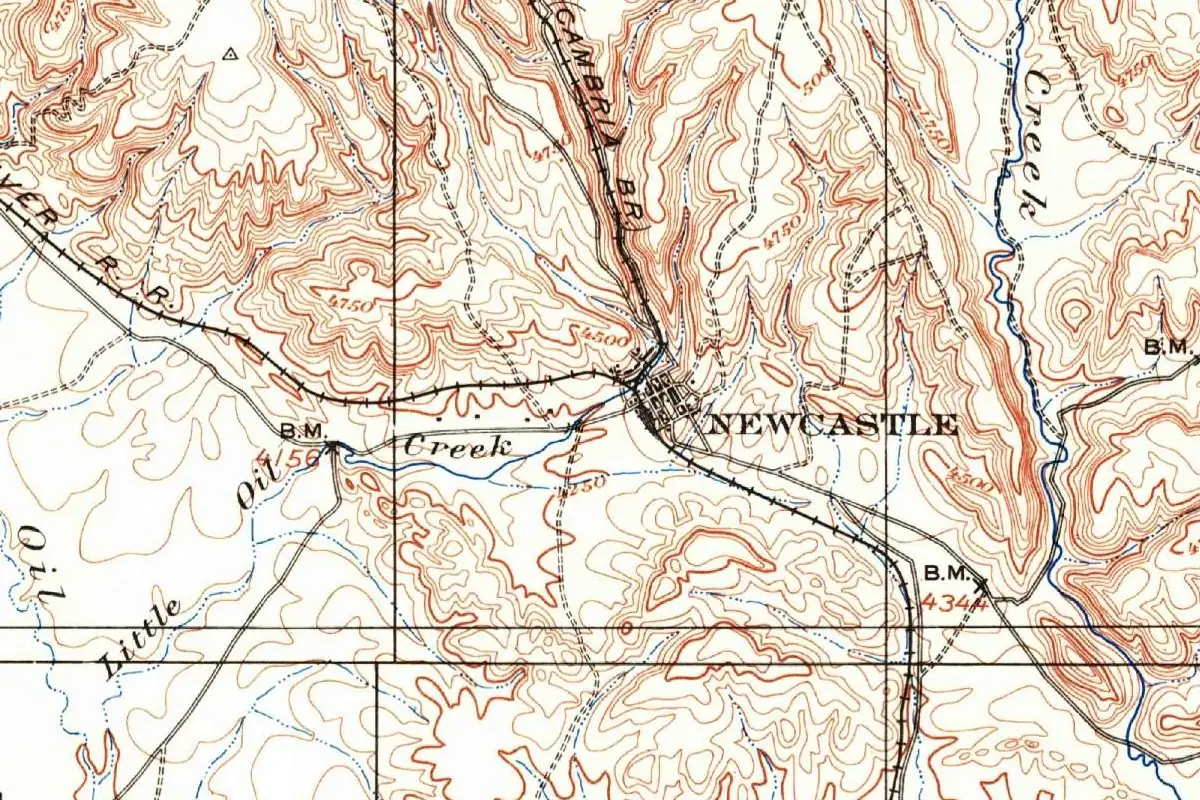
In Lebsack’s account the wait was shorter: within days of that vote, Burlington crews reached the town, and by December 1 they’d finished the branch north to Cambria. Bartlett counts 1,715 people in Newcastle in 1890 and only 756 ten years later. The 1899 sheet at the top of the page traces that line: the main track comes in from the west, and the “Cambria Br.” climbs north up its narrow valley to the mines that gave Newcastle both its reason to exist and its name.
Quick answers
Where did Newcastle get its name?
Probably from Newcastle upon Tyne, the English coal port, but that isn’t confirmed. Lebsack writes that the name came from J. H. Hemingway, superintendent of the Cambria Coal Company, who was from there. Her account is modern, and no older source turned up that says who named the town or why.
What was Tubb Town?
A squatters’ settlement near the site. When lots went on sale on September 10, 1889, Tubb Town moved into the new town all at once, Lebsack says.
How is Newcastle connected to Cambria?
Cambria was the coal camp just to the north, and Newcastle grew up where the railroad’s spur to its mines left the main line. Both names point to British coal country: Newcastle upon Tyne in England and, for Cambria, Welsh coal mines.
Key dates
- 1887The coal settlement of Cambria is established.
- 1889Lots go on sale on September 10, Tubb Town moves in the same day, and the town holds its first election on November 12.
- 1890Newcastle's population reaches 1,715.
Getting there
Open Newcastle in Google Maps
Opens in a new tab. The pin is the center of Newcastle in the USGS place-name record.
The closest airports, Amtrak stations and intercity bus stops, measured in a straight line from the center of Newcastle.
Airports
- Rapid City Regional (RAP) 59 mi 94 km
- Northeast Wyoming Regional (GCC) Gillette 74 mi 120 km
Intercity buses
- Jefferson Lines Spearfish 48 mi 77 km
Distances are as the crow flies, not by road. We don't list schedules or fares because they change; check with the airline, Amtrak or the bus company before you go. Official data (FAA commercial service airports (2025), FAA airport locations, Amtrak stations and Intercity Bus Atlas) from the FAA and the U.S. Bureau of Transportation Statistics, checked Nov 6, 2026.
Sponsored
Staying in Newcastle?
Compare hotels in Newcastle, Wyoming, on Expedia.
See hotels in NewcastleWe may earn a commission if you buy through this link. It never changes what we write. Read our affiliate disclosure
Historical Sources & References
- Nicole Lebsack, “Newcastle, Wyoming,” WyoHistory.org. The Burlington’s search for coal, Cambria in 1887, the name from J. H. Hemingway’s hometown of Newcastle-upon-Tyne, the lot sale and Tubb Town on September 10, 1889, and the branch to Cambria by December 1.
- Weston County Museum District, “Explore Newcastle”. A short modern retelling of the Newcastle-Upon-Tyne story, without the supervisor’s name; Newcastle founded in 1889.
- I. S. Bartlett, ed., History of Wyoming, vol. 1 (1918), p. 594. The town projected by Kilpatrick Brothers & Collins once the railroad reached Crawford, the first lot sale on September 10, 1889, the railroad through town “a year later,” and the population of 1,715 in 1890 and 756 in 1900.
- “Wyoming Place Names” (additions and corrections), Annals of Wyoming 15, no. 1 (January 1943), p. 86. Cambria “Named by Kilpatrick Bros., railroad contractors,” “after Welch coal mines.”
- Henry Gannett, The Origin of Certain Place Names in the United States (1905), p. 223. Twenty Newcastles “generally so called from the town in England or for the Duke of Newcastle.”
- GNIS feature 1592014 (U.S. Geological Survey). Newcastle’s entry in the Geographic Names Information System, with its Weston County location.
Spot something wrong, or know more? Tell us here. You can also email us or use our contact page. Corrections are noted here with their date, never made silently.