Douglas, Wyoming: Three Tents and a Senator's Name
Douglas, Wyoming, began as three tents near an old Army post and ended up with the name of Stephen A. Douglas, the senator who debated Abraham Lincoln. The tents came first, and the railroad, the town plat and the senator’s name all arrived together in 1886.
A tent town near Fort Fetterman
Before Douglas, the only settlement worth the name in this part of Wyoming was Fort Fetterman. When the Fremont, Elkhorn and Missouri Valley Railroad built up the North Platte River in 1886, the History of Wyoming that I. S. Bartlett edited in 1918 says, Douglas “was not then in existence,” and about two hundred people lived around the fort.
Then an upstart camp appeared about 8 miles (13 km) away. Doug McInnis, in his Converse County history on WyoHistory.org, says it began life as three tents: a general store, a restaurant and a saloon. The railroad, building west from Chadron, Nebraska, got there that year, and the first passenger train pulled in on August 29, 1886. Streets went in, permanent buildings went up, and some twenty-five bars opened. Since there was no church yet, the theological students who reportedly led the first services held them in barrooms, with a makeshift barrier blocking off the bar and a card table for an altar.
An Illinois senator on the North Platte
The railroad’s own place-name chronicler settles where the name came from. In his 1908 book on the names along the Chicago & North Western, the line that later absorbed the Fremont, Elkhorn and Missouri Valley, William H. Stennett wrote that Douglas “was platted by the Pioneer Town Site Company in 1886 and was named for Senator Stephen A. Douglas, of Illinois.” He even misspells the county as “Convery,” but there’s no doubt about the man.
A 1942 installment of “Wyoming Place Names,” a series in the Annals of Wyoming, says the same thing and adds why you’d know the name: Douglas was “Abraham Lincoln’s opponent in the famous Lincoln-Douglas debates.” The City of Douglas calls him “a noted stateman [sic] from Illinois.” What none of them tells you is who in the townsite company picked him, or why. Gannett’s 1905 Geological Survey bulletin lists counties in nine states (and probably three more) named for the same senator, but it has no entry for this town at all.
Sixty-nine O’Briens and a county seat
When Converse County was carved out in 1888, Bartlett writes, Douglas was made the county seat, and its history “really dates from that time.” McInnis tells the story of that vote from a 1930s Federal Writers’ Project account. “When the names of 69 O’Briens had been counted for votes, the captain shouted, ‘No more O’Briens today,’” it goes. Douglas won.
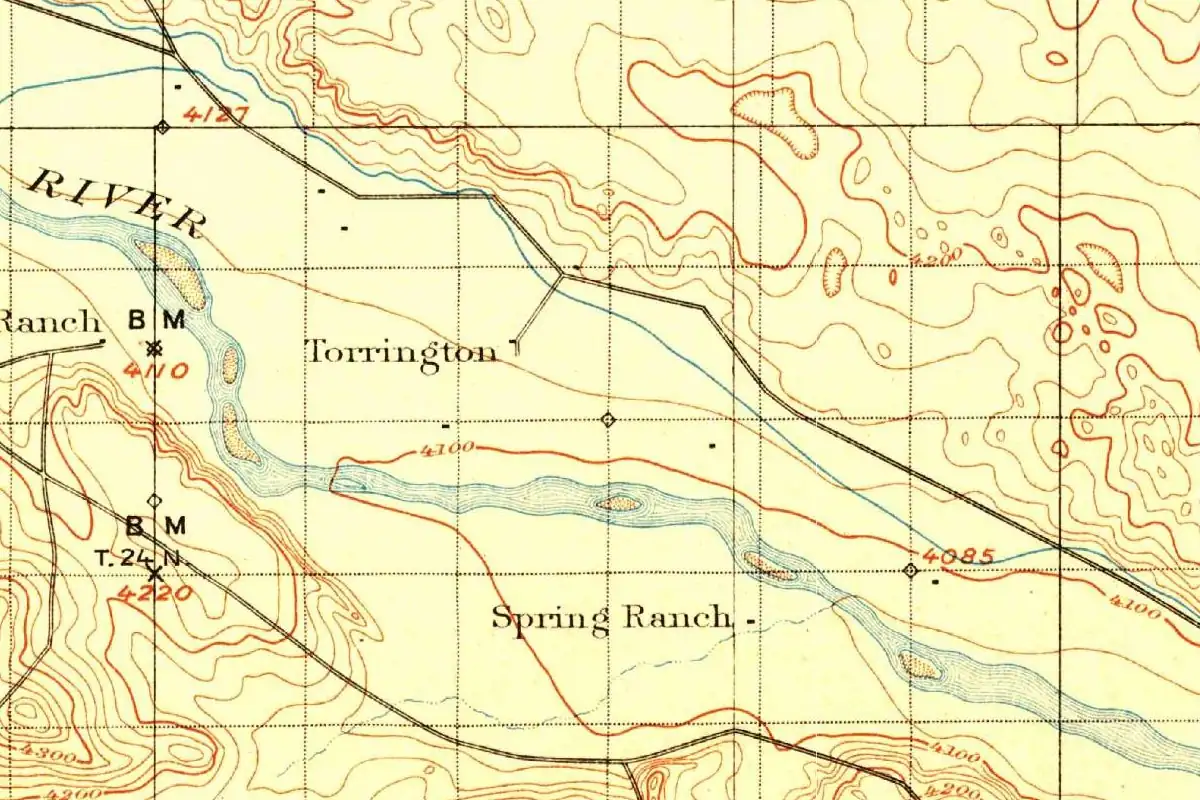
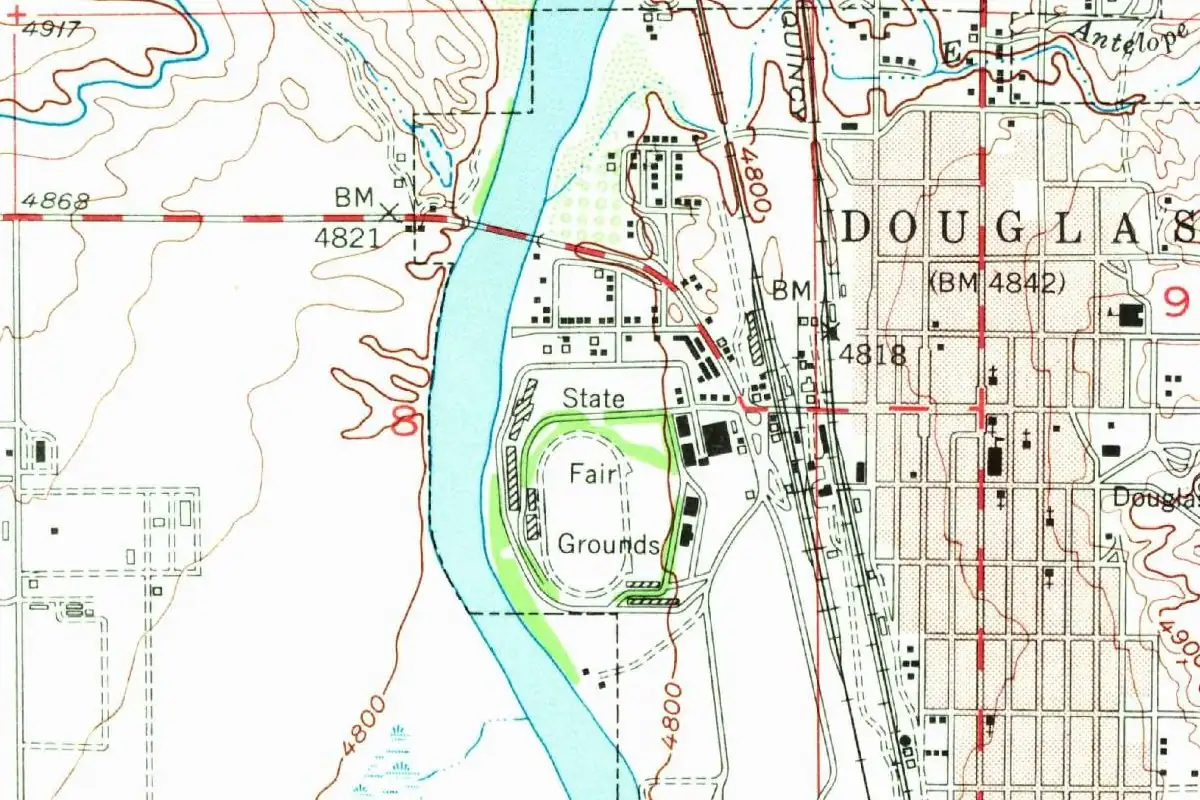
A few years later came a different kind of crowd. The Wyoming State Fair has been held in Douglas nearly every year since 1905, according to McInnis. The fairgrounds racetrack is easy to find on the 1949 Geological Survey sheet above, tucked between the river and the railroad, right across the tracks from the grid of streets that started as three tents.
Quick answers
Which Douglas is Douglas, Wyoming, named for?
Stephen A. Douglas, the U.S. senator from Illinois. A 1908 railroad place-name book and a 1942 state list both say so, and the city agrees.
Did Douglas grow up around the railroad?
Yes. It started as a tent camp, and the Fremont, Elkhorn and Missouri Valley Railroad reached it in 1886. Stennett says the Pioneer Town Site Company platted the town that same year.
Is Douglas, Wyoming, the old Fort Fetterman?
No. Fort Fetterman was a separate settlement about 8 miles (13 km) away, and McInnis says the new town soon eclipsed it.
Key dates
- 1886The Fremont, Elkhorn and Missouri Valley Railroad reaches Douglas; the first passenger train arrives on August 29.
- 1888Converse County is created, and Douglas becomes the county seat.
- 1905Douglas hosts the Wyoming State Fair for the first time.
- 1908William H. Stennett's railroad place-name book records the town as named for Senator Stephen A. Douglas.
Getting there
Open Douglas in Google Maps
Opens in a new tab. The pin is the center of Douglas in the USGS place-name record.
The closest airports, Amtrak stations and intercity bus stops, measured in a straight line from the center of Douglas.
Airports
- Casper/Natrona County International (CPR) 56 mi 90 km
- Laramie Regional (LAR) 101 mi 163 km
Intercity buses
- Express Arrow Douglas under 1 mi 0 km
Distances are as the crow flies, not by road. We don't list schedules or fares because they change; check with the airline, Amtrak or the bus company before you go. Official data (FAA commercial service airports (2025), FAA airport locations, Amtrak stations and Intercity Bus Atlas) from the FAA and the U.S. Bureau of Transportation Statistics, checked Nov 6, 2026.
Sponsored
Staying in Douglas?
Compare hotels in Douglas, Wyoming, on Expedia.
See hotels in DouglasWe may earn a commission if you buy through this link. It never changes what we write. Read our affiliate disclosure
Historical Sources & References
- William H. Stennett, A History of the Origin of the Place Names Connected with the Chicago & North Western and Chicago, St. Paul, Minneapolis & Omaha Railways (1908), p. 65. “Platted by the Pioneer Town Site Company in 1886 and was named for Senator Stephen A. Douglas, of Illinois.”
- “Wyoming Place Names,” Annals of Wyoming 14, no. 3 (July 1942), p. 232. Named in honor of Senator Stephen A. Douglas, “Abraham Lincoln’s opponent in the famous Lincoln-Douglas debates,” citing the 1941 Writers’ Program guide to Wyoming, p. 284.
- City of Douglas, “History of Douglas”. The town born from the railroad’s extension and named after Stephen A. Douglas; Fort Fetterman eight miles (13 km) away.
- Doug McInnis, “Converse County, Wyoming,” WyoHistory.org. The three tents, the first passenger train on August 29, 1886, the barroom church services, the county-seat vote with its O’Briens and the State Fair since 1905.
- I. S. Bartlett, ed., History of Wyoming, vol. 1 (1918), pp. 572, 574. Douglas “not then in existence” when the railroad came up the North Platte in 1886; county seat in 1888.
- Henry Gannett, The Origin of Certain Place Names in the United States (1905), p. 108. Counties in nine states named for Stephen A. Douglas; no entry for Douglas, Wyoming.
- GNIS feature 1587750 (U.S. Geological Survey). The government’s place-name entry for Douglas, in Converse County, with its coordinates.
Spot something wrong, or know more? Tell us here. You can also email us or use our contact page. Corrections are noted here with their date, never made silently.