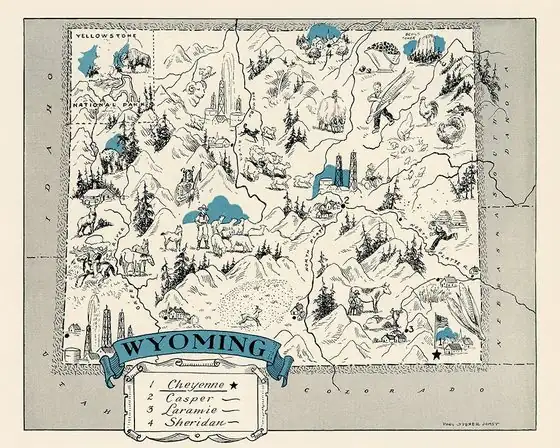
Sheridan, Wyoming: A Veteran Named It for His General
Sheridan is named for Gen. Philip H. Sheridan. WyoHistory.org says John D. Loucks, a Civil War veteran who had served under the general, sketched the town site in the spring of 1882 and gave it the name. A 1918 state history confirms that both the town and Sheridan County took their names from the general.
A town sketched in a cabin
Sheridan, Wyoming, got its name in 1882 from John D. Loucks, a Civil War veteran who sketched the town and named it for the general he’d served under. That general was Philip H. Sheridan, and his name ended up on the county, too.
The best-known version of the founding comes from Gregory Nickerson’s history of the city on WyoHistory.org, an online encyclopedia of Wyoming history. One evening in the spring of 1882, he writes, Loucks “sat on a hill above Goose Creek and envisioned a town laid out in the valley below him.” Then he went back to his cabin, sketched out the town site, and gave it the name “Sheridan” in honor of the general.
Nickerson says a trapper named George Mandel had built a cabin and a post office near the forks of Goose Creek but decided not to stay. Mandel sold his 40 acres to Loucks, who paid $50 for the claim.
Wrapping paper and a surveyor from Big Horn
The Downtown Sheridan Association tells the same story and adds one detail. Loucks plotted the town in 1882, its walking tour says, “on the back of a sheet of wrapping paper.” The county’s tourism office repeats the same words on its Historic Main Street page. Both say Sheridan was named after “one of John Loucks’ civil war officers, General Sheridan.”
A sketch on wrapping paper still needed a real survey. Loucks hired Jack Dow of Big Horn to survey the town, Nickerson writes, and registered the plat at the land office in Cheyenne. He also became the first postmaster.
Loucks didn’t stop at the town’s name, either. According to the downtown association, he named several streets after his close friends. Grinnell Street, for one, honors Cornelius Howland Grinnell, who had come to Sheridan in 1880 and started a livestock business on the land where the city now stands.
What the 1918 history adds, and where it differs
The oldest account we could find is in I. S. Bartlett’s History of Wyoming, a 1918 compilation printed in Chicago. Its Sheridan section doesn’t mention the hill or the wrapping paper. It does settle the main question in one sentence: when Sheridan County was created in 1888 and the town became the county seat, “both county and town” took their names from “Gen. Philip H. Sheridan, who conducted several successful campaigns against the Indians of the Northwest.”
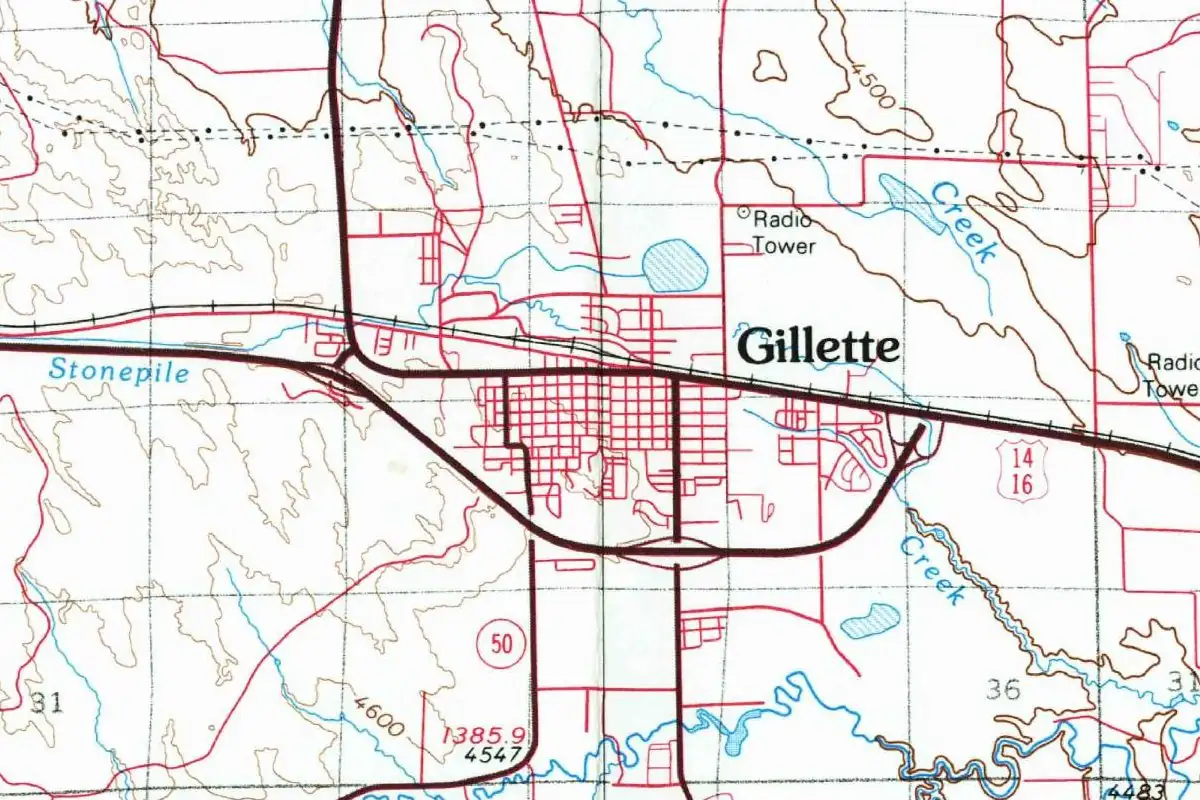
Bartlett tells the beginnings a little differently from Nickerson, though. In his telling, “The first cabin in Sheridan was built by O. P. Hanna,” a scout who, Bartlett says, was well known to Generals Crook and Terry. And it was “Henry A. Coffeen” who “developed the plans for the town,” while the civil engineer Edward Gillette surveyed the railroad and some mining claims nearby. That’s the same Edward Gillette whose name went on Gillette, Wyoming. Jessica Salzman’s 2023 profile of him on WyoHistory.org says his crew surveyed the railroad route into the Sheridan area in the fall of 1890, and that he lived the last half of his life in Sheridan.
Loucks still shows up in Bartlett’s book. The legislature approved Sheridan’s incorporation on March 6, 1884, and Loucks, “one of the pioneer business men,” was elected the first mayor. At that point, Bartlett adds, the town “was only about two years old,” which fits a founding in 1882.
So you get two founding stories that overlap but don’t match. On the name, though, Nickerson, the downtown association and Bartlett all point to the general.
The general’s other namesakes
The general’s name is on plenty of other places, too. Bulletin 258 of the Geological Survey, dated 1905, folds every Sheridan Henry Gannett knew into one shared entry: a village in Illinois, a county in Kansas, a town in Montana, a county in Nebraska and, as he put it, a “county and mountain in Yellowstone Park, Wyoming,” all “named for Gen. Philip H. Sheridan.” The Wyoming town itself isn’t on his list.
The valley had an Army past before the town did. Nickerson writes that it served as a staging area for General Crook’s 1876 campaign against the Lakota and Cheyenne, and that over the next two years the Army forced the tribes onto reservations, opening northern Wyoming to settlers. He also notes that this is the ancestral homeland of the Crow people.
A county seat and a railroad
The town’s name spread when its county was born. In the spring of 1888, Nickerson says, residents of Johnson County north of Piney Creek pushed to form a county of their own. The bill passed the territorial legislature 14 to 2 over Governor Moonlight’s veto. In the county-seat election, Sheridan got 486 votes to Big Horn’s 248 and Dayton’s 224.
The Burlington & Missouri Railroad arrived in 1892, and Nickerson calls it the event that “sealed Sheridan’s destiny” as the center of the region. Coal mines opened nearby after the panic of 1893, and the population went from 1,559 in 1900 to 8,408 in 1910. Bartlett, writing a few years later, called the place the “Queen City of Northern Wyoming.” He counted just 281 people there in 1890, and by the time his book came out, he said, Sheridan claimed to be the largest city in the state, having passed Cheyenne. He was careful to add that the claim was “based on estimates only.”
Buffalo Bill Cody, the man behind Cody, Wyoming, invested in the Sheridan Inn, Nickerson writes, and used it as his headquarters during tryouts for his Wild West show.
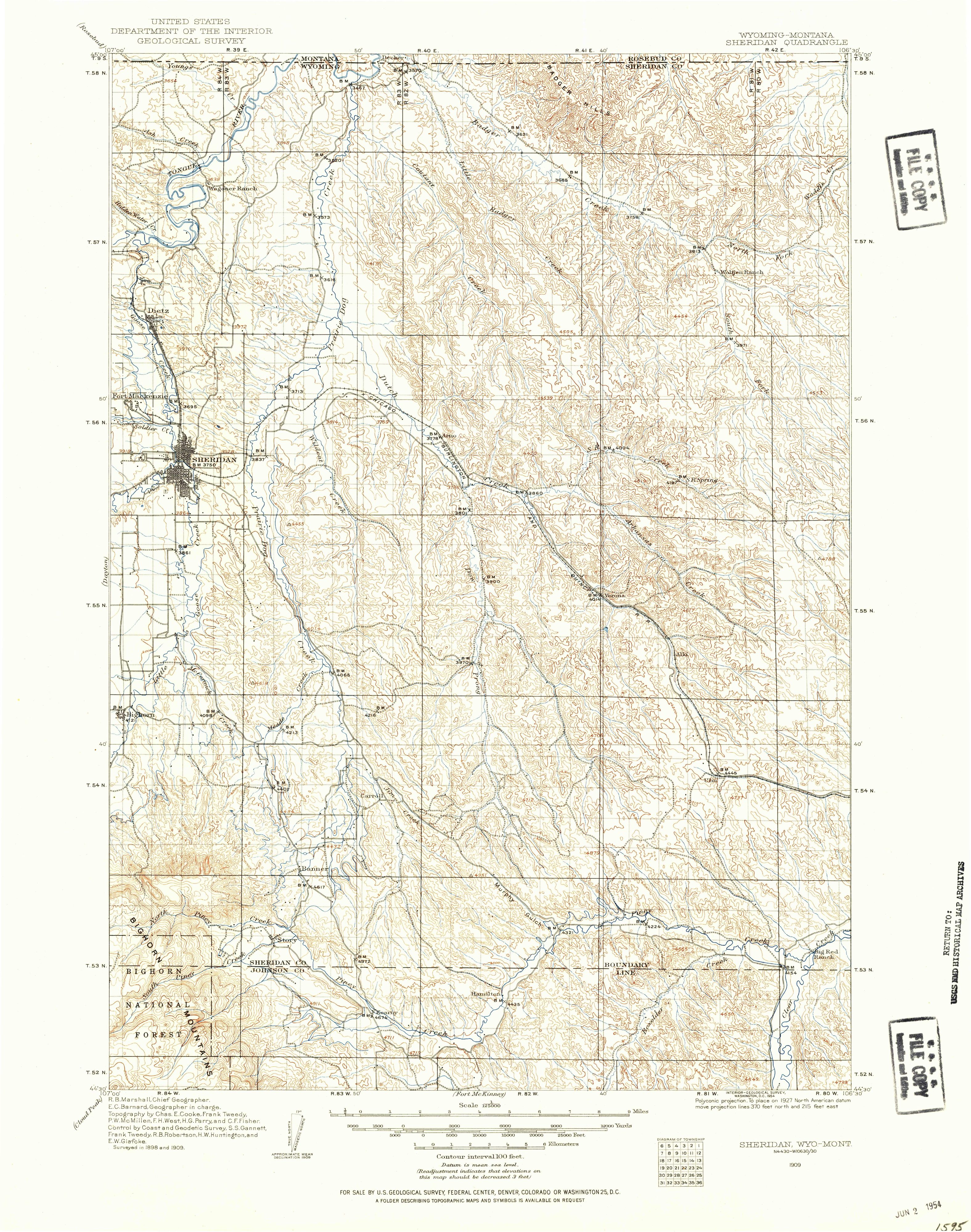
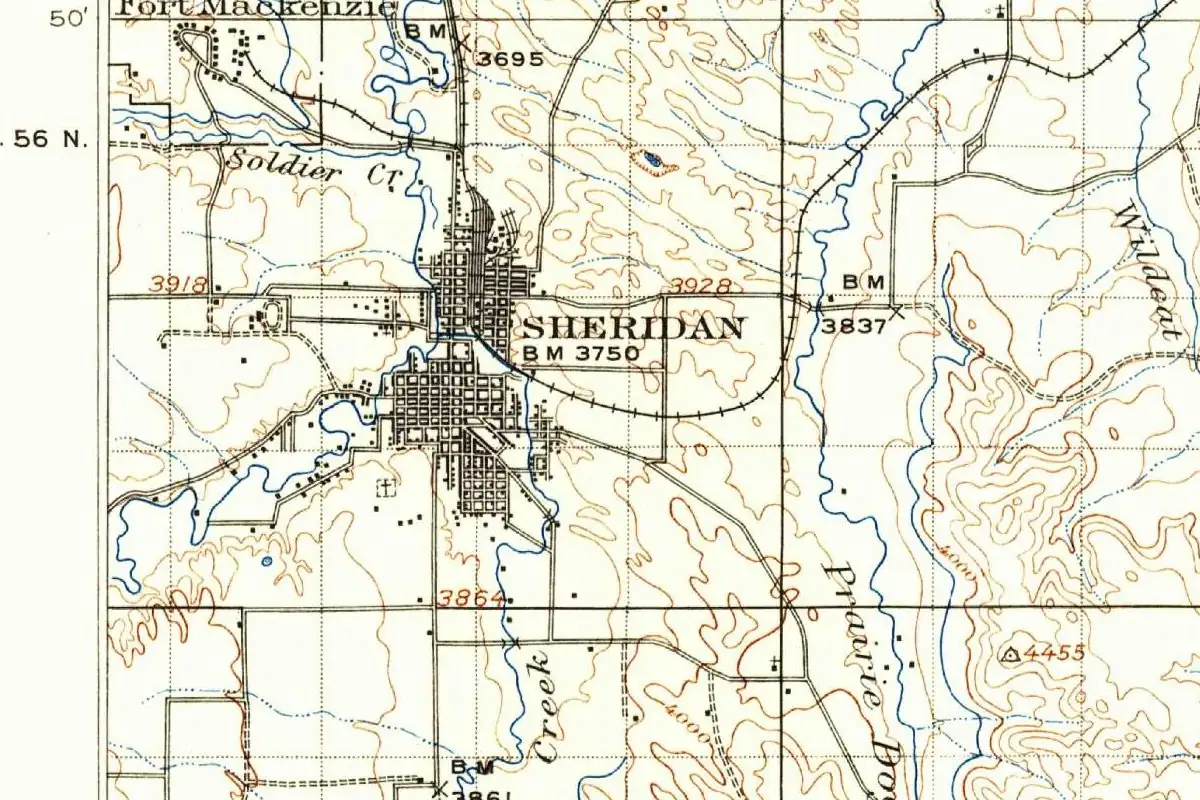
If you look at the 1909 map at the top of this page, you’ll find Fort Mackenzie just northwest of the street grid. There’s more on the state’s other towns on our Wyoming page.
Quick answers
Who is Sheridan, Wyoming, named after?
Gen. Philip H. Sheridan, the Union general. Bartlett’s 1918 history says both the town and the county took his name.
Who named Sheridan, Wyoming?
John D. Loucks, according to WyoHistory.org and the Downtown Sheridan Association. WyoHistory says Loucks had served under the general, and the association calls Sheridan one of Loucks’s “civil war officers.”
When was Sheridan, Wyoming, founded?
Loucks laid it out in 1882, and the legislature approved its incorporation on March 6, 1884. Bartlett says the town was then “only about two years old.”
Who built the first cabin in Sheridan?
It depends on the source. Nickerson credits the trapper George Mandel with a cabin and post office near the forks of Goose Creek, while Bartlett says “the first cabin in Sheridan was built by O. P. Hanna.”
Key dates
- 1876The Goose Creek valley serves as a staging area for General Crook's campaign, WyoHistory.org says.
- 1882Spring: John D. Loucks sketches the town site and names it Sheridan.
- 1884March 6: The legislature approves Sheridan's incorporation; Loucks becomes the first mayor.
- 1888Sheridan County is created, and Sheridan wins the vote for county seat.
- 1892The Burlington & Missouri Railroad reaches Sheridan.
Things to do in Sheridan, Wyoming
Trail End State Historic Site
The home of John B. Kendrick, a former Wyoming governor and U.S. senator. Construction began in 1908 and ended in 1913, and exhibits drawn mostly from the family's original belongings show daily life in the house from 1913 to 1933.
Sheridan Inn
Built by the Sheridan Land Company and opened on May 27, 1893. Buffalo Bill Cody owned it from 1894 to 1901 and is said to have auditioned acts for his Wild West show on its wraparound porch. It's a National Historic Landmark.
King's Saddlery and King's Saddlery Museum
Don King opened the saddlery in 1963, and his saddles tooled with a wild rose motif are on display in the Cowboy Hall of Fame and the ProRodeo Hall of Champions. Behind the store, the museum holds wagons, old and famous saddles, historic photographs and leather-working tools.
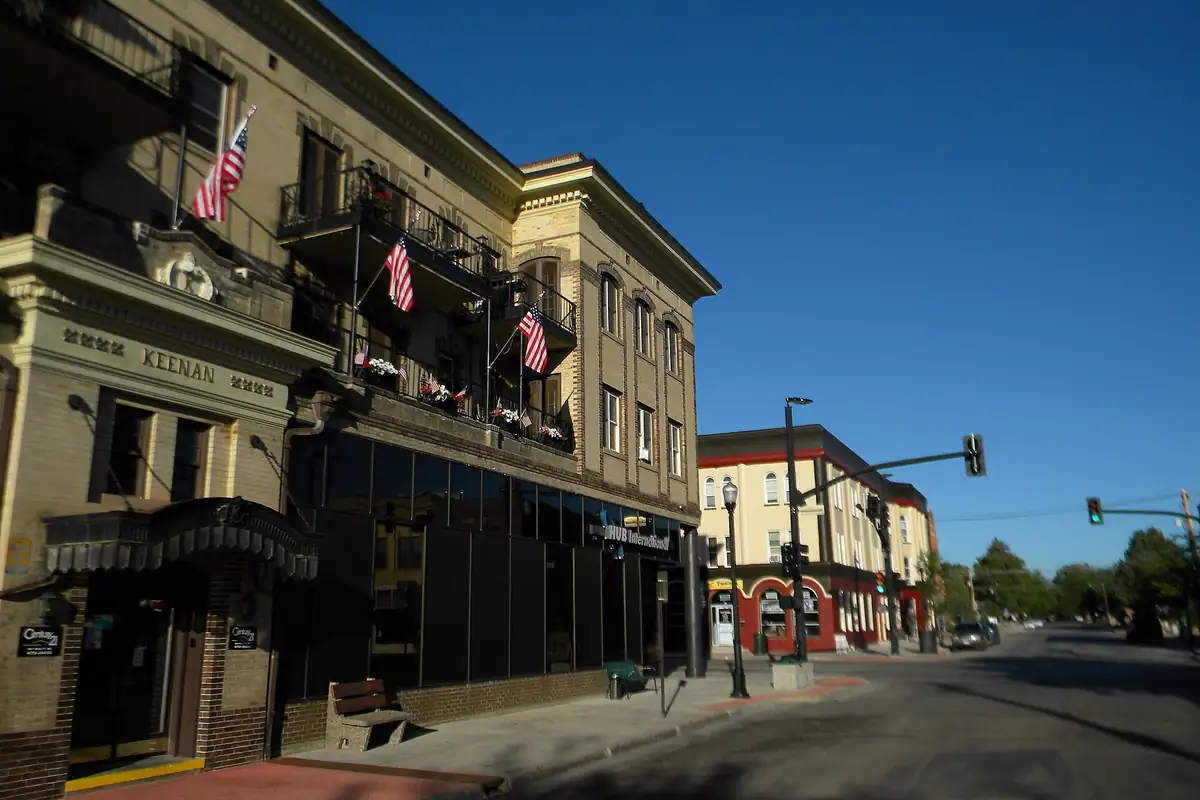
Sheridan Main Street Historic District
Brick and stone buildings that replaced the first false-front wooden stores between 1910 and 1920. The district has been on the National Register of Historic Places since 1982, and the Downtown Sheridan Association has a walking tour of it.
Getting there
Open Sheridan in Google Maps
Opens in a new tab. The pin is the center of Sheridan in the USGS place-name record.
The closest airports, Amtrak stations and intercity bus stops, measured in a straight line from the center of Sheridan.
Airports
- Sheridan County (SHR) 2 mi 4 km
- Northeast Wyoming Regional (GCC) Gillette 76 mi 123 km
Intercity buses
- Jefferson Lines Sheridan 1 mi 2 km
- Express Arrow Buffalo 34 mi 54 km
Distances are as the crow flies, not by road. We don't list schedules or fares because they change; check with the airline, Amtrak or the bus company before you go. Official data (FAA commercial service airports (2025), FAA airport locations, Amtrak stations and Intercity Bus Atlas) from the FAA and the U.S. Bureau of Transportation Statistics, checked Nov 14, 2026.
Sponsored
Staying in Sheridan?
Compare hotels in Sheridan, Wyoming, on Expedia.
See hotels in SheridanWe may earn a commission if you buy through this link. It never changes what we write. Read our affiliate disclosure
Historical Sources & References
- Gregory Nickerson, “Sheridan, Wyoming,” WyoHistory.org (2014). Mandel’s cabin and his sale to Loucks for $50; Loucks on the hill in the spring of 1882 naming the town for “the Union general he had served under”; Jack Dow’s survey and the Cheyenne land office; the 1888 county fight and votes; the railroad in 1892; the population figures; Crook’s 1876 campaign, the Crow homeland and Buffalo Bill at the Sheridan Inn.
- Downtown Sheridan Association, Walking Tour: Early Sheridan. The town plotted “on the back of a sheet of wrapping paper,” named for “one of John Loucks’ civil war officers, General Sheridan,” incorporated in 1884; Loucks naming streets for his friends, including Grinnell.
- Sheridan County Travel and Tourism, Historic Main Street. The same text as the downtown association’s page, so it isn’t an independent source.
- I. S. Bartlett, ed., History of Wyoming, vol. 1 (1918), p. 604. “Queen City of Northern Wyoming”; O. P. Hanna’s first cabin; Coffeen’s plans and Gillette’s survey; incorporation approved March 6, 1884, with Loucks as first mayor; “both county and town deriving their names from Gen. Philip H. Sheridan.”
- Henry Gannett, The Origin of Certain Place Names in the United States, 2nd ed. (1905), p. 282. The Sheridans of Illinois, Kansas, Montana, Nebraska and Wyoming, “named for Gen. Philip H. Sheridan.”
- Jessica Salzman, “Edward Gillette: Surveyor, Statesman, Entrepreneur,” WyoHistory.org (2023). Gillette’s crew surveying the route into the Sheridan area in the fall of 1890, and his life in Sheridan.
- GNIS feature 1594251 (U.S. Geological Survey). The city’s official entry in the national names system, in Sheridan County.
- U.S. Geological Survey, Sheridan quadrangle (1909). The 1:125,000 sheet, surveyed in 1898 and 1909, that the map at the top of this page was cropped from.
Sponsored
Put this 1909 map on your wall
The 1909 USGS Sheridan sheet, in a 1954 printing, is in the public domain. Download the full-size scan for free, then have it printed on canvas with CanvasOnTheCheap.
Print a map on canvasDownload the full-size mapWe may earn a commission if you buy through this link. It never changes what we write. Read our affiliate disclosure
Spot something wrong, or know more? Tell us here. You can also email us or use our contact page. Corrections are noted here with their date, never made silently.