Prescott, Arizona: A Capital Named for a Historian
Prescott is named for the historian William Hickling Prescott, author of The History of the Conquest of Mexico. Citizens around Granite Creek adopted the name by resolution at a meeting on May 30, 1864, when the town was laid out as Arizona's territorial capital. Other names proposed, the city says, were Audubon, Goodwin City and Aztlan.
A capital with no name yet
Prescott, Arizona, was founded in 1864 as a territorial capital and named for William Hickling Prescott, the historian of the conquest of Mexico. That’s the author the city’s own historic-district guide names: the man behind The History of the Conquest of Mexico.
Arizona had just become a territory, and its new government needed a seat. Thomas Edwin Farish, who wrote a multi-volume history of Arizona as the state’s official historian in the 1910s, says the spot was chosen because it sat in the middle of the placer gold country that was drawing people “from both the East and the West.” He also admired the setting: the town “was in the heart of the Indian country, but a more picturesque spot for a future city could not have been selected.” On the same page he credits the name to one man: “The name was given in honor of the great American historian, by Secretary McCormick.”
That’s the short version. Farish’s book tells it two more ways, and one of them explains where the name “Goodwin City” came from.
Fort Whipple, the Goodwinites and the governor
Farish reprints an interview with Fred G. Hughes, a pioneer who said he came out with the California Volunteers as a bullwhacker. The troops, Hughes said, reached Chino Valley and set up Fort Whipple there on December 21, 1863. Governor John N. Goodwin’s party arrived soon after and made the post the territory’s temporary capital, and Secretary R. C. McCormick started a monthly paper there, the Arizona Miner, on a small printing outfit he had brought along.
The placer miners on Granite Creek, Hughes said, had already held a meeting and “dubbed their camp ‘Goodwin,’ in honor of the Governor.” The “Goodwinites” wanted the capital in their “city.” Goodwin picked a different spot instead, some time in April 1864, and had it surveyed, and it was “afterwards named Prescott.” Fort Whipple moved up to the new town, and the old camp in Chino Valley got a new name of its own, Camp Clark.
So “Goodwin City,” one of the losing names on the city’s list, belonged to a real mining camp. Farish mentions it again later on, as “Goodwin City, afterward called Gimletville.” It just wasn’t where the governor wanted his capital.
A few pages later, Farish tells the naming itself with a crowd in the room.
The meeting at Yeserea’s store
On a Monday evening, May 30, 1864, the people living around Granite Creek met at the store of Don Manuel Yeserea. Farish says they agreed on the size and boundaries of the town, and “the name of Prescott adopted by resolution in honor of the historian.”
Farish doesn’t line the two passages up. One gives the name to McCormick, the other to a resolution of the settlers, and he never says who moved it. You get both versions from the same book.
The name wasn’t the only candidate. According to the City of Prescott’s guide, three other names were proposed: “Audubon,” “Goodwin City” and “Aztlan.” The guide adds that the Arizona Miner reported why the name was accepted: Prescott was “a good citizen, a true patriot.” We haven’t seen that issue of the Miner ourselves, so take it as the city quotes it.
The surveying gear was simple. R. W. Groom and Van C. Smith laid out the town, Farish writes, with Groom acting as something of a civil engineer, and “in the absence of other instruments they used a frying pan.” By July 4, 1864, 232 lots had sold at public sale.
Aztlan tries again
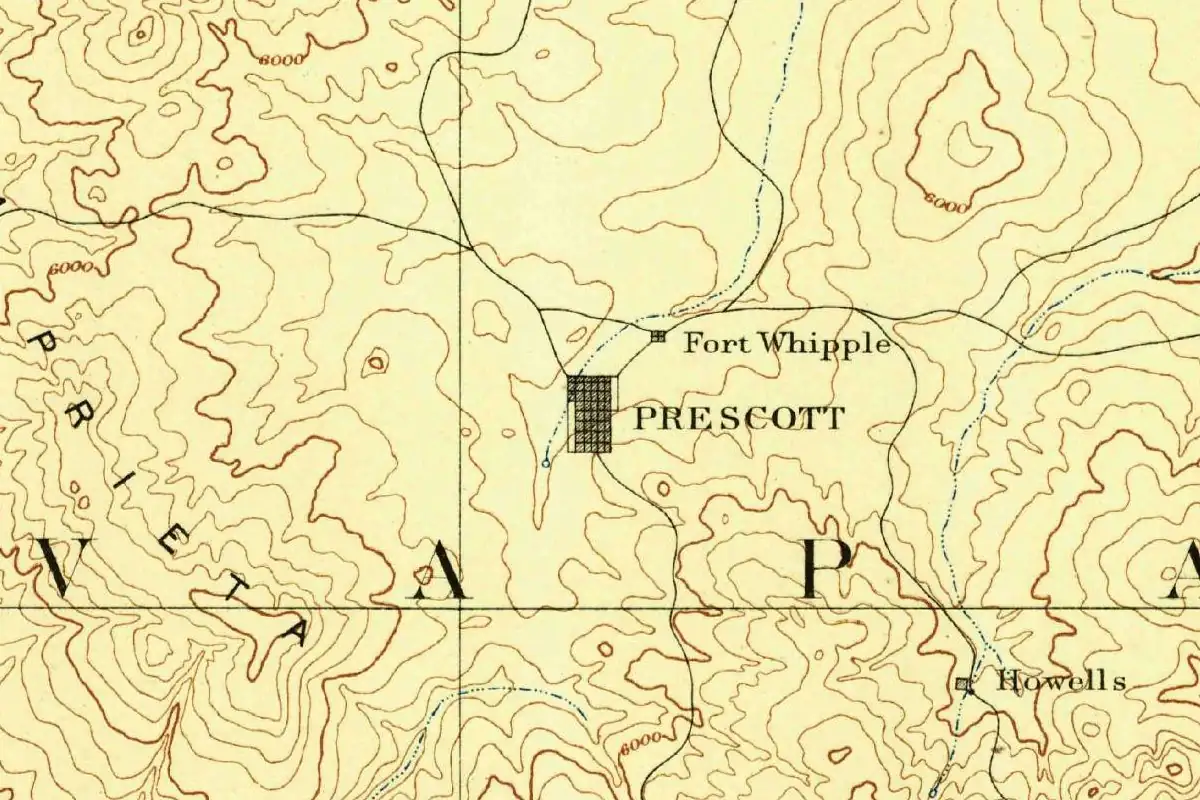
One of those rejected names didn’t stay buried. That October, the first territorial legislature took up a bill that fixed the capital at “Prescott, situated on the east bank of Granite Creek,” about a mile (1.6 km) from the Army post at Fort Whipple. You can see that pairing on the 1887 map at the top of this page: a small block of streets labeled PRESCOTT, with Fort Whipple just off to the northeast.
Farish quotes the House proceedings. One amendment tried to swap in La Paz and lost, 8 to 9. Another tried Walnut Grove, on the Lower Hassayampa, and lost by the same count. A third proposed a new seat within 10 miles (16 km) of where the Rio Verde meets the Rio Salado, and said it “shall be called Aztlan.” That one lost 7 to 10. Prescott kept the capital, and its name.
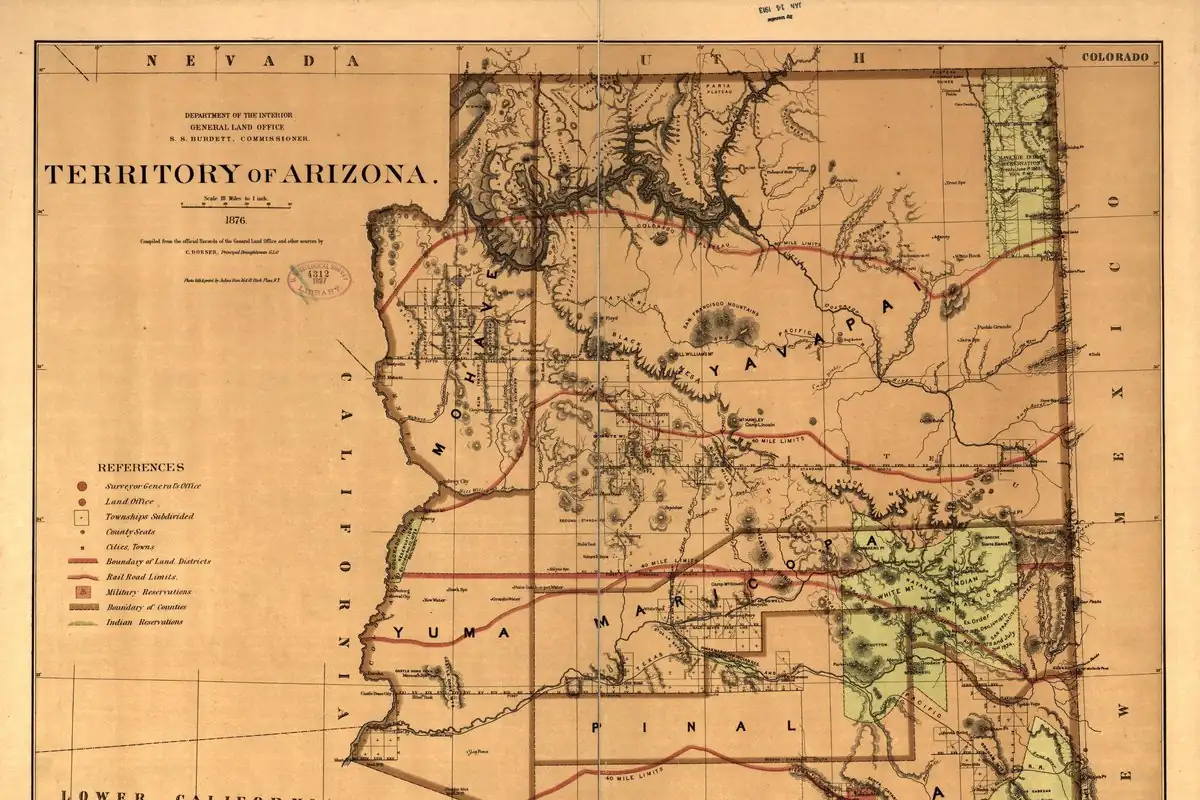
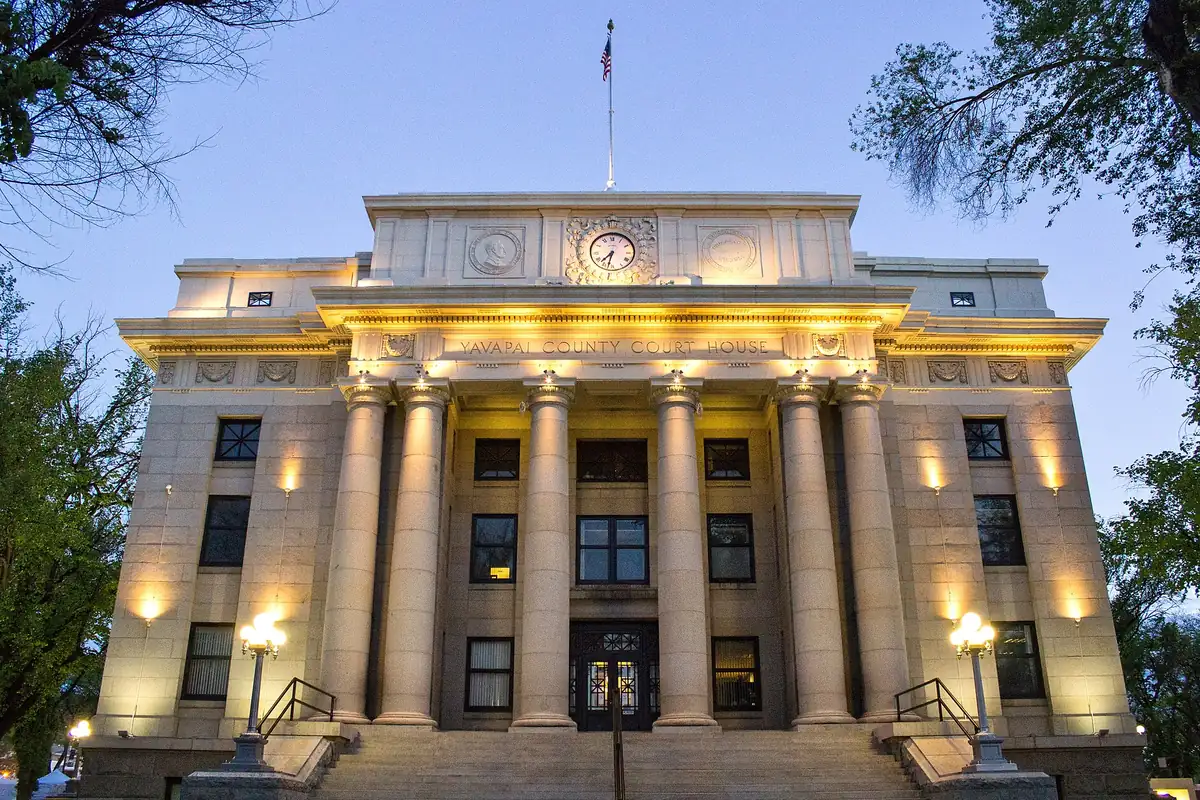
For a while, anyway. The city’s guide says the capital moved to Tucson in 1867, came back to Prescott at the end of 1877, and left for good for Phoenix in 1889. Prescott had also been made the seat of Yavapai County, one of the four original territorial counties, which also takes in the copper town of Jerome.
One line in 1905
The name itself never got complicated. By 1905, when Henry Gannett was writing up the origins of the country’s place names for the Geological Survey, Prescott needed only a few words. The Arizona town was “named for W. H. Prescott, the historian.” He listed three other Prescotts right below it, in Kansas, Massachusetts and Wisconsin, and each one honored somebody else.
That’s worth knowing if you’ve ever wondered whether the Arizona city honors a Bunker Hill colonel or a railroad man. The Massachusetts town, by Gannett’s account, was named for Col. William Prescott of Bunker Hill. Arizona’s Prescott went with the writer.
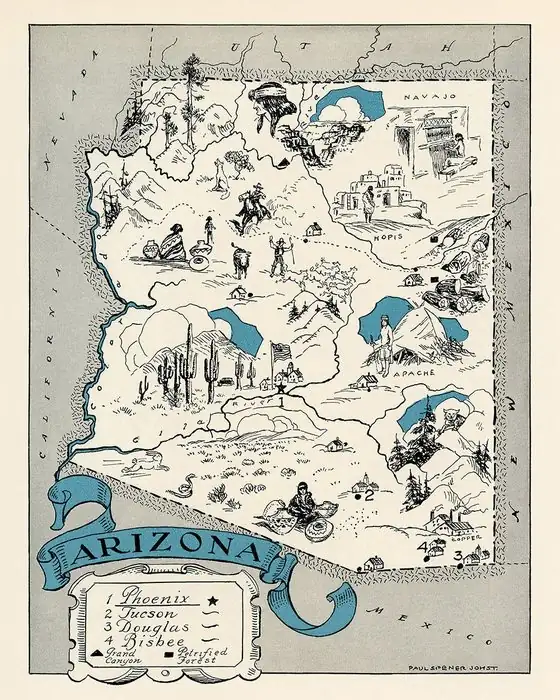
There’s more on the territory’s other towns on our Arizona page.
Quick answers
Who is Prescott, Arizona, named after?
William Hickling Prescott, the historian who wrote The History of the Conquest of Mexico. Farish, the city and Gannett all agree on the historian.
Who named Prescott?
Citizens around Granite Creek adopted the name by resolution on May 30, 1864, Farish writes. On another page he credits Secretary McCormick with giving the name.
What other names were considered for Prescott?
The city’s historic-district guide lists “Audubon,” “Goodwin City” and “Aztlan.” In October 1864 a legislative amendment to put the capital at a new town called Aztlan failed, 7 to 10.
Was Prescott the capital of Arizona?
Yes. It was founded as the territorial capital in 1864. The capital went to Tucson in 1867, returned at the end of 1877 and moved to Phoenix in 1889.
Key dates
- 1863December 21: Fort Whipple is set up in Chino Valley, Fred G. Hughes recalled.
- 1864May 30: Citizens around Granite Creek agree on the town's boundaries and adopt the name Prescott by resolution.
- 1864October: The first territorial legislature votes down amendments to put the capital at La Paz, Walnut Grove or a new town called Aztlan.
- 1867The capital moves to Tucson.
- 1877The capital returns to Prescott at the end of the year.
- 1889The capital moves permanently to Phoenix.
Things to do in Prescott, Arizona
Sharlot Hall Museum
A four-acre history museum campus with 11 exhibit buildings, eight of them historic, including Fort Misery, thought to be the oldest surviving log cabin in Arizona, and a rose garden honoring Arizona's pioneer women.
Phippen Museum
A museum of Western art and heritage in Prescott's Granite Dells, founded in 1974 and named for the artist George Phippen, a founding member of the Cowboy Artists of America.
Thumb Butte
A landmark just west of town in the Prescott National Forest. Trail 33 climbs about 600 feet (183 m) in a little more than a mile (1.6 km), with benches and signs about the plants along the way.
Watson Lake
A lake about 4 miles (6 km) from downtown Prescott, amid Watson Woods and the Granite Dells, used for fishing, boating, kayaking, hiking, rock climbing, camping and picnics.
Getting there
Open Prescott in Google Maps
Opens in a new tab. The pin is the center of Prescott in the USGS place-name record.
The closest airports, Amtrak stations and intercity bus stops, measured in a straight line from the center of Prescott.
Airports
- Prescott Regional/Ernest A Love Field (PRC) 8 mi 14 km
- Flagstaff Pulliam (FLG) - Flagstaff 61 mi 99 km
- Phoenix Sky Harbor International (PHX) 81 mi 130 km
Amtrak trains
- Flagstaff station (FLG) 65 mi 105 km
Intercity buses
- Greyhound Camp Verde McDonald's 33 mi 54 km
- Route 66 Express Amtrak Connecting Service · Williams 51 mi 83 km
Distances are as the crow flies, not by road. We don't list schedules or fares because they change; check with the airline, Amtrak or the bus company before you go. Official data (FAA commercial service airports (2025), FAA airport locations, Amtrak stations and Intercity Bus Atlas) from the FAA and the U.S. Bureau of Transportation Statistics, checked Nov 14, 2026.
Sponsored
Staying in Prescott?
Compare hotels in Prescott, Arizona, on Expedia.
See hotels in PrescottWe may earn a commission if you buy through this link. It never changes what we write. Read our affiliate disclosure
Historical Sources & References
- Thomas Edwin Farish, History of Arizona, vol. 3 (1916), pp. 206-207. The May 30, 1864, meeting at Yeserea’s store; “the name of Prescott adopted by resolution in honor of the historian”; Groom, Van C. Smith and the frying pan; 232 lots sold by July 4. Page 207 is here, after a portrait plate.
- Thomas Edwin Farish, History of Arizona, vol. 3 (1916), p. 189. Why the capital went to the placer country, and “The name was given in honor of the great American historian, by Secretary McCormick.”
- Thomas Edwin Farish, History of Arizona, vol. 3 (1916), pp. 31-32. Fred G. Hughes’s account: Fort Whipple set up in Chino Valley on December 21, 1863; the miners’ camp “Goodwin”; the site chosen in April 1864 and “afterwards named Prescott”; Camp Clark. On p. 212: “Goodwin City, afterward called Gimletville.”
- Thomas Edwin Farish, History of Arizona, vol. 3 (1916), pp. 118-119. The October 1864 House votes on La Paz, Walnut Grove and “Aztlan,” and the bill’s wording placing Prescott on Granite Creek near Fort Whipple.
- City of Prescott, A Property Owner’s Guide to Prescott Historic Districts. The proposed names Audubon, Goodwin City and Aztlan; William Hickling Prescott and his history of Mexico; the Arizona Miner quotation; the capital’s moves in 1867, 1877 and 1889; Yavapai County as one of four original counties.
- Henry Gannett, The Origin of Certain Place Names in the United States, 2nd ed. (1905), p. 253. Prescott, Arizona, “named for W. H. Prescott, the historian,” next to the Prescotts of Kansas, Massachusetts and Wisconsin.
- GNIS feature 33189 (U.S. Geological Survey). The city’s entry in the nation’s official place-name system, in Yavapai County.
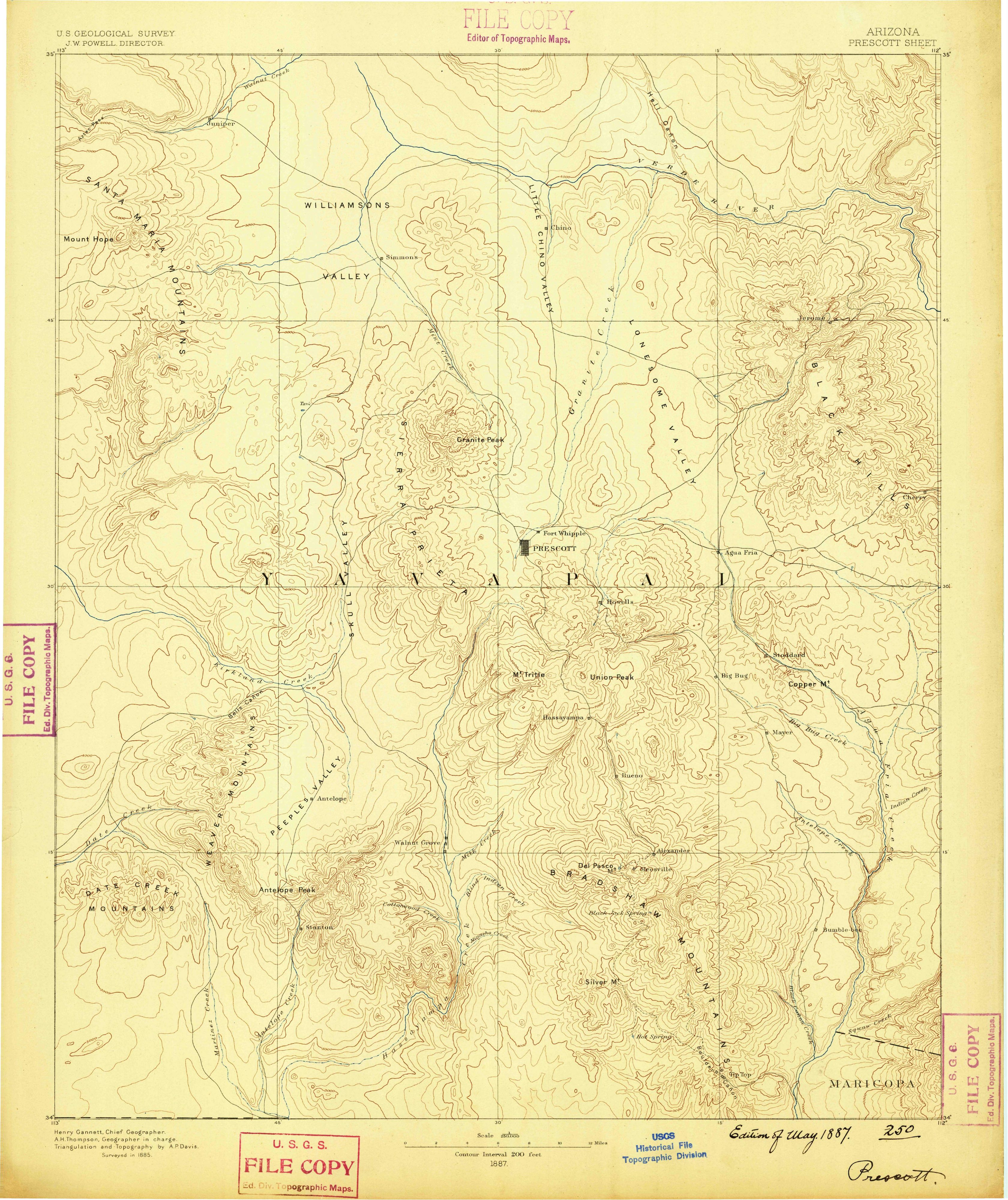
- U.S. Geological Survey, Prescott sheet (1887). The 1:250,000 sheet, surveyed in 1885, that the map at the top of this page was cropped from.
Sponsored
Put this 1887 map on your wall
The 1887 USGS Prescott sheet is in the public domain. Download the full-size scan for free, then have it printed on canvas with CanvasOnTheCheap.
Print a map on canvasDownload the full-size mapWe may earn a commission if you buy through this link. It never changes what we write. Read our affiliate disclosure
Spot something wrong, or know more? Tell us here. You can also email us or use our contact page. Corrections are noted here with their date, never made silently.