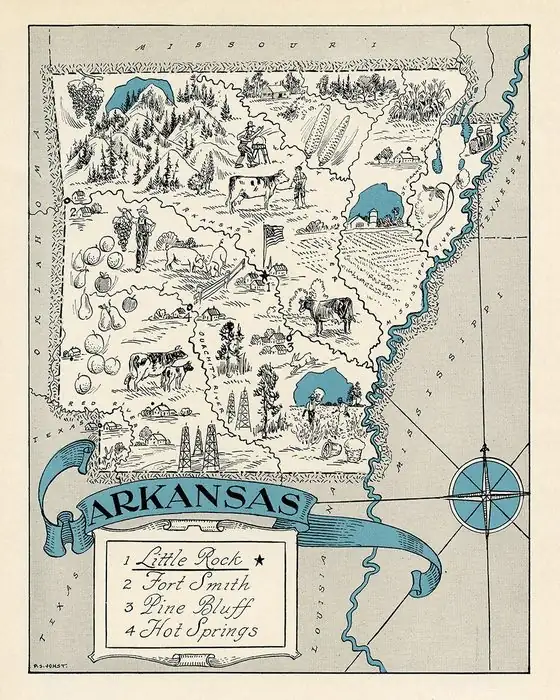
Eureka Springs, Arkansas: A Town Named "I Have Found It"
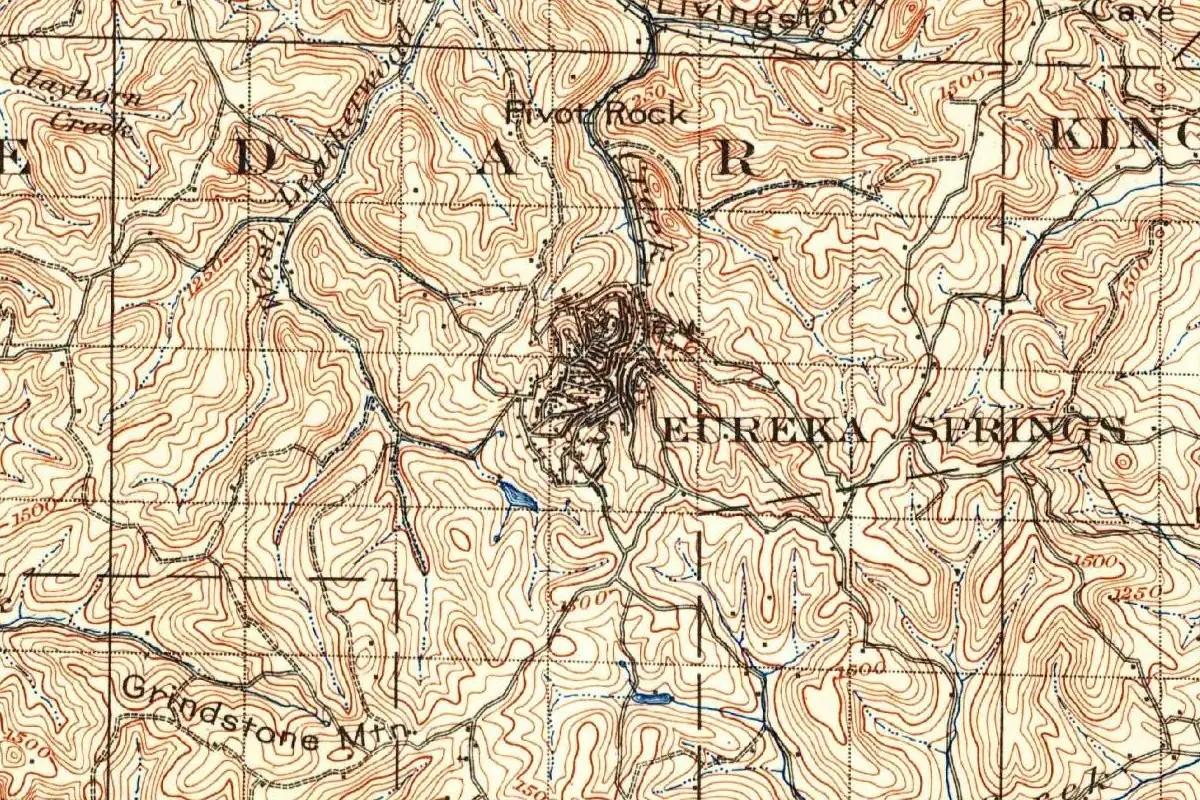
Eureka Springs, Arkansas, got its name on July 4, 1879, when campers at a healing spring settled on Eureka, the Greek word for “I have found it.” What they’d found was water. A crowd of sick people had come up into the hills of Carroll County, about 9 miles (14 km) south of the Missouri line, to drink from a spring that ran into a basin in the rock. Who came up with the word is still argued over: an 1881 book credits a Mr. McCoy, and a plaque copied in 1954 credits the judge’s teenage son.
A basin in the limestone
The spring that started it all is the Basin Spring. An 1889 county history says it was “so called from a circular depression eighteen inches in diameter and a foot deep in the solid limestone rock,” where water from the cliff above collected. By 1889 that basin had been destroyed in improving the street, the same book adds, but the spring kept its name. Not everyone agreed it was gone: a plaque copied in 1954 says the original basin lies right beneath it.
The story of who found the water first comes in several versions, and they don’t agree on the year. All of them involve Dr. Alvah Jackson and a son with sore eyes. In the 1889 history, the doctor was camping with his sons in the summer of 1858 and told the boy to bathe his eyes in the spring, and within a few days they were better. An 1881 book about the springs puts the hunting trip in 1856 and has Jackson’s dogs chasing a panther into a cave nearby. Either way, “Dr. Jackson’s eye-water” got around.
The man who turned a spring into a town was Judge Sanders, of the county court. In May 1879, Jackson talked him into trying the water for his erysipelas, and in ten weeks, the county history says, he was cured. Word spread, and the sick started coming in wagons. “It is to this remarkable cure that the existence of the city is directly traceable,” the 1889 book says.
Jackson Spring, Sanders’ Spring or Eureka
By the summer of 1879 there was a camp of invalids around the spring, and it needed a name. L. J. Kalklosch, who published The Healing Fountain in 1881, wrote down three choices:
“…some suggested that it be named Jackson Spring; others that it be named Sanders’ Spring; but a Mr. McCoy, who had no doubt read of the discovery of Archimedes, said to name it Eureka—‘I have found it.’”
The crowd went with McCoy’s word. Kalklosch says the place “was christened ‘Eureka Springs,’ on July 4th, 1879.” That’s the old story of Archimedes, who’s said to have shouted “Eureka” when the answer to a problem hit him. A spring that people thought could cure them made a fitting match.
A guidebook from 1884 by Charles Cutter tells the same day from the campers’ side. Only one house had gone up, and most people thought a town there was a fantasy, but “the national holiday was celebrated by naming the spring, which has since been known as Eureka.” Notice that Cutter says they named the spring. The town grew around it and took the name with it.
The other name on the plaque
You’ll also hear that a teenager picked the name. Otto Ernest Rayburn copied a plaque at Basin Spring in his 1954 book The Eureka Springs Story. It said that Dr. Jackson and about twenty-five families met there on July 4, 1879, “and adopted the name suggested by C. Burton Saunders, Eureka Springs.” Burton was the judge’s son, about fifteen at the time. Rayburn printed both stories, McCoy’s and Burton’s, and called it “still a matter of dispute.” McCoy’s version has the older paper behind it: Kalklosch printed it in 1881, two years after the naming, and nobody says when the plaque went up. But he gives McCoy no first name, so there’s not much to check either way. (The early books spell the family name Sanders; Rayburn spells it Saunders.)
From camp to city in a year
Things moved fast after the Fourth. The 1889 history says Judge Sanders built the first house on July 4, 1879, a pole cabin with a roof of rough boards. By August 10 there were about 180 people and fifteen houses, and a week later about 300. On February 14, 1880, the county court approved the petition that made Eureka Springs an incorporated town, and the federal census that year counted 3,984 people.
The springs kept names of their own. By 1889 the county history counted forty-two inside the city limits, among them the Sweet Spring, named for the taste of its water, the Magnetic Spring, the Dairy Spring, and the Crescent Spring on Spring Street. The Crescent Hotel opened to the public on May 10, 1886, five stories of white stone from quarries on the White River, with 400 guests at its formal opening. The 1889 book describes the hotel and the spring in different paragraphs and never says whether one was named for the other, so we won’t either.
If you came to town for a ghost tour, you’ll find Eureka Springs on our list of ghost tour towns. We leave the ghosts to the guides. The name, though, is on paper: a crowd at a spring on the Fourth of July, deciding they’d found what they were looking for.
Quick answers
What does Eureka mean in Eureka Springs?
“I have found it.” It’s a Greek expression, and Kalklosch tied the choice to Archimedes in 1881. What the campers believed they’d found was a healing spring.
Who named Eureka Springs?
Sources don’t agree. An 1881 book credits “a Mr. McCoy,” while a plaque at Basin Spring, copied in a 1954 book, credits C. Burton Saunders, the judge’s son.
When did Eureka Springs get its name?
On July 4, 1879. An 1884 guidebook says the campers marked the holiday by naming the spring Eureka.
Why is it called Basin Spring?
For a round hollow in the limestone, about 18 inches (46 cm) across and a foot (30 cm) deep, that caught the water. The 1889 county history says street work destroyed it, but a plaque copied in 1954 says the original basin is still there.
Key dates
- 1879May: Judge Sanders, of the county court, starts taking the waters at the spring, with Dr. Alvah Jackson as his guide.
- 1879July 4: the campers name the place Eureka Springs, and Judge Sanders builds the first house.
- 1879August 10: about 180 people and fifteen houses.
- 1880February 14: the county court approves the petition that makes Eureka Springs an incorporated town.
- 1886May 10: the Crescent Hotel opens to the public.
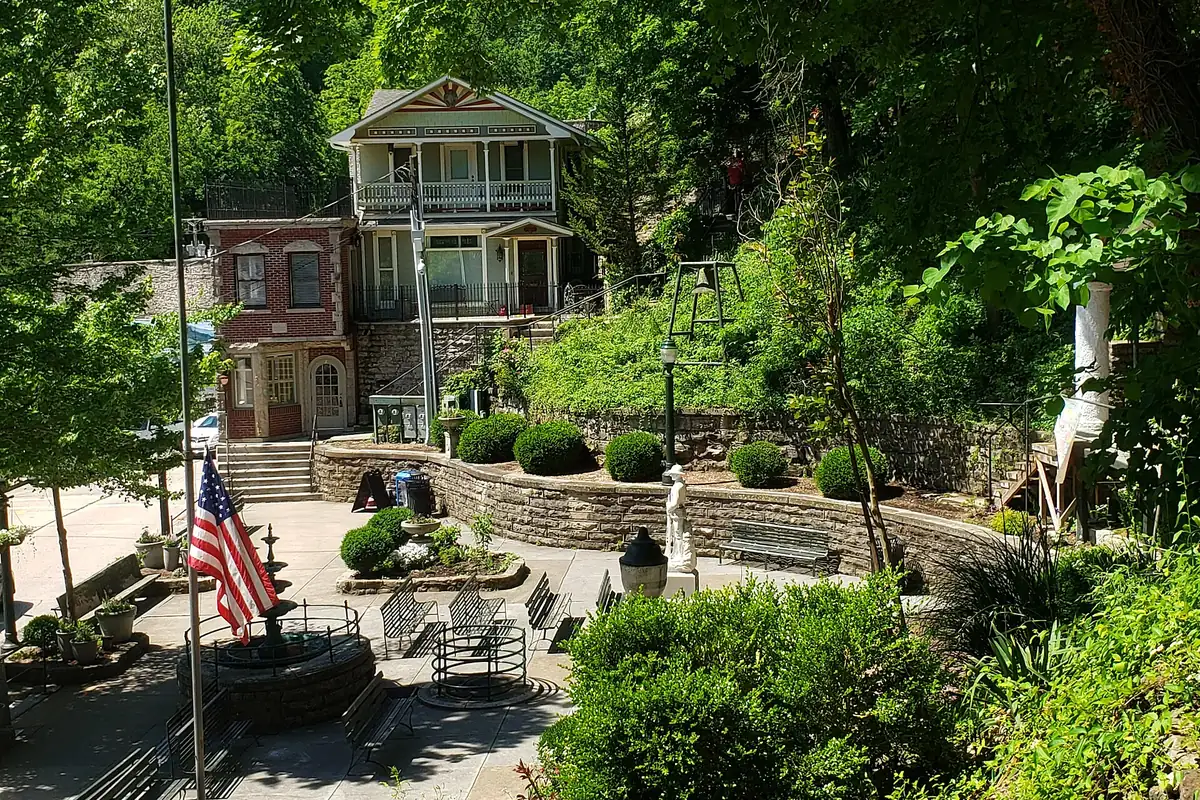
Getting there
Open Eureka Springs in Google Maps
Opens in a new tab. The pin is the center of Eureka Springs in the USGS place-name record.
The closest airports, Amtrak stations and intercity bus stops, measured in a straight line from the center of Eureka Springs.
Airports
- Northwest Arkansas Ntl (XNA) Bentonville 33 mi 53 km
- Springfield-Branson Ntl (SGF) 61 mi 99 km
Intercity buses
- Jefferson Lines Branson / Hollister 34 mi 55 km
Distances are as the crow flies, not by road. We don't list schedules or fares because they change; check with the airline, Amtrak or the bus company before you go. Official data (FAA commercial service airports (2025), FAA airport locations, Amtrak stations and Intercity Bus Atlas) from the FAA and the U.S. Bureau of Transportation Statistics, checked Nov 10, 2026.
Sponsored
Staying in Eureka Springs?
Compare hotels in Eureka Springs, Arkansas, on Expedia.
See hotels in Eureka SpringsWe may earn a commission if you buy through this link. It never changes what we write. Read our affiliate disclosure
Sponsored
Want the spooky side of Eureka Springs?
The name has its story above. For the ghost stories, US Ghost Adventures runs walking ghost tours in Eureka Springs.
See ghost tours in Eureka SpringsWe may earn a commission if you book through this link. It never changes what we write. Read our affiliate disclosure
Historical Sources & References
- L. J. Kalklosch, The Healing Fountain (1881), pp. 5-7. The three names suggested for the spring, Mr. McCoy’s “Eureka” and the christening on July 4, 1879; also Dr. Jackson’s hunting trip of 1856.
- Charles Cutter, Cutter’s Guide to the Eureka Springs of Arkansas (1884), p. 8. The camp on July 4, 1879, the single house and the naming of the spring as Eureka (“I have found it”).
- History of Benton, Washington, Carroll, Madison, Crawford, Franklin, and Sebastian Counties, Arkansas (Goodspeed, 1889), pp. 367-375 and 384. The basin in the rock, Dr. Jackson in 1858, Judge Sanders’s cure in 1879, the first house, the growth of 1879, incorporation in 1880, the 1880 census, the springs and the Crescent Hotel of 1886.
- Otto Ernest Rayburn, The Eureka Springs Story (1954). The plaque at Basin Spring that credits C. Burton Saunders, and the author’s note that who named the town is still disputed.
- Henry Gannett, The Origin of Certain Place Names in the United States, 2nd ed. (1905), p. 122. Eureka as a Greek expression meaning “I have found it,” in the entry for other towns of that name.
- GNIS feature 48926 (U.S. Geological Survey). Where Eureka Springs sits in the Interior Department’s gazetteer: its name, Carroll County and map coordinates.
Spot something wrong, or know more? Tell us here. You can also email us or use our contact page. Corrections are noted here with their date, never made silently.