French Quarter: Name, History and Historic Sites
The French Quarter is the grid a French engineer laid out for New Orleans in 1722, yet most of its buildings date from after the U.S. bought Louisiana. So “French” describes the street plan and the people who started the town. It doesn’t describe the houses.
French Quarter Origin
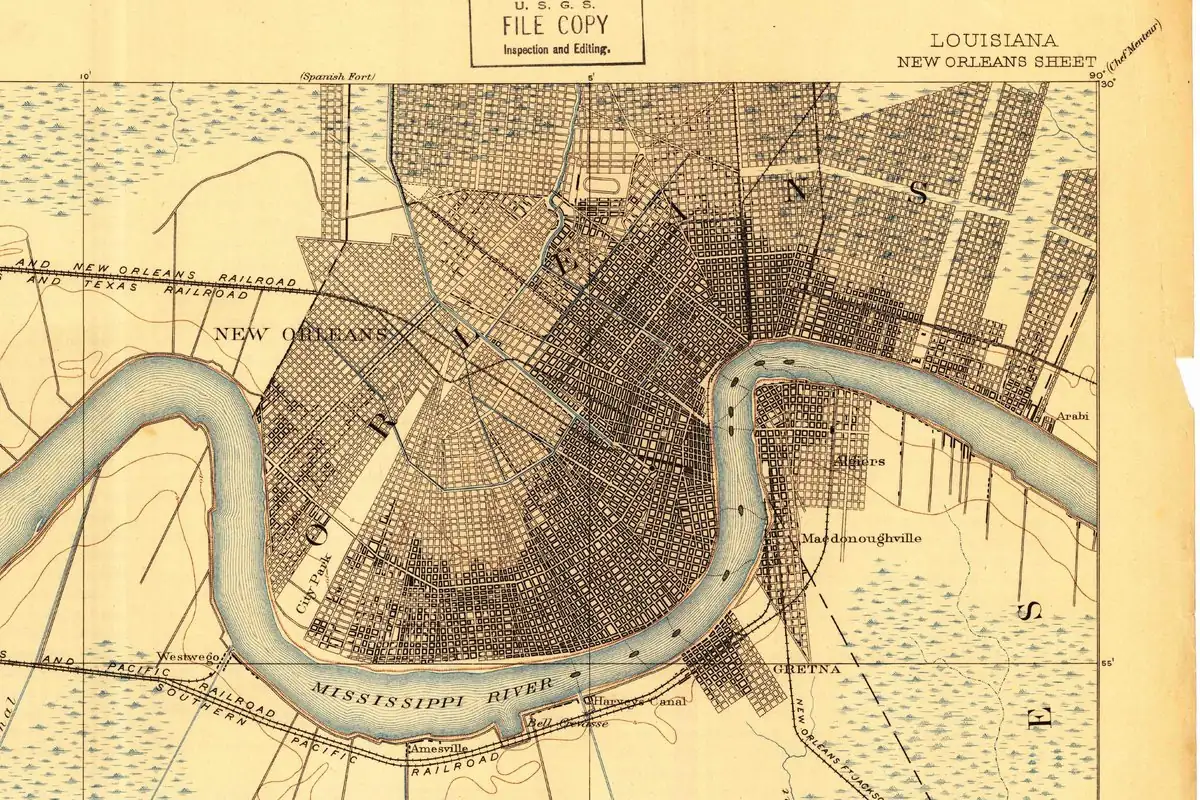
France claimed the Mississippi and everything it drained after La Salle’s trip down the river in 1682, the National Park Service says, and named the territory Louisiana for Louis XIV. In 1718 the French chose a bend in the river for their new town. The town’s own name honored France’s regent, the Duke of Orléans, as our New Orleans page explains. Four years later, the Park Service says, the military engineer Adrien de Pauger set out the streets as a grid, and that grid is the district that now goes by two names, Vieux Carré and French Quarter.
The two names mean different things. Vieux Carré is French for “old square,” and the Park Service, which spells out the sound as “view-ka-ray,” calls it the original city as the French military laid it out. French Quarter is English, and in the old guidebooks it works as a contrast. The Picayune’s Guide to New Orleans of 1904 told tourists that the city was really “two cities”: the part below Canal Street, “called the ‘French Quarter,’ or ‘down-town section,’” and the part above, “called the ‘American Quarter,’ or ‘up-town section.’” In that guide the Vieux Carré is only the oldest slice of the French Quarter, the part Bienville laid out when he founded the city.
Neither name replaced the other. An 1885 guidebook published by Will H. Coleman already puts them side by side, calling the area “le vieux carre, or the old French quarter,” and our New Orleans street names guide quotes that line too. The city’s preservation office still uses both. Its page on the Vieux Carré Commission says the 1921 amendment to the state constitution dealt with the old buildings of “New Orleans’ Vieux Carré, the so-called ‘French Quarter.’” We haven’t found when the English name first appeared in print.
French Quarter History
The town grew slowly under France. The Park Service says settlers were recruited from France, enslaved Africans were brought in early and a group of German settlers came too. Another Park Service page, from New Orleans Jazz National Historical Park, says enslaved West Africans made up 30% of the town’s people as early as 1721.
Then the flag changed. The Seven Years’ War ended French rule: in 1762, the Park Service says, the city passed to Spain, and it grew richer under Spanish rule. Two great fires, in 1788 and 1794, burned through the town. Here the sources weigh things differently. The Park Service says the rebuilding showed “some Spanish influence” but that French culture stayed strong because few Spaniards moved in. The Society of American Archivists’ guide to the city, written for its 2013 meeting in New Orleans, goes further: the new buildings, it says, had arches, plastered brick walls, roofs of slate or tile, inner courtyards and iron worked by hand, which gave the city “a distinctive Spanish appearance.”
Coleman’s 1885 guidebook saw it that way too. It says the street names keep the memory of French rule, but that Spain’s rule shows “even more distinctly” in the stucco walls, iron lattices, arches and balconies. It also says that after the fires Governor Carondelet paid a premium for tile roofs in place of shingles.
Most of what you see is newer still. France took Louisiana back in 1800, and three years later sold it to the United States. The archivists’ guide says the great bulk of the Quarter’s buildings went up after that sale, and the cast iron that gives so many balconies their lacy look didn’t arrive until the 1830s. The one French colonial building left, it says, is the old Ursuline Convent, finished in 1752-1753.
The Americans brought their own houses. The Park Service quotes the architect Benjamin Henry Latrobe, who came to the city in 1819 and complained that newcomers had “begun to introduce the lop-sided London house.” It explains that the tight blocks and deep, narrow lots already in place kept American builders close to the street, so the Quarter kept its Creole look. Meanwhile, the jazz park’s page says, many English-speaking newcomers built upriver of Canal Street, away from the Creole downtown. That’s the same split the 1904 guide described as the French and American quarters.
By 1900 the Quarter was run-down, and many people thought of it as a slum, according to the archivists’ guide. Saving it took several tries. The city’s Vieux Carré Commission page says New Orleans passed the country’s first ordinance creating a historic district, though it didn’t produce a working commission. A 1925 commission was only advisory and faltered. Then a 1936 law, Act 139, changed the state constitution so the city council could create the commission and set its powers. In 1941, the page says, the Louisiana Supreme Court described the goal as preserving “the whole French and Spanish quarter.”
French Quarter Historical Sites in New Orleans
The Quarter is much more than Bourbon Street. The Park Service counts about 120 blocks, with Canal Street and Esplanade Avenue at the two ends, Rampart Street at the back and the river in front. The city’s commission page gives Iberville Street, not Canal, as the upriver edge of its district.
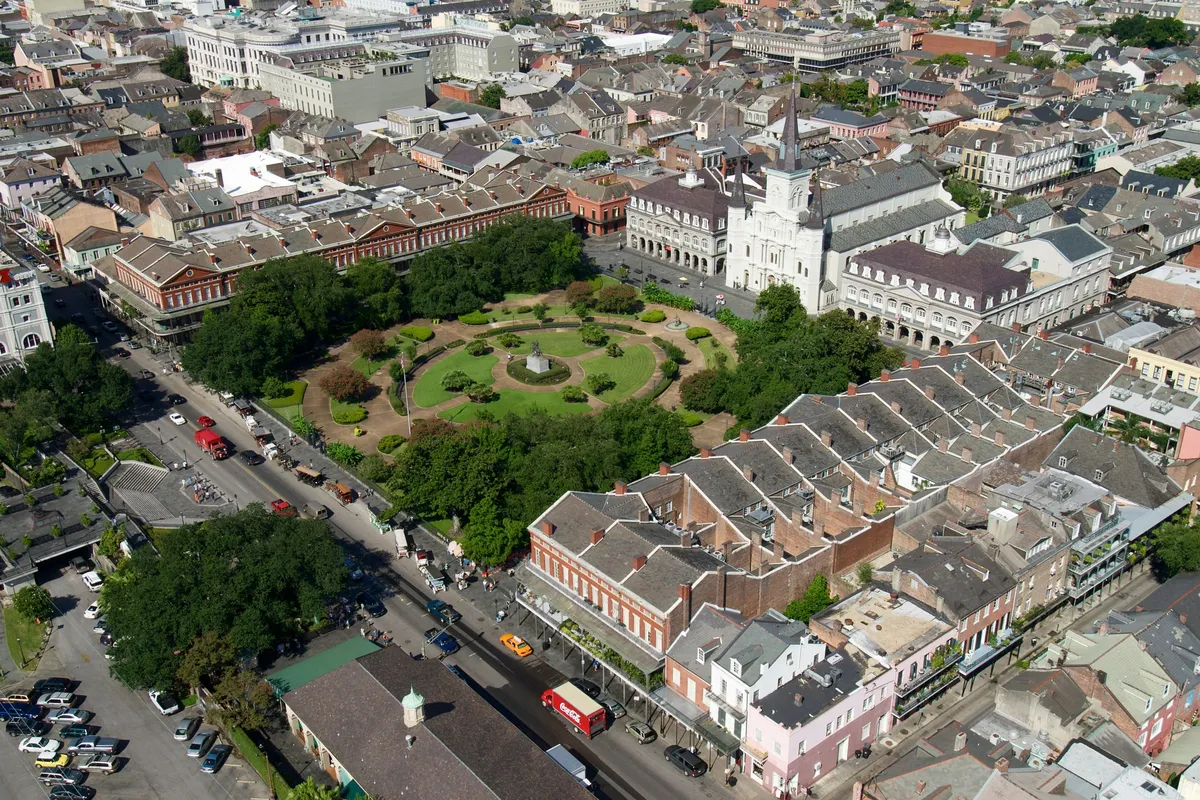
Jackson Square, in the photo at the top, is the old Place d’Armes. Our street names guide cites a city council decision of January 25, 1851, for the change, and notes that another history says 1850. The Ursuline Convent, the archivists’ guide says, has served as a convent, a bishop’s residence, a school, a meeting place for the state legislature and an archive, and it’s a museum now.
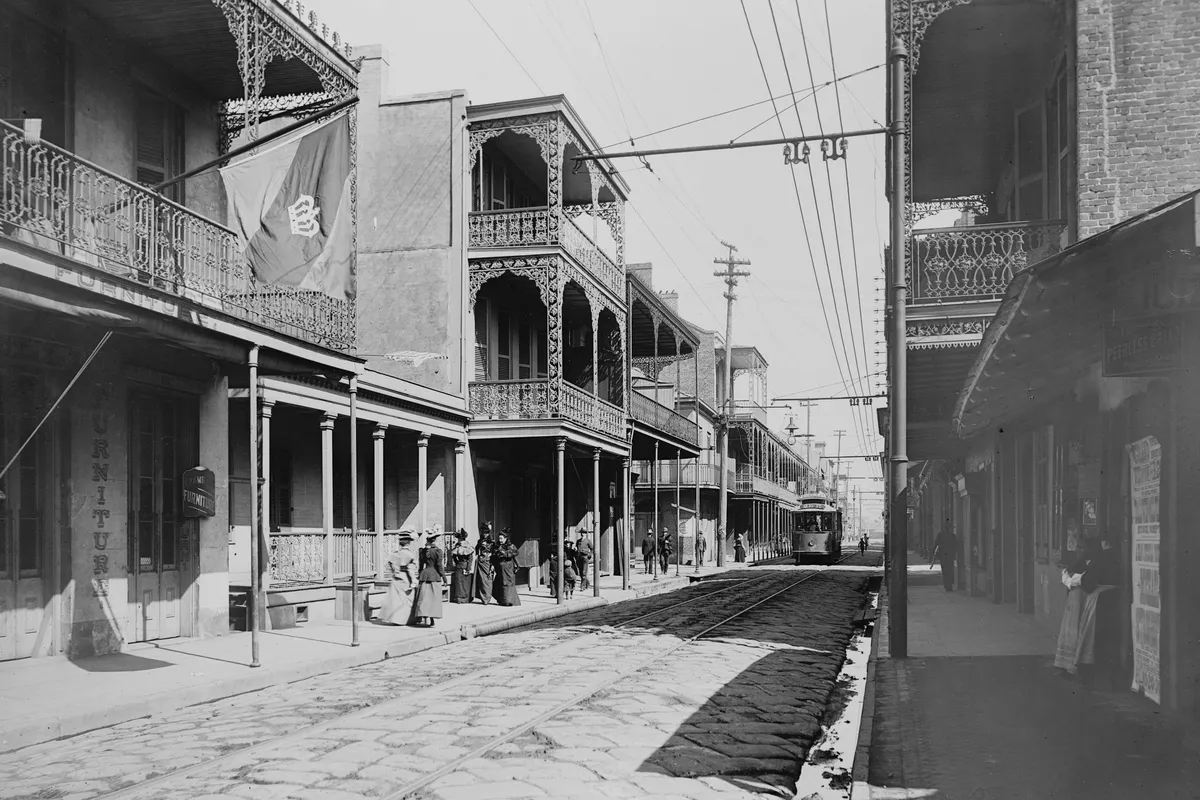
Royal Street, in the old photo at the bottom of this page, shows the kind of lacy ironwork balconies that, by the archivists’ account, mostly came after the 1830s. Walk a few blocks and you’ll cross streets named for French royals and saints. Toulouse, Chartres and Conti are among them, and the guide traces each one.
The Park Service’s lesson also points to two kinds of houses worth spotting. One is the Creole townhouse, the most common type after the fires, with iron balconies and a narrow passage to a back courtyard. The other is the porte-cochère townhouse, whose name means “coach door,” with a carriageway to the courtyard and a shop on the ground floor.
Quick answers
Why Is the French Quarter Called French?
Because it’s the town the French founded and laid out, starting in 1718. Guidebooks such as the 1904 Picayune guide used the name to tell it apart from the “American Quarter” above Canal Street.
What Does Vieux Carré Mean?
“Old square” in French. It’s a second name for the same district, not an older one that was replaced. An 1885 guidebook already used the two together.
Why Does Much of the French Quarter Look Spanish?
Fires in 1788 and 1794 destroyed much of the town while Spain ruled it, and the rebuilding showed Spanish influence. The archivists’ guide adds that most buildings standing today went up after 1803, under American rule.
Is Bourbon Street the Whole French Quarter?
No. Bourbon is one street in a district of about 120 blocks, by the Park Service’s count. Its name, our street names guide says, honors the Duke of Bourbon, one of the French royal princes.
Key dates
- 1718The French pick a bend of the Mississippi for their new city, New Orleans.
- 1722Military engineer Adrien de Pauger lays out the streets in a grid, the core of today's Vieux Carré.
- 1752-1753The Ursuline Convent is finished; it is the only French colonial building left in the Quarter.
- 1762After the Seven Years' War, New Orleans passes to Spain.
- 1788, 1794Two great fires burn much of the city, and it is rebuilt under Spanish rule.
- 1803The Louisiana Purchase makes New Orleans an American city.
- 1885A city guidebook calls the old square "le vieux carre, or the old French quarter."
- 1936Act 139 amends the state constitution so New Orleans can create the Vieux Carré Commission.
Getting there
Open French Quarter in Google Maps
Opens in a new tab. The pin is an approximate point for French Quarter.
The closest airports, Amtrak stations and intercity bus stops, measured in a straight line from the center of French Quarter.
Airports
- Louis Armstrong New Orleans International (MSY) Kenner 12 mi 19 km
- Gulfport-Biloxi International (GPT) 67 mi 108 km
Amtrak trains
- New Orleans station (NOL) 1 mi 2 km
- Slidell station (SDL) 28 mi 45 km
Intercity buses
- FlixBus New Orleans Bus Station 1 mi 2 km
- Greyhound New Orleans International Airport 12 mi 19 km
Distances are as the crow flies, not by road. We don't list schedules or fares because they change; check with the airline, Amtrak or the bus company before you go. Official data (FAA commercial service airports (2025), FAA airport locations, Amtrak stations and Intercity Bus Atlas) from the FAA and the U.S. Bureau of Transportation Statistics, checked Nov 21, 2026.
Sponsored
Planning a visit?
Compare hotels near French Quarter on Expedia.
See hotels nearbyWe may earn a commission if you buy through this link. It never changes what we write. Read our affiliate disclosure
Historical Sources & References
- National Park Service, “Vieux Carré: A Creole Neighborhood in New Orleans”: La Salle in 1682, the founding in 1718, de Pauger’s grid of 1722, the meaning and pronunciation of Vieux Carré, the settlers, Spanish control from 1762, the two fires, 1800 and 1803, Latrobe’s 1819 complaint, the Creole and porte-cochère townhouses, and the district’s size and edges.
- Society of American Archivists, “About New Orleans”: the Ursuline Convent as the only French colonial building, the Spanish look after the fires, most buildings built after 1803, cast iron from the 1830s, and the Quarter as a run-down district by 1900.
- City of New Orleans, Vieux Carré Commission, “About”: the first historic district ordinance, the 1921 amendment and “the so-called ‘French Quarter,’” the 1925 commission, Act 139 of 1936, the 1941 court opinion and the district’s boundaries.
- Historical Sketch Book and Guide to New Orleans (Will H. Coleman, 1885): “le vieux carre, or the old French quarter” and the traces of Spanish rule (p. 2); Carondelet and the tile roofs (p. 10).
- The Picayune’s Guide to New Orleans (1904): the “two cities” and the French and American quarters (p. 9); the Vieux Carré as part of the French Quarter (p. 11); the French Quarter as the downtown section (p. 14).
- National Park Service, “Early History,” New Orleans Jazz National Historical Park: enslaved West Africans as 30% of the town in 1721, and Americans settling upriver of Canal Street after 1803.
- “Royal St., New Orleans, Louisiana,” Library of Congress: the Detroit Publishing Co. photo at the bottom of this page, dated between 1890 and 1901.
- GNIS feature 556332, Vieux Carre: the federal record, which lists the district under its French name, Vieux Carre.
Spot something wrong, or know more? Tell us here. You can also email us or use our contact page. Corrections are noted here with their date, never made silently.