Escondido, California: A Town Named 'Hidden'
Escondido is the Spanish word for hidden. Sources disagree on why it fit. A 1914 book on California place names says the town was said to be named for its location in the valley, Henry Gannett's 1905 federal list says "hidden treasure," and the city adds hidden water. Nobody recorded who chose it.
Hidden from what?
Escondido, California, carries the Spanish word for hidden, and nobody wrote down which hidden thing the people who chose it had in mind. Old sources point to three different answers: the valley tucked in behind its hills, water that was hard to find, and buried treasure.
The word itself isn’t in doubt. The City of Escondido says the name means “hidden” in Spanish, and a 1913 history of San Diego County put it the same way: Escondido, “situated at the base of the mountains in the midst of green, means hidden or concealed.” What you won’t find, in any of the sources below, is the person who first picked it or a note explaining why.
Three stories, one word
Henry Gannett put together a national list of American place names for the U.S. Geological Survey in 1905. His entry for the San Diego County town is two lines long, and it goes straight for the treasure:
“Escondido; city in San Diego County, California. A Spanish word meaning ‘hidden treasure.’”
That’s the oldest explanation we found in print, and it’s also the most colorful one. Gannett doesn’t say where he got it.
Nine years later, Nellie Van de Grift Sanchez wrote a whole book on California’s Spanish and Indian place names. She placed the town about 15 miles (24 km) from the coast, northeast of San Diego, and she leaned toward geography. Escondido, she wrote, “is said to have been so-named on account of its location in the valley.” Then she added a second idea: the Spaniards had called another place Escondido “because of the difficulty they experienced in finding the water for which they were anxiously searching, and it may be that in this case the origin of the name was the same.” Notice the hedges. “Is said to,” “may be.” She wasn’t sure either.
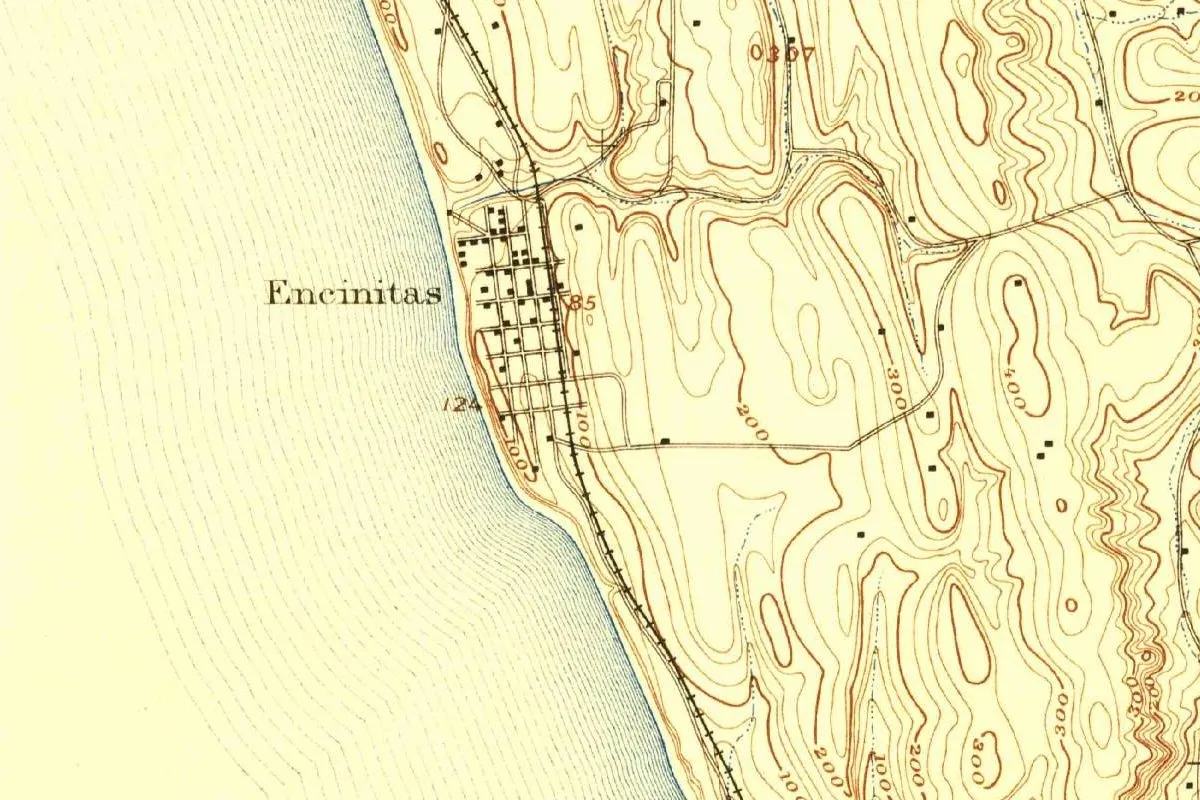
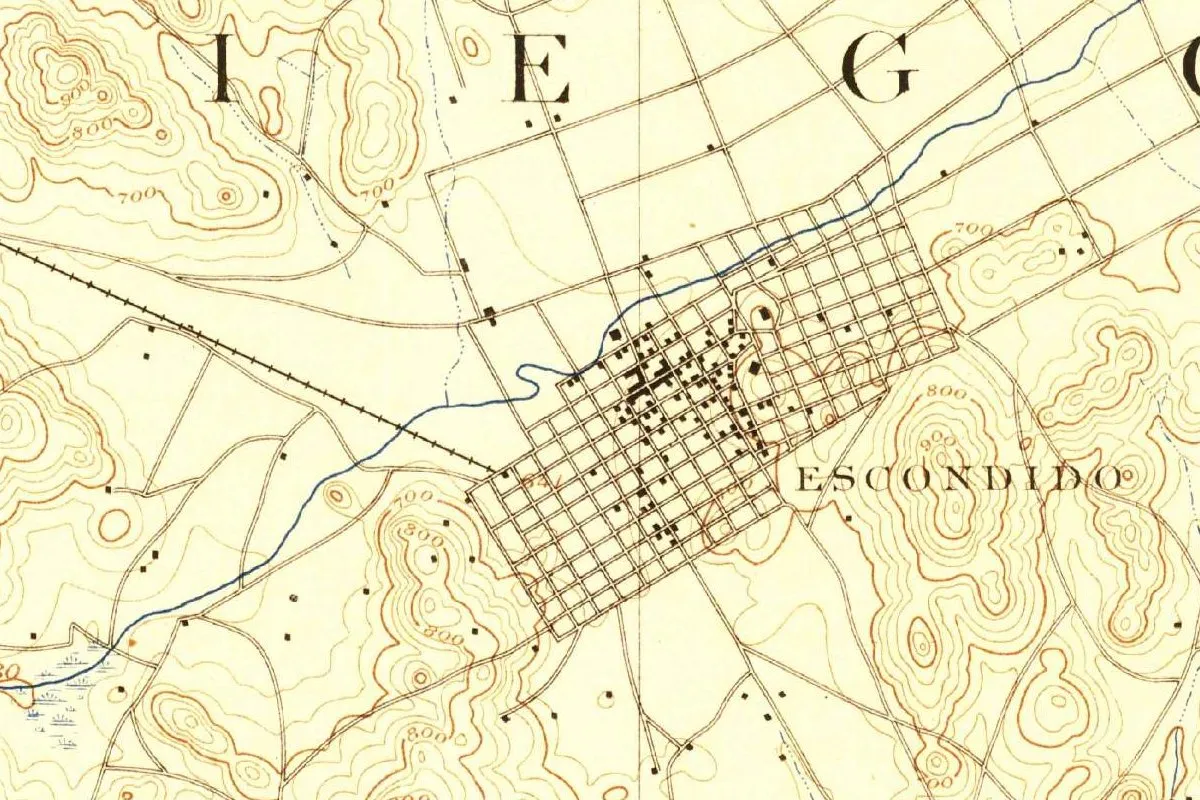
The city’s own budget history, printed for the 2019-20 fiscal year, keeps all three doors open. It says the name “was chosen possibly because the valley is surrounded by foothills or it may refer to hidden water or hidden treasure.” If you look at the old survey map at the top of this page, you can see why the valley version is popular: the town grid sits on flat ground with hills drawn all the way around it. Still, a map that fits a story doesn’t prove the story.
A rancho by that name, before the town
The name is older than the town. Before there was a street grid, the land belonged to a Mexican grant called Rancho Rincón del Diablo, the “devil’s corner.” According to the city, Governor Manuel Micheltorena granted it to Juan Bautista Alvarado in 1843.
By the 1850s, though, the word Escondido was already attached to the property. William E. Smythe’s 1907 History of San Diego says Judge Oliver Witherby, a former customs collector, “purchased the Escondido Rancho” in 1857, farmed it for more than ten years and sold it in 1868. The city’s budget history tells the same chain of owners with one different date: it has Alvarado’s heirs selling to Witherby in 1850. Both agree on the 1868 sale. The city says the Wolfskill brothers of Los Angeles paid $8,000 for it, and for a while the valley was known as Wolfskill Plains.
So Rincón del Diablo was the name of the land grant, not an earlier name of the city. And Escondido was in use for the ranch long before anyone sold town lots.
The post office that was called Apex
Here’s a detail that rarely makes the short versions. When the area got a post office on February 17, 1881, it wasn’t called Escondido at all. Black’s 1913 county history lists it under the heading “Apex, now Escondido,” with Charles A. McDougall as the first postmaster. Thomas W. Adams took over on June 28, 1883, “under whose administration the name of the office was changed from Apex to Escondido.” The book doesn’t say why, and it doesn’t give the exact day of the switch.
Then came the boom. The city says the Escondido Land and Town Company bought the land grant in 1886, laid out the town site and cut the valley into small farms for grapes and citrus. The voters incorporated on October 8, 1888, and elected a council, a clerk, a treasurer and a marshal.
What the name still hides
You’ll see different reasons in different places, and now you know why. Gannett said treasure, Sanchez leaned toward the valley and wondered about water, and the city lists all three. Spanish and Mexican place names are all over California, and plenty of them come with a story attached. Escondido’s has three, and the one thing that stayed hidden is the reason itself.
Quick answers
What does Escondido mean in English?
Hidden. The City of Escondido gives that meaning, and a 1913 history of San Diego County says it “means hidden or concealed.”
Was Escondido named for hidden treasure?
Maybe. Henry Gannett’s 1905 list says the word means “hidden treasure,” but a 1914 book says the town was “said to have been so-named on account of its location in the valley,” and the city also mentions hidden water. None of them says who chose it.
Was Escondido ever called Apex?
Its post office was. It opened as Apex on February 17, 1881, and the name was changed to Escondido while Thomas W. Adams was postmaster, after June 28, 1883.
Is Rincón del Diablo the old name of Escondido?
No. Rancho Rincón del Diablo was the 1843 Mexican land grant the town was later built on, not a former name of the city.
Key dates
- 1843Mexican Governor Manuel Micheltorena grants Rancho Rincón del Diablo, the land under today's Escondido, to Juan Bautista Alvarado.
- 1857Judge Oliver Witherby buys what a 1907 history calls the Escondido Rancho, and farms it for more than ten years.
- 1868Witherby sells the ranch; the city says the Wolfskill brothers paid $8,000 and the valley came to be called Wolfskill Plains.
- 1881February 17: a post office named Apex opens, with Charles A. McDougall as postmaster.
- 1883June 28: Thomas W. Adams takes over the Apex office, and under him its name changes to Escondido.
- 1886The Escondido Land and Town Company buys the land grant, lays out the town site and divides the valley into small farms.
- 1888October 8: Escondido incorporates as a city and elects a council, clerk, treasurer and marshal.
Getting there
Open Escondido in Google Maps
Opens in a new tab. The pin is the center of Escondido in the USGS place-name record.
The closest airports, Amtrak stations and intercity bus stops, measured in a straight line from the center of Escondido.
Airports
- McClellan-Palomar (CRQ) Carlsbad 11 mi 18 km
- San Diego International (SAN) 27 mi 44 km
Amtrak trains
- Solana Beach station (SOL) 14 mi 22 km
- Oceanside station (OSD) 18 mi 28 km
Intercity buses
- Limousine Express Escondido under 1 mi 0.6 km
- Mexicoach Escondido under 1 mi 0.6 km
- Amtrak Chartered Vehicle Amtrak Connecting Service · Solana Beach Amtrak Station 14 mi 22 km
Distances are as the crow flies, not by road. We don't list schedules or fares because they change; check with the airline, Amtrak or the bus company before you go. Official data (FAA commercial service airports (2025), FAA airport locations, Amtrak stations and Intercity Bus Atlas) from the FAA and the U.S. Bureau of Transportation Statistics, checked Nov 13, 2026.
Sponsored
Staying in Escondido?
Compare hotels in Escondido, California, on Expedia.
See hotels in EscondidoWe may earn a commission if you buy through this link. It never changes what we write. Read our affiliate disclosure
Historical Sources & References
- Henry Gannett, The Origin of Certain Place Names in the United States, 2nd ed. (USGS, 1905), p. 121. The entry for Escondido: “A Spanish word meaning ‘hidden treasure.’”
- Nellie Van de Grift Sanchez, Spanish and Indian Place Names of California (1914), pp. 43-44. Escondido “said to have been so-named on account of its location in the valley,” and the other Escondido named for water that was hard to find.
- Samuel F. Black, San Diego County, California, vol. 1 (1913), pp. 246 and 437. The post office “Apex, now Escondido”: opened February 17, 1881, Charles A. McDougall and Thomas W. Adams as postmasters and the change of name (p. 246); Escondido “means hidden or concealed” (p. 437).
- William E. Smythe, History of San Diego, 1542-1908 (1907), p. 293. Judge Oliver Witherby’s purchase of “the Escondido Rancho” in 1857 and its sale in 1868.
- City of Escondido, FY 2019-20 Operating Budget, City Profile & History. Rancho Rincón del Diablo and its 1843 grant, Witherby, the Wolfskill brothers and Wolfskill Plains, the three possible reasons for the name, the Escondido Land and Town Company in 1886 and incorporation on October 8, 1888.
- City of Escondido, “History”. The 1843 grant to Juan Bautista Alvarado, the 1886 town site and the 1888 incorporation.
- City of Escondido, “About Escondido”. Escondido, “meaning hidden in Spanish.”
- GNIS feature 1652706 (U.S. Geological Survey). Confirms Escondido is filed under San Diego County.
- U.S. Geological Survey, Escondido sheet (1893). The source of the map at the top of this page.
Spot something wrong, or know more? Tell us here. You can also email us or use our contact page. Corrections are noted here with their date, never made silently.