Temecula, California: The Luiseño Name Voters Kept
Temecula comes from Temeku, the name of a Luiseño village in the valley; the City of Temecula spells it Teméeku. What the word means isn't settled: a 1916 study said "meaning unknown" while noting that teme-t means sun, and the city translates it as "sun place." In 1989 voters chose Temecula over Rancho California.
A village name older than the city
Temecula, California, could have been Rancho California, but in 1989 voters picked a name that goes back to Temeku, a Luiseño village. The word belonged to the valley long before there was a city, a ranch or a subdivision to put it on.
The City of Temecula explains that the people from here to the coast who shared one language and culture became known as Luiseños, because many of their villages were under the influence of Mission San Luis Rey. The city says the Temecula people’s ancestors were in the valley as early as 900 A.D., and it tells the start of Luiseño history this way: everything began at ’Éxva Teméeku. The city gives ’Éxva as “place of sand” and Teméeku (Teh-MEH-koo) as “sun place,” and says the name Temecula was derived from it.
What scholars wrote down in 1916
A. L. Kroeber put Temecula in a 1916 University of California study of California place names that came from Native languages. His entry is short and careful:
“Temecula, in Riverside County, is Luiseño Temeku, meaning unknown, a village of this Shoshonean division. … Teme-t is ‘sun’ in Luiseño.”
So the link between the town and the village was clear to him. The meaning wasn’t. He didn’t translate Temeku, and he gave the word for sun only as a related fact. The city today goes a step further with “sun place.” You’ll see both, and they don’t fully agree, so neither should be taken as the last word. The city’s history sends readers who want more to the Pechanga Cultural Center.
Two years earlier, Nellie Van de Grift Sanchez’s book on California place names called Temecula “the name of a once important Indian village in the Temecula Valley,” about 35 miles (56 km) south of Riverside. She also recorded what happened to its people. They “were compelled to leave their valley in 1875,” she wrote, and moved to Pechanga Canyon.
Three Temeculas, one name
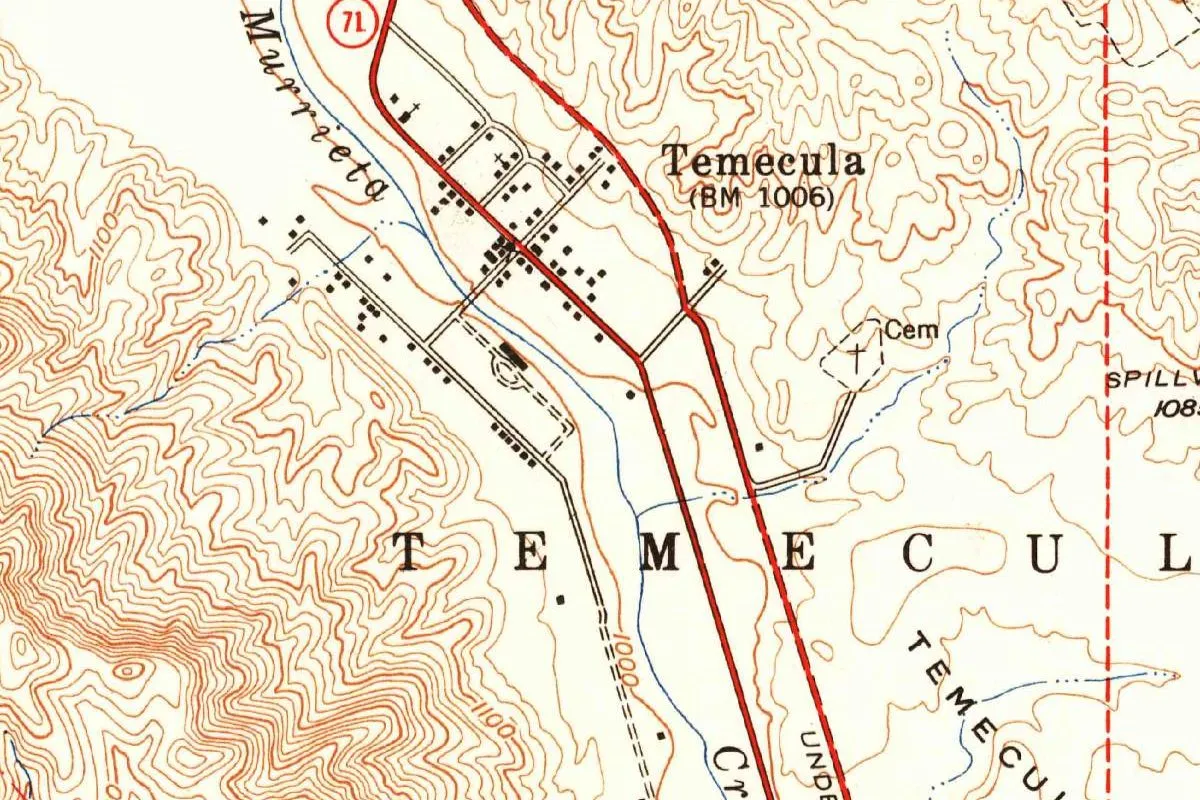
The city’s history leans on an idea from Phil Brigandi’s book Temecula: At the Crossroads of History: there have been several Temeculas, all with the same name. The first was the village where Temecula and Murrieta creeks join to form the Santa Margarita River. The second grew up farther upstream along Temecula Creek. The third is today’s Old Town, which formed around the railroad depot after the line arrived in 1882.
In between came the mail. The Butterfield Overland stage ran through the valley, and a post office opened at John Magee’s adobe. The city counts 1859, the year of that post office, as the year Temecula was established. In 1875 came the eviction Sanchez wrote about: on September 20, the city says, twenty armed men removed the Temecula people from their village under a court order. The Pechanga Reservation was created by executive order on June 27, 1882.
The 1989 vote against Rancho California
For most of the 20th century the valley was cattle country, run as the Vail Ranch. On December 4, 1964, Mahlon Vail sold its 87,500 acres to the Kaiser-Aetna company, which planned a new community and called it Rancho California. By the 1980s, the city says, plenty of newcomers thought of their homes as being in Rancho California, and of Temecula as the old town across the freeway.
When residents moved to incorporate, the name became a fight. The city describes a three-way debate between Temecula, Rancho California and Rancho Temecula, an older name that covered both Temecula and Murrieta. In the special election on November 7, 1989, according to the city’s election history, 87.7 percent of voters said yes to becoming a city. The ballot listed four names: Rancho California, Temecula, Temecula Valley and Rancho Temecula. Temecula got 69.9 percent.
The city’s own summary of why is blunt: voters seemed to realize that Rancho California “was a real estate development term created by a developer,” while Temecula was a town with history. Today, the city’s history page adds, Temecula is “one of the few cities in California to be known by its original, native name.” If you’re in California looking for a city that turned down a developer’s name for a very old one, this is it.
Quick answers
What does Temecula mean?
Nobody agrees on one translation. Kroeber wrote in 1916 that the Luiseño name Temeku had “meaning unknown,” while noting that “teme-t” means sun; the City of Temecula translates Teméeku as “sun place.”
Could Temecula have been named Rancho California?
It was on the ballot. Rancho California, the name Kaiser-Aetna had given its development, was one of four choices on November 7, 1989. Temecula won easily, with 69.9 percent, according to the city.
Is Temecula a Spanish word?
No. It comes from Temeku, the name of a Luiseño village in the valley, according to Kroeber’s 1916 study and the City of Temecula.
Key dates
- 1859A post office opens at John Magee's adobe on the Butterfield stage route; the city counts this as the year Temecula was established.
- 1875September 20: armed men evict the Temecula people from their village; others settle near Pechanga Canyon.
- 1882The railroad reaches Temecula, and businesses move near the depot, the start of today's Old Town.
- 1964December 4: Mahlon Vail sells the Vail Ranch to Kaiser-Aetna, which plans a new community called Rancho California.
- 1989November 7: voters approve cityhood and pick Temecula over Rancho California, Temecula Valley and Rancho Temecula.
Getting there
Open Temecula in Google Maps
Opens in a new tab. The pin is the center of Temecula in the USGS place-name record.
The closest airports, Amtrak stations and intercity bus stops, measured in a straight line from the center of Temecula.
Airports
- McClellan-Palomar (CRQ) Carlsbad 26 mi 42 km
- San Bernardino International (SBD) 42 mi 67 km
- John Wayne/Orange County (SNA) Santa Ana 43 mi 70 km
Amtrak trains
- Oceanside station (OSD) 25 mi 40 km
- San Clemente Pier station (SNP) 28 mi 44 km
Intercity buses
- FlixBus Temecula under 1 mi 0.5 km
- Mexicoach Temecula (Old Town Front St) under 1 mi 0.7 km
- Limousine Express Temecula under 1 mi 0.7 km
Distances are as the crow flies, not by road. We don't list schedules or fares because they change; check with the airline, Amtrak or the bus company before you go. Official data (FAA commercial service airports (2025), FAA airport locations, Amtrak stations and Intercity Bus Atlas) from the FAA and the U.S. Bureau of Transportation Statistics, checked Nov 13, 2026.
Sponsored
Staying in Temecula?
Compare hotels in Temecula, California, on Expedia.
See hotels in TemeculaWe may earn a commission if you buy through this link. It never changes what we write. Read our affiliate disclosure
Sponsored
Want the spooky side of Temecula?
The name has its story above. For the ghost stories, US Ghost Adventures runs walking ghost tours in Temecula.
See ghost tours in TemeculaWe may earn a commission if you book through this link. It never changes what we write. Read our affiliate disclosure
Historical Sources & References
- A. L. Kroeber, California Place Names of Indian Origin (1916), p. 62. “Temecula, in Riverside County, is Luiseño Temeku, meaning unknown,” a Luiseño village, and “Teme-t is ‘sun’ in Luiseño.”
- Nellie Van de Grift Sanchez, Spanish and Indian Place Names of California (1914), p. 47. Temecula as “a once important Indian village in the Temecula Valley,” about 35 miles (56 km) south of Riverside, and the people forced to leave in 1875 for Pechanga Canyon.
- City of Temecula, “Naming”. ’Éxva Teméeku, “place of sand” and “sun place,” the Luiseño name and Mission San Luis Rey, the ancestors in the valley by 900 A.D., and the cityhood debate over Temecula, Rancho California and Rancho Temecula.
- City of Temecula, “Election”. The special election of November 7, 1989: 87.7 percent for incorporation, the four names on the ballot and 69.9 percent for Temecula.
- City of Temecula, “History of Temecula”. The three Temeculas, the 1859 post office at John Magee’s adobe, the eviction of September 20, 1875, the Pechanga Reservation in 1882, the railroad, the 1964 sale of the Vail Ranch to Kaiser-Aetna and Rancho California, the 1989 vote, and Temecula as “one of the few cities in California to be known by its original, native name.”
- GNIS feature 1652799 (U.S. Geological Survey). Feature record for the Riverside County location and the city’s coordinates.
- U.S. Geological Survey, Temecula sheet (1948). The source of the map at the top of this page.
Spot something wrong, or know more? Tell us here. You can also email us or use our contact page. Corrections are noted here with their date, never made silently.