How Laguna Beach, California, Got Its Name (Not Lagona)
Laguna is Spanish for lake or lagoon. The name goes back to mission days, when it was given to the lakes in Laguna Canyon, and the beach settlement at the canyon's mouth borrowed it. Its post office, opened in 1891, was spelled Lagona until postmaster Nick Isch had it corrected to Laguna Beach in 1904.
From 1891 to 1904, the post office at Laguna Beach, California, was spelled Lagona, a slip on the Spanish word for the lakes up Laguna Canyon. The town’s name points inland, to fresh water in the hills, not to the ocean it’s famous for.
A word for lakes
Laguna means “lake or lagoon.” That’s how Nellie Van de Grift Sanchez put it in her 1922 book on California’s Spanish and Indian place names, where she listed a Laguna “in Sonoma and Orange Counties” and added that “there were many lagunas in the state.”
The one in Orange County goes back to the missionaries at San Juan Capistrano. Orange County historian Phil Brigandi counted Laguna among the names they handed down, and he noted that the various “lagunas” now spread across the south county are borrowed from “the original lakes named during the mission days.” Laguna Beach, he wrote, is one of the early American towns whose names were borrowed from earlier ones. So the town’s name is built on top of an older one: a Spanish word for the water, with an English word for the shore added later.
Those lakes sit in Laguna Canyon. The Laguna Beach Historical Society says a Mexican map of 1841 showed them as the only spring-fed lakes in what’s now Orange County. A 2016 landscape survey for the National Park Service adds that an Acjachemen place name, Tom-ok’, “may be a reference to the Laguna lakes.” If that’s right, people had their own name for that water before the Spanish one. Nobody, as far as these sources go, wrote down who first called the lakes lagunas, or when.
The village at the mouth of the canyon
The town grew where the canyon meets the sea. Samuel Armor’s History of Orange County, published in 1921, describes it in one long sentence:
“Laguna Beach, at the mouth of the Laguna Canyon and almost due south of El Toro, has been retarded in its growth by its difficulty of access.”
So the canyon gave the place both its name and its only road in. Armor’s book also profiles William H. Brooks, who it says was the first white man to live at Laguna Beach. By Armor’s account, he came down on a hunting trip in 1875, liked what he saw and took up a government claim on what became the townsite. Brigandi dates Brooks’s settling on the coast to 1876. Later he served as the village’s constable and, for three years, its postmaster.
Just down the coast was a neighboring settlement with a name you can figure out for yourself. Arch Beach, Armor wrote, took its name “from a natural arch formed by the action of the breakers cutting a passage through a large projecting rock.”
How the extra “o” got in
When Laguna got a post office on May 15, 1891, with Brooks in charge, the name on it was Lagona Beach. Brigandi thought “the mistake may have been made in Washington, since the misspelling does not seem to show up locally before then.” The office closed in October 1893. When it reopened on May 26, 1894, it was plain Lagona.
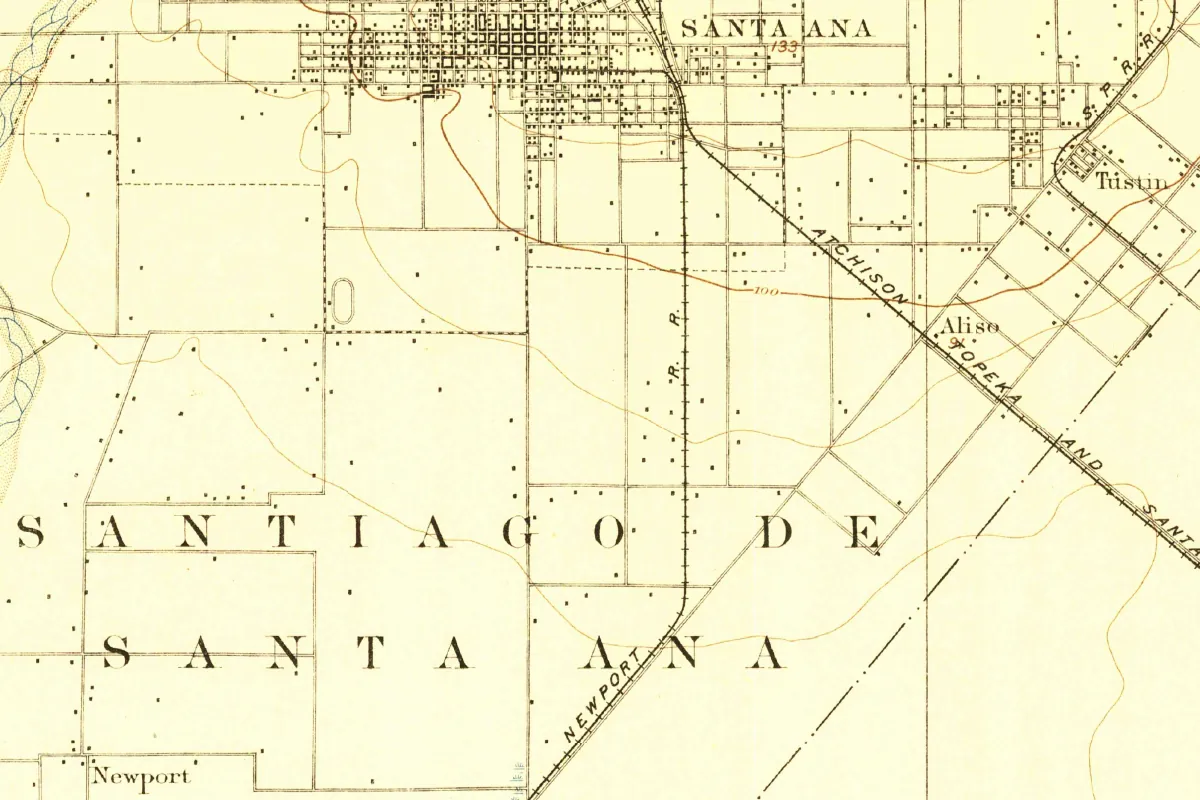
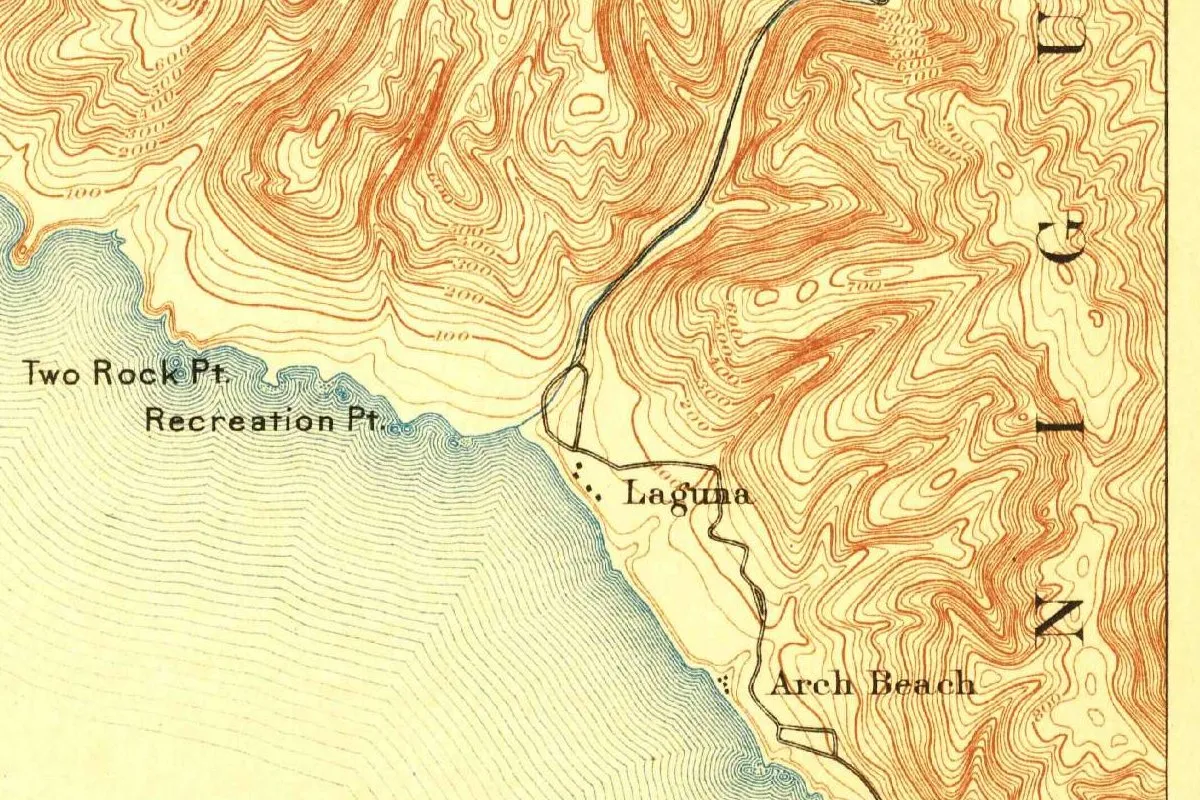
Meanwhile, federal mapmakers had it right. The U.S. Geological Survey’s Santa Ana sheet of 1896 prints the village as Laguna, with Arch Beach just south of it. If you’d mailed a letter there that year, though, you’d have addressed it to Lagona. And for about seven months, from October 1893 to May 1894, you couldn’t have mailed one from the village at all, because it had no post office.
The fix came in 1904. Brigandi credits postmaster John Nicholas “Nick” Isch, who ran the store where the mail was sorted, with taking the steps “to expand and correct the name to Laguna Beach.” The historical society puts it the same way: in 1904 the official name went “from Lagona back to its historic name, Laguna Beach.”
A beach town named for fresh water
Laguna Beach became an incorporated city in 1927, and by then it was known for its coves and its painters, not its lakes. Still, every time you say the name, you’re pointing up Laguna Canyon, toward the lakes. The “Beach” was the 1904 addition. The Laguna part is the old piece, one of the many lagunas that dot the map of California, and the post office spent most of thirteen years spelling it wrong.
Quick answers
What does Laguna mean in Laguna Beach?
Lake or lagoon. Sanchez gave that meaning in 1922, and Brigandi traced the name to lakes named in Laguna Canyon during the mission days.
Why was Laguna Beach once spelled Lagona?
Because its post office was registered that way. It opened as Lagona Beach in 1891 and reopened as Lagona in 1894; Brigandi says the mistake may have been made in Washington.
Who changed Lagona to Laguna Beach?
Postmaster Nick Isch, in 1904, according to Brigandi. The Laguna Beach Historical Society also dates the change to 1904.
When did Laguna Beach become a city?
In 1927, according to the Laguna Beach Historical Society.
Key dates
- 1841A Mexican map shows the lakes in Laguna Canyon, according to the Laguna Beach Historical Society.
- 1875William H. Brooks takes up a government claim on the future townsite, by Armor's account. Brigandi says Brooks settled on the coast in 1876.
- 1891May 15: a post office opens under the name Lagona Beach, with Brooks as postmaster. It closes in October 1893.
- 1894May 26: the post office reopens as Lagona.
- 1896The U.S. Geological Survey's Santa Ana sheet prints the village as Laguna, next to Arch Beach.
- 1904Postmaster Nick Isch gets the post office name corrected and expanded to Laguna Beach.
- 1927Laguna Beach incorporates as a city.
Getting there
Open Laguna Beach in Google Maps
Opens in a new tab. The pin is the center of Laguna Beach in the USGS place-name record.
The closest airports, Amtrak stations and intercity bus stops, measured in a straight line from the center of Laguna Beach.
Airports
- John Wayne/Orange County (SNA) Santa Ana 10 mi 17 km
- Long Beach (Daugherty Field) (LGB) 29 mi 46 km
Amtrak trains
- San Juan Capistrano station (SNC) 7 mi 12 km
- Irvine station (IRV) 8 mi 14 km
Intercity buses
- Amtrak Chartered Vehicle Amtrak Connecting Service · San Juan Capistrano Amtrak Station 7 mi 12 km
- Gold Runner San Juan Capistrano 7 mi 12 km
- FlixBus Irvine West Peltason 8 mi 13 km
Distances are as the crow flies, not by road. We don't list schedules or fares because they change; check with the airline, Amtrak or the bus company before you go. Official data (FAA commercial service airports (2025), FAA airport locations, Amtrak stations and Intercity Bus Atlas) from the FAA and the U.S. Bureau of Transportation Statistics, checked Nov 13, 2026.
Sponsored
Staying in Laguna Beach?
Compare hotels in Laguna Beach, California, on Expedia.
See hotels in Laguna BeachWe may earn a commission if you buy through this link. It never changes what we write. Read our affiliate disclosure
Sponsored
Want the spooky side of Laguna Beach?
The name has its story above. For the ghost stories, US Ghost Adventures runs walking ghost tours in Laguna Beach.
See ghost tours in Laguna BeachWe may earn a commission if you book through this link. It never changes what we write. Read our affiliate disclosure
Historical Sources & References
- Samuel Armor, History of Orange County, California (1921), pp. 83, 85, 251-252. The name Arch Beach from a natural arch cut by the breakers (p. 83); Laguna Beach “at the mouth of the Laguna Canyon” and its “difficulty of access” (p. 85); William H. Brooks, his 1875 claim on the future townsite and his years as constable and postmaster (pp. 251-252).
- Nellie Van de Grift Sanchez, Spanish and Indian Place Names of California (1922), p. 388. Laguna as “lake or lagoon,” with a Laguna listed in Orange County.
- Phil Brigandi, “Laguna Beach Post Office” (OC Historyland). Opening and closing dates of the Lagona Beach and Lagona post offices, Brooks settling on the coast in 1876 and serving as first postmaster, the possible mistake in Washington and Nick Isch’s 1904 correction.
- Phil Brigandi, “Historic Place Names in Orange County” (OC Historyland). Laguna among the names left by the missionaries at San Juan Capistrano, the lakes named in mission days, and Laguna Beach as a name borrowed from an earlier one.
- Laguna Beach Historical Society, Chronology. The 1841 Mexican map showing the Laguna Canyon lakes, the 1904 change from Lagona to Laguna Beach and the 1927 incorporation.
- Historic American Landscapes Survey, Laguna Beach, HALS No. CA-123 (2016). The Acjachemen place name Tom-ok’ and the note that it “may be a reference to the Laguna lakes.”
- GNIS feature 1660874 (U.S. Geological Survey). Entry 1660874 spells the name as two words and files it under Orange County.
- U.S. Geological Survey, Santa Ana sheet (1:62,500), 1896. The 1896 sheet that labels the village Laguna, eight years before the post office dropped Lagona.
Spot something wrong, or know more? Tell us here. You can also email us or use our contact page. Corrections are noted here with their date, never made silently.