Why Is Orange, California, Called Orange? It Was Richland
Orange began as Richland, a townsite laid out around 1871 by Alfred Chapman and Andrew Glassell. When it got a post office in 1873, California already had a Richland, so the town became Orange. Why that word is debated: a campaign for an Orange County, an attractive image for newcomers, or a poker game nobody can confirm.
Orange, California, was laid out around 1871 as Richland, and it took the name Orange only because California already had a town called Richland. Why the founders reached for Orange, of all words, has more than one answer, and the most famous one is probably the least true.
Two lawyers and a farm town
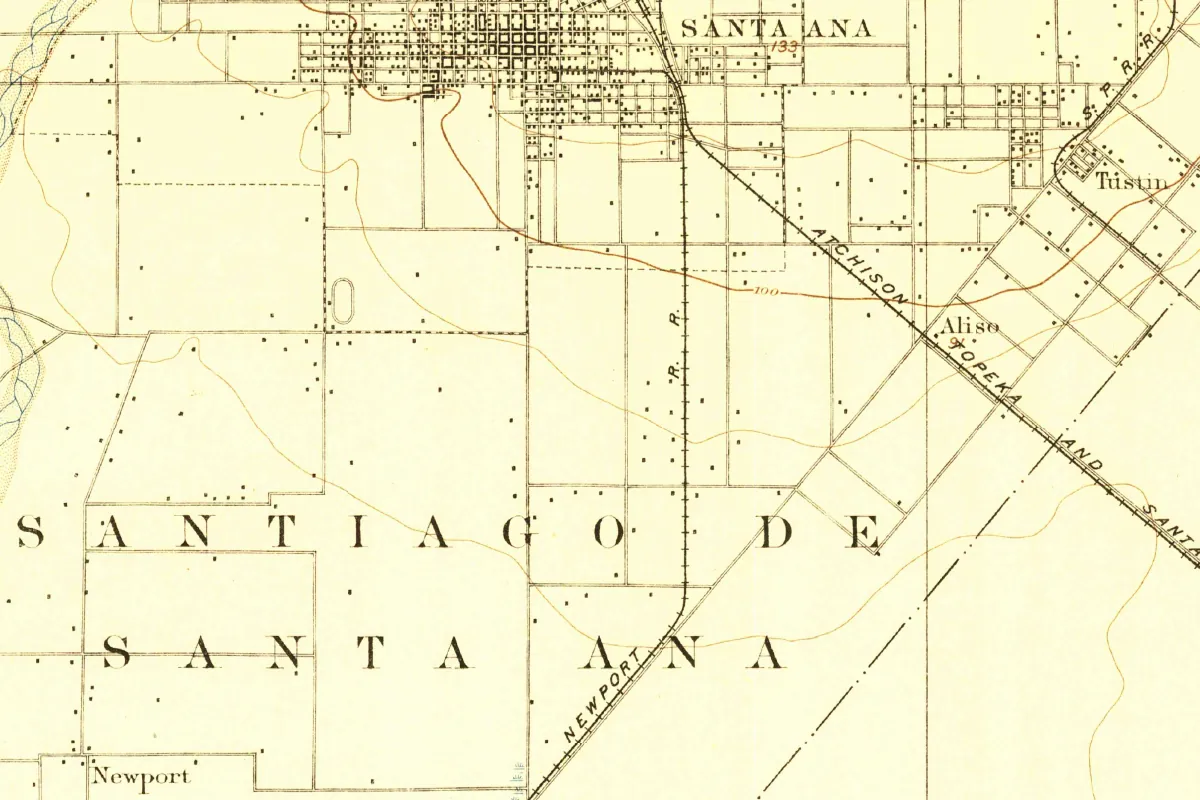
The land had been part of the Santiago de Santa Ana rancho. In 1870, according to J. M. Guinn’s Historical and Biographical Record of Southern California (1902), Alfred B. Chapman and Andrew Glassell bought the shares of several Yorba heirs, thousands of acres in all, and cut them into farm lots. A ditch from the Santa Ana River reached the tract in the winter of 1871-72, and several muscat vineyards and “a few orange trees” went in that spring.
Chapman told the story himself in court in 1877, during a fight over water rights, and Samuel Armor’s 1921 History of Orange County reprints it:
“The townsite of Orange was laid off in 1870 or 1871 by Captain Glassell and myself. … I was the father of Orange and Spurgeon and Bradford were the fathers of Santa Ana.”
Armor says the townsite was 40 acres, with eight lots saved in the middle for a public plaza. You can still walk around it. And the name on it, at first, was Richland, a sensible thing to call a place you hoped would grow crops.
Richland was taken
Armor gives the reason for the change in one line: “there was already one Richland in the state and the government would not grant a postoffice to another.” Orange County historian Phil Brigandi says the other Richland was in Sacramento County and dates the new Orange post office to September 1, 1873, with Dr. George H. Beach as its first postmaster. Guinn just says “early in 1873.”
Richland didn’t vanish overnight. One biography in Armor’s book records a wedding “at Richland, now Orange, then in Los Angeles County, on June 28, 1873.” Guinn says the old name simply “fell into disuse,” and Orange took over for both the town and the school district.
So why Orange?
This is where you’ll find different answers.
The county campaign
Guinn, who lived in Anaheim at the time, connected the choice to politics. “The agitation for the formation of a new county to be named Orange was quite active about this time,” he wrote. “The town of Orange had hopes of becoming the seat of government of the new county.” Elsewhere in the same book he explains why county boosters liked the word: they argued “that immigrants would be attracted by the name, forgetful of the fact that there were only about fifty other places named Orange in the United States.”
Henry Gannett’s 1905 federal bulletin on place names said Orange County, California, was “so named on account of the large orange groves.” He didn’t list the city. Brigandi points out that there wasn’t a single producing orange grove around Orange in 1873; grapes were the big crop then. Guinn’s own timeline agrees, with just a few young orange trees planted in 1872.
A name that sounded good
The plainest explanation is about image. Brigandi’s history of the Orange post office says the new name was chosen “to reflect Southern California’s image as a semi-tropical agricultural paradise.” The Orange County Historical Society says much the same: “the name fit well with Southern California’s image.” That fits with Guinn’s boosters, who also thought the word would sell the place to newcomers.
The poker game
The story most people have heard is that the town’s name was settled at a card table. Brigandi traced it to Margaret Gardner, who wrote more than 60 years later that her father, Henri F. Gardner, “told me that he had heard that Mr. Chapman, Mr. Glassell, and two other men each advocated a different name.” The choices were Orange, Lemon, Olive and Almond, “so they played a poker game, the winner to name it.” Brigandi notes that Gardner wasn’t in town at the time and that nobody else seems to have told the story. There’s no paperwork to back it up.
Brigandi also mentions that Glassell’s family had once lived on a plantation called Richland in Orange County, Virginia, and he had no doubt that it influenced the decision. That’s his judgment, though, not a record from 1873.
A town that grew into its name
Orange was incorporated on April 6, 1888, and the county it had hoped to lead followed in 1889, with the county seat going to its neighbor Santa Ana, the town Spurgeon laid out at about the same time Chapman and Glassell laid out Richland. The orange groves came later, after vine disease hit the vineyards in the 1880s.
So here’s what you can say for sure: a farm town in California lost its first name to a post office rule and picked a fruit it barely grew yet. The card game makes a better story, but the record points to boosters thinking about how a name would sound to newcomers, and maybe about a county.
Quick answers
What was Orange, California, called before?
Richland. Armor’s 1921 county history and Guinn’s 1902 history both say the town started under that name.
Why did Richland change its name to Orange?
Because California already had a Richland, and the post office wouldn’t approve a second one, according to Armor. Brigandi says the other Richland was in Sacramento County.
Was Orange, California, named in a poker game?
Probably not. Brigandi traced the story to a secondhand account that doesn’t seem to show up until more than 60 years later, by someone whose father wasn’t in town at the time.
Was Orange named for orange groves?
Not at first. Brigandi says there were no producing orange groves there in 1873, and he says it was picked to reflect Southern California’s image as a semi-tropical agricultural paradise. Guinn’s 1902 history links it to the campaign for a new county to be called Orange.
Key dates
- 1870Alfred B. Chapman and Andrew Glassell buy land from several Yorba heirs in the Santiago de Santa Ana rancho, Guinn's 1902 history says.
- 1871The townsite, 40 acres around a central plaza, is laid out as Richland. Chapman later testified it was 1870 or 1871.
- 1873The post office opens as Orange: early in the year, by Guinn's account; September 1, by Brigandi's.
- 1888April 6: the city of Orange incorporates.
Getting there
Open Orange in Google Maps
Opens in a new tab. The pin is the center of Orange in the USGS place-name record.
The closest airports, Amtrak stations and intercity bus stops, measured in a straight line from the center of Orange.
Airports
- John Wayne/Orange County (SNA) Santa Ana 8 mi 13 km
- Long Beach (Daugherty Field) (LGB) 17 mi 28 km
Amtrak trains
- Anaheim station (ANA) 2 mi 3 km
- Santa Ana station (SNA) 3 mi 4 km
Intercity buses
- International Bus Lines Anaheim 2 mi 3 km
- Limousine Express Anaheim 2 mi 3 km
- FlixBus Anaheim Bus Station 2 mi 3 km
Distances are as the crow flies, not by road. We don't list schedules or fares because they change; check with the airline, Amtrak or the bus company before you go. Official data (FAA commercial service airports (2025), FAA airport locations, Amtrak stations and Intercity Bus Atlas) from the FAA and the U.S. Bureau of Transportation Statistics, checked Nov 13, 2026.
Sponsored
Staying in Orange?
Compare hotels in Orange, California, on Expedia.
See hotels in OrangeWe may earn a commission if you buy through this link. It never changes what we write. Read our affiliate disclosure
Sponsored
Want the spooky side of Orange?
The name has its story above. For the ghost stories, US Ghost Adventures runs walking ghost tours in Orange.
See ghost tours in OrangeWe may earn a commission if you book through this link. It never changes what we write. Read our affiliate disclosure
Historical Sources & References
- Samuel Armor, History of Orange County, California (1921), pp. 64-65, 318. Chapman’s 1877 testimony on laying out the townsite, the 40 acres and the plaza, the name Richland and why it changed (p. 64); incorporation on April 6, 1888 (p. 65); the 1873 wedding “at Richland, now Orange” (p. 318).
- J. M. Guinn, Historical and Biographical Record of Southern California (1902), pp. 185, 194. Chapman and Glassell’s 1870 purchase, the ditch and first plantings, the post office “named Orange” early in 1873, the county campaign and Richland falling into disuse (p. 194); the county name chosen to attract immigrants (p. 185).
- Henry Gannett, The Origin of Certain Place Names in the United States (USGS, 1905), p. 232. Orange County, California, “so named on account of the large orange groves.”
- Phil Brigandi, “How Orange Got its Name” (OC Historyland). The poker-game story and its source, the lack of producing orange groves in 1873, Glassell’s family ties to Richland in Orange County, Virginia, and the case for Guinn’s explanation.
- Phil Brigandi, “Orange Post Office” (OC Historyland). The post office opening on September 1, 1873, the other Richland in Sacramento County, first postmaster George H. Beach and the name chosen to reflect Southern California’s image as a “semi-tropical agricultural paradise.”
- Orange County Historical Society, “A Brief History of Orange”. The 1871 townsite named Richland, the 1873 change to Orange and a name that “fit well with Southern California’s image.”
- Orange Community Historical Society, “Andrew Glassell and Alfred Beck Chapman”. Orange County’s creation in 1889, with Santa Ana chosen over Anaheim and Orange as county seat.
- GNIS feature 1652765 (U.S. Geological Survey). A one-word entry, Orange, inside the county that carries the same name.
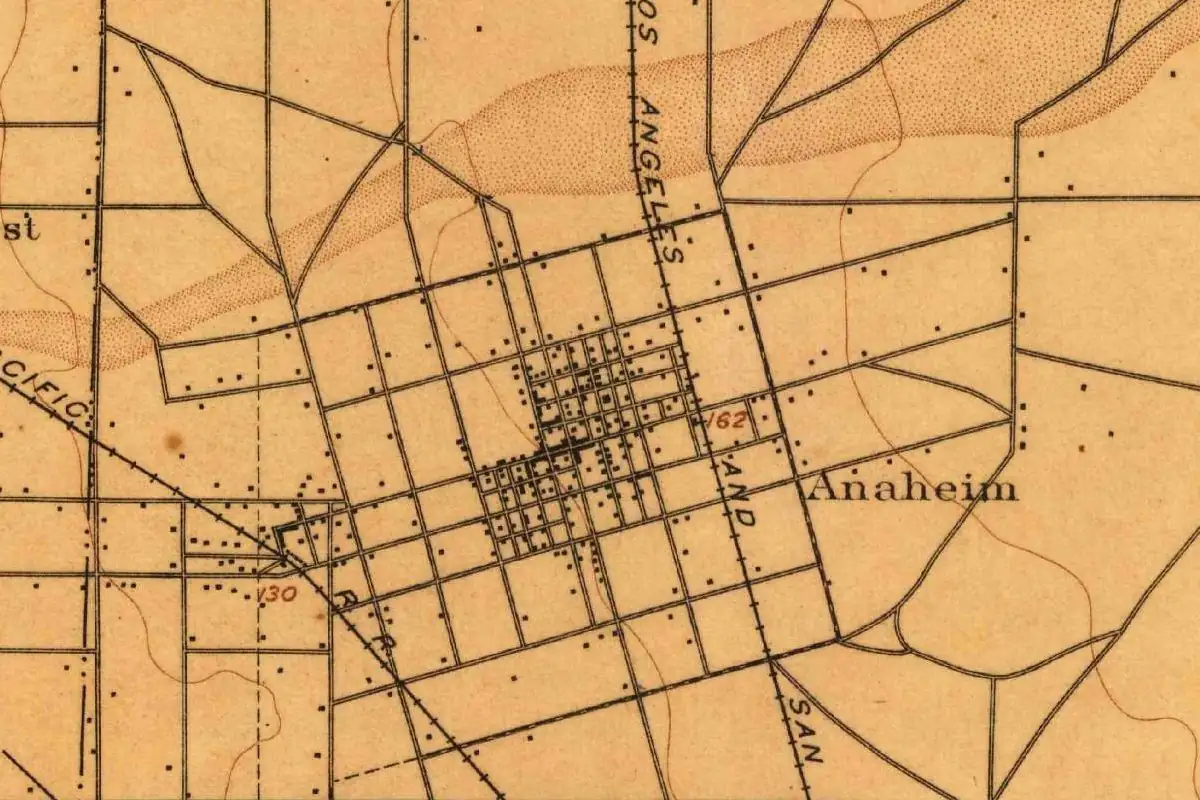
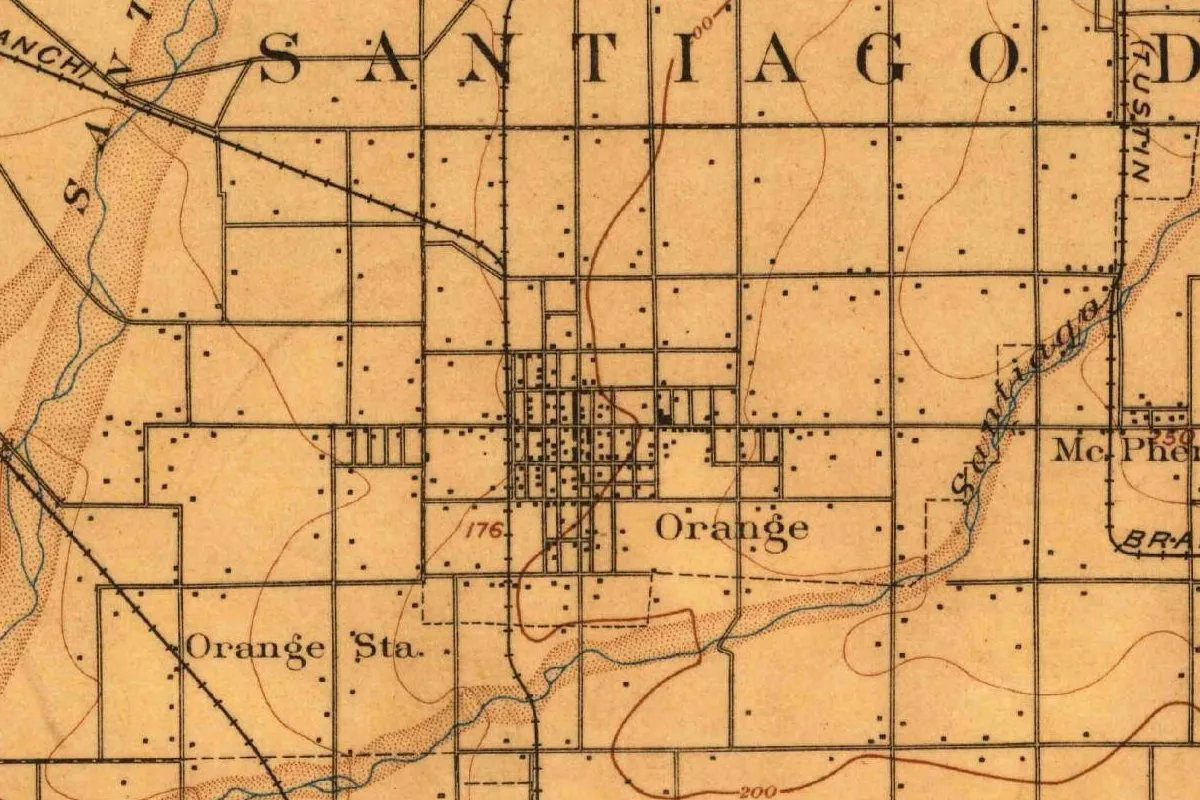
- U.S. Geological Survey, Anaheim sheet (1:62,500), 1896. The 1896 sheet with Orange, Orange Sta. and Santiago Creek, eight years after the city’s incorporation.
Spot something wrong, or know more? Tell us here. You can also email us or use our contact page. Corrections are noted here with their date, never made silently.