How Garden Grove, California Got Its Name Before the Trees
Garden Grove got its name from A. G. Cook, a settler the city calls Alonzo Cook and its founding father. He chose it for the local school district and village. A pioneer neighbor later recalled that people objected there wasn't a tree in the district, and Cook replied they'd make the name fit by planting trees.
“Nothing that could be called a tree”
When A. G. Cook proposed the name Garden Grove for a new California school district, some neighbors objected that the place didn’t have a single tree. Cook’s answer was that the name would come true later: they’d plant the trees.
That exchange comes down to us from a neighbor. Nannie Price and her husband, J. D. Price, came to the area in 1874 and settled on an eighty-acre farm a mile (1.6 km) east of where the town grew, according to Samuel Armor’s 1921 History of Orange County. Years later she wrote down her “Reminiscences of Pioneer Days” for the Garden Grove News, and Armor reprinted part of them. She remembered that the Bolsa school district at first covered everything from Huntington Beach to two miles (3 km) north of the Prices’ home, and that the settlers eventually split off a district of their own. Then she gets to the name:
“Finally, we formed our district, and Mr. A. G. Cook named it Garden Grove. Some objected, thought it was not appropriate, as there was nothing that could be called a tree in the whole district, but Mr. Cook said: ‘We’ll make it appropriate by planting trees and making it beautiful.’”
So the name wasn’t a description. It was a promise, and the person who made it was the one who picked it.
Who was Cook?
The City of Garden Grove calls him Alonzo Cook, and its media kit calls him Dr. Alonzo Cook. The city’s history says he bought 160 acres in the area in 1874 for about $15 an acre, later gave land north of Main Street and Garden Grove Boulevard for the first schoolhouse and post office, and suggested the name “Garden Grove” for the school and the village around it. The city even repeats his line about planting trees, though its page doesn’t say where the quote comes from. Armor’s book is the oldest place we found it.
The older books use initials. John Albert Wilson’s History of Los Angeles County, published in 1880, has a short entry on Garden Grove, because back then it was part of Los Angeles County. It says the town site “was selected and laid out in 1877, by A. G. Cook and C. Howe,” that Cook had sold off several parcels, and that about twenty-five families lived there. Nannie Price’s memoir calls him “Mr. A. G. Cook” too. If you’re wondering whether A. G. and Alonzo are the same man, nothing we read contradicts it, but none of the sources spells out the middle initial either.
One small difference between the versions: Price says Cook named the school district, while the city says he named the school and the village around it. Either way, the name started with the school.
A school district on the Las Bolsas plain
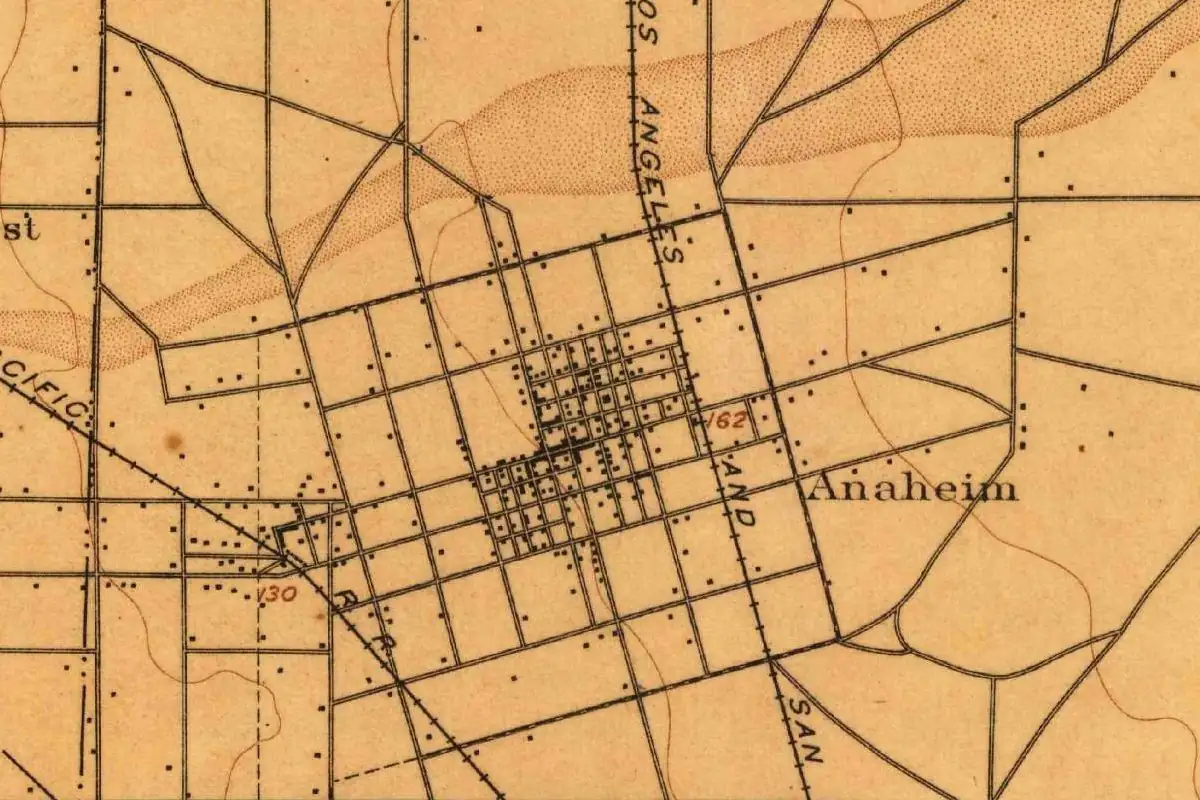
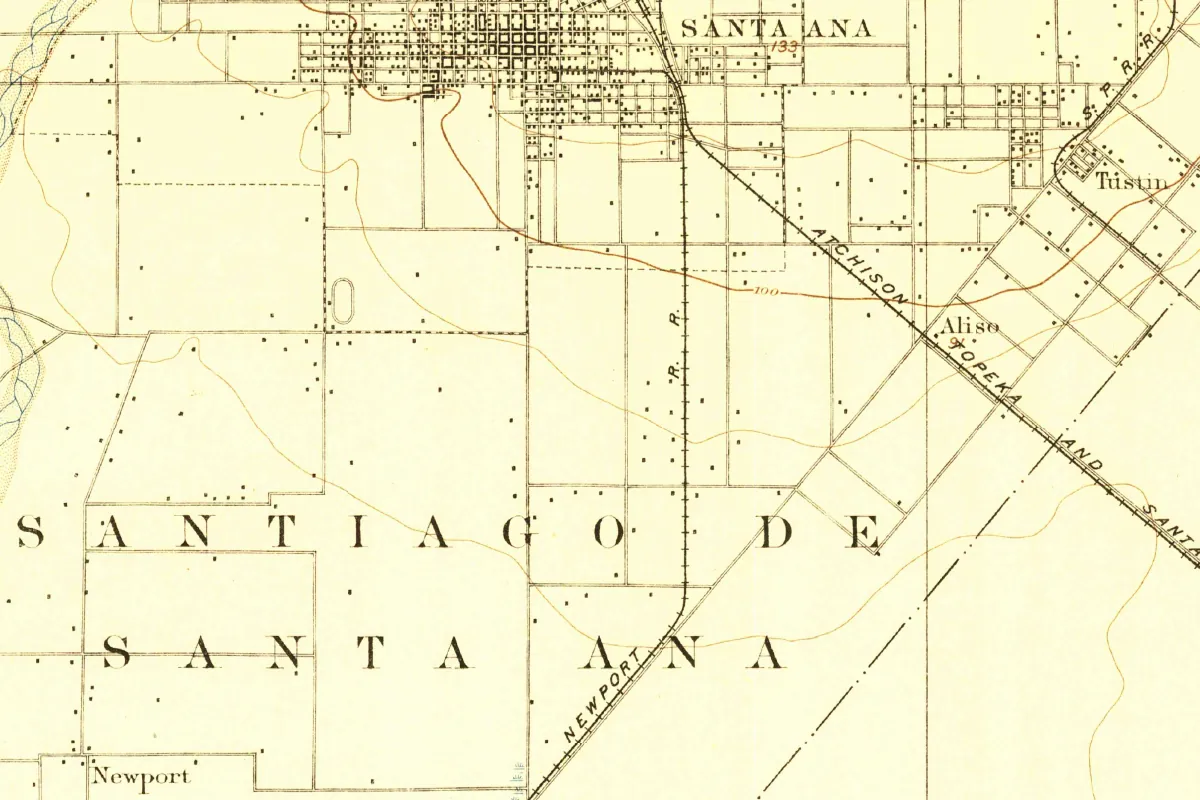
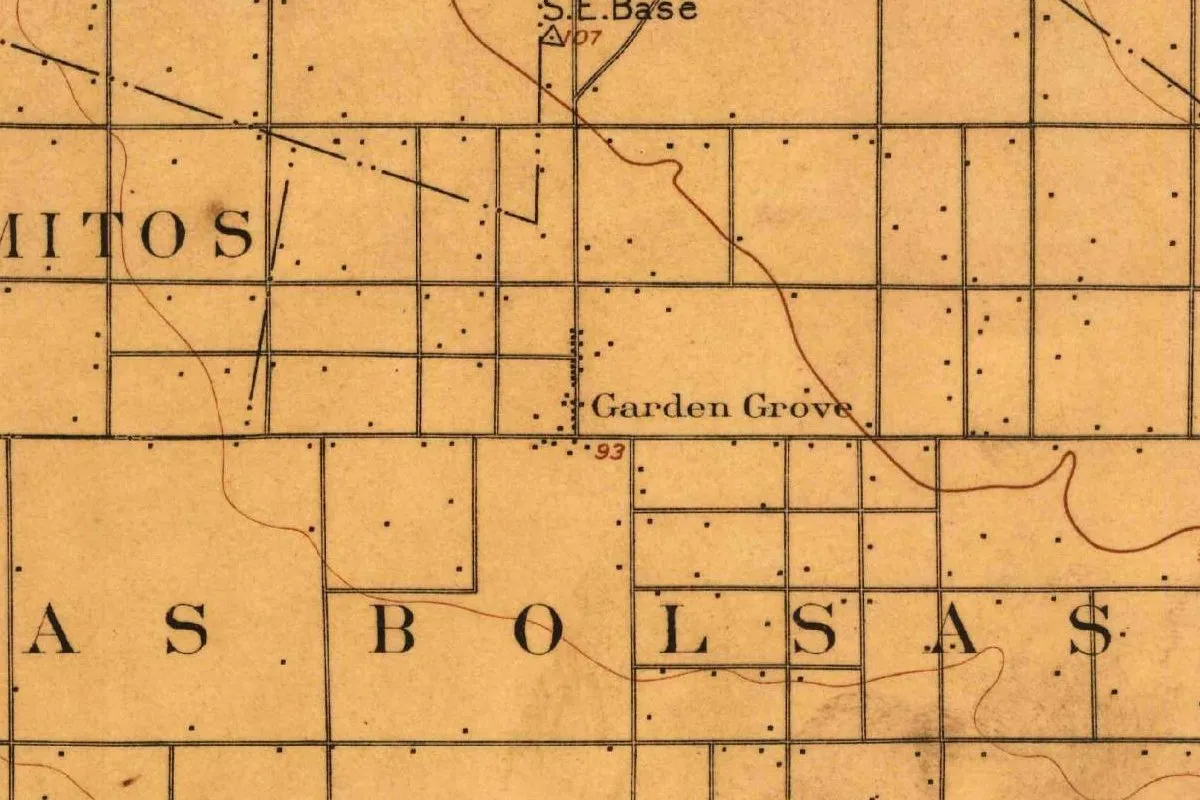
On the 1896 survey map you can see how thin the settlement still was. Garden Grove is a short row of dots on a grid of section lines, with the word BOLSAS spread in big letters across the land to the south. It’s the same name Price used for the school district the settlers broke away from.
The city says the Garden Grove area had about 200 people by 1889, the year Orange County was formed, and that the Pacific Electric railway came through in 1905. The trees did come. Price’s memoir also told of the first orange groves, according to Armor, and his 1921 book describes Garden Grove, five miles (8 km) northwest of Santa Ana, as the center of a big farming, dairy and poultry district. It even says shipping records showed Garden Grove had become “the greatest egg producing district in Southern California.”
Garden Grove didn’t become a city until 1956. That year, the city says, it had 41,238 people. Somewhere along the way, Cook’s promise about the trees stopped sounding like a joke and started sounding like a fair description of a California farm town, which is probably the best thing that can happen to a name picked on hope.
Quick answers
Who named Garden Grove, California?
A. G. Cook, according to the memoir of pioneer Nannie Price reprinted in Armor’s 1921 county history. The City of Garden Grove calls him Alonzo Cook and its founding father.
Why is it called Garden Grove if there were no trees?
Because Cook meant it as a goal. When neighbors said there was nothing that could be called a tree in the district, he answered that they’d make the name appropriate by planting trees.
Was Garden Grove ever in Los Angeles County?
Yes. It’s covered in Wilson’s 1880 History of Los Angeles County, and the city says Orange County wasn’t formed until 1889.
When did Garden Grove become a city?
In 1956, according to the city, decades after Cook and C. Howe laid out the town site in 1877.
Key dates
- 1874Alonzo Cook buys 160 acres in the area for about $15 an acre, the city says. J. D. and Nannie Price settle a mile east of the future town.
- 1877A. G. Cook and C. Howe select and lay out the town site of Garden Grove, according to an 1880 history of Los Angeles County.
- 1889Orange County is formed. The Garden Grove area has about 200 people, the city says.
- 1905The Pacific Electric line reaches Garden Grove.
- 1956Garden Grove incorporates as a city, with 41,238 people, according to the city.
Getting there
Open Garden Grove in Google Maps
Opens in a new tab. The pin is the center of Garden Grove in the USGS place-name record.
The closest airports, Amtrak stations and intercity bus stops, measured in a straight line from the center of Garden Grove.
Airports
- John Wayne/Orange County (SNA) Santa Ana 8 mi 13 km
- Long Beach (Daugherty Field) (LGB) 12 mi 20 km
Amtrak trains
- Anaheim station (ANA) 4 mi 7 km
- Santa Ana station (SNA) 5 mi 8 km
Intercity buses
- Rapid Connection Anaheim (Marketplace) 3 mi 5 km
- Limousine Express Anaheim 4 mi 7 km
- International Bus Lines Anaheim 4 mi 7 km
Distances are as the crow flies, not by road. We don't list schedules or fares because they change; check with the airline, Amtrak or the bus company before you go. Official data (FAA commercial service airports (2025), FAA airport locations, Amtrak stations and Intercity Bus Atlas) from the FAA and the U.S. Bureau of Transportation Statistics, checked Nov 13, 2026.
Sponsored
Staying in Garden Grove?
Compare hotels in Garden Grove, California, on Expedia.
See hotels in Garden GroveWe may earn a commission if you buy through this link. It never changes what we write. Read our affiliate disclosure
Historical Sources & References
- Samuel Armor, History of Orange County, California (1921), pp. 84 and 391-392. Garden Grove five miles northwest of Santa Ana and “the greatest egg producing district in Southern California” (p. 84); J. D. and Nannie Price’s arrival in 1874 and their farm a mile east of the town (p. 391); Nannie Price’s memoir from the Garden Grove News, with the Bolsa school district, the quoted passage on Cook and the trees, and her account of the first orange groves (p. 392).
- John Albert Wilson, History of Los Angeles County, California (1880), p. 160. The town site of Garden Grove “selected and laid out in 1877, by A. G. Cook and C. Howe,” Cook’s sales of several parcels and about twenty-five families living there.
- City of Garden Grove, “City History”. Alonzo Cook’s purchase of 160 acres in 1874, the land for the first schoolhouse and post office, the name suggested for the school and village, his reply about planting trees, about 200 people by 1889, the Pacific Electric in 1905 and incorporation in 1956 with 41,238 people.
- City of Garden Grove, “Media Kit”. The same account, naming him Dr. Alonzo Cook and the city’s “founding father.”
- GNIS feature 1660662 (U.S. Geological Survey). Garden Grove under Orange County, tied to the Anaheim quadrangle and on file since 1981.
- U.S. Geological Survey, Anaheim sheet (1896). Downloadable scan of the 1896 Anaheim survey, cut down for this page to the Garden Grove cluster and the BOLSAS lettering.
Spot something wrong, or know more? Tell us here. You can also email us or use our contact page. Corrections are noted here with their date, never made silently.