Palm Springs, California: The Hot Spring Behind the Name
The name points to two things: the native fan palm, Washingtonia filifera, and the hot mineral spring, according to the Agua Caliente Band of Cahuilla Indians. The Cahuilla called the area Sec-he and the Spanish called it Agua Caliente, or hot water. A 1906 desert book says the settlement gets its name from that spring.
Before it was Palm Springs, California, the Cahuilla people at its hot spring called the place Sec-he, and Spanish speakers called it Agua Caliente. The English name came last, and it describes the same spot: a desert spring with palms around it.
Sec-he, then Agua Caliente
The Agua Caliente Band of Cahuilla Indians tells it in three steps. In the beginning, the people living near the hot mineral spring called the area Sec-he. The Tribe’s history glosses that as “boiling water” on one page and as “sound of boiling water” on another. “The Spanish who arrived named it Agua Caliente (hot water).” And then, the Tribe says, came the name Palm Springs, “in reference to both the native Washingtonia filifera palm tree” and the hot spring itself. Every one of those names describes the same water: its sound, its heat and the trees around it.
The spring wasn’t scenery. The Tribe’s history says it gave the Cahuilla clean water, a place to bathe and a place for healing. When writer J. Smeaton Chase described the village in 1920, he started with the people who’d been there first:
“This small band of Indians, a part of the widely-scattered Cahuilla tribe, have lived from time immemorial about the hot spring which gives the Indian village, or ranchería, the Spanish name of Agua Caliente, by which the Reservation is still officially known.”
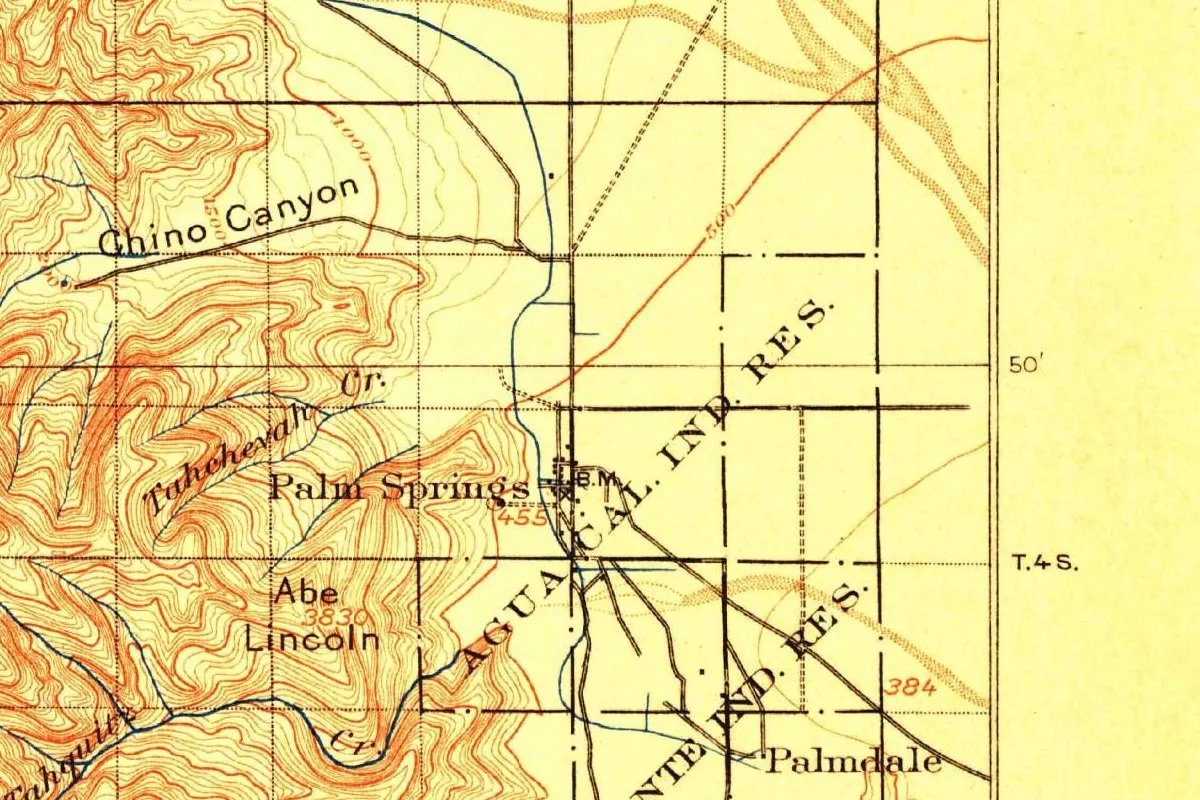
You can see the same pairing on federal maps of the time. The U.S. Geological Survey’s San Jacinto sheet of 1901 prints “Palm Springs” beside a cluster of buildings, with “AGUA CAL. IND. RES.” running across the land next to it.
“The Palm Spring”
The plainest statement of where the English name came from is in George Wharton James’s The Wonders of the Colorado Desert, published in 1906. James had bathed in it many times, and he wrote:
“Opposite Dr. Murray’s hotel is the remarkable spring from which the settlement gets its name. Here is the Palm Spring, the agua caliente, the hot spring, that to Indians and whites alike has been a source of wonder as well as of health for many years.”
Three names, one spring. James wrote Palm Spring in the singular; the town ended up with the plural. James goes on to describe it: hot water and sand welling up through a central shaft into a shallow pool, and a bubbling quicksand that, he said, pushed a bather back up before he could sink past the shoulders. The nearest railroad station, he noted, was within five miles (8 km) of the valley.
The palm part of the name is just as literal. Chase’s list of desert plants in Our Araby includes Washingtonia filifera, the fan palm, “the native palm of the desert,” which grows up to 70 feet (21 m) high and is “never in dry soil.” In other words, where you found these palms, you’d usually find water.
Not the only Palm Springs
That’s also why the name wasn’t unique. On December 15, 1853, William P. Blake, the geologist on a federal railroad survey, was heading west from the desert along Carrizo Creek toward San Diego. He passed “a clump of palm trees on the north of the trail, and a green bank from which springs issue, known as the ‘Palm Springs.’” That was a different place, on the day’s march from Carrizo Creek to Vallecito.
Nellie Van de Grift Sanchez found the same habit in Spanish. Her 1922 book on California place names lists Dos Palmas, in Riverside County, “so called from two giant palms near a spring.” Palms meant water, and travelers named places for it.
The name nobody signed
What’s missing is a name and a date. These sources tell you what Palm Springs means and what the spring was called before, but nobody in them takes credit for first writing “Palm Springs” on this particular spring. If you see a precise first date for the name, it’s worth asking whether it’s this Palm Springs or the one on Carrizo Creek.
Chase, writing from the village in 1920, put the order of things simply when he talked about the Cahuilla: “we are the new-comers.” The resort town in California that grew up around the spring kept a name that describes what the Tribe had been using all along.
Quick answers
Why is Palm Springs called Palm Springs?
For its native fan palms and its hot mineral spring, according to the Agua Caliente Band of Cahuilla Indians. James wrote in 1906 that the settlement “gets its name” from that spring.
What did the Cahuilla call Palm Springs?
Sec-he. The Tribe’s history translates it as “boiling water” in one version and “sound of boiling water” in another.
What does Agua Caliente mean?
Hot water. It’s the Spanish name for the spring, and Chase noted in 1920 that the reservation was still officially known by it.
Is the “Palm Springs” in an 1853 railroad report this town?
No. The “Palm Springs” that geologist William P. Blake recorded on December 15, 1853, was on Carrizo Creek, on the road to San Diego.
Key dates
- 1853December 15: a railroad survey geologist notes a different "Palm Springs" on Carrizo Creek, on the road to San Diego.
- 1901The U.S. Geological Survey's San Jacinto sheet prints Palm Springs next to the Agua Caliente Indian Reservation.
- 1906George Wharton James writes that the settlement gets its name from the hot spring opposite Dr. Murray's hotel.
- 1920J. Smeaton Chase writes that the reservation is still officially known as Agua Caliente.
Getting there
Open Palm Springs in Google Maps
Opens in a new tab. The pin is the center of Palm Springs in the USGS place-name record.
The closest airports, Amtrak stations and intercity bus stops, measured in a straight line from the center of Palm Springs.
Airports
- Palm Springs International (PSP) 2 mi 4 km
- San Bernardino International (SBD) 44 mi 70 km
- Ontario International (ONT) 63 mi 101 km
Amtrak trains
- Palm Springs station (PSN) 5 mi 7 km
- San Bernardino station (SNB) 48 mi 77 km
Intercity buses
- Amtrak Chartered Vehicle Amtrak Connecting Service · Palm Springs Amtrak Bus Stop under 1 mi 0.6 km
- Greyhound Desert Hot Springs Chevron 4 mi 7 km
- FlixBus Palm Springs North 5 mi 8 km
Distances are as the crow flies, not by road. We don't list schedules or fares because they change; check with the airline, Amtrak or the bus company before you go. Official data (FAA commercial service airports (2025), FAA airport locations, Amtrak stations and Intercity Bus Atlas) from the FAA and the U.S. Bureau of Transportation Statistics, checked Nov 13, 2026.
Sponsored
Staying in Palm Springs?
Compare hotels in Palm Springs, California, on Expedia.
See hotels in Palm SpringsWe may earn a commission if you buy through this link. It never changes what we write. Read our affiliate disclosure
Sponsored
Want the spooky side of Palm Springs?
The name has its story above. For the ghost stories, US Ghost Adventures runs walking ghost tours in Palm Springs.
See ghost tours in Palm SpringsWe may earn a commission if you book through this link. It never changes what we write. Read our affiliate disclosure
Historical Sources & References
- Agua Caliente Band of Cahuilla Indians, “Cultural History,” on the Native American Heritage Commission’s page for the Tribe. Sec-he as the Cahuilla name for the area (“boiling water”), the Spanish name Agua Caliente and the name Palm Springs for the native palm and the hot spring.
- Agua Caliente Indian Reservation, History (Vision Agua Caliente). Sec-he as “sound of boiling water,” and the spring as a source of clean water, bathing and healing.
- George Wharton James, The Wonders of the Colorado Desert, vol. 2 (1906), pp. 278, 287-289. The spring “from which the settlement gets its name,” called the Palm Spring and the agua caliente (p. 287); the bather pushed back up out of the shaft (p. 288); his many baths in the spring (p. 289); the station “within five miles” (p. 278).
- J. Smeaton Chase, Our Araby: Palm Springs and the Garden of the Sun (1920), pp. 22, 70. The Cahuilla living “from time immemorial” by the hot spring, the name Agua Caliente and “we are the new-comers” (p. 22); Washingtonia filifera, “the native palm of the desert” (p. 70).
- William P. Blake, Geological Report, Pacific Railroad Reports, vol. 5 (1856), p. 122. The “Palm Springs” on Carrizo Creek, recorded on December 15, 1853.
- Nellie Van de Grift Sanchez, Spanish and Indian Place Names of California (1922), p. 407. Dos Palmas in Riverside County, “so called from two giant palms near a spring.”
- GNIS feature 1652768 (U.S. Geological Survey). Riverside County is the county on record for Palm Springs, ID 1652768.
- U.S. Geological Survey, San Jacinto sheet (1:125,000), 1901. The 1901 sheet that labels Palm Springs and the Agua Caliente Indian Reservation.
Spot something wrong, or know more? Tell us here. You can also email us or use our contact page. Corrections are noted here with their date, never made silently.