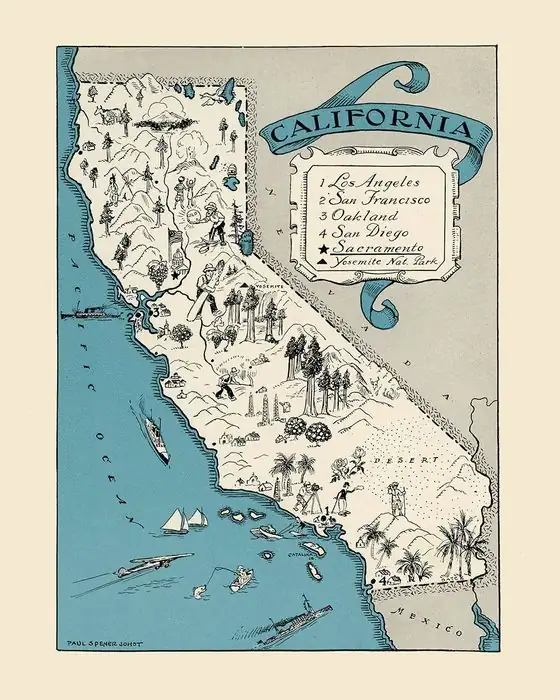
What Does Encinitas Mean? Little Oaks, in Spanish
Encinitas is Spanish for 'little oaks.' Henry Gannett gave that meaning in 1905, and Nellie Van de Grift Sanchez wrote 'little oaks' in 1922, adding 'the little live-oaks' for a land grant of the same name. Sanchez explains that the Spanish call the evergreen live oak encino. Merriam-Webster's pronunciation is en-sih-NEE-tus.
Encinitas, California, has a Spanish name that means little oaks, and Spanish explorers who passed this coast in 1769 named a valley nearby for its oaks. Whoever first put the word on the town didn’t leave a note that’s turned up in the sources, but the meaning itself isn’t in doubt. Two old reference books give it in nearly the same words.
Little oaks
Henry Gannett gave the town one short entry in 1905: “Encinitas; township in San Diego County, California. A Spanish word meaning ‘little oaks.’” On the same page he defines Encinal as a “forest of evergreen oak.”
Nellie Van de Grift Sanchez gives the same meaning in her Spanish and Indian Place Names of California of 1922. “Encinitas (little oaks) is a place on the coast about twenty miles northwest of San Diego,” she writes. That’s about 32 km. In the list of land grants at the back of the book, she turns it into “Las Encinitas (the little live-oaks).”
The live oak matters here. Sanchez explains that the Spanish had two words for oak, and kept them apart: “the roble is not the evergreen, or live-oak, which is called encino.” So the little oaks of Encinitas are, by her reading, the evergreen kind. You’ll find the same tree behind Oakland, whose site was known as the Encinal de Temescal, an oak grove.
Spanish diminutives turn up in town names well beyond California. Antonito, Colorado, took its name from the San Antonio River and cut it down to “little Anthony.” And Mesa, Arizona, like Encinitas, took its Spanish name from the land it sat on.
Oaks on the road north
The oaks were on the record long before the town was. In July 1769 Gaspar de Portolá led a land party north out of San Diego, the expedition that Richard L. Carrico’s 1977 study of the coast’s Native villages takes as its subject. Richard F. Pourade, retelling the march in The Explorers, follows the party past Escondido Creek, which “empties into San Elijo Lagoon near Cardiff.”
Then, Pourade writes, “Climbing and dropping again they came to Encinitas Creek and they named the valley as the Spring of the Valley of Los Encinos, or oaks.” He quotes Father Crespí’s diary, which describes “another little valley with many live oaks.” Pourade doesn’t say the town’s name grew out of that campsite, and neither do Gannett or Sanchez.
A rancho called Los Encinitos
The name also turns up on a land grant. William E. Smythe’s History of San Diego, published in 1908, prints a table of the county’s land grants with “the date each grant was confirmed.” One of them is “Los Encinitos,” granted to Andrés Ybarra, confirmed on April 18, 1871, at 4,431.03 acres. That’s about 1,793 hectares. Note the spelling: Smythe ends it in -os, where Sanchez and the town end it in -as.
Twenty-two people and a train
The town that grew up on the bluff was tiny at first. The Encinitas Historical Society tells how Edward and Jane Hammond, English immigrants, came in 1883 with their seven children. “The moment they all stepped off the train on its new tracks, the population of Encinitas surged to twenty-two.” Edward and his son Ted built a school big enough for eight grades.
The modern city is younger than that. Encinitas incorporated in 1986, the city says, and the new city “brought together the communities of New Encinitas, Old Encinitas,” Cardiff-by-the-Sea, Olivenhain and Leucadia under the one Spanish name. If you’re wondering why Cardiff shows up in Pourade’s account of 1769, that’s why: today it’s part of Encinitas.
The 1893 map
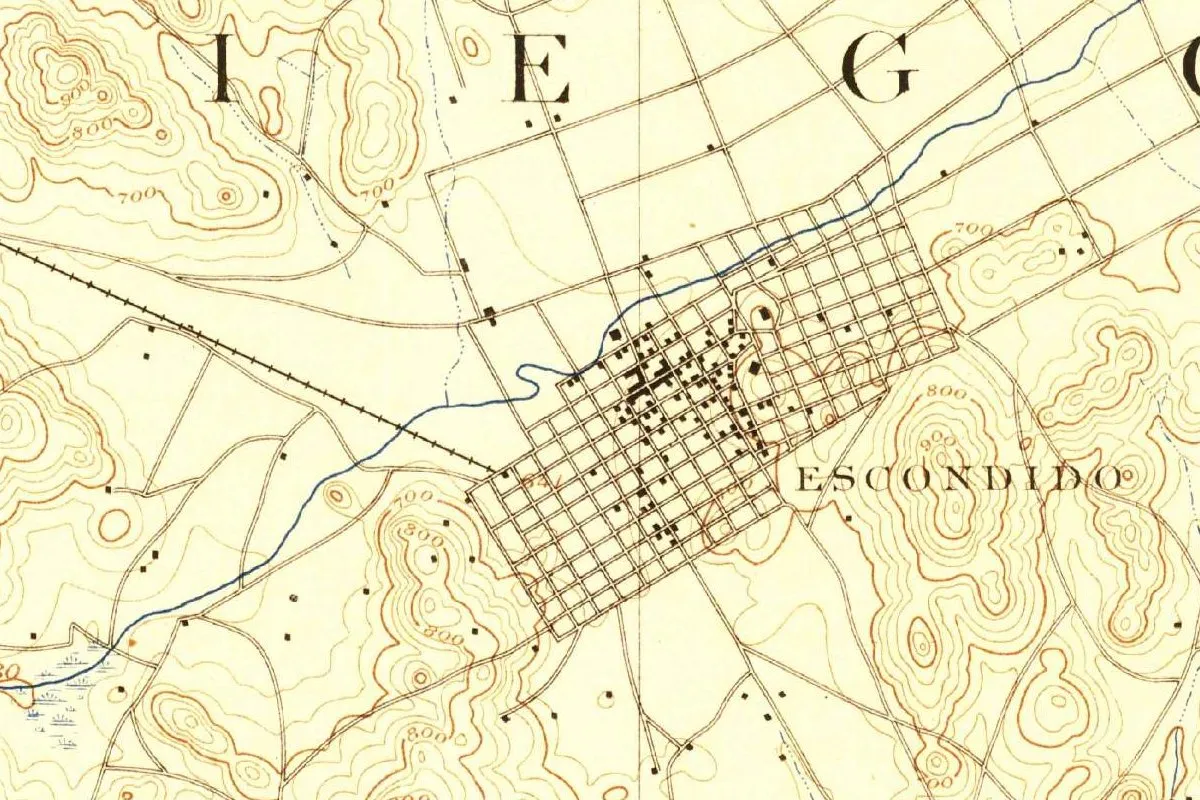
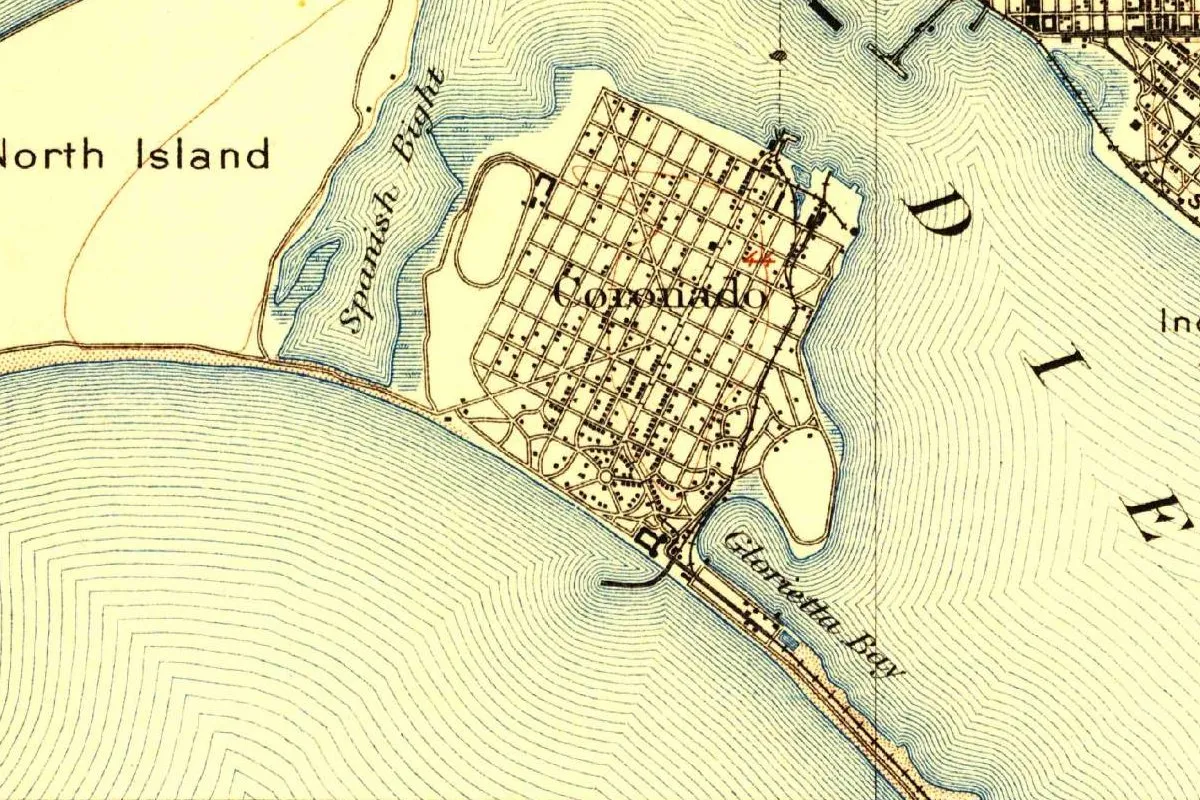
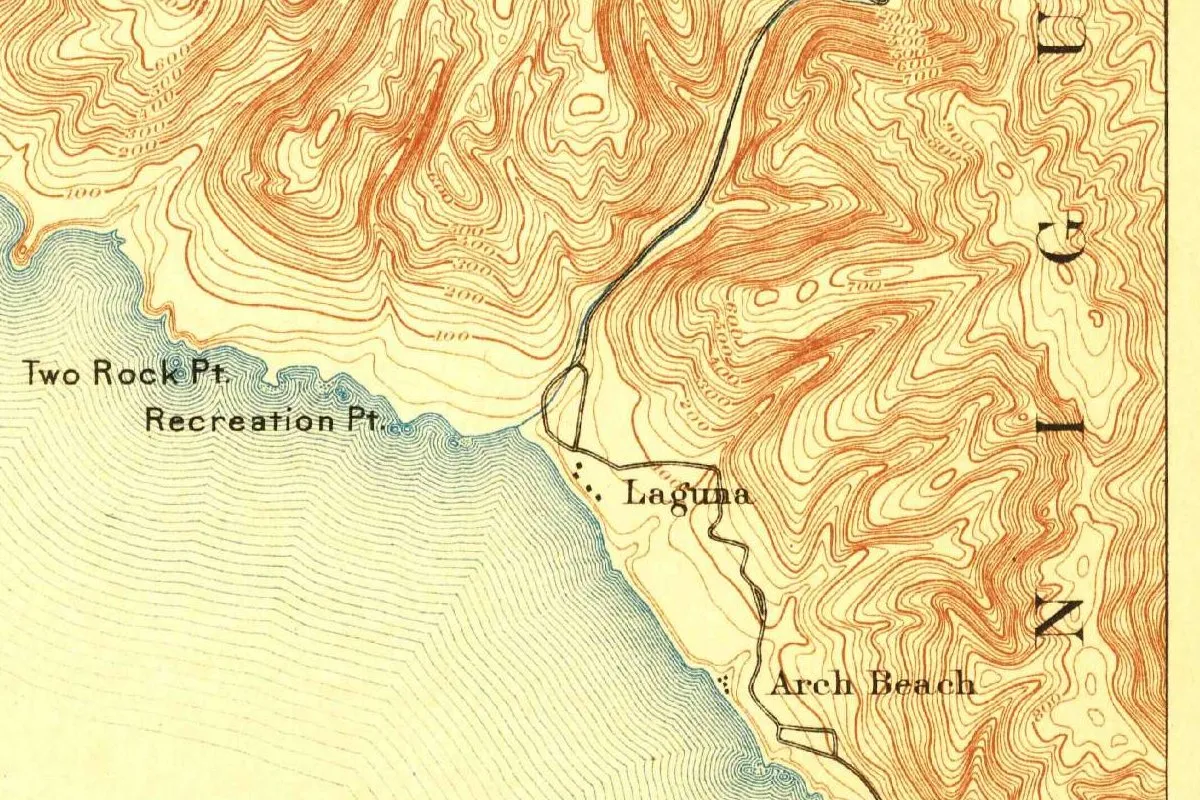
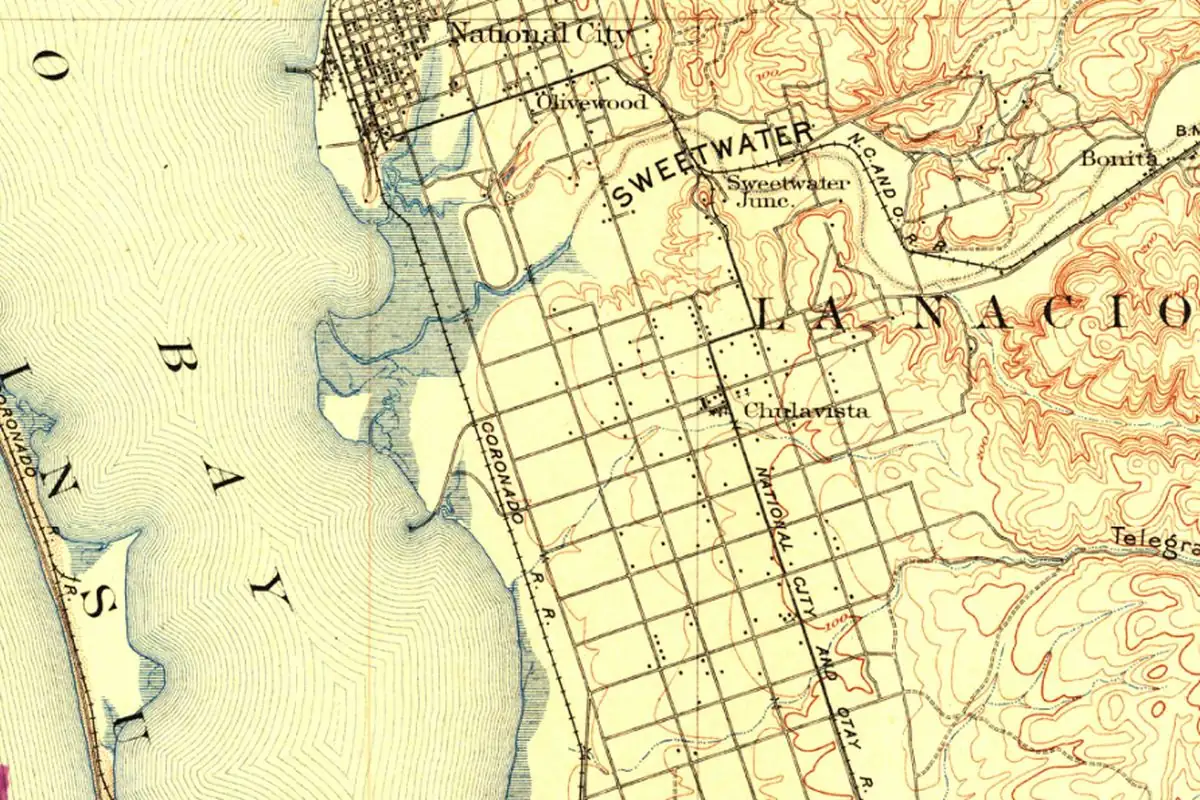
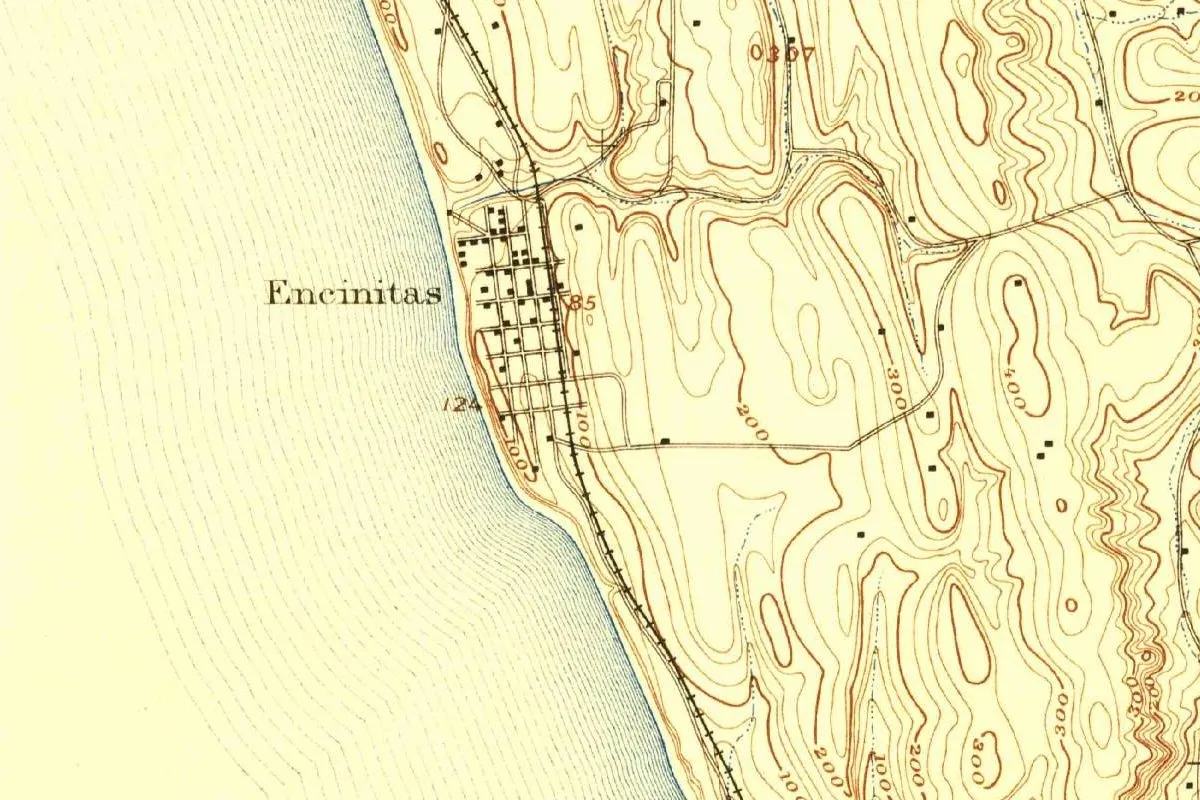
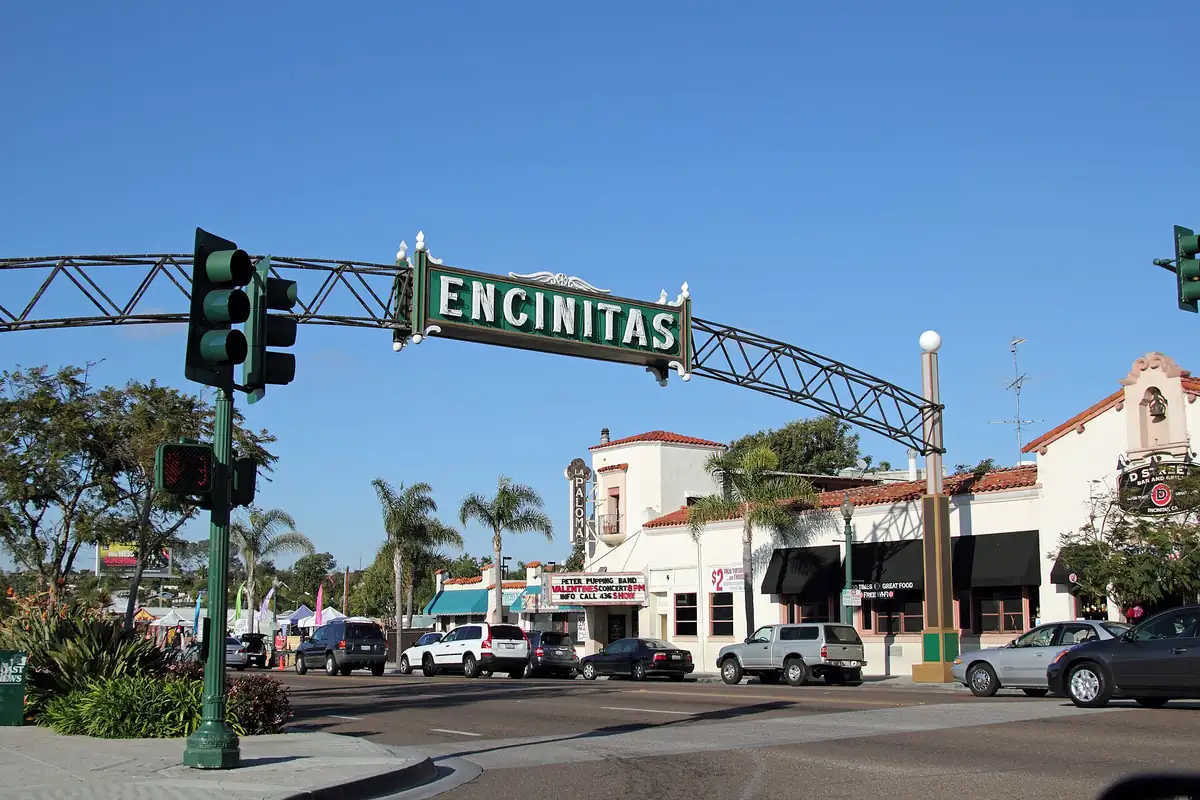
The map at the top of this page is a piece of the Geological Survey’s Oceanside sheet, surveyed in 1891 and first issued in May 1893. This copy is an August 1897 reprint. Encinitas is a few blocks of grid on the bluff, with a railroad running right alongside it and the hills climbing inland behind. The photo below shows the arch that spells out the name over the street downtown.
Quick answers
What does Encinitas mean?
Little oaks. Gannett (1905) gives “little oaks” for the Spanish word, and Sanchez (1922) gives “little oaks” and, for the land grant, “the little live-oaks.”
How do you pronounce Encinitas?
En-sih-NEE-tus. Merriam-Webster gives \ˌen(t)-sə-ˈnē-təs, with the stress on the third syllable.
Who named Encinitas?
Unknown. The sources here give the meaning but not who chose the name. Portolá’s party named a valley at Encinitas Creek for its oaks in 1769, and a land grant called Los Encinitos was confirmed in 1871.
Is Encinitas one town or several?
Several. The city, incorporated in 1986, joined New Encinitas, Old Encinitas, Cardiff-by-the-Sea, Olivenhain and Leucadia.
Key dates
- 1769Portolá's party, heading north from San Diego, names a valley at Encinitas Creek the Spring of the Valley of Los Encinos.
- 1871The land grant Los Encinitos, granted to Andrés Ybarra, is confirmed on April 18.
- 1883The Hammond family arrives by train, and the population of Encinitas rises to 22.
- 1893The Geological Survey's Oceanside sheet, surveyed in 1891, shows Encinitas on the coast.
- 1905Henry Gannett lists Encinitas as a Spanish word meaning 'little oaks.'
- 1986Encinitas incorporates as a city that joins five coastal and inland communities.
Things to do in Encinitas, California
San Diego Botanic Garden
A garden on county-owned parkland in Encinitas with rare bamboo groves, desert gardens, a tropical rainforest, California native plants, Mediterranean climate landscapes and a children's tree house.
San Elijo Lagoon Ecological Reserve
A 979-acre (396 ha) reserve, mostly shallow-water estuary, where Escondido and La Orilla creeks meet the Pacific, with about 7 miles (11 km) of trails for hiking and birdwatching.
1883 Schoolhouse
The oldest building still standing in Encinitas, a one-room schoolhouse that taught eight grades for 44 years. It's now home to the Encinitas Historical Society, kept in its original style with a garden on the grounds.
The Boathouses
Two houses shaped like ships, the SS Encinitas and SS Moonlight, built in the late 1920s by architect Miles Kellogg from timber of the 1888 Moonlight Beach Dance Parlor. They've never been to sea.
Getting there
Open Encinitas in Google Maps
Opens in a new tab. The pin is the center of Encinitas in the USGS place-name record.
The closest airports, Amtrak stations and intercity bus stops, measured in a straight line from the center of Encinitas.
Airports
- McClellan-Palomar (CRQ) Carlsbad 6 mi 10 km
- San Diego International (SAN) 22 mi 35 km
Amtrak trains
- Solana Beach station (SOL) 3 mi 5 km
- Oceanside station (OSD) 12 mi 19 km
Intercity buses
- Gold Runner Solano Beach 3 mi 5 km
- Amtrak Chartered Vehicle Amtrak Connecting Service · Solana Beach Amtrak Station 3 mi 5 km
- FlixBus La Jolla - UC San Diego 11 mi 18 km
Distances are as the crow flies, not by road. We don't list schedules or fares because they change; check with the airline, Amtrak or the bus company before you go. Official data (FAA commercial service airports (2025), FAA airport locations, Amtrak stations and Intercity Bus Atlas) from the FAA and the U.S. Bureau of Transportation Statistics, checked Nov 17, 2026.
Sponsored
Staying in Encinitas?
Compare hotels in Encinitas, California, on Expedia.
See hotels in EncinitasWe may earn a commission if you buy through this link. It never changes what we write. Read our affiliate disclosure
Historical Sources & References
- Henry Gannett, The Origin of Certain Place Names in the United States (1905), p. 119. “A Spanish word meaning ‘little oaks,’” and Encinal, “forest of evergreen oak.” Checked against the page image.
- Nellie Van de Grift Sanchez, Spanish and Indian Place Names of California (1922), p. 45. “Encinitas (little oaks),” about twenty miles (32 km) northwest of San Diego. Checked against the page image.
- Sanchez (1922), p. 124. Roble and encino, the evergreen live oak. Checked against the page image.
- Sanchez (1922), p. 379. “Las Encinitas (the little live-oaks)” among the land grants. Checked against the page image.
- William E. Smythe, History of San Diego (1908), p. 112. Los Encinitos, Andrés Ybarra, confirmed April 18, 1871, 4,431.03 acres (about 1,793 ha). Checked against the page image.
- Richard F. Pourade, The Explorers, chapter 10. Escondido Creek and Cardiff, Encinitas Creek and the Spring of the Valley of Los Encinos, and Crespí’s “many live oaks.”
- Richard L. Carrico, “Portola’s 1769 Expedition and Coastal Native Villages of San Diego County” (1977). The year of the expedition.
- City of Encinitas, “About Encinitas”. Incorporation in 1986 and the five communities.
- Encinitas Historical Society, “1883 Schoolhouse”. The Hammonds, the train and the population of twenty-two.
- Merriam-Webster, “Encinitas”. The pronunciation.
- San Diego Botanic Garden; San Elijo Lagoon; Encinitas Historical Society, “Boathouses”. The details in the things-to-do list.
- GNIS feature ID 1652705 (U.S. Geological Survey). Encinitas in the national gazetteer, in San Diego County, with its coordinates.
- U.S. Geological Survey, Oceanside sheet (1893, reprinted 1897). The 1:62,500 map that the image at the top of this page was cropped from.
Spot something wrong, or know more? Tell us here. You can also email us or use our contact page. Corrections are noted here with their date, never made silently.